思宇MedTech

Search documents
科思明德董事长&CEO徐科端:祝大家笃行致远,与时代同新
思宇MedTech· 2026-02-18 04:20
Core Viewpoint - The company expresses gratitude to clients and partners while reflecting on the challenges and opportunities of the past year, emphasizing its commitment to innovation and customer value in the face of digital transformation [4]. Group 1: Company Vision and Strategy - The company aims to embrace change with an open attitude, refine its products through solid internal capabilities, and connect the future with innovative thinking [4]. - The focus will remain on enhancing technical capabilities and deepening partnerships to navigate uncertainties and achieve high-quality development [4]. Group 2: Industry Context - The digital and intelligent transformation is reshaping various industries, presenting unprecedented opportunities for growth and innovation [4]. - The company acknowledges the importance of teamwork and client trust in achieving technological breakthroughs [4]. Group 3: Product Development - The company has recently launched two electronic endoscope products, indicating a commitment to advancing medical technology [6]. - The industry is witnessing significant investment in innovative endoscope technology, as evidenced by a recent financing round for a domestic company [5].


684亿现金收购!2家上市公司整合,患者监测进入新阶段
思宇MedTech· 2026-02-18 04:20
该交易预计于2026年下半年完成,尚需通过相关反垄断审批及迈心诺股东批准。丹纳赫表示,将以现有现 金及债务融资完成收购。交易完成后, 迈心诺 将在丹纳赫诊断板块(Diagnostics segment)内独立运 营,并保留品牌。 财务层面,丹纳赫预计该交易将在完成后的首个完整财年为调整后EPS带来 0.15–0.20美元增厚, 第五个 完整财年 增厚约0.70美元, 并实现年度成本协同超过 1.25亿美元。 资本市场方面, 迈心诺 股价在消息公布后盘前 上涨超过34%, 丹纳赫股价则在盘前 下跌约7%。 # 交易结构拆解:现金并购 + 独立运营 + 诊断整合 本次交易为全现金收购,显示丹纳赫对资产质量与整合能力具有高度确定性判断。 2026年2月17日, 丹纳赫 (Danaher,NYSE: DHR)宣布已达成协议, 将以约99亿美元现金(约684亿 人民币)收购迈心诺 ( Masimo , Nasdaq: MASI)。交易价格为 每股180美元 ,较2月13日收盘价 溢 价约38%, 总溢价接近 30亿美元。 在组织架构上, 迈心诺 将并入丹纳赫诊断板块,但 保持独立运营。 这一安排符合丹纳赫长期并购策略 ...



美敦力全球高级副总裁顾宇韶:愿大家勇立潮头 共创未来
思宇MedTech· 2026-02-17 03:53
新春寄语 美敦力全球高级副总裁及 大中华区总裁 顾宇韶 推荐阅读: 自 1989年进入中国市场,美敦力深耕三十六载,走过了从"引进来"、"走出去"到"立得稳"的发展历程,美敦 力在时代浪潮中也不断进阶,从最初的技术输入者,成长为与中国医疗行业共创共赢的生态伙伴。围绕"全球 创新本土化,中国创新全球化"的战略方向,美敦力持续推进数智化与本土全价值链的深度融合,覆盖研发、 生产、销售、培训、售后及投资等关键环节,不断夯实在华发展的长期根基。 2025年,当中国人工智能浪潮加速奔涌,美敦力也聚焦数智医疗创新,不断升级本土价值链布局,致力于扩大与优 质医疗服务的可及,并取得了一系列标志性进展。10月,美敦力在华首个数字化医疗创新地落地北京,聚焦人工智 能和大数据驱动的疾病管理解决方案,同时建设高水平的医疗培训中心、打造患者关爱中心、特别设有美敦力博物 馆,助力构建本土智慧化、普惠化的医疗体系,期望成为连接全球创新力量与中国本土生态伙伴的关键枢纽。 依托上海、成都双创新中心,美敦力累计实现超过 25 万人次的医疗专业培训,支持中国临床能力提升。我们连续 8 年全勤参与进博会、首次亮相链博会,积极参与国家级开放交流盛事。 ...


【特稿】短短2个月6项合作:顶尖医院从采购方变身创新者
思宇MedTech· 2026-02-17 03:53
Core Insights - Mayo Clinic has announced six cross-disciplinary collaborations, indicating a shift from being mere technology consumers to becoming organizers of innovation within the healthcare ecosystem [2][4][19] - The collaborations span various technologies, including wearable oxygen monitoring, AI imaging protocols, digital outpatient services, and gene testing, showcasing a significant expansion beyond traditional hospital procurement [2][4] Group 1: Demand Structure Transformation - The demand logic in hospitals is undergoing a three-tier leap, moving from single-point solutions to system capability building [4][5] - The first leap involves a shift in focus from "single-use effectiveness" to "long-term data value," emphasizing the importance of data systems in future medical devices [6][10] - The second leap sees hospitals transitioning from end-users to co-creation partners, indicating that those who define the technology path will likely shape the future market [8][12] - The third leap reflects a change from short-term procurement to long-term ecological collaboration, with hospitals now evaluating partnerships based on ecosystem development rather than one-time transactions [12][13] Group 2: Mayo Clinic's Strategic Layout - The Mayo Clinic Platform is not just a technology platform but a foundational infrastructure for innovation, allowing hospitals to create an innovative environment and select partners to define technology paths [14][15] - The Center for Digital Health at Mayo Clinic plays a strategic role, emphasizing that digital capabilities are core competitive advantages rather than mere support tools [15][18] Group 3: Global Trends and Driving Factors - A similar transformation is occurring globally, with hospitals shifting from passive technology acceptance to active innovation organization [19][20] - Four key driving factors include: 1. Medical data becoming a strategic asset, no longer viewed as a byproduct but as a resource for innovation [20] 2. AI entering substantive clinical applications, requiring continuous training and validation in real-world settings [21] 3. Increased demand for real-world evidence, positioning hospitals as critical nodes for evidence generation [21] 4. Dual pressures of quality and efficiency, making technological innovation a necessity rather than an option [21] Group 4: Systemic Impact on Medical Device Companies - The logic of product definition is evolving, requiring consideration of data dimensions, system integration capabilities, and collaborative support for multi-center research [22] - Market organization capabilities must upgrade, shifting from promotional execution to strategic dialogue and long-term partnerships [23] - The collaboration model is fundamentally changing from supplier relationships to innovation partnerships, emphasizing value co-creation over product supply [24] Group 5: Strategic Opportunities and Competitive Positioning - The current period is a critical window for companies to adapt to the evolving demand structure, as hospitals seek long-term partners that fit their innovation ecosystems [25][28] - Three key capabilities will determine future competitive positioning: data value creation, ecosystem integration, and collaborative co-creation [27][28]

马年新春:与医疗科技创新者,共赴下一程!
思宇MedTech· 2026-02-16 15:59
Core Viewpoint - The medical technology industry is navigating through change and uncertainty, with accelerated innovation, improved regulatory frameworks, and evolving global market dynamics [1] Group 1: Industry Progress and Contributions - Every professional in the medical technology field is contributing to change through various roles, from laboratory testing to market engagement [2] - These diverse efforts collectively drive the continuous advancement of the medical technology industry [3] Group 2: Future Outlook and Challenges - The industry is entering a new phase by 2026, where the focus shifts from mere technological innovation to the practical application and market dynamics of these innovations [5] - Key questions for the future include how technology can effectively enter clinical settings, enhance medical efficiency and quality, and create long-term value in real-world scenarios [7] Group 3: Strategic Directions - Innovation is evolving from product competition to a focus on systemic capabilities and comprehensive solutions [6] - The industry faces a new strategic balance between globalization and localization [6] Group 4: Company Initiatives - The company aims to deepen the understanding of medical technology innovations and industry trends, serving as a platform for future industry discussions [8] - Plans include building a systematic knowledge framework for niche markets, creating valuable industry conferences and white papers, and establishing a dialogue platform connecting research, clinical practice, and industry [10]

获批FDA!可穿戴的胰腺癌罕见新疗法
思宇MedTech· 2026-02-16 02:53
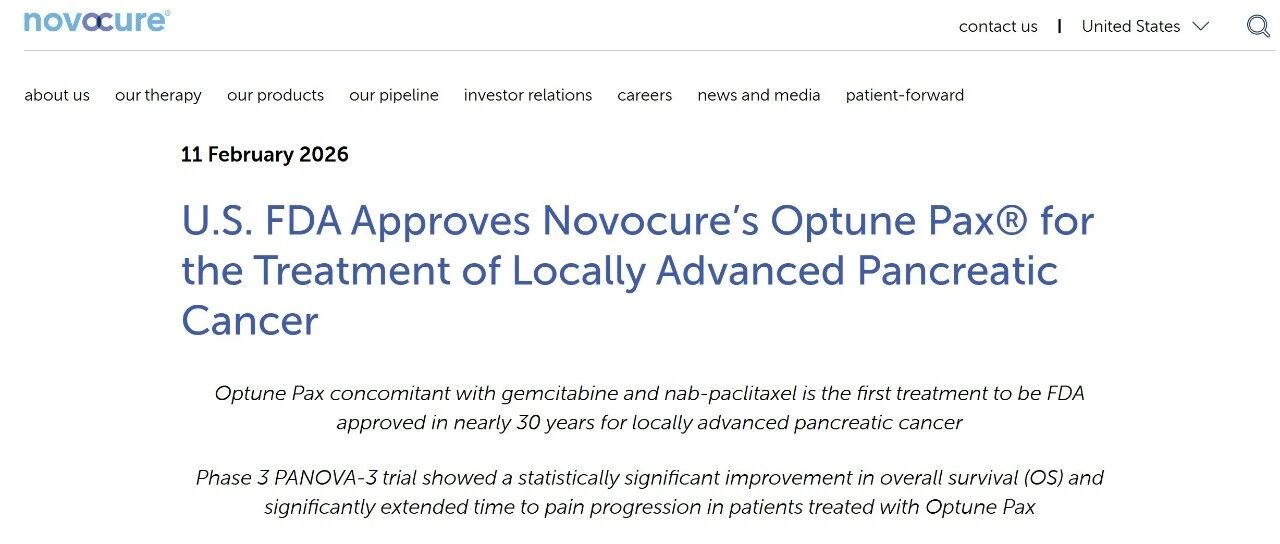
Core Viewpoint - A newly approved non-invasive treatment for locally advanced pancreatic cancer, utilizing a wearable device to continuously deliver electric fields that disrupt tumor cell division, has gained attention. This treatment, approved by the FDA for use in the U.S., is not yet available in China but offers insights for domestic professionals [2]. Group 1: Treatment Mechanism - The Optune Pax system employs Tumor Treating Fields (TTFields) technology, delivering low-intensity alternating electric fields to the tumor area via electrode arrays attached to the skin [3]. - The core mechanism of action is that the electric field affects rapidly dividing cancer cells while having a limited impact on normal cells, which divide more slowly [4][5]. Group 2: Device Characteristics - Optune Pax is a lightweight and portable system, allowing patients to receive treatment while maintaining daily activities [6]. - The device applies physical forces to charged cellular structures, disrupting spindle formation during mitosis, blocking chromosome separation, and leading to cancer cell death [7]. Group 3: Clinical Trial Results - The approval of Optune Pax is based on the pivotal Phase III clinical trial PANOVA-3, which demonstrated a significant improvement in overall survival [9]. - In the intention-to-treat population, the median overall survival was 18.3 months for the treatment group compared to 15.1 months for the control group, indicating a clinically meaningful improvement [10]. - The one-year survival rate was 68.1% for the treatment group versus 60.2% for the control group [11]. - Patients experienced delayed progression of pain and improved quality of life indicators, with the treatment showing good overall tolerability [12]. Group 4: Challenges and Future Considerations - Despite positive clinical trial results, real-world application faces challenges, including balancing efficacy and treatment burden, which will directly impact its adoption [17]. - Key observations for future development include the need for real-world data to validate the long-term value of TTFields in pancreatic cancer treatment [18]. - The treatment landscape for pancreatic cancer has seen little innovation over decades, making this development noteworthy [19].

13%营收增长!这家医疗器械公司四季度业绩超预期
思宇MedTech· 2026-02-16 02:53
Core Viewpoint - Dexcom, a leader in continuous glucose monitoring (CGM), reported Q4 2025 revenue of $1.26 billion, a 13% year-over-year increase, and a net profit of $267 million, up over 70%, indicating a shift in growth structure driven by product cycle upgrades, treatment ecosystem integration, and algorithm capabilities [1][4][16]. Group 1: Financial Performance - The company has entered a profit release phase, with profit growth significantly outpacing revenue growth, as evidenced by a gross margin increase to 63% and improved operating profit margins [4][5]. - The revenue for Q4 2025 was $1.26 billion, with a gross profit of $792.7 million, reflecting a strong financial performance [6]. Group 2: Growth Drivers - The first growth driver is the upgrade in wear cycle, particularly with the launch of the G7 15-day version, which enhances user convenience and increases annual value per user [7]. - The second driver involves the integration with insulin pump companies, transforming CGM from a data collection tool to a core data source for automated insulin delivery systems, increasing user retention [8]. - The third driver is the regulatory approval for algorithm-based insulin dose optimization, marking a shift from data collection to decision support, enhancing the commercial value of CGM [9][10]. Group 3: Industry Context - The global CGM market is experiencing high growth, but competition is solidifying, with leading companies establishing strong barriers through technological advancements and ecosystem integration [12]. - The competition is shifting from accuracy to comprehensive capabilities, with smaller companies facing pressure if they lack differentiation [13]. Group 4: Implications for Domestic Companies - Domestic CGM companies should focus on building data platforms and system integration capabilities rather than solely hardware manufacturing to achieve long-term breakthroughs [15].
超5亿融资!创新械企完成C轮
思宇MedTech· 2026-02-13 04:08
Core Viewpoint - Neurent Medical has completed a $74 million (approximately 510 million RMB) Series C financing, marking a transition from the "technology validation phase" to the "clinical penetration phase" following FDA 510(k) approval of its Neuromark system in 2025 [1][2]. Financing and Use of Funds - The funds will primarily be used for three areas: promoting the Neuromark system, building real-world evidence through multi-center studies, and developing new indications and product iterations [2][5]. Technology and Mechanism - Chronic rhinitis is increasingly recognized as driven by abnormal excitation of the parasympathetic nervous system rather than solely an inflammatory disease [3]. - Neuromark focuses on "functional regulation" by precisely adjusting nerve activity rather than tissue removal, addressing limitations of traditional treatment methods [4]. Engineering Design and Operation - Neuromark is an impedance-controlled radiofrequency nerve modulation system characterized by "precise positioning + controlled energy + real-time feedback" [8]. - The system features a flexible catheter design that can access narrow areas of the nasal cavity, ensuring stable contact with nerve distribution [9]. - It employs real-time impedance measurement to adjust radiofrequency power and duration, aiming to alter nerve conduction rather than burn tissue, thus reducing mucosal necrosis and postoperative pain [10]. Clinical Value and Target Population - Typical patients include those with long-term medication dependence and recurrent symptoms, with studies showing sustained symptom score reductions for over a year and potential for reduced long-term medication use [11][12]. Company Background - Neurent Medical, based in Ireland, focuses exclusively on nasal nerve modulation, differing from traditional ENT companies by establishing a comprehensive treatment pathway around a single disease [13][14]. - The development logic follows a path of accumulating evidence for a single indication, leading to guideline inclusion and payment negotiations [15]. Significance of Financing - The financing is crucial for supporting physician training and real-world data collection, which are key for integrating nerve modulation products into healthcare reimbursement systems [16]. Conclusion - For chronic rhinitis, a high-prevalence condition often managed with medication, the clinical breakthrough is expected to come from the establishment of repeatable and standardized treatment methods rather than singular technological advancements [17].

1462亿!飞利浦最新财报发布
思宇MedTech· 2026-02-13 04:08
Core Insights - Philips reported a Q4 2025 sales of €5.097 billion, a 1% year-over-year increase, with adjusted EBITA of €770 million and an EBITA margin of 15.1% [1][2] - For the full year 2025, sales totaled €17.834 billion (approximately ¥146.2 billion), a 1% decline from the previous year, but adjusted EBITA increased to €2.195 billion, with an EBITA margin of 12.3% [1][2] - Despite macroeconomic uncertainties, Philips demonstrated strong performance with improved gross margins and stable cash flow, while outlining financial targets for 2026-2028 [1][8] Financial Performance - Q4 2025 nominal sales growth was 1%, while comparable sales growth reached 7% [2] - Income from operations in Q4 2025 was €540 million, representing 11% of sales, compared to 4% in Q4 2024 [2] - Net income for Q4 2025 was €397 million, a significant recovery from a loss of €333 million in Q4 2024 [2] Business Segment Performance 1. **Diagnosis & Treatment** - Q4 2025 sales were €2.403 billion, a 2% decline, but comparable sales growth was 4% [3][4] - EBITA for this segment was €243 million, with an EBITA margin of 10.1% [3] 2. **Connected Care** - Q4 2025 sales were €1.422 billion, flat year-over-year, with a comparable sales growth of 7% [5][11] - Adjusted EBITA increased to €235 million, with an EBITA margin of 16.5% [5] 3. **Personal Health** - Q4 2025 sales reached €1.118 billion, a 9% increase, with comparable sales growth of 14% [6][7] - EBITA margin improved to 22.7%, driven by innovative product launches [6] Financial Outlook and Goals - Philips set financial targets for 2026, expecting comparable sales growth of 3% to 4.5% and an adjusted EBITA margin of 12.5% to 13.0% [8] - Free cash flow is projected to be between €1.3 billion and €1.5 billion [8] Strategic Developments - Philips continues to enhance its innovation-driven strategy through new technology releases and strategic acquisitions [9] - The company showcased several industry-leading innovations at the RSNA 2025, including the world's first helium-free 3.0T MRI system and an AI-driven spectral CT system [12][14] - A strategic acquisition of SpectraWAVE, Inc. aims to strengthen Philips' position in the coronary intervention market [15] - Philips entered a five-year strategic partnership with AdventHealth to upgrade patient monitoring equipment across its hospital network [16]


检验互认驱动:黑灯实验室智能化路径与市场机遇
思宇MedTech· 2026-02-13 04:08
Core Viewpoint - The article emphasizes the importance of standardization in medical testing and the integration of the IVD market to enhance the efficiency and quality of healthcare services in China, particularly through the implementation of result recognition policies [2][3]. Group 1: Result Recognition Policy - Result recognition is a key strategy in China's healthcare reform aimed at reducing redundant tests and lowering overall medical costs by unifying technical standards and breaking down data barriers [3]. - The core value of the recognition policy is a systematic approach to "cost control, quality improvement, and efficiency enhancement," with clear targets set for 2025, including over 200 mutual recognition projects within city domains [4]. - The market demand is shifting from merely increasing testing volume to a pressing need for "quality homogenization" and "service integration," creating growth opportunities for products and services that help medical institutions meet recognition standards efficiently and cost-effectively [4]. Group 2: Current Status and Challenges - A four-tier recognition framework has been established across the country, with increasing depth and breadth of implementation [5]. - The core challenges to effective implementation include three major gaps: insufficient comparability of results, fragmented quality control systems, and lack of coordination among supporting mechanisms [7]. - The recognition of results and the DRG/DIP payment reform are aligned in their goals of improving efficiency and controlling costs, but they face execution challenges due to quality shortcomings in mutual recognition [8]. Group 3: Standards and Technological Integration - The foundation of result recognition relies on the "homogenization" of management and technology between laboratories, primarily through two core international standards: ISO 15189 and ISO 17511 [9]. - ISO 15189 focuses on establishing a comprehensive quality management system, while ISO 17511 ensures the traceability of measurement results to international standards [10]. - The integration of these standards into intelligent laboratory systems is crucial for ensuring the reliability of test results and facilitating automated processes [18]. Group 4: Market Dynamics and Growth - The automated laboratory market in China is projected to grow at a compound annual growth rate (CAGR) exceeding 30%, with the black-box laboratory model expected to surpass 15 billion yuan by 2026 [23]. - The market is driven by policy compliance and operational efficiency, with high demand for solutions that reduce human labor reliance by over 60% while enhancing throughput and stability [23]. - The competitive landscape features three main types of players: medical device manufacturers, specialized automation integrators, and healthcare IT companies, each focusing on different aspects of the market [25]. Group 5: Investment Opportunities - The shift towards intelligent laboratory solutions necessitates a comprehensive approach that includes not just automation hardware but also a complete "turnkey" intelligent system that ensures stable and recognizable results [26]. - The business model is evolving from one-time hardware sales to ongoing service subscriptions, reagent consumption, and data analysis services, particularly in resource-constrained environments [27]. - There is a growing need for innovative IVD products that can seamlessly integrate with automated systems, emphasizing the importance of standardized interfaces and built-in traceability data [29]. Group 6: Risk and Success Factors - Identifying structural risks is crucial as the market experiences rapid growth driven by policy and capital, with a focus on sustainable revenue and profit generation [34]. - The dual engines of policy and capital define market dynamics, but companies must ensure their business essence can sustain growth beyond initial policy-driven demand [35]. - Successful companies typically build multiple layers of competitive advantages, including technology-market fit, resilient business models, and advanced data governance capabilities [42][44].