中关村储能产业技术联盟

Search documents
陈海生:“十五五”新型储能产业发展四大趋势
中关村储能产业技术联盟· 2026-01-28 08:25
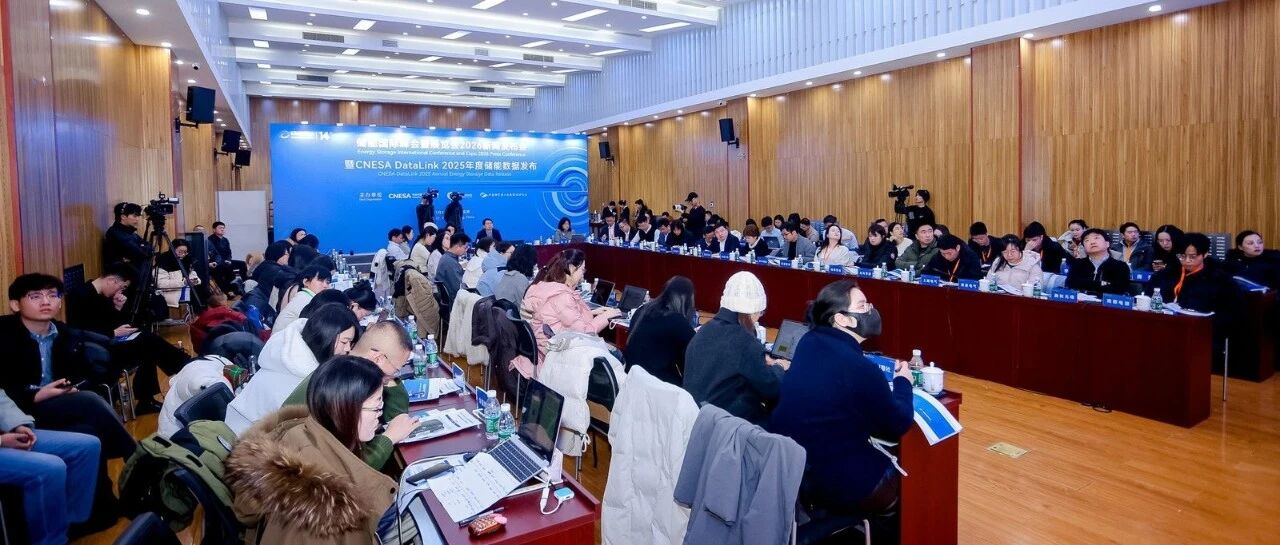
文 | 中国改革报 郭兴 张小宝 政策"拐杖"被移开,中国储能产业是否还能跑出加速度? 近日, 中关村储能产业技术联盟组织召开的CNESA Data Link 2025年度储能数据发布会 (以下简称"发布会")揭晓了答案。发布会上, 中关 村储能产业技术联盟理事长陈海生 全面总结了2025年新型储能产业发展情况,并展望了2026年发展趋势。 陈海生介绍,在强制配储政策退出的背景下,2025年,中国新型储能产业逆势而上, 交出了一份新增投运66.43吉瓦/189.48吉瓦时的亮眼成绩 单。 截至2025年末,中国电力储能累计装机达213.3吉瓦,其中新型储能累计装机首次突破100吉瓦大关,达到144.7吉瓦,历史性地占据总装机 容量的2/3以上。据了解, 这一规模是"十三五"末期的45倍。 "更为深刻的变革在于结构性的跨越。"陈海生表示,在政策"拐杖"被移开之后, 新型储能产业不仅没有失速,反而凭借内生的市场与技术动力 ,跑出了更稳健、更高质量的加速度。 技术自立与场景迁移 "十三五"与"十四五"这10年,是电力市场改革的关键期,更是新型储能技术路线从"陪衬"走向"主角"的进化期。10年间,我国不仅新型电力系统 ...

海博思创与大同市签约,发力智能制造与独立储能电站
中关村储能产业技术联盟· 2026-01-28 08:25
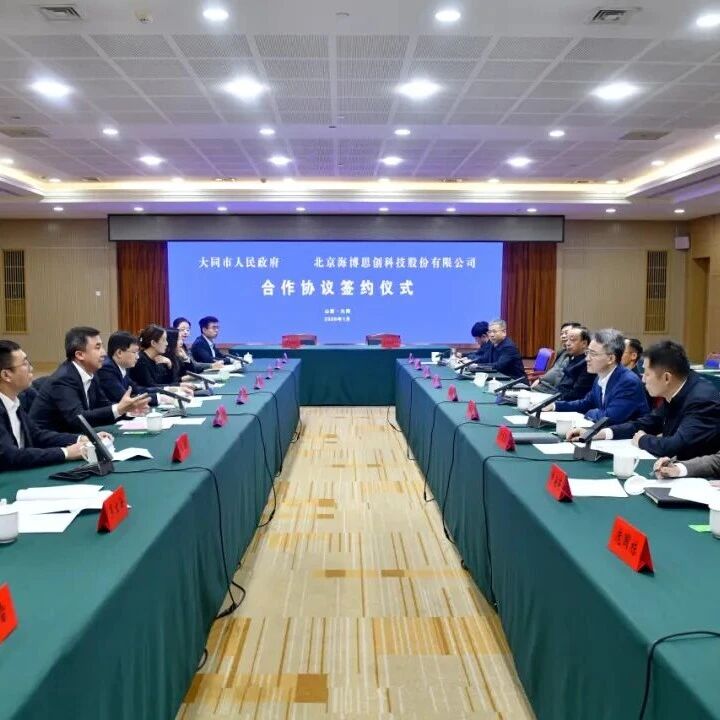
山西是国家重要的综合能源基地, 已构建起涵盖现货、调频、备用等多层次的电力市场机制, 完善的市场体系为储能产业发展营造了良好环境。大同作为山西省能源转型的前沿阵地,历史底 蕴深厚,具备政策支撑有力、产业基础扎实的发展优势,在新能源储能领域具有独特的资源禀赋 和发展潜力。 自2023年海博思创储能装备产业园落户大同以来,双方合作持续深化,结出累累硕果。 海博思 创大同智能制造基地2025年实现产值跨越式增长,二期建设稳步推进,相关储能电站项目也取 得阶段性重要进展 ,充分体现"大同速度"与"大同服务"的高效与温度。 展望未来,海博思创将充分发挥作为储能行业龙头企业的带动作用,推动更多优质项目、先进技 术与创新模式落地大同。海博思创将与大同市同频共振,携手构建储能产业生态圈,集聚产业链 上下游优质企业协同发展,全力将大同打造成储能产业发展的高地。 文 | 海博思创 1月26日,北京 海博思创 科技股份有限公司与 大同市政府 正式签署合作协 议。双方将围绕 智能制造、独立储能电站 等重点领域,开展全方位、深层次的 合作,共同推动大同市新能源产业结构优化与提升,助力区域能源转型与可持 续发展。 签约仪 式上,大同市委 ...
20亿!科力远携手国资共同设立储能基金
中关村储能产业技术联盟· 2026-01-28 08:25
ESIE 2026 1 月 22 日, 科力远 与 天津滨海新能源 投资管理有限公司、 天津滨海新区新兴产业基金管理 有 限公司、深圳市 元科慧储 投资有限公司 共同投资设立 储能基金并签订合伙协议 。该基金目标 总规模人民币 20 亿元,首期规模 5 亿元 ,将主要投资新型储能场景及产业链上下游优质项目。 双方共同设立储能基金,将有助于整合储能产业资源, 打通储能项目开发、投建、运营运维到资 产化的全周期闭环 ,构建可持续滚动升级的一体化发展模式。同时,通过聚焦新型储能场景及产 业链上下游优质项目, 基金助力联合体应用场景创新,推动项目落地,批量化构建储能优质资产 。 依托滨海建投在京津冀区域的风电、光伏、园区等优质资源,双方也将进一步探索新型储能全 链条协同发展新模式,拓展业务增量空间。 此前, 科力远已与中创新航、凯博资本 等大储能生态创新联合体成员单位共同发起设立储能产 业基金,并于 2025 年完成扩募, 总规模达 14.02 亿元 ,为多个独立储能电站项目提供资金赋 能,实现了产业与资本的双向赋能。 中国储能产业发展的风向标 第十四届储能国际峰会暨展览会 新增66.43GW/189.48GWh!2 ...


全国多地取消固定分时电价
中关村储能产业技术联盟· 2026-01-28 03:42
文 | 第一财经 进入2026年,国内电力行业迎来一场意义深远的市场化变革," 取消固定分时电价"成为行业热点话题 ,多地密集出台政策,对直接参与电力市 场交易用户的固定分时电价机制作出调整。 业内普遍认为, 逐步取消固定分时电价是电力市场化改革的大势所趋。 此次各地政策调整,核心要义是将电价定价权从政府转移至市场,实现 电力价格"由市场主导决定",让价格信号更真实、准确地反映实时电力供需状况,为电力资源优化配置提供支撑。 第一财经记者梳理官方文件发现, 截至目前全国已有11个省市发布相关通知, 提及对入市用户不再执行政府核定的固定分时电价, 其中9地已 明确落地取消政策 ,江苏、山西两省的调整方案仍处于征求意见阶段。 在国家政策层面,2025年12月17日, 国家发改委、国家能源局印发《电力中长期市场基本规则》 (发改能源规〔2025〕1656号,下称"1656号 文"),明确自2026年3月1日起,直接参与市场交易的经营主体,不再人为规定分时电价水平和时段。 分时电价机制是电力市场化改革过渡阶段的核心电价调控手段 ,指电力主管部门根据一天中不同时段的电力供需状况、电网负荷变化,将时间 划分为高峰、平段、低 ...

标杆案例!中车“云枢”3.XMW PCS落地,重塑PCS选型逻辑
中关村储能产业技术联盟· 2026-01-27 11:41
Core Viewpoint - The successful grid connection of Inner Mongolia Energy Group's 500MW/2000MWh independent energy storage power station, utilizing CRRC Times Electric's "Cloud Hub" series 3.45MW energy storage converters, marks a significant advancement in the energy storage industry, transitioning from "scale racing" to "value winning" by 2026 [1][5]. Group 1: Technological Advancements - The "Cloud Hub" is the first 3.XMW level grid-forming PCS, setting a high-end competitive dimension with six core technologies, including ultra-fast voltage support and adjustable inertia support, which address critical pain points in grid stability [6]. - Compared to traditional models, the "Cloud Hub" improves power density by 22% and reduces footprint by 30%, significantly lowering initial investment costs and adapting to mainstream lithium battery systems [6]. Group 2: Future Value and Investment Considerations - The hardware pre-embedding capability of the "Cloud Hub" allows for advanced functions like inertia response, aligning with investors' concerns about long-term asset value in large energy storage projects [8]. - The software-defined capability enables the "Cloud Hub" to evolve from an energy storage unit to a grid stability support unit over its lifecycle, ensuring sustained asset value [8]. Group 3: Policy and Market Adaptability - The implementation of the new "Design Standards for Electrochemical Energy Storage Stations" in 2026 emphasizes quality and system value, requiring energy storage stations to be adaptable to future technological iterations and market rule changes [9]. Group 4: Reliability and Environmental Adaptation - The "Cloud Hub" leverages engineering philosophies from China's high-speed rail systems, ensuring reliability in extreme environments, such as the -30°C conditions in Inner Mongolia, which enhances the project's overall lifecycle availability and profitability [10]. Group 5: Industry Benchmarking and Cost Efficiency - The project serves as a benchmark, redefining the selection logic for core equipment in large independent energy storage stations, demonstrating that higher power PCS can lead to reduced equipment numbers and lower operational costs [14]. - The "Cloud Hub" enables the potential for unlocking higher-value ancillary services, positioning the project for revenue model upgrades as market mechanisms evolve [14].


国家重点研发计划“规模储能价值收益及碳排放评估技术合作研究”项目年度总结暨研究推进会在京召开
中关村储能产业技术联盟· 2026-01-27 11:41
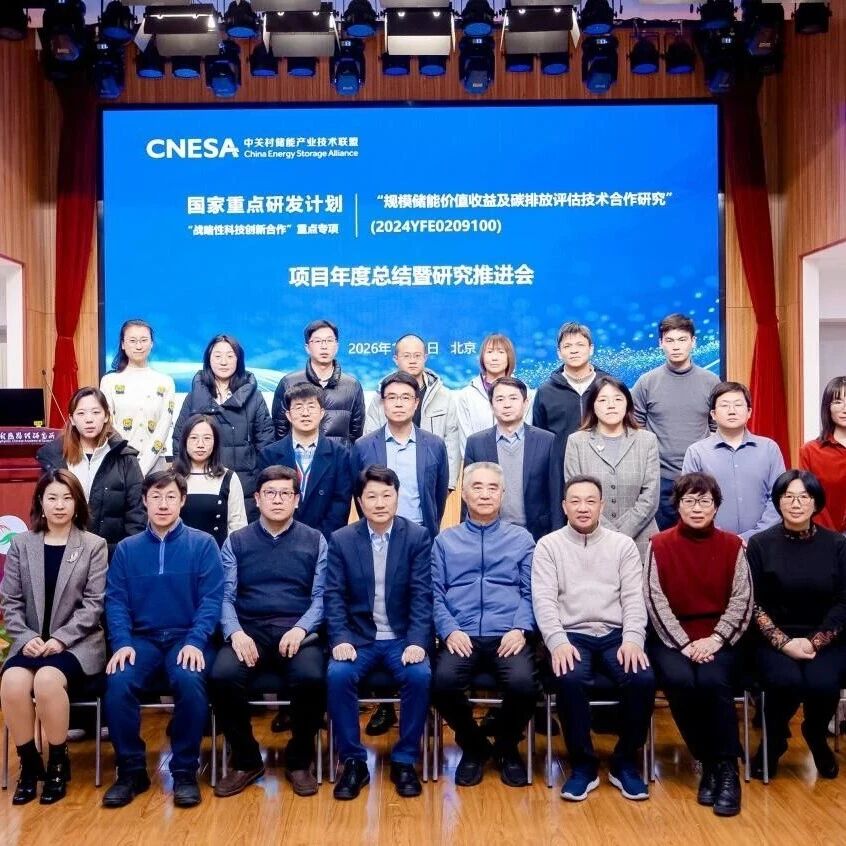
Core Viewpoint - The project aims to address key bottlenecks in the energy storage industry as it transitions from large-scale to market-oriented development, focusing on economic benefits and carbon emission accounting [4]. Group 1: Project Overview - The project is part of the National Key R&D Program "Strategic Technology Innovation Cooperation" and focuses on value yield and carbon emission assessment technologies for large-scale energy storage [1]. - The project is led by the Zhongguancun Energy Storage Industry Technology Alliance, with participation from various experts and representatives [1][4]. Group 2: Project Progress and Achievements - The project has made significant progress in 2025, completing all assessment indicators on schedule, developing a software platform for cost and carbon footprint accounting, and producing a report on market rules and business models [6]. - Three group standards have been initiated, and three software copyrights have been obtained, alongside active international collaboration [6]. Group 3: Expert Feedback and Future Directions - The project consulting expert group, led by Professor Xia Qing from Tsinghua University, acknowledged the solid work done by the project team and provided constructive feedback on research depth, result focus, and financial norms [10]. - The project team plans to incorporate expert suggestions to enhance collaborative research, deepen scenario studies, and ensure high-quality project completion [12].
6400万元!宁夏同心县100MW储能电站100%股权被收购
中关村储能产业技术联盟· 2026-01-27 05:50
文 | 中关村储能产业技术联盟 中国安储能源集团有限公司 于2026年1月26日宣布,作为买方与 卖方宁夏晋欣胜辉能源科技有限公司 、目标公司 吴忠市瑞储科技有限公司 及 担保人订立股权转让协议,拟以人民币6400万元(约7168万港元)收购目标公司100%股权。 目标公司主要从事位于 宁夏吴忠市同心县的电化学储能电站项目 ,装机容量为100兆瓦/200兆瓦时,已于2025年4月投产,2025年度实现收益约 2542万元。 项目由20个模组化储能单元及540个186千瓦/372千瓦时的能源模组组成,采用锂离子电池技术实现高效充放电循环,以实现灵活的能源储存及 释放。电站总装机容量约达100兆瓦/200兆瓦时, 定位为大型公用事业级储能设施, 通过提供削峰服务、调频及辅助服务创造收益,以此保障 电网稳定、平衡电力供需。 鉴于目标公司营运稳健且有能力产生现金流, 收购事项符合集团多元化收益入来源的策略目标,可带来稳定收益与营运现金流, 促进可持续长 期增长并最大化股东价值。 中国储能产业发展的风向标 相关阅读 八大储能龙头领衔ESIE 2026!重磅新品即将发布,4月北京见 首发丨CNESA重磅发布《中国独立储能 ...

2026这些储能标准必须关注,建议收藏
中关村储能产业技术联盟· 2026-01-27 05:50
文 | 中关村储能产业技术联盟 "十四五"期间,储能技术路线结构发生显著变化,抽水蓄能占比首次低于40%,以锂电池为代表的新型储能实现跨越式增长。 据中关村储能产业技术联盟(CNESA)不完全统计,截至2 025年底,中国电力储能累计装机规模2 13.3GW,抽水蓄能占比31 .3%, 以锂电池为代表的新型储能累计装机占比超过2/ 3。 在这一蓬勃发展的产业态势下,健全储能领域标准体系,特别是完善安全标准的相关工作尤为重要。 经不完全统计, 2 02 5年我国发布了4 0余项储能及其相关的国家标准、行业标准、地方标准,涵盖了储能规划设计、设备试验、并网运 行、安全应急等多个方面 ,为规范引导产业高质量发展,保障储能电站安全、促进能源结构转型以及产业链绿色低碳转型提供了重要 支撑。 本文 旨在梳理202 5年发布的储能重点标准及其影响,并重点列出2 02 6年已经实施和即将实施的储能重点标准清单 ,帮助行业从业者 准确把握政策规范动向,规避风险,确保项目合规、安全、高效推进。 储能安全标准体系强化 以锂电池为代表的电化学储能飞速发展,储能装机规模迅速扩大,储能的安全问题已成为行业的核心焦点。据不完全统计, 20 ...

八大储能龙头领衔ESIE 2026!重磅新品即将发布,4月北京见
中关村储能产业技术联盟· 2026-01-26 06:43
Core Viewpoint - The article highlights the upcoming ESIE 2026 event, emphasizing its role as a significant international platform for the energy storage industry, focusing on innovation, value reconstruction, and global collaboration [2][19]. Group 1: Event Overview - ESIE 2026 will take place from March 31 to April 3, 2026, at the Beijing Capital International Exhibition Center, featuring an exhibition area of 160,000 square meters and expecting over 200,000 professional visitors [2]. - The event aims to create a comprehensive "energy storage ecosystem exhibition," focusing on resource matching, content services, and long-term ecological connections to support the growth of energy storage enterprises [2][23]. Group 2: Participating Companies - Eight leading companies, including CRRC Zhuzhou Institute, Sungrow Power, and CATL, have signed sponsorship agreements to promote high-quality development in the energy storage industry through the ESIE platform [2][4]. - In addition to the eight sponsors, nine other leading enterprises will co-host the event, showcasing the entire industry chain from advanced materials to system integration [4]. Group 3: Forum and Activities - The event will feature over 30 thematic forums and more than 20 concurrent activities, focusing on topics such as innovative applications, financing, and global market trends [8][19]. - Key sessions include the opening ceremony, main forum, and specialized forums on cutting-edge technologies and market mechanisms [11][12]. Group 4: International Collaboration - ESIE 2026 aims to serve as a core hub for international cooperation, supported by over 80 global organizations, including IRENA and the World Bank [27]. - The event will attract decision-makers from over 60 countries, facilitating direct access to international markets and sharing practical experiences in energy storage [28][29]. Group 5: Media and Promotion - The event has established a media partnership with over 200 authoritative media outlets to enhance brand visibility and reach a wide audience through various reporting formats [31]. - The focus is on transitioning from "traffic value" to "industry value," marking a significant upgrade in the event's impact on the energy storage sector [32].

500MWh!比亚迪东欧最大储能项目投运
中关村储能产业技术联盟· 2026-01-26 06:43
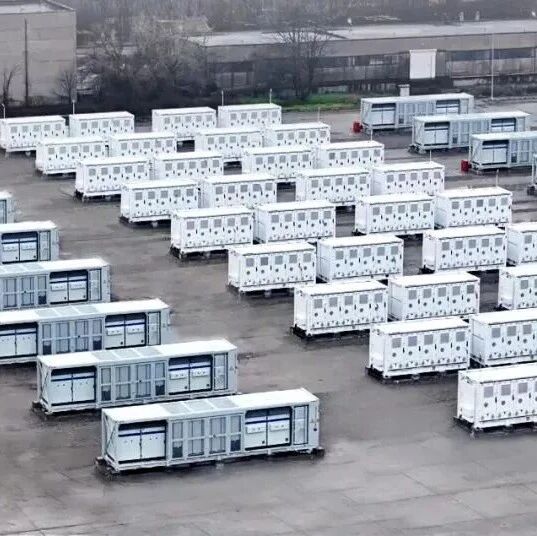
Group 1 - The core viewpoint of the article highlights the successful operation of a 500 MWh independent battery energy storage system (BESS) project in Bulgaria, marking it as one of the largest independent storage projects in Eastern Europe, showcasing BYD's technological strength and global expansion efforts [2] - The project was developed through a strategic partnership between BYD Energy and Contour Global, emphasizing the importance of collaboration in establishing a long-term relationship and expanding into the European market [2] - BYD Energy has confirmed its participation in the 14th International Energy Storage Summit and Exhibition (ESIE 2026), inviting industry peers to join the global energy storage event [4] Group 2 - BYD has secured a significant 300 MWh energy storage contract in Mexico, indicating its growing influence in the Latin American market [8] - The company has also won a bid for a 200 MW/836.16 MWh independent energy storage project, further solidifying its position in the energy storage sector [8] - Additionally, BYD signed the largest energy storage supply agreement in Latin America, totaling 3.5 GWh, which reflects its commitment to expanding its market presence [8]