Workflow
HSBC HOLDINGS(00005)
icon
Search documents
2026年格隆汇“全球视野”十大核心资产之汇丰控股
Ge Long Hui· 2026-01-05 11:09
Core Viewpoint - HSBC Holdings has been selected as a key asset in the "Global Vision" top ten core assets for 2026, representing the financial sector, due to its strategic transformation and focus on the Asia-Pacific market [1] Group 1: Strategic Transformation - HSBC has undergone a significant transformation over three years, divesting low-profit retail assets in Europe and the U.S. and refocusing on the Asia-Pacific market, emphasizing retail banking, cross-border trade, and wealth management [1] - The results of this transformation are evident in the first three quarters of 2025, with net interest income increasing by 4% year-on-year and a return on tangible equity (RoTE) of 18.2% [1] Group 2: Industry Opportunities - The global banking industry is entering a recovery phase in 2024, with the Asia-Pacific region becoming a core growth engine, contributing over 60% of the global cross-border trade growth of 8% [5] - The interest rate cut cycle is expected to benefit HSBC by reducing cross-border financing costs and stimulating demand for cross-border mergers and acquisitions, trade financing, and IPO activities in the Asia-Pacific region [5] Group 3: Business Segments Performance - HSBC's business structure has been reorganized into four main segments: Hong Kong, UK, Corporate and Institutional Banking (CIB), and International Wealth Management and Premier Banking (IWPB), enhancing operational efficiency [7] - The Hong Kong segment serves as a profit anchor, with a revenue increase of 5% to $11.8 billion in the first three quarters of 2025, driven by a 21% growth in non-resident clients since January 2023 [7] - The CIB segment is projected to benefit from a recovery in global capital markets, with revenue growth of 10%-12% driven by cross-border trade financing and investment banking activities [11] - The IWPB segment is expected to achieve revenue growth of 18%-20% due to the increasing wealth of high-net-worth individuals in the Asia-Pacific region [14] Group 4: Competitive Advantages - HSBC's core competitive advantage lies in its deep-rooted local network and cross-border service capabilities in the Asia-Pacific region, which have been built over 160 years [16] - The bank's strategic restructuring has enhanced its resilience to market cycles, with a focus on high-return businesses, resulting in 59% of revenue coming from CIB and IWPB [16] Group 5: Financial Improvement and Valuation - HSBC's financial health is improving, with a 4% year-on-year increase in net interest income and a stable RoTE above 18% [19] - The bank's current valuation is below historical averages, with potential for a 15%-20% recovery as the market recognizes its focus on high cash returns and Asia-Pacific growth [19]
芯片股引爆全球!中概股深夜爆发,百度狂飙12%,DeepSeek要发大招了,梁文锋署名新论文引爆AI圈!
雪球· 2026-01-03 03:46
Group 1 - The core viewpoint of the article highlights the mixed performance of major U.S. stock indices on the first trading day of 2026, with a notable surge in Chinese tech stocks and a significant increase in the Nasdaq Golden Dragon Index, which rose by 4.38%, marking its largest single-day gain since May 12 of the previous year [2][3][7] - Major technology stocks showed a mixed performance, with ASML and Micron Technology both achieving historical highs, rising over 9% and 10% respectively, while other tech giants like Tesla and Microsoft experienced declines of over 2% [3][5] - The semiconductor sector saw a strong rally, with the Philadelphia Semiconductor Index increasing by over 4.5%, driven by significant gains in companies like ASML and Micron Technology, which are benefiting from the growing demand for AI infrastructure [10][15] Group 2 - Tesla's Q4 delivery data fell short of expectations, resulting in a loss of its title as the world's top electric vehicle seller to BYD, which reported a 27.86% increase in annual electric vehicle sales [22][25][26] - Foreign investment institutions maintain a positive outlook on Chinese assets, with predictions of a 38% increase in the Chinese stock market by the end of 2027, emphasizing structured investment opportunities in technology innovation, green energy, and high-end manufacturing [28]
智通ADR统计 | 1月3日
智通财经网· 2026-01-03 00:08
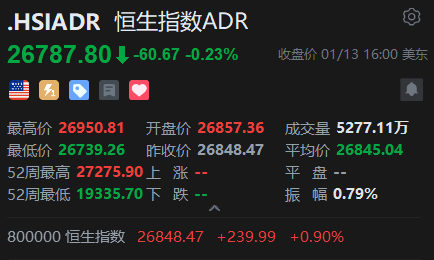
Group 1 - The Hang Seng Index (HSI) closed at 26,445.95, up by 107.48 points or 0.41% as of January 2, 16:00 Eastern Time [1] - The highest price during the trading session was 26,472.92, while the lowest was 26,180.87, with a trading volume of 58.0567 million [1] - The HSI has a 52-week high of 27,275.90 [1] Group 2 - Major blue-chip stocks showed mixed performance, with HSBC Holdings closing at HKD 125.368, up 0.86% from the Hong Kong close [2] - Tencent Holdings closed at HKD 627.621, reflecting a 0.74% increase from the Hong Kong close [2] Group 3 - Tencent Holdings (code: 00700) latest price is HKD 623.000, with an increase of HKD 24.000 or 4.01% [3] - Alibaba Group (code: 09988) latest price is HKD 149.000, up by HKD 6.200 or 4.34% [3] - HSBC Holdings (code: 00005) latest price is HKD 124.300, increasing by HKD 1.900 or 1.55% [3] - Other notable stocks include AIA Group (code: 01299) at HKD 83.300, up 4.26%, and Baidu Group (code: 09888) at HKD 143.800, up 9.35% [3]
英国富时100指数突破10000点大关 此前创下2009年以来最佳年度表现
Xin Lang Cai Jing· 2026-01-02 09:16
Core Insights - The FTSE 100 index in the UK has surpassed the 10,000-point mark for the first time, achieving its best annual performance since 2009 [1] Group 1: Performance Highlights - Fresnillo and Endeavour Mining were the standout performers in the precious metals mining sector last year [1] - Financial institutions such as HSBC, Barclays, and National Westminster Bank contributed significantly to the index's point increase over the past 12 months [1] Group 2: Comparative Performance - The FTSE 100 index, primarily composed of export-oriented companies, surged by 22% in 2025, outperforming both the Stoxx Europe 600 index and the S&P 500 index [1]
汇丰控股(0005.HK)再创历史新高,2025年累涨逾70%
Xin Lang Cai Jing· 2026-01-02 05:02
Group 1 - HSBC Holdings (0005.HK) shares increased by 1.72% to HKD 124.50, reaching a historical high [1] - The stock has cumulatively risen by 70.57% since 2025 [1]
汇丰控股(00005) - 董事会成员名单及角色与职务
2026-01-01 23:30
香港股份代號:5 2026年1月2日 HSBC Holdings plc 滙豐控股有限公司 董事會成員名單及角色與職務 鮑哲鈺 孫瑋 段小纓 范貝恩女爵士 傅偉思 古肇華 麥浩智博士(員工投入事務指定非執行董事) 莫佩娜 梅愛苓 張瑞蓮 滙豐控股有限公司董事會成員名單如下: 獨立非執行主席 聶智恆 高級獨立非執行董事 高安賢 執行董事 艾橋智(集團行政總裁) 郭珮瑛(集團財務總監) 獨立非執行董事 集團設有六個董事委員會,各董事在這些委員會所擔任的職位如下: 集團監察委員會 聶智恆(主席) 鮑哲鈺 段小纓 傅偉思 高安賢 集團薪酬委員會 范貝恩女爵士(主席) 段小纓 高安賢 HSBC Holdings plc 滙豐控股有限公司 註冊辦事處及集團總管理處: 8 Canada Square, London E14 5HQ, United Kingdom 網站:www.hsbc.com 英格蘭及威爾斯註冊有限公司。註冊編號 617987 董事會成員名單 / 2 麥浩智博士 莫佩娜 梅愛苓 集團風險管理委員會 傅偉思(主席) 孫瑋 范貝恩女爵士 古肇華 梅愛苓 聶智恆 張瑞蓮 提名及企業管治委員會 梅愛苓(主席) 古 ...
智通港股通持股解析|1月1日
智通财经网· 2026-01-01 00:35
Core Insights - The top three companies by stockholding ratio in the Hong Kong Stock Connect are China Telecom (71.90%), GCL-Poly Energy (69.96%), and Da Zhong Public Utilities (68.75%) [1][2] - The companies with the largest increase in stockholding over the last five trading days include SMIC (+1.092 billion), China Merchants Bank (+1.052 billion), and Hong Kong Exchanges and Clearing (+790 million) [1][2] - The companies with the largest decrease in stockholding over the last five trading days include China Mobile (-3.216 billion), Tencent Holdings (-1.107 billion), and the Tracker Fund of Hong Kong (-465 million) [1][2] Stockholding Ratios - China Telecom (00728) holds 99.79 million shares with a stockholding ratio of 71.90% [2] - GCL-Poly Energy (01330) holds 28.3 million shares with a stockholding ratio of 69.96% [2] - Da Zhong Public Utilities (01635) holds 36.7 million shares with a stockholding ratio of 68.75% [2] - Other notable companies in the top 20 include China Shenhua (66.39%) and China Merchants Energy (64.43%) [2] Recent Trading Activity - The top three companies with increased holdings in the last five trading days are: - SMIC (00981): +1.092 billion, +15.28 million shares [2][3] - China Merchants Bank (03968): +1.052 billion, +19.92 million shares [2][3] - Hong Kong Exchanges and Clearing (00388): +790 million, +1.93 million shares [2][3] - The top three companies with decreased holdings in the last five trading days are: - China Mobile (00941): -3.216 billion, -39.36 million shares [2][3] - Tencent Holdings (00700): -1.107 billion, -1.84 million shares [2][3] - Tracker Fund of Hong Kong (02800): -465 million, -18.01 million shares [2][3]
智通港股沽空统计|1月1日
智通财经网· 2026-01-01 00:21
Group 1 - The top three companies with the highest short-selling ratios are Cheung Kong (00001), CLP Holdings (00002), and Hong Kong and China Gas (00003), all reporting a short-selling ratio of 0.00% [1][2] - The top three companies by short-selling amount are also Cheung Kong (00001), CLP Holdings (00002), and Hong Kong and China Gas (00003), with amounts not specified [1][2] - The companies with the highest deviation values are Energy and Energy Global (01142), Hu Shang Ayi (02589), and China Shipbuilding Defense (00317), with deviation values of -0.41%, -0.41%, and -0.66% respectively [1][2] Group 2 - The top ten short-selling ratios include Cheung Kong (00001), CLP Holdings (00002), and Hong Kong and China Gas (00003), all at 0.00%, with significant negative deviation values [2] - The top ten short-selling amounts also feature Cheung Kong (00001), CLP Holdings (00002), and Hong Kong and China Gas (00003), all at 0.00% short-selling ratio and notable negative deviation values [2] - The top ten companies with the highest deviation values include Energy and Energy Global (01142), Hu Shang Ayi (02589), and China Shipbuilding Defense (00317), with deviation values indicating a decline compared to their average short-selling ratios over the past 30 days [2][3]
汇丰刘晶预计2026年中国降准50BP,财政赤字率或维持4%
Core Viewpoint - HSBC forecasts that China will implement a 50 basis point reserve requirement ratio cut by 2026, supported by a series of easing policies and resilient exports, aiming for a 5% economic growth in 2025 [1] Economic Growth Outlook - Global economic growth is expected to remain stable in 2026, with a slowdown in trade export growth, while strong investments in artificial intelligence will support investment and trade growth in the next two years [1] - China is projected to achieve around 5% economic growth in 2025, aided by easing policies introduced since Q4 2024 and resilient export performance [1] Structural Transformation - The year 2026 marks the beginning of the "14th Five-Year Plan," where China will continue its structural transformation and maintain reasonable growth, with domestic demand, including consumption and investment, becoming the main driver of growth [1] Fiscal Policy - The Central Economic Work Conference has proposed maintaining a necessary fiscal deficit, with HSBC estimating the fiscal deficit rate target for 2026 to remain at a relatively high level of 4% [1] - The issuance scale of local government special bonds and special treasury bonds is expected to be similar to that of 2025 to support consumption and major project investments [1] Monetary Policy - There is potential for a further interest rate cut of 20 basis points in 2026, along with a possible reserve requirement ratio cut of 50 basis points [1]
银行:银行2026年展望:稳中求进
2025-12-31 16:02
Summary of the Conference Call Transcript Industry Overview - The banking sector is entering a phase of high-quality development, with a focus on absolute and relative returns from bank stocks, driven by high dividend yields and asset quality [3][4][20]. Key Points Financial Performance Projections - Expected revenue growth for listed banks in 2026 and 2027 is +2.5% and +3.6% respectively, with net profit growth of +1.9% and +2.6% [4][20]. - Revenue and profit growth are anticipated to improve due to: 1. Narrowing net interest margin pressure 2. Quality-focused credit issuance amid weak demand [4][20]. 3. Stabilization of fee income growth after several years of fee reductions [4][20]. 4. Stable or improving net non-performing loan generation rates [4][11]. 5. Accelerated supply-side reforms leading to a reduction in the number of bank licenses, improving competition and operational landscape [4][11]. Customer Demand and Market Dynamics - The low-interest-rate environment has shifted customer demand, with government and state-owned enterprises becoming significant contributors to leverage, affecting the structure of new social financing [5][10]. - Regulatory policies are influencing the development of inclusive finance, focusing on risk compensation rather than merely increasing customer numbers [5][10]. Risk Factors - Risks associated with real estate developers and retail sectors are highlighted, with potential for greater-than-expected exposure [6][11]. Profitability and Valuation Adjustments - Adjustments to profitability forecasts for 2025 and 2026 have been made, with a focus on net interest income recovery and fee income growth [20][21]. - The expected net interest margin for 2026 is projected to be approximately 1.34%, a decrease of 6 basis points from 2025 [21][22]. - Fee income is expected to grow by 3.6% and 4.9% in 2026 and 2027 respectively, indicating a positive trend in non-interest income [21][22]. Asset Quality and Credit Costs - The net non-performing loan generation rate is expected to stabilize or slightly decline, with structural characteristics of retail and corporate lending continuing [11][21]. - Credit costs are projected to remain stable at around 0.58% for 2026 and 2027, reflecting the balance between corporate and household debt servicing capabilities [21][22]. Investment Recommendations - The report suggests a continued positive outlook for bank stocks, emphasizing the importance of dividend yield and asset quality in investment decisions [3][4][20]. Additional Insights - The banking sector is undergoing a transformation towards high-quality development, with a shift in focus from scale to quality, driven by macroeconomic pressures and regulatory changes [12][20]. - The reduction in the number of banking licenses over the past five years indicates successful risk management efforts within the sector [11][12]. - The report emphasizes the need for banks to adapt their strategies to maintain competitiveness in a changing regulatory and economic environment [12][20].