
HKEX(00388)

Search documents
港交所:“桦加沙”靠近 证券及衍生产品市场将正常交易
Di Yi Cai Jing· 2025-09-23 06:07
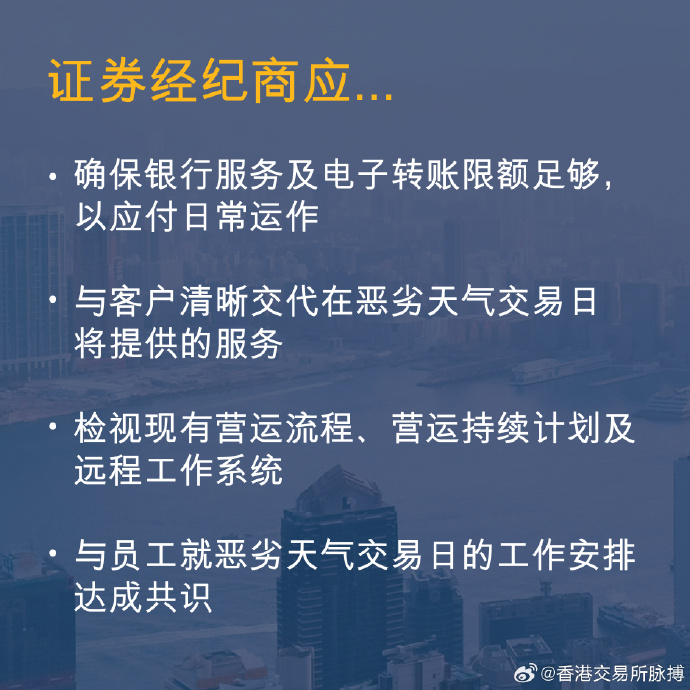
Core Viewpoint - The Hong Kong Stock Exchange (HKEX) has issued a statement advising market participants to make early operational and human resource adjustments in response to the approaching "Hagupit" storm, with the Hong Kong Observatory expected to issue a No. 8 gale or storm signal at 2:20 PM [1] Group 1: Operational Guidelines - HKEX will maintain normal trading hours for the securities and derivatives markets, including the Shanghai-Hong Kong Stock Connect, during the issuance of a No. 8 or higher gale/storm signal, black rainstorm warning, or extreme conditions warning [1] - Market participants are encouraged to refer to established severe weather trading arrangements to support stable market operations [1] Group 2: Recommendations for Investors - Investors should familiarize themselves with the electronic trading platforms and transfer channels provided by banks and securities brokers [4] - It is important for investors to understand the services offered by banks and securities brokers on severe weather trading days [4] Group 3: Employee Preparedness - Employees of securities brokers or banks should be well-acquainted with remote access to company systems and the HKEX systems if necessary [7] - Employees are advised to discuss work arrangements with employers in light of severe weather conditions and to make relevant preparations to respond to potential weather changes [7]


德勤:港交所今年可稳守全年全球IPO集资第一位
Zhi Tong Cai Jing· 2025-09-23 05:54
Group 1 - Deloitte anticipates over 80 IPOs in Hong Kong this year, raising between 250 to 280 billion HKD, an increase of 25-40% from the previous forecast of 200 billion HKD [1] - The increase in IPO fundraising is attributed to a favorable capital market in Hong Kong, prompting A+H companies to accelerate their listing plans, with each raising over 1 billion USD (approximately 7.8 billion HKD) [1] - The Hong Kong Stock Exchange (HKEX) is expected to maintain its position as the global leader in IPO fundraising for the year, as the fundraising amount has been adjusted to 250 to 280 billion HKD, significantly ahead of the second-ranked New York Stock Exchange [1] Group 2 - The potential IPOs of Fannie Mae and Freddie Mac, which could be the largest in history, are mentioned, but their listing is unlikely to occur in the fourth quarter of this year due to legislative requirements [1] - The long-term possibility of the two government-sponsored enterprises going public is acknowledged, but immediate prospects for a fourth-quarter listing are deemed low [1]
港交所:超强台风桦加沙来袭,23日交易照常进行
Bei Ke Cai Jing· 2025-09-23 05:44
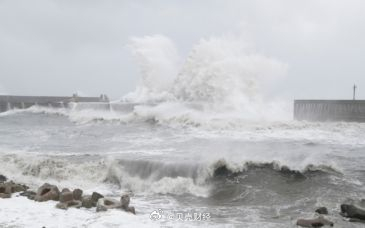
Core Viewpoint - The Hong Kong Stock Exchange (HKEX) is prepared to continue normal operations despite the approach of Super Typhoon Haikui, which is expected to impact the region [1] Group 1: Weather Impact on Operations - Super Typhoon Haikui has intensified and is moving towards the Guangdong coast, prompting the HKEX to monitor the situation closely [1] - The Hong Kong Observatory plans to issue a No. 8 gale or storm signal on September 23, indicating severe weather conditions [1] Group 2: Trading Arrangements - Starting from September 2024, HKEX has implemented arrangements for trading during adverse weather conditions, allowing its securities and derivatives markets to operate normally during No. 8 or higher gale/storm signals, black rainstorm warnings, or extreme situation warnings [1] - The upcoming typhoon represents a significant test for the new "trading during typhoon" regulations established by HKEX [1]
应对超强台风“桦加沙” 港交所:照常运行,密切监测最新情况
Xin Hua Cai Jing· 2025-09-23 05:38
Core Viewpoint - The 18th typhoon "Haikui" has intensified to a super typhoon level and is approaching the coastal areas of Guangdong, posing a significant test for the Hong Kong Stock Exchange's new trading arrangements during severe weather conditions [1] Group 1: Typhoon Impact on Trading - The Hong Kong Stock Exchange has been informed that the Hong Kong Observatory plans to issue a No. 8 gale or storm signal on September 23 afternoon [1] - The exchange will continue to operate under normal trading hours during the issuance of a No. 8 or higher gale/storm signal, black rainstorm warning, or extreme situation warning, as per the new regulations implemented in September 2024 [1] - This situation marks a critical evaluation of the "trading during typhoons" policy since its introduction [1]
香港交易所:“桦加沙”靠近 证券及衍生产品市场将正常交易
Zheng Quan Shi Bao Wang· 2025-09-23 05:36
Core Viewpoint - The Hong Kong Stock Exchange (HKEX) has issued a statement regarding the impact of Typhoon Haikui, indicating that trading will continue during severe weather conditions, including the issuance of a No. 8 or higher gale/typhoon signal [1] Group 1 - HKEX announced that it expects the Hong Kong Observatory to issue a No. 8 gale/typhoon signal at 2:20 PM [1] - The securities and derivatives markets, including the Shanghai-Hong Kong Stock Connect, will operate normally during the issuance of severe weather warnings [1] - Market participants are advised to make early operational and human resource adjustments in accordance with established severe weather trading arrangements to support stable market operations [1]
“北向互换通”,上新!
证券时报· 2025-09-22 15:28
Core Viewpoint - The expansion of the "Northbound Swap Connect" aims to enhance risk management tools for overseas investors and promote the internationalization of the Renminbi [1][2]. Group 1: Expansion of Northbound Swap Connect - On September 22, the Hong Kong Stock Exchange, in collaboration with the China Foreign Exchange Trade System and the Shanghai Clearing House, introduced interest rate swap contracts based on the one-year Loan Prime Rate (LPR1Y) under the "Northbound Swap Connect" [1]. - On the launch day, 31 domestic and foreign institutions participated, with a total of 53 transactions and a nominal principal amount of 6.46 billion RMB [1]. Group 2: Market Activity and Future Developments - Since its launch on May 15, 2023, the "Swap Connect" has been operating smoothly, with increasing trading activity, becoming a key channel for overseas institutions to manage Renminbi interest rate risks [2]. - As of August 2025, 82 foreign financial institutions from 15 countries and regions have completed over 15,000 Renminbi interest rate swap transactions, totaling approximately 8.15 trillion RMB in nominal principal [2]. - Starting September 22, the maximum term for existing Renminbi non-deliverable interest rate swap (CNY NDIRS) contracts has been extended from 5.5 years to 11 years to better assist overseas investors in managing interest rate risks [2].

(机遇香港)伦敦金属交易所批准在香港新增3个认可仓库
Sou Hu Cai Jing· 2025-09-22 15:18
Group 1 - The Hong Kong government welcomes the approval of three warehouses in Yuen Long by the London Metal Exchange (LME) as recognized warehouses [1][2][3] - The expansion of LME's storage facilities in Hong Kong aligns with the policy direction outlined in the Chief Executive's 2025 Policy Address, enhancing Hong Kong's position as an international financial, shipping, and trading hub [2] - With the addition of these three warehouses, the total number of recognized warehouses operated by LME in Hong Kong has increased to eleven, facilitating efficient delivery options for international metal trading [2]
“北向互换通”下新增LPR标的利率互换
Xin Hua Cai Jing· 2025-09-22 14:14
Core Insights - The introduction of interest rate swap contracts referencing the one-year Loan Prime Rate (LPR1Y) under the "Northbound Swap Connect" aims to enhance risk management tools for overseas investors and promote the internationalization of the Renminbi [1][2] Group 1: Market Development - On the launch day, 31 domestic and foreign institutions participated, with a total of 53 transactions and a nominal principal amount of 6.46 billion RMB [1] - Since its launch on May 15, 2023, the "Swap Connect" has facilitated over 15,000 Renminbi interest rate swap transactions, totaling approximately 8.15 trillion RMB in nominal principal from 82 foreign financial institutions across 15 countries and regions by the end of August 2025 [1] Group 2: Investor Benefits - The addition of LPR as a reference rate allows international investors to seamlessly connect with the domestic interest rate derivatives market, enhancing their ability to manage interest rate risks associated with domestic investments [2] - The optimization measures of the "Swap Connect" are expected to attract more international investors to the domestic capital market, thereby accelerating the internationalization of the Renminbi [2] Group 3: Product Expansion - Starting from September 22, the maximum term for existing Renminbi non-deliverable interest rate swap (CNY NDIRS) contracts has been extended from 5.5 years to 11 years, providing better risk management options for overseas investors [3]
互联互通再扩容!港交所最新发布!
中国基金报· 2025-09-22 14:04
Core Viewpoint - The Hong Kong Stock Exchange (HKEX) has introduced a new interest rate swap contract based on the one-year Loan Prime Rate (LPR1Y) under the "Northbound Swap Connect" to meet the diverse needs of overseas investors [2][4]. Group 1: New Financial Instruments - The HKEX, in collaboration with the China Foreign Exchange Trade System and the Shanghai Clearing House, has launched the LPR1Y interest rate swap contract to enhance risk management tools for foreign investors [4]. - On the launch day, 31 domestic and foreign institutions participated, with a total of 53 transactions amounting to RMB 6.46 billion [4]. Group 2: Enhancing Risk Management - The introduction of LPR interest rate swaps will enrich the risk management tools available to overseas investors, addressing their diverse interest rate risk management needs and aiding in the internationalization of the RMB [5]. - The existing non-deliverable interest rate swap (CNY NDIRS) contract's maximum term has been extended from 5.5 years to 11 years to better assist foreign investors in managing interest rate risks [7]. Group 3: Operational Performance - Since its launch on May 15, 2023, the "Swap Connect" has been operating smoothly, becoming an important channel for foreign institutional investors to manage RMB interest rate risks [7]. - As of August 2025, 82 foreign financial institutions from 15 countries and regions have conducted over 15,000 RMB interest rate swap transactions, totaling approximately RMB 8.15 trillion in nominal principal [7].
互联互通再扩容!港交所最新发布!
Zhong Guo Ji Jin Bao· 2025-09-22 14:03
Core Viewpoint - Hong Kong Exchanges and Clearing Limited (HKEX) has introduced a new interest rate swap contract based on the one-year Loan Prime Rate (LPR1Y) under the "Northbound Swap Connect" to meet the diverse needs of overseas investors [1][2][3] Group 1: New Financial Instruments - The introduction of LPR1Y-based interest rate swaps aims to enhance the risk management tools available to overseas investors, addressing previous concerns about the lack of liquidity and risk management options in Chinese government bonds [2][3] - On the launch day, 31 domestic and foreign institutions participated, executing 53 trades with a total nominal principal amount of RMB 6.46 billion [2] Group 2: Operational Stability - Since its launch on May 15, 2023, the "Swap Connect" has been operating smoothly, becoming an important channel for overseas institutions to manage RMB interest rate risks [4] - As of August 2025, 82 overseas financial institutions from 15 countries and regions have conducted over 15,000 RMB interest rate swap transactions, totaling approximately RMB 8.15 trillion in nominal principal [4] Group 3: Future Developments - HKEX plans to continue collaborating with regulatory bodies and market participants to enrich the "Swap Connect" product offerings and improve the risk management framework [4] - The maximum term for the existing CNY Non-Deliverable Interest Rate Swap (CNY NDIRS) contracts has been extended from 5.5 years to 11 years to better assist overseas investors in managing interest rate risks [4]