CHINA TELECOM(00728)

Search documents
eSIM手机来了!
证券时报· 2025-10-14 12:41
Core Viewpoint - The recent approval of eSIM technology by China's three major telecom operators marks a significant step towards the commercialization of eSIM mobile services in the smartphone sector, transitioning from traditional SIM cards to electronic SIM cards [1][4][7]. Group 1: eSIM Technology Overview - eSIM is a virtual electronic SIM card that replaces physical SIM cards, allowing users to activate mobile services without inserting a physical card [6]. - The integration of eSIM within devices eliminates the need for a SIM card slot, enabling thinner devices and providing more internal space for other components [6]. Group 2: Operators' Support and Services - China Unicom, China Mobile, and China Telecom have all received approval to conduct commercial trials for eSIM services, although online processing is currently not available [4][5]. - China Unicom has adapted 75 devices for eSIM, serving millions of users, while China Mobile plans to support a full range of eSIM products across various device types [11]. Group 3: Benefits of eSIM - eSIM technology addresses issues associated with traditional SIM cards, such as damage and the need for physical replacements, enhancing reliability [10][12]. - The use of eSIM facilitates easier switching to local carriers when traveling, eliminating the need for roaming services or purchasing local SIM cards [12].





以后手机不用插卡了? 三大运营商获eSIM手机商用试验批复许可
Yang Shi Xin Wen· 2025-10-14 12:29
Core Points - eSIM technology has become a hot topic recently, with major Chinese telecom operators receiving approval for commercial trials [1][3] - eSIM allows users to activate mobile services without a physical SIM card, enabling thinner devices and more internal space [2] - The approval marks a new phase for eSIM technology in mobile phones, following its previous applications in IoT and wearables [2] Industry Developments - China Unicom, China Mobile, and China Telecom have all announced the approval for eSIM mobile service trials as of October 13 [3] - China Unicom has adapted 75 devices, serving millions of users, while China Mobile plans to support a full range of eSIM products across various devices [3] - China Telecom has confirmed the launch of eSIM mobile services across 31 provinces in China [3] Device Compatibility - Supported eSIM devices include models from Apple, Huawei, and OPPO, which will be available for sale soon [4]
三大运营商获eSIM手机商用试验批复许可 中国移动表示将提供全体系eSIM产品支持
Di Yi Cai Jing· 2025-10-14 12:26
Core Viewpoint - Major Chinese telecom operators, including China Unicom, China Mobile, and China Telecom, have received approval to conduct commercial trials for eSIM mobile services, marking a significant advancement in mobile technology in China [1] Group 1: Company Announcements - China Unicom has adapted a total of 75 devices, including smartphones, smartwatches, and tablets, with a user base exceeding several million [1] - China Mobile plans to offer a comprehensive range of eSIM products, extending beyond smartphones to include smartwatches, tablets, and in-car devices [1] - China Telecom has officially launched eSIM mobile services for sale across all 31 provinces and municipalities in China [1]


eSIM暂不开放线上办理 需到营业厅办理开通
Xin Lang Cai Jing· 2025-10-14 12:18
Core Points - China Unicom, China Mobile, and China Telecom have officially received approval to conduct commercial trials for eSIM mobile services as of October 13 [1] - During the trial period, the three companies will not offer online processing; users must visit physical stores to activate eSIM services [1] - Supported eSIM devices include models from Apple, Huawei, and OPPO, which will be gradually available for sale [1]
中国手机eSIM业务正式上线 这些需要注意
Zhong Guo Xin Wen Wang· 2025-10-14 11:29
中新网北京10月14日电(记者 吴涛)随着近日工信部对部分运营商eSIM手机商用试验批复许可,三大运 营商手机eSIM业务正式在国内上线。它带来哪些便利,消费者使用时又该注意什么? 三大运营商均可办理 虽然eSIM可以轻松实现多卡多待,同一台eSIM手机最多可开通2个国内运营商的eSIM号码。 办理eSIM号码也需符合"一证五号"规定,即同一证件名下最多可办理5个号码,这里面包含eSIM号码。 另外,在销户时,消费者自行删除eSIM数据不等于销户,需要通过运营商来进行销户。再者,eSIM芯 片为焊接式,私自拆卸可能导致设备损坏或信息泄露。 苹果官网也进行了更新:中国移动、中国电信和中国联通将为iPhone Air提供 eSIM 支持,具体时间依 监管部门审批情况而定。这意味着三大运营商均支持iPhone Air的eSIM服务。 值得注意的是,多家运营商提供全体系eSIM产品支持,不仅涵盖手机这一核心通信设备,还扩展至智 能手表、平板电脑、车载设备等多种形态,实现了跨终端、跨场景的无缝连接与协同工作。 eSIM手机业务是一种将实体SIM卡功能集成到手机芯片中的技术,用户无需插入和更换实体SIM卡即可 办入网、换 ...
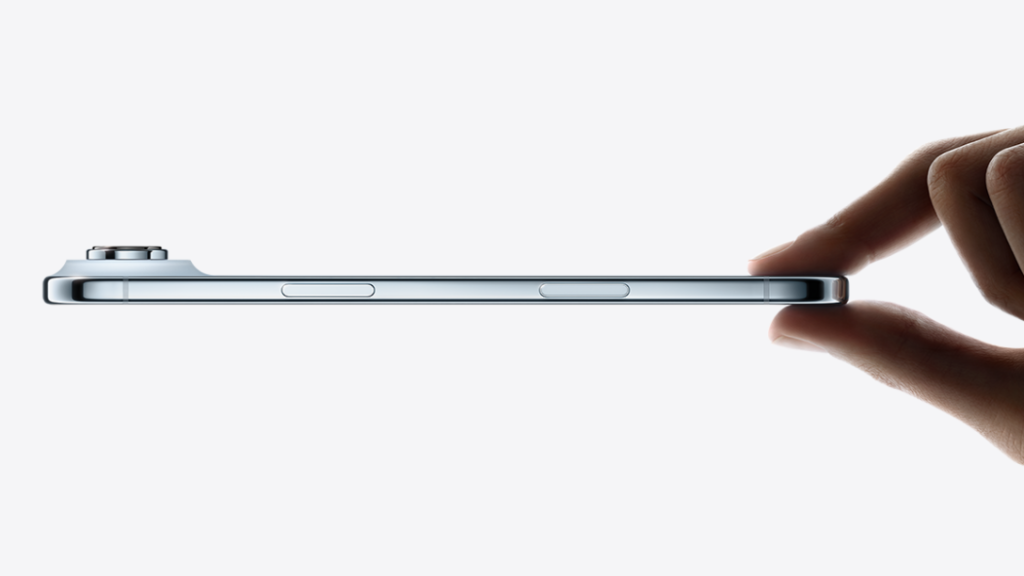
运营商集体上线eSIM,iPhone Air下周上市
Hu Xiu· 2025-10-14 10:46
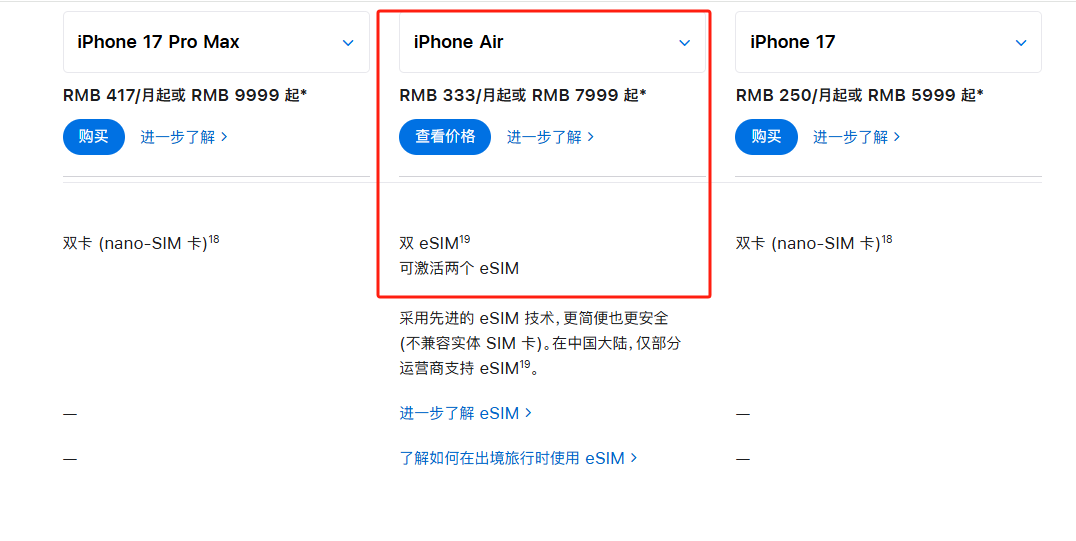
本文来自微信公众号:IT时报 (ID:vittimes),作者:钱立富,编辑:孙妍,原文标题:《运营商集体上线eSIM手机业务,待iPhone Air下周上市,华 为OV跟进》,题图来自:AI生成 eSIM手机业务终于来了! 昨日(10月13日)晚间,三家电信运营商不约而同发布消息称,已获得工信部eSIM手机商用试验批复许可。 同样是在10月13日晚间,苹果方面正式宣布,中国大陆用户可于10月17日早9点起预购iPhone Air,10月22日起正式发售。 10月14日,《IT时报》记者走访了三家电信运营商营业厅。工作人员称,当前可进行预约,等到苹果iPhone Air发售后,用户可携机在营业厅办理eSIM手 机业务。 集体官宣靴子落地 9月10日,苹果在秋季发布会上推出了轻薄手机iPhone Air,在全球范围内统一采用仅支持eSIM的设计,且可激活两个eSIM,没有配备实体卡槽。苹果中 国官网当时称,中国联通是唯一受支持的iPhone eSIM运营商。 一个月后,"靴子"终于落地。 但在9月12日iPhone 17系列预售当天,iPhone Air缺席。同日苹果中国官网更新消息称:"中国移动、中国电信和中 ...

华为、OPPO等国内厂商也将陆续上市eSIM手机
Qi Lu Wan Bao· 2025-10-14 09:23
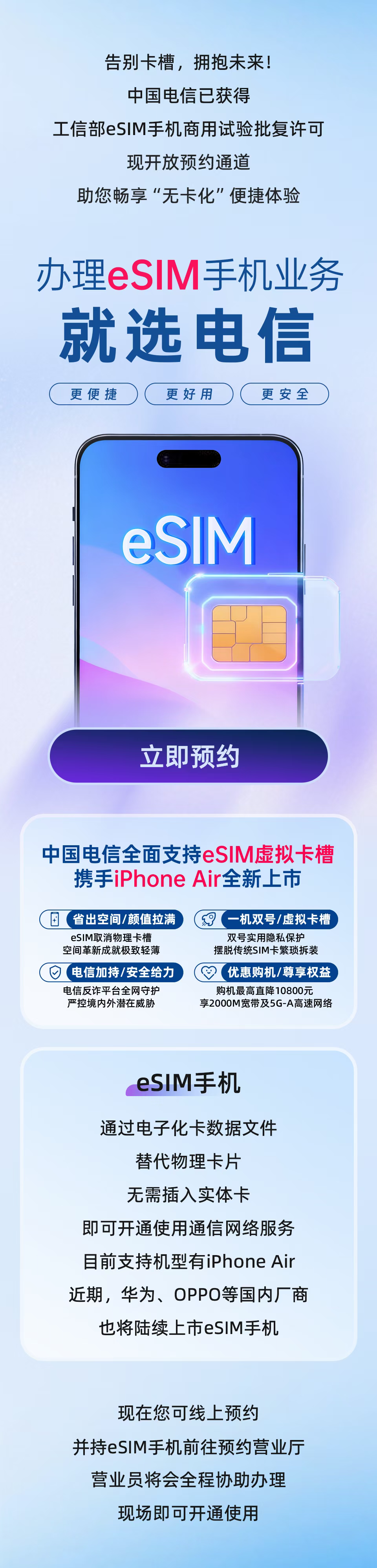
Core Insights - Apple announced that the iPhone Air will be available for pre-order in China starting October 17 at 9 AM, with official sales beginning on October 22 [1] - Major Chinese telecom operators, including China Mobile, China Unicom, and China Telecom, have received approval to launch eSIM services, marking the arrival of a "cardless" era [1] - Domestic manufacturers such as Huawei and OPPO are also expected to release eSIM phones soon [1] Group 1 - eSIM, or Embedded-SIM, is an electronic version of the traditional SIM card, allowing users to activate mobile network services without a physical SIM card [9] - The use of eSIM technology enhances the device's sealing level and improves water and dust resistance, contributing to a thinner design [9] - Under the eSIM system, a single user can manage up to five numbers, including eSIM numbers, with a maximum of two domestic operator numbers supported per eSIM device [9] Group 2 - China Telecom is fully supporting the eSIM virtual card slot alongside the launch of the iPhone Air [5] - The eSIM technology allows for dual-number functionality and enhances privacy protection while eliminating the need for traditional SIM card installation [6] - Promotions include significant discounts on device purchases and additional benefits such as high-speed internet access [6]
“数智内蒙古”:探访北疆高质量发展数字新引擎
Zhong Guo Xin Wen Wang· 2025-10-14 09:01
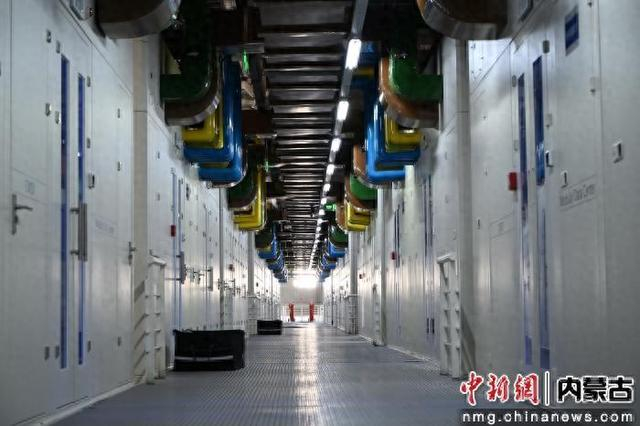
Core Insights - The "Digital Inner Mongolia" initiative is enhancing the region's digital infrastructure through advanced technologies like 5G, AI, and computing power, significantly contributing to industrial upgrades and public service improvements [1][3][5] Group 1: Network Infrastructure Development - The telecommunications sector in Inner Mongolia has seen substantial improvements in network coverage, with a total of 92,600 5G base stations established by August 2025, achieving a coverage rate of 99.5% in administrative villages and 100% in industrial parks [3][4] - The deployment of 5G-A has progressed, with over 3,000 5G-A base stations operational, providing peak user rates of 3 Gbps, which is 3-5 times faster than standard 5G [3][4] Group 2: Computing Power Infrastructure - Inner Mongolia is a key node in the "East Data West Computing" strategy, with accelerated data center construction, including the completion of the Huawei Ascend 910C super node cluster with a computing power of 300 PFlops [6][8] - The region's telecommunications companies are enhancing cross-domain security and connectivity, with Inner Mongolia Telecom launching the first 400G quantum secure OTN computing encryption line in the country [7][8] Group 3: Technological Innovation and Applications - The integration of 5G and AI technologies in various sectors has led to significant efficiency gains, such as a 10% increase in production efficiency in industrial manufacturing and the establishment of the world's first 5G-A smart open-pit mine [9][10] - In the public service sector, new AI-driven products and services are being introduced, such as the "Cloud Smart Phone" and "AI Smart Home" solutions, enhancing user experience and operational efficiency [10][11] Group 4: Policy Guidance and Future Outlook - The Inner Mongolia Communications Administration is actively promoting the "Sail Action" upgrade plan for large-scale 5G applications, aiming to optimize information infrastructure and foster high-quality digital economic development [12]
中国eSIM手机解禁 库克在抖音直播带货iPhone Air
Jing Ji Guan Cha Wang· 2025-10-14 08:36
经济观察报 记者 钱玉娟 10月13日晚,中国联通率先通过官方公众号宣布,于近期正式获得开展eSIM手机运营服务商用试验的批复,这一信息的意义正如其标题所示,"eSIM手机, 来了!" 中国移动紧随其后,在公布eSIM手机业务获批的同时,还附上了业务办理网点的预约页面截图,以供用户参考。 中国电信虽然直到13日深夜才公布消息,但它提到,其eSIM手机业务于当日获批,随即便在国内31个省市正式上市销售。 伴随中国大陆市场的运营商可提供eSIM手机服务,作为苹果迄今为止最轻薄的iPhone新品,仅支持eSIM的iPhone Air迎来了它在中国市场发售的曙光。 10月13日晚,苹果公司CEO库克甚至走进Apple Store旗舰店抖音直播间,面向中国消费者表示,iPhone Air即将于下周在中国正式发售,自10月17日起接受 预购。 今年9月中旬,在iPhone 17全球首发前,苹果公司宣布入驻抖音商城。 Canalys数据显示,2024年,苹果iPhone在中国大陆市场的出货量为4290万台,相比2023年下滑17%,是前五大厂商中跌幅最大的一家。 2025年以来,在天猫、京东、拼多多这些可触达中国消费者的电 ...

以后手机不插卡了?三大运营商宣布!记者体验发现
2 1 Shi Ji Jing Ji Bao Dao· 2025-10-14 08:13
Core Points - The three major telecom operators in China, China Mobile, China Unicom, and China Telecom, have received approval to conduct commercial trials for eSIM mobile services [1][2][15] - eSIM technology allows for embedded SIM cards that do not require physical insertion or replacement, enhancing device design and performance [1][7] - Apple has been a strong proponent of eSIM technology, launching the iPhone Air with eSIM design, which is the thinnest iPhone to date at 5.6 mm [1][5][3] Group 1: eSIM Technology Overview - eSIM is an embedded SIM card that can be configured over-the-air (OTA), improving device waterproofing and design flexibility [1] - The technology is expected to gradually replace physical SIM cards, leading to a "no SIM card" era [7] - Currently, only Apple devices support eSIM, but other brands like Huawei and OPPO are expected to release eSIM-enabled phones soon [6] Group 2: Market Impact and Consumer Adoption - The approval of eSIM services resolves the last hurdle for the iPhone Air's launch in China, allowing pre-orders to start on October 17 and sales on October 22 [3][2] - The adoption of eSIM technology in China may take time as consumer acceptance is still developing [7] - Industry insiders believe that the approval will accelerate system optimization and service preparation, leading to more convenient features like remote activation and seamless switching between devices [15]