
CHINA MOBILE(00941)

Search documents
7天6板,600403,最新人气王!国内首款eSIM手机将发售,多家A股公司已抢先布局
Zheng Quan Shi Bao Wang· 2025-10-20 10:45
Core Insights - eSIM technology is entering a new commercial phase in China, with major telecom operators officially launching eSIM services for mobile phones, marking a significant shift in the industry [2][3] - The adoption of eSIM is expected to expand beyond mobile phones into various sectors, including consumer electronics and the Internet of Things (IoT), driven by technological advancements and policy support [3][4] Industry Developments - Apple has announced the launch of the iPhone Air, the first eSIM-only phone in China, set to be released on October 22 [2] - Domestic brands like OPPO and vivo are quickly following suit, with OPPO already launching an eSIM-compatible model and others expected to release their versions soon [2][3] - eSIM technology is anticipated to enhance device capabilities, such as waterproofing and shock resistance, while also allowing for multiple SIM profiles [3] Market Performance - eSIM concept stocks have shown strong performance, with an average increase of 42.42% year-to-date, significantly outperforming the Shanghai Composite Index [5] - Six stocks in the eSIM sector have seen gains exceeding 50%, including Hengbao Co., Dongxin Peace, and Meige Intelligent [5] - Despite the overall positive trend, some stocks have experienced significant pullbacks, with several dropping over 30% from their year-to-date highs [8] Company Strategies - Several A-share companies are actively investing in eSIM technology, including Unisoc, which has launched multiple eSIM products, and Eastcompeace, which has developed an embedded operating system for eSIM management [4] - Megmeet has established a mature eSIM solution and is producing large volumes of 4G/5G chips, while Chutianlong has received product approval from China Unicom for its eSIM offerings [4] Future Projections - GSMA Intelligence forecasts that by the end of 2025, global eSIM smartphone connections will reach 1 billion, and by 2030, this number is expected to rise to 6.9 billion, representing 76% of total smartphone connections [3]


中国移动:前三季度股东应占利润1154亿元,同比增长4%
Xin Lang Cai Jing· 2025-10-20 10:44
Core Viewpoint - China Mobile reported a slight increase in operational revenue for the first three quarters of 2025, indicating stable growth in a competitive telecommunications market [1] Financial Performance - The group's operational revenue reached RMB 794.7 billion, representing a year-on-year growth of 0.4% [1] - Communication service revenue amounted to RMB 683.1 billion, with a year-on-year increase of 0.8% [1] - EBITDA was recorded at RMB 265.4 billion, showing a year-on-year growth of 0.9% [1] - Shareholder profit attributable to the company was RMB 115.4 billion, reflecting a year-on-year increase of 4.0% [1] Customer Metrics - The total number of mobile customers reached 1.009 billion, with 5G network customers accounting for 622 million [1] - The number of fixed broadband customers stood at 329 million [1]
中国移动:前三个季度净利1154亿元 同比增4%
Ge Long Hui A P P· 2025-10-20 10:44
Core Insights - China Mobile reported a net profit of 115.4 billion RMB for the first three quarters, representing a year-on-year growth of 4% [1] - The company's operating revenue for the same period reached 794.7 billion RMB, showing a slight increase of 0.4% year-on-year [1] - Communication service revenue amounted to 683.1 billion RMB, with a year-on-year growth of 0.8% [1] - Revenue from product sales and other services declined to 111.5 billion RMB, reflecting a year-on-year decrease of 1.7% [1]
中国移动前三个月净利润1,154亿元人民币,同比增长4%
Mei Ri Jing Ji Xin Wen· 2025-10-20 10:41
中国移动前三个月净利润1,154亿元人民币,同比增长4%。 ...
手机eSIM商用启动,推动物联网eSIM加速实施
3 6 Ke· 2025-10-20 10:40
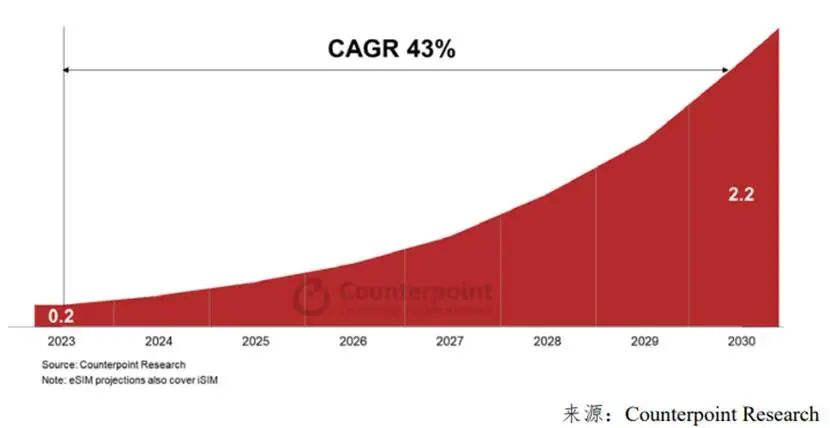
除手机外,蜂窝物联网也是eSIM应用的另一个主战场,而且是发展更为迅速的一个领域。目前,eSIM已广泛应用于 智能穿戴、智能表计、车联网、工业互联网等领域,为物联网各类场景网络接入提供便捷手段。从用户视角看,物联 网eSIM需求更强烈,对场景的支持更加明显。本次在对手机eSIM启动全面商用,支持eSIM整个产业链加速完善,客 观上也推动物联网eSIM进一步发展。 物联网eSIM对用户的价值明显 近期,针对eSIM的宣传较多,对于eSIM基本概念已有大量普及。eSIM作为蜂窝通信设备用户身份识别模块新的形 态,相对于实体Sim卡有多重显著优势,一个看得见的优势是支持取消卡槽,为各类终端节省出一定空间,为设备的 小型化设计、散热等带来实实在在的好处;另外,传统Sim卡依赖金属触点,在频繁震动、高温高湿、盐雾等恶劣场 景下,容易造成Sim卡接触不良或氧化,从而导致通信中断,而eSIM作为嵌入式的模组,在这方面可靠性大大提升。 除了这些显而易见的好处外,eSIM还有诸多隐形优势,节约供应链物流成本较为典型,因为无需实体Sim卡,可以大 大简化卡片的制作、包装、物流、库存等环节,节约相关厂商成本。用户也可以获得"无感" ...


中国移动(00941.HK)首3季股东应占利润1154亿元 同比增长4.0%
Ge Long Hui· 2025-10-20 10:35
Core Insights - China Mobile reported its unaudited performance and operational data for the first three quarters of 2025, showing a revenue of RMB 794.7 billion, a year-on-year increase of 0.4% [1] - The company's communication service revenue reached RMB 683.1 billion, growing by 0.8% year-on-year [1] - Shareholder profit stood at RMB 115.4 billion, reflecting a 4.0% increase compared to the previous year [1] Group Performance - The total number of mobile customers reached 1.009 billion, with 622 million being 5G network customers [1] - The number of fixed broadband customers was 329 million [1] - Mobile internet traffic increased by 8.3% year-on-year, with mobile data usage (DOU) reaching 17.0 GB, up by 8.1% [1] - The mobile ARPU (Average Revenue Per User) was RMB 48.0 [1] Personal Market - The company focused on expanding its segmented market and enhancing value management, implementing growth plans for customer retention and service upgrades [1] - The mobile customer base grew to 1.009 billion, with 5G customers at 622 million [1] Family Market - China Mobile emphasized the "Mobile Love Home" brand, creating a family-centered integrated business model [2] - The total number of fixed broadband customers reached 329 million, with a net increase of 14.2 million in the first three quarters [2] - The family broadband customer count was 288 million, with a net increase of 9.76 million [2] - The comprehensive ARPU for family customers was RMB 44.4 [2] Government and Enterprise Market - The company strengthened its platform-based operational system and refined its customer management for both government and enterprise sectors [2] - The DICT (Data, Information, Communication Technology) business revenue showed good growth, with AI-related income experiencing rapid increases [2] Emerging Markets - China Mobile is actively leveraging high-level opening opportunities to foster international business growth [2] - The company is deepening its "content + technology + integrated innovation" operations, achieving steady growth in key product customer scales [2]
中国移动:第三季度净增客户数399.6万户
Xin Lang Cai Jing· 2025-10-20 10:34
Core Insights - China Mobile announced that by Q3 2025, the total number of customers reached 1.009 billion, with a net increase of 3.996 million customers in the current quarter and a cumulative net increase of 4.559 million customers for the year [1] - The number of 5G network customers stands at 622 million [1] - The total number of fixed broadband customers is 329 million, with a net increase of 5.537 million customers in the current quarter and a cumulative net increase of 14.196 million customers for the year [1] Customer Growth - Total customer base reached 1.009 billion by Q3 2025 [1] - Net increase of 3.996 million customers in the current quarter [1] - Cumulative net increase of 4.559 million customers for the year [1] 5G Network - 5G network customers totaled 622 million [1] Fixed Broadband - Total fixed broadband customers reached 329 million [1] - Net increase of 5.537 million customers in the current quarter [1] - Cumulative net increase of 14.196 million customers for the year [1]
中国移动:2025年首3季度股东应占利润1154亿元,同比增长4.0%
Xin Lang Cai Jing· 2025-10-20 10:34
Core Insights - The core point of the article is that China Mobile reported its operating revenue and net profit for the first three quarters of 2025, showing modest growth in both metrics compared to the previous year [1] Financial Performance - Operating revenue for the first three quarters of 2025 reached RMB 794.7 billion, reflecting a year-on-year increase of 0.4% [1] - The profit attributable to shareholders was RMB 115.4 billion, which represents a year-on-year growth of 4.0% [1]
中国移动(00941):三季度移动业务净增客户数399.6万户
智通财经网· 2025-10-20 10:31
Core Insights - China Mobile reported a total of approximately 1.009 billion mobile business customers as of Q3 2025, with a net increase of 3.996 million customers in the quarter [1] - The number of 5G network customers reached approximately 622 million [1] - The total number of fixed broadband customers was about 329 million, with a net increase of 5.537 million customers in the quarter [1] Customer Growth - Mobile business customer base increased by 3.996 million in Q3 2025 [1] - Fixed broadband customer base saw a net addition of 5.537 million in the same quarter [1] 5G Network Expansion - 5G network customer count stands at approximately 622 million, indicating significant adoption [1]
中国移动(00941) - 2025年三季度客户数据
2025-10-20 10:25
香港交易及結算所有限公司及香港聯合交易所有限公司對本公告之內容概不 負 責,對 其 準 確 性 或 完 整 性 亦 不 發 表 任 何 聲 明,並 明 確 表 示 概 不 就 因 本 公 告 全 部或任何部分內容而產生或因倚賴該等內容而引致之任何損失承擔任何責任。 CHINA MOBILE LIMITED 中國移動有限公司 (根據公司條例在香港註冊成立之有限公司) 股份代號:941(港幣櫃台)及 80941(人民幣櫃台) 2025年三季度客戶數據 中國移動有限公司 楊 杰 董事長 香 港,2025年10月20日 – 1 – 前瞻性陳述 中國移動有限公司(「本公司」)董事會(「董事會」)宣 佈2025年三季度本公司及其 各附屬公司(「本集團」)的 客 戶 數 據,詳 情 如 下: 本 公 告 中 所 包 含 的 前 瞻 性 陳 述 不 構 成 亦 不 應 視 為 本 公 司 作 出 的 承 諾。這 些 前 瞻 性 陳 述 涉 及 已 知 和 未 知 的 風 險、不 確 定 性 以 及 其 他 因 素,而 這 些 因 素 可 能 導 致 本 公 司 的 實 際 表 現、財 務 狀 況 或 經 營 業 績 與 這 ...