
CHINA MOBILE(00941)

Search documents
中国移动(00941) - 2025 Q3 - 季度业绩
2025-10-20 10:24
Financial Performance - Operating revenue for the first three quarters of 2025 reached RMB 794.7 billion, a year-on-year increase of 0.4%[3] - Communication service revenue amounted to RMB 683.1 billion, reflecting a year-on-year growth of 0.8%[3] - EBITDA for the period was RMB 265.4 billion, with a year-on-year increase of 0.9%[3] - The company reported a net profit attributable to shareholders of RMB 115.4 billion, representing a year-on-year growth of 4.0%[4] - The EBITDA margin improved to 33.4%, compared to 33.2% in the previous year[4] - Communication service revenue reached RMB 683.1 billion, growing by 0.8% year-on-year, while sales of products and other revenues decreased by 1.7% to RMB 111.5 billion[14] - The group's net profit attributable to shareholders was RMB 115.4 billion, reflecting a year-on-year growth of 4.0%, with a profit margin of 14.5%[11] - EBITDA for the same period was RMB 265.4 billion, an increase of 0.9%, representing 38.8% of communication service revenue[11] Customer Metrics - The number of mobile customers reached 1.009 billion, with 5G network customers totaling 622 million[3] - The total number of fixed broadband customers reached 329 million, with a net increase of 14.2 million in the first three quarters[8] - The household broadband customer base reached 288 million, with a net increase of 9.76 million during the same period[8] - The average revenue per user (ARPU) for mobile services was RMB 48.0, down from RMB 49.5[5] Operational Efficiency - The group aims to position itself as a "world-class information service technology innovation company," focusing on deepening reforms and enhancing operational efficiency[11] - Network operation and support costs were RMB 205.1 billion, slightly down from RMB 206.3 billion in the previous year[14] - Employee compensation and related costs increased to RMB 117.2 billion from RMB 114.0 billion year-on-year[14] Assets and Liabilities - Total assets as of September 30, 2025, increased to RMB 2,109,124 million, compared to RMB 2,108,127 million as of December 31, 2024, reflecting a slight growth of 0.05%[18] - Non-current assets decreased from RMB 1,539,568 million in 2024 to RMB 1,601,345 million in 2025, with fixed assets specifically declining from RMB 714,494 million to RMB 672,651 million, a decrease of approximately 5.85%[18] - Current assets totaled RMB 507,779 million, down from RMB 568,559 million in the previous year, indicating a decrease of about 10.68%[18] - The company's total liabilities decreased from RMB 711,588 million in 2024 to RMB 704,171 million in 2025, a reduction of approximately 1.8%[21] - The equity attributable to shareholders increased to RMB 1,401,788 million, up from RMB 1,392,032 million, representing a growth of about 0.11%[21] Cash Flow and Investments - Operating cash flow for the nine months ended September 30, 2025, was RMB 161,047 million, compared to RMB 224,075 million for the same period in 2024, a decline of approximately 28.14%[23] - The company reported a net cash inflow from operating activities of RMB 197,727 million for the nine months ended September 30, 2025, down from RMB 258,591 million in the previous year, a decrease of approximately 23.50%[23] - Net cash outflow from investment activities was RMB 141,841 million for the nine months ended September 30, 2025, compared to RMB 127,014 million in the same period of 2024, representing an increase of 11.4%[26] - The company reported a decrease in cash and cash equivalents at the end of the period to RMB 97,619 million as of September 30, 2025, down from RMB 121,279 million at the end of September 30, 2024[28] Dividends and Financing - The company paid dividends to shareholders amounting to RMB 103,410 million for the nine months ended September 30, 2025, compared to RMB 97,458 million in the same period of 2024, reflecting a year-over-year increase of 6.5%[28] - The company reported a net cash outflow from financing activities of RMB 88,661 million for the nine months ended September 30, 2025, compared to RMB 117,323 million in the same period of 2024, indicating a decrease of 24.5%[28] Other Financial Metrics - Basic earnings per share rose to RMB 5.34 from RMB 5.18 year-on-year[16] - The total comprehensive income for the period was RMB 114.6 billion, compared to RMB 111.9 billion in the previous year[16] - Interest income from financial investments was RMB 7,851 million for the nine months ended September 30, 2025, compared to RMB 5,700 million in the same period of 2024, marking an increase of 37.7%[26] - The company disposed of financial assets measured at fair value, resulting in a gain of RMB 32,838 million for the nine months ended September 30, 2025, compared to RMB 41,597 million in the same period of 2024[26] - The cash received from the exercise of stock options was RMB 5,304 million for the nine months ended September 30, 2025, compared to RMB 4,051 million in the same period of 2024, showing an increase of 30.8%[28] - The company recorded a decrease in the statutory deposit reserve of RMB 1,034 million for the nine months ended September 30, 2025, compared to RMB 49 million in the same period of 2024[26]
特锐德:已与国内众多头部数据中心建立了良好的合作关系,包括中国移动、中国电信、阿里巴巴等知名企业
Mei Ri Jing Ji Xin Wen· 2025-10-20 09:54
Core Viewpoint - The company, Teruid (300001.SZ), is actively providing diversified power equipment solutions tailored for the data center industry, emphasizing its innovative approaches and established partnerships with major clients [2]. Group 1: Company Offerings - Teruid offers a variety of power equipment solutions for data centers, including core switchgear products and box transformer products [2]. - The company has developed a 110kV prefabricated modular substation to quickly address the power supply and transformation needs of data centers [2]. - Teruid has innovatively designed power modules for data centers, utilizing prefabricated solutions to standardize deployment, which integrates transformers, UPS, and distribution cabinets [2]. Group 2: Efficiency and Cost-Effectiveness - The prefabricated solutions significantly shorten construction periods, reduce costs, and enhance delivery efficiency for data center projects [2]. - The company leverages its technical strength and high-quality product services to establish strong partnerships with leading data center operators [2]. Group 3: Client Relationships - Teruid has formed successful collaborations with prominent companies in the industry, including China Mobile, China Telecom, Alibaba, ProLogis, and ByteDance [2].


港股、海外周观察:多事之秋,反弹不畅
Soochow Securities· 2025-10-20 09:23
Group 1 - The report indicates that recent events suggest short-term volatility in the Hong Kong stock market may not have ended, but the long-term upward trend remains unchanged [1] - Economic data, US-China tariff news, US tech earnings, and the Fourth Plenary Session are expected to influence trading patterns and styles in the Hong Kong market [1][2] - The technology sector is facing increased volatility risks, with US tech earnings impacting the trading rhythm of Chinese tech stocks [1][2] Group 2 - The report highlights that the US stock market showed resilience despite concerns over US-China tensions and credit worries, with the Nasdaq leading gains at 2.1% [1][4] - Federal Reserve Chairman Powell's dovish stance suggests a likelihood of maintaining the current policy path, with a potential rate cut in October being the optimal solution [1][5] - The report notes that the average win rate for October over the past decade is low, while the advantages of November and December are relatively prominent [1][23] Group 3 - The report discusses the ongoing US government shutdown, which has entered its third week, potentially exacerbating negative impacts on the economy [3] - Concerns over credit quality in regional banks have emerged, but these are viewed as isolated incidents rather than indicative of a broader liquidity crisis [2][3] - The report emphasizes the importance of monitoring US-China trade relations, as further escalation could negatively impact the US economy and inflation risks [3][4] Group 4 - The report notes that developed markets saw an increase of 1.4% while emerging markets declined by 0.3% during the week [4][12] - The Hang Seng Tech Index fell by 8.0%, and the Hang Seng Index dropped by 4.0%, with public utilities leading sector gains [4][12] - The report highlights significant inflows into financials and non-essential consumer sectors, while the information technology sector experienced outflows [4][12] Group 5 - The report indicates that global stock ETFs saw a net inflow of $446.43 billion, with the US stock ETFs leading at $231.7 billion [7][49] - The technology sector was the top recipient of inflows among global stock ETFs, while the communication sector experienced the most significant outflows [7][51] - The report also notes that institutional investors marginally increased their holdings in gold, with significant inflows into major gold ETFs [6][54]



山东移动“海陆空”一体化擘画智慧油田新蓝图
Qi Lu Wan Bao· 2025-10-20 08:35
Core Viewpoint - The digital transformation of China's energy industry is accelerating, with Shandong Mobile leading the development of smart oil fields through innovative 5G technology and integrated solutions, setting a benchmark for the industry [1][11]. Group 1: Offshore Smart Oil Fields - Shandong Mobile has developed a 5G private network to enhance communication for offshore oil platforms, addressing the challenges of data transmission and remote control in complex marine environments [2][4]. - The innovative "5G 2.6GHz + 700MHz dual-frequency layered, land-sea collaboration" network design allows for extensive coverage and stable communication between platforms and land [3]. - Real-time data transmission and remote monitoring capabilities have significantly improved operational transparency and safety, enabling efficient emergency response and decision-making [4][11]. Group 2: Onshore Safety Management - A "5G + Smart Oil Field Integrated Safety Protection System" has been established to enhance safety management in onshore oil fields, addressing issues of information silos and inadequate warning systems [5][8]. - The system integrates thousands of sensors and monitoring devices, creating a "digital twin" of the oil field for comprehensive situational awareness and proactive risk management [6][8]. - The implementation of this system has doubled the efficiency of safety incident response and management, marking a significant transformation in oil field operations [8][11]. Group 3: Low-altitude Inspection Innovations - The introduction of 5G-A integrated sensing technology has revolutionized pipeline inspection, allowing for high-precision monitoring and data collection through drones [10]. - This new inspection model enhances operational efficiency and reduces costs and risks associated with traditional manual inspections [10]. - The real-time data analysis capabilities of the system provide detailed reports on potential hazards, ensuring comprehensive safety management for long-distance pipelines [10][11]. Group 4: Future Outlook - Shandong Mobile aims to continue integrating advanced technologies such as 5G, computing networks, and artificial intelligence to further enhance the digital transformation of the energy sector [11]. - The company's efforts represent a significant step towards ensuring national energy security and promoting high-quality industrial development [11].
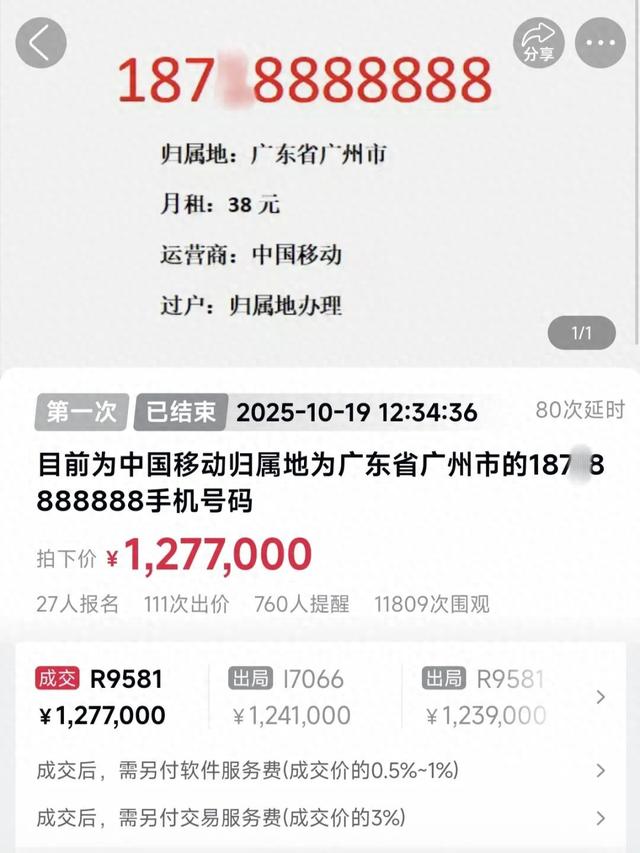
同一天拍出两个“尾号8888888”手机号,成交价分别为127.7万元和95.3万元
Huan Qiu Wang· 2025-10-20 05:35
Core Points - Two mobile phone numbers with the ending "8888888" were successfully auctioned on October 19, with one from China Mobile in Guangzhou sold for 1.277 million yuan and the other from China Telecom in Lijiang sold for 953,000 yuan [1][7] - The auction attracted significant interest, with 27 bidders for the China Mobile number and 33 bidders for the China Telecom number, resulting in a competitive bidding process [6][7] Auction Details - The starting bid for both numbers was set at 1,000 yuan, leading to substantial price increases during the auction [6] - The monthly rental for the China Mobile number is 38 yuan, while the China Telecom number has a monthly rental of 58 yuan, both with no minimum consumption period after transfer [3][4] Additional Costs - Buyers are required to pay additional fees, including a software service fee (0.5%-1% of the transaction price) and a transaction service fee (3% of the transaction price) [7]

视源股份亮相2025中国移动全球合作伙伴大会,携手共绘AI+新图景
Jin Tou Wang· 2025-10-20 03:42
Group 1: Event Overview - The 2025 China Mobile Global Partner Conference was held in Guangzhou, focusing on "Carbon-Silicon Symbiosis and Co-creation in the AI Era" [1] - Key products showcased included AI smart teaching solutions, AI learning cloud computers, and industrial-grade quadruped robots [1] Group 2: Xiwo's Product Highlights - Xiwo, an education technology brand under Vision Source, presented new products such as the Xiwo Parent-Child Screen and AI Learning Machine, attracting significant attention from parents [2] - The AI Learning Cloud Computer, a combination of a learning machine, computer, and tablet, features extensive learning resources and AI homework assistance [2] - Xiwo received multiple awards at the conference, including the "Best Product Cooperation Partner Award" and "Top Ten Excellent Partners in Smart Home" [2] Group 3: MAXHUB's Innovations - MAXHUB created an immersive exhibition area showcasing AI technology in smart office scenarios, including the MAXHUB X7 industrial-grade quadruped robot [3] - The cloud video conferencing solutions developed in collaboration with China Mobile were highlighted, integrating core functions like writing, displaying, remote communication, and AI meeting minutes [3] Group 4: Future Collaborations - Vision Source and China Mobile launched the "Smart Engine, Enjoy Action" initiative for AI-customized mobile phones and AI terminal ecosystem cooperation [4] - The company aims to integrate advanced AI education technology with robust cloud network capabilities to support the vision of "Carbon-Silicon Symbiosis" [4]
贸易摩擦降温,港股持续走高,恒生中国企业ETF(159960)涨超2%
Sou Hu Cai Jing· 2025-10-20 03:02
Core Viewpoint - The Hong Kong stock market is experiencing an upward trend, driven by a softening of trade tensions and positive expectations for the fourth quarter [1] Group 1: Market Performance - The Hang Seng China Enterprises ETF (159960) rose by 2.07%, with notable increases in stocks such as NetEase-S (09999) up by 5.36%, SMIC (00981) up by 5.14%, and ZTO Express-W (02057) up by 4.70% [1] - The top ten weighted stocks in the Hang Seng China Enterprises Index (HSCE) account for 55.33% of the index, including Alibaba-W (09988) and Tencent Holdings (00700) [2] Group 2: Economic Indicators - Trade tensions have eased, with Trump indicating that "such high tariffs are unsustainable" [1] - Short-term market fluctuations are expected due to a lack of incremental positive news, but there are anticipated marginal positive factors that could drive the market up [1] Group 3: Future Outlook - The fourth quarter is expected to see a "first suppress then rise" trend for the Hong Kong stock market, with potential drivers including continuous innovation in China's tech sector and a low probability of high tariffs being implemented [1] - The upcoming Fourth Plenary Session of the Communist Party discussing the "14th Five-Year Plan" is expected to boost risk appetite [1] - The expectation of continued interest rate cuts by the Federal Reserve is likely to lead to sustained capital inflows, improving fundamentals and profit expectations, which could drive a slow bull market trend [1]




恒指收跌641点,全周累跌1043点
Guodu Securities Hongkong· 2025-10-20 02:47
Group 1: Market Overview - The Hang Seng Index closed down 641 points, a decline of 2.48%, and accumulated a weekly drop of 1,043 points or 3.97% [2] - The Hang Seng Tech Index fell by 243 points or 4.05%, with a weekly loss of 499 points or 7.98% [2] - The trading volume for the day was 314.62 billion, with a net inflow of 6.30 billion from northbound trading [2] Group 2: Company Performance - HSBC Holdings (00005) closed down 1.9% at 100.9 HKD, while AIA Group (01299) fell 2.2% to 69.05 HKD [3] - Semiconductor companies like SMIC (00981) and Hua Hong Semiconductor (01347) saw declines of 6.5% and 6.9%, respectively [3] - BYD Electronics (00285) was the worst-performing blue chip, dropping 8.1% to 37.74 HKD [3] Group 3: Economic and Regulatory Developments - The Financial Secretary of Hong Kong, Paul Chan, emphasized the importance of attracting U.S. businesses and talent to invest in Hong Kong, highlighting the city's favorable business environment [6] - The Insurance Authority has classified AIA and Prudential as Domestic Systemically Important Insurers (D-SII), which will subject them to enhanced regulatory requirements [8] - The People's Bank of China Governor, Pan Gongsheng, discussed the need for multilateral cooperation in light of increasing global economic challenges [9] Group 4: Retail Sector Insights - Chow Tai Fook (01929) reported a 4.1% year-on-year increase in retail value for the second fiscal quarter, with same-store sales in Hong Kong and Macau rising by 6.2% [11] - Xtep International (01368) experienced low single-digit growth in retail sales in mainland China for the third quarter, with inventory turnover of approximately 4 to 4.5 months [14] Group 5: Financing Activities - Zhengli New Energy (03677) announced a placement of 45.92 million new H shares at a discount of 7.89% to raise approximately 504 million HKD for various projects [12] - Aneng Logistics (09956) received a conditional proposal for potential privatization from a consortium led by Dazhong Capital and Temasek [13]



智通港股通持股解析|10月20日
智通财经网· 2025-10-20 00:32
Core Insights - The top three companies by Hong Kong Stock Connect holding ratios are China Telecom (70.56%), COSCO Shipping Energy (69.91%), and GCL-Poly Energy (69.65%) [1][2] - Xiaomi Group-W, Meituan-W, and Pop Mart have seen the largest increases in holding amounts over the last five trading days, with increases of +1.967 billion, +1.692 billion, and +1.514 billion respectively [1][2] - The companies with the largest decreases in holding amounts over the same period include Innovent Biologics (-2.053 billion), SMIC (-1.978 billion), and Alibaba-W (-1.651 billion) [1][2] Hong Kong Stock Connect Latest Holding Ratios - China Telecom (00728): 9.793 billion shares, 70.56% holding ratio [1] - COSCO Shipping Energy (01138): 906 million shares, 69.91% holding ratio [1] - GCL-Poly Energy (01330): 282 million shares, 69.65% holding ratio [1] - China Shenhua (01088): 2.284 billion shares, 67.62% holding ratio [1] - Kaisa Group (01108): 168 million shares, 67.37% holding ratio [1] Recent Increases in Holdings (Last 5 Trading Days) - Xiaomi Group-W (01810): +1.967 billion, +42.788 million shares [1] - Meituan-W (03690): +1.692 billion, +17.904 million shares [1] - Pop Mart (09992): +1.514 billion, +5.498 million shares [1] - China Mobile (00941): +1.438 billion, +16.863 million shares [1] - Huahong Semiconductor (01347): +1.434 billion, +18.918 million shares [1] Recent Decreases in Holdings (Last 5 Trading Days) - Innovent Biologics (01801): -2.053 billion, -23.641 million shares [2] - SMIC (00981): -1.978 billion, -28.625 million shares [2] - Alibaba-W (09988): -1.651 billion, -10.691 million shares [2] - Tencent Holdings (00700): -1.475 billion, -2.426 million shares [2] - Yingfu Fund (02800): -1.259 billion, -48.701 million shares [2]



股市必读:中国移动(600941)10月17日主力资金净流入6531.77万元,占总成交额4.93%
Sou Hu Cai Jing· 2025-10-19 17:07
Summary of Key Points Core Viewpoint - On October 17, 2025, China Mobile (600941) reported a closing price of 107.93 yuan, reflecting a slight increase of 0.11% with a trading volume of 12.27 million hands and a total transaction amount of 1.326 billion yuan [1]. Trading Information - On October 17, the net inflow of main funds was 65.32 million yuan, accounting for 4.93% of the total transaction amount - Retail investors experienced a net outflow of 14.60 million yuan, representing 1.1% of the total transaction amount [1][3]. Company Announcement - China Mobile's board announced that on October 17, 2025, Guangdong Mobile exercised its conversion rights, converting a total of 1.874 billion yuan (approximately 2.054 billion HKD) of Shanghai Pudong Development Bank's A-share convertible bonds into approximately 149.81 million A-shares at a conversion price of 12.51 yuan per share (approximately 13.71 HKD) - Following this conversion, the group's holdings in Shanghai Pudong Development Bank's A-shares increased to approximately 5.935 billion shares, representing about 18.15% of the expanded share capital - The newly issued shares are subject to a five-year transfer restriction, and the conversion is deemed fair and reasonable, aligning with the overall interests of the company and its shareholders [1][3].
