通信服务

Search documents
中国移动:公司经营业绩稳中有进,派息率再创新高(简体版)-20260401
First Shanghai Securities· 2026-04-01 05:40
Investment Rating - The report assigns a "Buy" rating to China Mobile with a target price of HKD 108, representing a potential upside of 35% from the current stock price of HKD 79 [4][6]. Core Insights - China Mobile's operational performance shows steady progress, with a record high dividend payout ratio of 75% for 2025, despite a slight decline in net profit [6]. - The company reported total operating revenue of CNY 1,050.2 billion for 2025, reflecting a year-on-year increase of 0.9%, while net profit was CNY 137.1 billion, a nominal decrease of 0.9% [6]. - The report highlights the ongoing optimization of the company's three main business segments, with communication services accounting for 79.8% of total revenue [6]. Financial Performance Summary - **Revenue and Profitability**: - Operating revenue for 2025 is projected at CNY 1,050.2 billion, with a slight increase of 0.9% year-on-year. The main business revenue is expected to be CNY 895.5 billion, up 0.7% [5][6]. - Net profit is forecasted at CNY 137.1 billion, with an EPS of HKD 7.20, reflecting a decrease of 1.7% [5][6]. - EBITDA is expected to reach CNY 338.9 billion, with an EBITDA margin of 32.3%, an increase of 0.2 percentage points year-on-year [6]. - **Capital Expenditure**: - The company plans to spend CNY 150.9 billion on capital expenditures in 2025, a decrease of 8% from the previous year [6]. - For 2026, capital expenditure is projected to be approximately CNY 136.6 billion [6]. - **Dividend Policy**: - The dividend per share for 2025 is set at HKD 5.27, a year-on-year increase of 3.5%, with a payout ratio of 75% [6][16]. Business Segment Performance - **Communication Services**: - Revenue from communication services is expected to be CNY 714.9 billion, down 1% year-on-year, accounting for 79.8% of total revenue [6]. - The mobile customer base reached 1.005 billion, with 642 million 5G customers, reflecting a penetration rate of 63.9% [6]. - **Computing and Intelligent Services**: - Revenue from computing services is projected at CNY 89.8 billion, with a growth rate of 11.1%, while intelligent services revenue is expected to be CNY 90.8 billion, growing by 5.3% [6]. - The report notes significant growth in AI-driven services, with a 279% increase in intelligent computing services [6]. - **International Business Expansion**: - International revenue is expected to grow by 28.5% year-on-year, driven by the expansion of global data centers and partnerships [6].

中国移动(600941):2025年报点评:派息率稳中有升,持续加强Token经营
Changjiang Securities· 2026-04-01 04:44
Investment Rating - The investment rating for the company is "Buy" and is maintained [7]. Core Insights - In 2025, the company achieved operating revenue of 1,050.2 billion yuan, a year-on-year increase of 0.9%, while the net profit attributable to shareholders was 137.1 billion yuan, a decline of 0.9% primarily due to a one-time tax impact from the separation of package revenue [4][10]. - The company has adjusted its business scope to focus on three main areas: communication services, computing power services, and intelligent services, with rapid development in AI-related businesses and a continuous strengthening of token operations [10]. - Capital expenditures have continued to decline, with a structural shift towards computing power networks; cash flow has been affected by accelerated outflows, but the dividend payout has already met the three-year guidance ahead of schedule [10][4]. - For 2026, despite the impact of VAT adjustments, the company aims for steady revenue growth and profit growth on a comparable basis, with guidance indicating rapid growth in free cash flow and a stable increase in the dividend payout ratio [10][4]. Summary by Relevant Sections Financial Performance - In 2025, the company reported total operating revenue of 1,050.2 billion yuan, with a 0.9% year-on-year growth, and a net profit of 137.1 billion yuan, reflecting a 0.9% decline. Excluding the one-time tax impact, the comparable net profit growth was 2.0% [4][10]. - The fourth quarter of 2025 saw operating revenue of 255.5 billion yuan, a 2.5% increase, while the net profit for the quarter was 21.7 billion yuan, down 20.9% [10]. Business Strategy - The company has redefined its business focus into three main areas: communication services, computing power services, and intelligent services. The revenue from communication services was 714.9 billion yuan, down 1.0%, while computing power services grew by 11.1% to 89.8 billion yuan [10][4]. - The company aims to become a world-class technology service enterprise by 2030, with specific targets for revenue growth in communication and computing power services during the 14th Five-Year Plan period [10]. Capital Expenditure and Cash Flow - Capital expenditures for 2025 were 150.9 billion yuan, an 8.0% decrease, with a forecast of 136.6 billion yuan for 2026, a 9.5% decline [10][4]. - Operating cash flow for 2025 was 232.9 billion yuan, down 26%, while free cash flow decreased by 46% to 82.0 billion yuan. The company expects free cash flow to grow rapidly in 2026 [10][4].
KDDI (OTCPK:KDDI.Y) Earnings Call Presentation
2026-03-31 07:00
Findings of Investigation by the Special Investigation Committee March 31, 2026 Toshiya Natori, Attorney-at-law, SHIN MARUNOUCHI LAW FIRM Tomohiro Hen, Attorney-at-law, Nagashima Ohno & Tsunematsu Yasunori Sato, Certified Public Accountant, Deloitte Tohmatsu LLC Outline of Investigation (1) The Special Investigation Committee (the "Committee") was retained by KDDI on January 14, 2026 to investigate the circular transactions lacking substance at BIGLOBE and G-PLAN (the "Fictitious Circular Transactions"). ◼ ...
中国移动(600941):通信+算力+智能三大赛道稳步前行
HTSC· 2026-03-27 03:32
Investment Rating - The report maintains a "Buy" rating for the company [6][10]. Core Views - The company reported a slight increase in revenue of 0.9% year-on-year to RMB 1,050.2 billion for 2025, while net profit attributable to shareholders decreased by 0.9% to RMB 137.1 billion, which was below previous forecasts [1][5]. - The company is expected to benefit from opportunities in the "AI+" sector, with a focus on digital transformation and enhanced competitiveness as a leading global telecom operator [1][4]. - The company plans to increase its dividend payout ratio to 75% for 2025, with expectations for further increases in 2026 [1][5]. Revenue and Profitability - Traditional communication service revenue declined by 1% to RMB 7,148.6 billion, with mobile ARPU slightly decreasing to RMB 46.8 [2][3]. - The company achieved a growth of 11% in computing service revenue to RMB 898 billion, and intelligent service revenue increased by 5.3% to RMB 908 billion [3][4]. - The company anticipates a reduction in capital expenditures by 9.5% to RMB 136.6 billion in 2026, which will help alleviate depreciation pressures [4][10]. Financial Projections - The forecast for net profit attributable to shareholders for 2026-2028 is RMB 130.2 billion, RMB 134.2 billion, and RMB 138.4 billion, respectively, reflecting a downward adjustment of 15% and 16% from previous estimates [5][10]. - The estimated book value per share (BPS) for 2026-2028 is projected to be RMB 67.23, RMB 68.85, and RMB 70.54 [5][10]. - The target price for A shares is set at RMB 114.30, while the target price for H shares is set at HKD 94.40 [5][10].
中国移动(00941) - 海外监管公告 自2025年1月1日至2025年12月31日止期间财务报表
2026-03-26 13:26
香港交易及結算所有限公司及香港聯合交易所有限公司對本公告之內容概不 負 責,對 其 準 確 性 或 完 整 性 亦 不 發 表 任 何 聲 明,並 明 確 表 示 概 不 就 因 本 公 告 全 部或任何部分內容而產生或因倚賴該等內容而引致之任何損失承擔任何責任。 CHINA MOBILE LIMITED 中國移動有限公司 (根據公司條例在香港註冊成立之有限公司) 股份代號:941(港幣櫃台)及 80941(人民幣櫃台) 海外監管公告 自2025年1月1日 至2025年12月31日止期間財務報表 本公告乃中國移動有限公司(「本公司」)根 據《香 港 聯 合 交 易 所 有 限 公 司 證 券 上 市 規 則》第13.10B條 而 作 出。 茲提述本公司在上海證券交易所網站刊登的《中 國 移 動 有 限 公 司 自2025年1月1 日 至2025年12月31日 止 期 間 財 務 報 表》,僅 供 參 考。 承董事會命 中國移動有限公司 陳忠岳 董事長 香 港,2026 年3月26日 本 公 告 中 所 包 含 的 前 瞻 性 陳 述 不 構 成 亦 不 應 視 為 本 公 司 作 出 的 承 諾。這 些 前 ...
满格信号连接万家灯火-菏泽联通以担当守护团圆时刻
Qi Lu Wan Bao· 2026-02-24 14:03
Group 1 - The company ensured communication stability during the Spring Festival by implementing a comprehensive plan based on big data analysis of historical communication patterns, focusing on high-traffic areas such as train stations and rural regions [1] - The company optimized key base stations through network expansion, parameter adjustments, and interference clearing to maintain a stable information flow during the holiday [1] - A 24-hour duty system was established with emergency teams ready to respond within a "10-minute level" standard, ensuring quick resolution of network issues [1] Group 2 - The company provided continuous customer service with 24/7 hotline support and special services for elderly customers and returning travelers, addressing urgent needs effectively [3] - Company leadership visited frontline staff to offer support and New Year wishes, emphasizing the importance of safety and well-being during the holiday [3] - The commitment of the company's employees to maintain smooth communication and provide quality service reflects their dedication to the mission of connecting families and serving the community [3]



【环球财经】日本核心CPI连续53个月同比上涨
Xin Hua Cai Jing· 2026-02-20 02:51
Group 1 - The core consumer price index (CPI) in Japan, excluding fresh food, rose by 2.0% year-on-year to 112.0 in January, marking the 53rd consecutive month of increase [1] - The main driver of the CPI increase is the rising food prices, with food prices excluding fresh items increasing by 6.2% year-on-year [1] - Specific food items saw significant price increases, including coffee beans up by 51.0%, regular japonica rice up by 27.9%, and chocolate up by 25.8% [1] Group 2 - Prices for housing repairs, communication fees, and hotel accommodations also experienced year-on-year increases [2] - Prime Minister Sanna Marin announced plans to convene a bipartisan "National Conference" to discuss social security and tax system reforms, in response to the two-year commitment to eliminate the food consumption tax [2] - The International Monetary Fund (IMF) expressed skepticism regarding the tax reduction measures, advising Japan to avoid cutting consumption taxes due to potential fiscal risks [2]
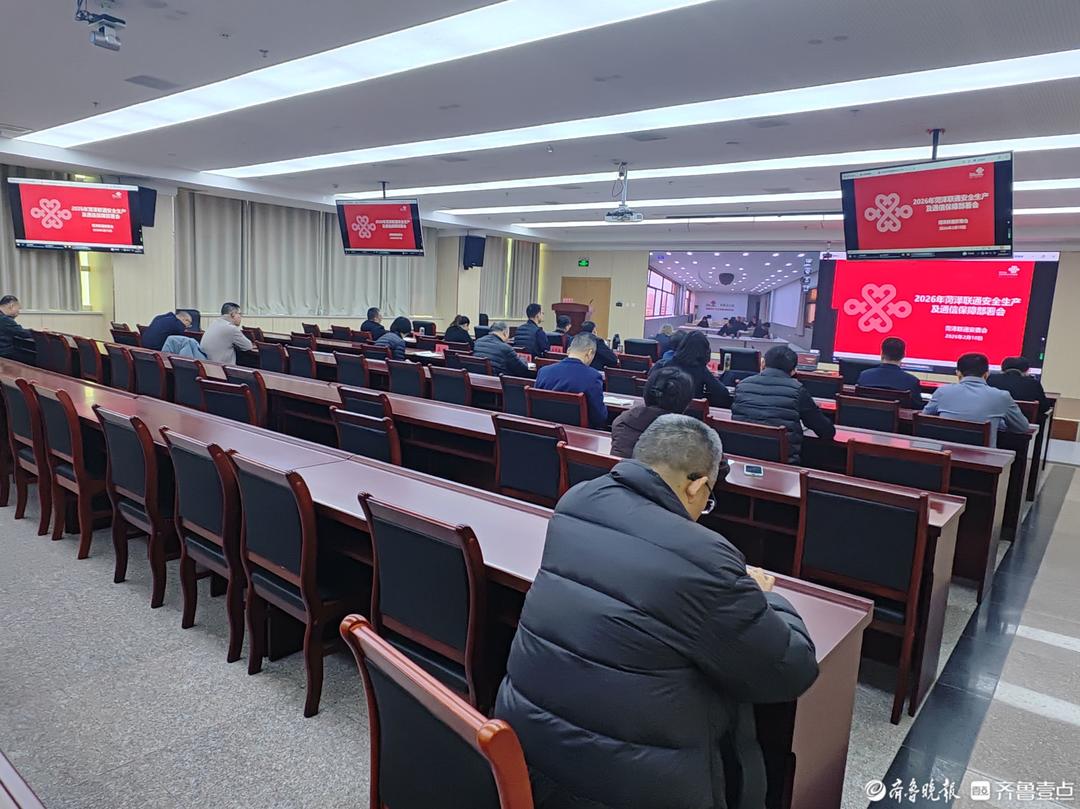
菏泽联通部署春节前安全生产工作 筑牢通信防线
Qi Lu Wan Bao· 2026-02-15 04:35
Core Viewpoint - The company emphasizes the importance of safety production and communication assurance during the upcoming Spring Festival, highlighting the need to prevent various safety risks and ensure stable network operations for users [1][3]. Group 1: Safety Production Measures - The meeting outlines comprehensive safety production deployment, focusing on key elements such as personnel, machinery, materials, environment, and management [3]. - A thorough inspection and rectification process will be implemented, with a focus on critical areas like core machine rooms, base stations, and transmission lines [3]. - Strict 24/7 duty management will be enforced to ensure operational safety [3]. Group 2: Communication Assurance Strategies - Communication assurance is identified as a core task during the Spring Festival, with a commitment to network connectivity and quality service [3]. - The company plans to anticipate network load and optimize network capacity in key areas such as transportation hubs, rural towns, and commercial districts [3]. - An emergency response system will be established, ensuring sufficient repair materials and equipment are available, along with the formation of emergency teams to enhance fault handling efficiency [3]. Group 3: Employee Engagement and Commitment - All participants of the meeting expressed their commitment to implementing the meeting's directives with a focus on meticulous and efficient work practices [3]. - The company aims to solidify its foundation for high-quality development by ensuring a smooth communication experience for the public during the festive season [3].
通胀“温和”放缓!美国1月CPI同比2.4%低于预期,核心CPI降至四年来最低水平,服务通胀坚挺
Sou Hu Cai Jing· 2026-02-13 14:10
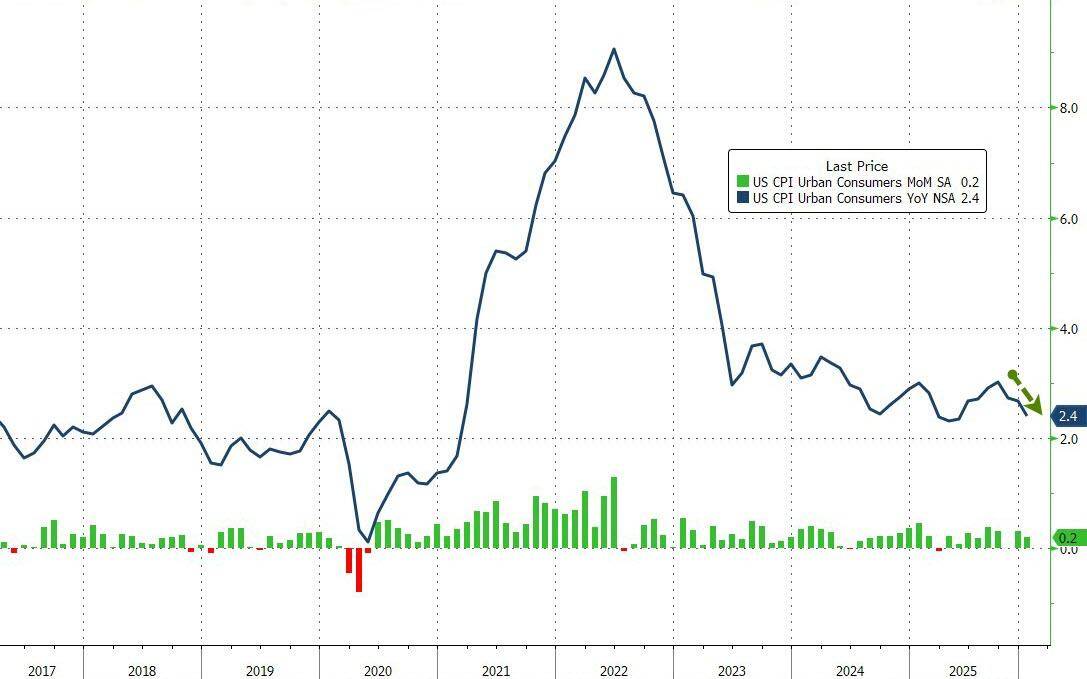
Core Insights - The overall inflation data for January in the U.S. is described as "moderate," with the CPI year-on-year falling to 2.4%, below expectations, and the core CPI dropping to 2.5%, marking the lowest level since 2021 [1][2] - The monthly core inflation remains resilient, driven by rising service prices, despite some declines in certain goods and services [3][4] Inflation Data Summary - The January CPI increased by 0.2% month-on-month, lower than the expected 0.3%, and the year-on-year rate slowed from 2.7% in December to 2.4%, also below the anticipated 2.5% [1] - The core CPI, excluding food and energy, rose by 0.3% month-on-month, matching expectations and slightly higher than the previous value of 0.2%, with a year-on-year rate of 2.5%, down from 2.6% in December [2] Market Reactions - Following the data release, U.S. stock futures saw a short-term increase, with the Nasdaq futures up by 0.13%, S&P 500 futures up by 0.12%, and Dow futures up by 0.06%. The dollar index experienced a slight decline of 0.03% [3] - Traders are estimating a 50% probability for a third interest rate cut by the Federal Reserve this year [3] Service and Goods Price Dynamics - The rise in core inflation for January was primarily driven by service-related price increases, including airfares, personal care, entertainment, healthcare, and communication [3] - Conversely, prices for certain goods and services, such as used cars and trucks, household items, and auto insurance, decreased in January, offsetting some of the upward pressure from services [4] Federal Reserve Implications - The Federal Reserve's 2% inflation target is mainly based on the PCE price index, and both CPI and PCE remain above this target level. The labor market showed signs of stability, with January employment growth accelerating and the unemployment rate dropping from 4.4% in December to 4.3% [6] - Despite the lower-than-expected inflation readings, the resilience of core inflation and a stable labor market may lead the Federal Reserve to maintain interest rates for the time being, with the current benchmark overnight rate set between 3.50% and 3.75% [6] Seasonal Adjustments - It is noteworthy that core CPI often tends to "exceed expectations" in January, with many economists suggesting that seasonal adjustment factors may not fully capture the disturbances caused by one-time price increases at the beginning of the year [7]
Telus (TU) Lags Q4 Earnings and Revenue Estimates
ZACKS· 2026-02-12 15:26
分组1 - Telus reported quarterly earnings of $0.15 per share, missing the Zacks Consensus Estimate of $0.18 per share, and down from $0.18 per share a year ago, representing an earnings surprise of -17.81% [1] - The company posted revenues of $3.77 billion for the quarter ended December 2025, missing the Zacks Consensus Estimate by 3.98%, and down from $3.85 billion year-over-year [2] - Over the last four quarters, Telus has surpassed consensus EPS estimates only once and has not beaten consensus revenue estimates [2] 分组2 - Telus shares have increased by approximately 8.1% since the beginning of the year, outperforming the S&P 500's gain of 1.4% [3] - The company's earnings outlook is crucial for investors, with current consensus EPS estimates at $0.18 for the coming quarter and $0.75 for the current fiscal year [7] - The Zacks Industry Rank places Diversified Communication Services in the top 19% of over 250 Zacks industries, indicating a favorable outlook for the sector [8]