GF SECURITIES(01776)

Search documents
广发证券(01776) - 海外监管公告 - 广发証券股份有限公司2024年面向专业投资者公开发行公...
2025-11-24 09:35
香港交易及結算所有限公司及香港聯合交易所有限公司對本公告的內容概不負責,對其準確性 或完整性亦不發表任何聲明,並明確表示,概不對因本公告全部或任何部份內容而產生或因倚 賴該等內容而引致的任何損失承擔任何責任。 GF SECURITIES CO., LTD. 廣發証券股份有限公司 (於中華人民共和國註冊成立的股份有限公司) (股份代號:1776) 海外監管公告 本公告乃根據香港聯合交易所有限公司證券上市規則第13.10B條刊發。 根據中華人民共和國的有關法例規定,廣發証券股份有限公司(「本公司」)在深圳 證券交易所網站( http://www.szse.cn )刊發的《廣發証券股份有限公司2024年面向專 業投資者公開發行公司債券(第五期)2025年付息公告》。茲載列如下,僅供參閱。 承董事會命 廣發証券股份有限公司 林傳輝 董事長 中國,廣州 2025年11月24日 债券代码:524029 债券简称:24 广发 12 债券代码:524030 债券简称:24 广发 13 广发证券股份有限公司 2024 年面向专业投资者公开发行公司债券(第五期) 2025 年付息公告 本公司及董事会全体成员保证公告的内容真实、准 ...
广发证券(000776) - 广发证券股份有限公司2024年面向专业投资者公开发行公司债券(第五期)2025年付息公告
2025-11-24 07:56
债券代码:524029 债券简称:24 广发 12 债券代码:524030 债券简称:24 广发 13 广发证券股份有限公司 2024 年面向专业投资者公开发行公司债券(第五期) 2025 年付息公告 本公司及董事会全体成员保证公告的内容真实、准确、完整,没有虚假记载、 误导性陈述或者重大遗漏。 特别提示: 由广发证券股份有限公司(以下简称"本公司")发行的广发证券股份有限 公司 2024 年面向专业投资者公开发行公司债券(第五期)(以下简称"本期债 券")将于 2025 年 11 月 26 日支付 2024 年 11 月 26 日至 2025 年 11 月 25 日期 间的利息。为确保付息工作的顺利进行,现将有关事宜公告如下: 一、本期债券基本情况 1、债券名称:广发证券股份有限公司 2024 年面向专业投资者公开发行公司 债券(第五期) 5、起息日:2024 年 11 月 26 日。 6、付息日:本期债券品种一的付息日为 2025 年至 2026 年每年的 11 月 26 日,品种二的付息日为 2025 年至 2027 年每年的 11 月 26 日(如遇法定节假日或 1 休息日,则顺延至其后的第 1 个交 ...
近期证券业并购对行业长期影响分析:券业整合2.0开启,行业长期格局优化
Guoxin Securities· 2025-11-24 06:07
Investment Rating - The investment rating for the non-bank financial sector is "Outperform the Market" [2][7]. Core Viewpoints - The report indicates that the securities industry is entering a new phase of mergers and acquisitions, termed "M&A 2.0," which emphasizes functional enhancement and the creation of a complementary business ecosystem rather than merely increasing capital size [3][5]. - The report highlights that recent mergers, such as the absorption of Dongxing Securities and Xinda Securities by CICC, reflect a shift towards strengthening professional capabilities and expanding business lines [4][18]. - The overall improvement in the securities industry's fundamentals, including active market trading and growth in margin financing, is expected to drive both valuations and profitability for brokerages [4][22]. Summary by Sections Industry Overview - The report notes a significant wave of mergers and restructuring in China's securities industry, driven by both policy support and market competition. The aim is to cultivate leading investment banks and enhance core competitiveness through consolidation [6][10]. - In the first three quarters of 2025, 43 listed brokerages achieved revenue of CNY 421.42 billion, a year-on-year increase of 42.57%, and a net profit of CNY 169.29 billion, up 62.48% [6]. Mergers and Acquisitions - The merger between Guotai Junan and Haitong Securities is highlighted as a scale-driven consolidation, significantly enhancing net capital strength and risk tolerance, while optimizing the national network layout [15][17]. - CICC's merger with Dongxing and Xinda Securities is characterized as a functional superiority-driven integration, aimed at enhancing business capabilities and expanding service offerings [18][20]. Business Structure and Performance - The report outlines a dual-driven characteristic in the securities industry, with brokerage and proprietary trading as the main revenue drivers. In the first three quarters of 2025, brokerage income reached CNY 111.78 billion, a year-on-year increase of 74.64% [11]. - The revenue structure is shifting, with brokerage income accounting for 26.5%, investment income 44.4%, and other segments contributing to the overall performance [11]. Investment Recommendations - The report suggests that the recent mergers are likely to stimulate investment enthusiasm in the industry. It recommends focusing on leading brokerages with comprehensive performance layouts and those with high elasticity in earnings, such as Huatai Securities and CITIC Securities [22].


【广发证券“投研财富+” 投资者教育专栏】现制茶饮:供需共振、长坡厚雪的新消费赛道
Zhong Guo Zheng Quan Bao· 2025-11-24 00:55
Core Viewpoint - The emergence of ready-to-drink tea has simplified the traditional tea preparation process, appealing particularly to younger consumers and leading to significant industry growth and structural upgrades [1] Supply Side Analysis - The ready-to-drink tea industry is transitioning from powdered to fresh, healthy products, with high-quality raw materials becoming increasingly common [2] - Major tea brands are focusing on supply chain improvements, allowing for quality upgrades at relatively affordable prices, with over 85% of new products priced below 20 yuan in 2024 [2] - The number of ready-to-drink tea stores in China is projected to increase from 293,000 in 2019 to 448,000 by 2024, enhancing accessibility and driving consumption frequency [2] Demand Side Analysis - Consumer preferences are shifting from basic functional needs to higher-level demands such as emotional value, health, and social interaction [3] - Ready-to-drink tea has become an integral part of daily life, with significant social attributes driving consumption in various scenarios [3] - Young consumers, particularly those under 30, represent a substantial portion of the market, with 42% of consumers aged under 20 and 29% aged 20-30 [3] Long-term Outlook - There is significant growth potential for the penetration rate of ready-to-drink tea, with current per capita consumption in mainland China at 11 cups compared to over 50 cups in Hong Kong and Taiwan [4] - The industry is experiencing increasing chain rates and concentration, with the chain rate reaching 56.1% in 2023, up 17.1 percentage points since 2018 [4] Short-term Considerations - The ongoing subsidy battle in the delivery market is expected to support high growth in same-store sales, particularly benefiting the ready-to-drink tea category [5] - However, there are concerns about the sustainability of this growth post-subsidy, as well as the potential impact of consumer price sensitivity on original-priced products [6] - The focus will shift back to fundamental business practices as subsidies decrease, with supply chain efficiency and refined operations becoming critical for success [6]
今日盘后生效,MSCI中国指数新纳26股!
Shang Hai Zheng Quan Bao· 2025-11-24 00:49
Market Performance - The three major U.S. stock indices closed lower last week, with the Dow Jones down 1.91%, the Nasdaq down 2.74%, and the S&P 500 down 1.95% [1] - European indices also performed poorly, with the FTSE 100 down 1.64%, the CAC 40 down 2.29%, and the DAX down 3.29% [1] Economic Data Releases - A series of key economic data, delayed due to government shutdown, will be released this week, potentially increasing market volatility ahead of the Federal Reserve's December meeting [2] - Important data includes September retail sales and Producer Price Index (PPI) on Tuesday, and September durable goods orders on Wednesday [2] - The release of the revised Q3 GDP growth rate and October personal income and spending data has been rescheduled [2] CPI and Employment Reports - The U.S. Bureau of Labor Statistics announced it will not release the complete October Consumer Price Index (CPI) report, with the November report scheduled for December 18 [3] - The delay in the October employment report may increase the importance of weekly initial jobless claims data [2] MSCI Index Adjustments - The MSCI China Index will undergo adjustments effective after the market close on November 24, including the addition of 26 stocks and the removal of 16 stocks [4] - New additions include companies like Qianli Technology and Huahong Semiconductor, while removals include Beikong Water Group and China Everbright Bank [4] U.S.-Ukraine Talks - U.S. and Ukrainian representatives reported progress in talks regarding a new 28-point plan to end the Russia-Ukraine conflict [5] - U.S. Secretary of State Rubio indicated that both sides are working to narrow differences and move towards a mutually acceptable solution [6]





广发证券全球首席经济学家沈明高: 以“科技资本”赋能新质生产力 破解科技金融规模化难题
Zheng Quan Shi Bao Wang· 2025-11-23 23:42
Core Insights - The core challenge of technological financial innovation is transitioning from singular breakthroughs to scalable development, necessitating a financial ecosystem that can support a modern industrial system and foster globally competitive tech enterprises [1][2] Group 1: Technological Financial Innovation - Emphasis on the need for scaling from "1 to N" in technological financial innovation, with the "14th Five-Year Plan" highlighting the absence of replicable models for supporting new productive forces [1] - The "15th Five-Year Plan" suggests a framework for a modern industrial system, balancing the service of "technological industrialization" and "industrial technology" [1][2] - The essence of technological finance is "innovation capitalization," which requires converting technological innovation into capital returns to sustain future innovation cycles [1][2] Group 2: Challenges in Innovation Capitalization - Five major challenges to achieving innovation capitalization include non-standardization, unprofitability, light asset models, high uncertainty, and long cycles, which traditional financial services struggle to address [2] - The concept of "technology capital" is introduced, which should provide additional value alongside financial investment, encompassing understanding of technology, industry, pricing, risk management, and resource allocation [2] Group 3: Future Outlook and Recommendations - Artificial intelligence is identified as a "general technology" leading the fourth industrial revolution, with a critical window for adoption in the next 5-10 years [3] - The "smart manufacturing industry chain" is projected to become a new pillar of the economy, potentially rivaling real estate, with significant spillover effects [3] - A recommendation for the Greater Bay Area to establish a "1+N" industrial system centered around the smart manufacturing industry chain [3] Group 4: Risk Sharing Mechanism - The absence of a risk-sharing mechanism is identified as a barrier to meeting the investment needs of early-stage tech enterprises [3][4] - Suggestions include local governments establishing subordinate funds to absorb initial losses, thereby encouraging social capital to invest in early-stage and hard technology ventures [4]

广发证券全球首席经济学家沈明高: 以“科技资本”赋能新质生产力破解科技金融规模化难题
Zheng Quan Shi Bao· 2025-11-23 20:48
Core Insights - The core challenge of technological financial innovation is transitioning from singular breakthroughs to scalable development, necessitating a financial ecosystem that can support a modern industrial system and foster globally competitive tech enterprises [1] Group 1: Technological Financial Innovation - Emphasis on the need for scaling from "1 to N" in technological financial innovation, with the "14th Five-Year Plan" highlighting numerous innovative points that have yet to form replicable models [1] - The "15th Five-Year Plan" suggests a framework for a modern industrial system, balancing the service of "technological industrialization" and "industrial technologicalization" [1] Group 2: Innovation Capitalization - The essence of technological finance is "innovation capitalization," which involves converting technological innovation into capital returns to support sustainable innovation and iteration [1] - Five major challenges to achieving innovation capitalization include non-standardization, unprofitability, light asset models, high uncertainty, and long cycles, which traditional financial services struggle to address [2] Group 3: Concept of "Tech Capital" - The concept of "tech capital" is introduced, requiring additional value such as technological and industrial understanding, market comprehension, and risk management alongside financial investment [2] - "Tech capital" must possess five capabilities: understanding technology, industry, pricing, risk management, and resource allocation [2] Group 4: Future Outlook - Artificial intelligence is identified as a "general technology" leading the fourth industrial revolution, with a potential for exponential growth in adoption over the next 5-10 years [3] - The "smart manufacturing industry chain" is projected to become a new pillar of the economy, comparable to real estate, with significant spillover effects [3] Group 5: Risk Sharing Mechanism - The absence of a risk-sharing mechanism is identified as a root cause for unmet investment needs in early-stage tech enterprises, with suggestions for government or private entities to assume a "subordinated" role [3] - Establishing a subordinated fund by local governments could incentivize social capital to invest in early-stage hard technology [4]
亚玛顿:接受广发证券调研
Mei Ri Jing Ji Xin Wen· 2025-11-23 11:27
Group 1 - The core viewpoint of the article is that Amatton (SZ 002623) has announced its participation in a research meeting with GF Securities, where key executives will address investor inquiries [1] - For the first half of 2025, Amatton's revenue composition shows that the new energy sector accounts for 88.61%, the electronic glass and display device industry accounts for 10.99%, and other businesses account for 0.4% [1] - As of the report date, Amatton's market capitalization is 3.7 billion yuan [1]

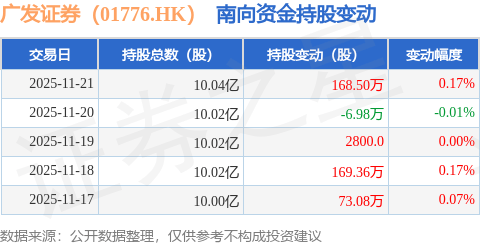
广发证券(01776.HK):11月21日南向资金增持168.5万股
Sou Hu Cai Jing· 2025-11-21 19:28
以上内容为证券之星据公开信息整理,由AI算法生成(网信算备310104345710301240019号),不构成 投资建议。 广发证券股份有限公司是一家主要从事证券业务的中国公司。该公司通过五个分部开展业务。投资银行 分部从事股权融资、债务融资、财务顾问和企业解决方案等。财富管理分部从事零售证券经纪、期货经 纪、金融产品代销、融资融券及回购交易融资服务、融资租赁等。交易及机构客户服务分部主要从事为 机构客户提供证券研究、资产托管服务、销售及投资交易(包括自营和其他对客交易服务)、另类投资 等。投资管理分部从事资产管理、公募基金管理、私募基金管理等。其他分部主要为公司总部运营。 证券之星消息,11月21日南向资金增持168.5万股广发证券(01776.HK)。近5个交易日中,获南向资金 增持的有4天,累计净增持404.24万股。近20个交易日中,获南向资金增持的有14天,累计净增持2363.4 万股。截至目前,南向资金持有广发证券(01776.HK)10.04亿股,占公司已发行普通股的58.97%。 | 交易日 | 持股总数 (股) | 持股变动(股) | 变动幅度 | | --- | --- | --- | ...
年内券商罚单已达310张
财联社· 2025-11-21 08:39
Core Viewpoint - The number of penalties in the securities industry has increased recently, but the total for the year remains significantly lower than the previous year, with 310 penalties issued so far, representing 61.63% of last year's total [1] Summary by Sections Penalty Statistics - As of November 19, 310 penalties have been issued this year, which is 61.63% of the 503 penalties from the same period last year [1] - In the fourth quarter alone, 37 penalties have been issued, down from 78 in the same period last year [1][4] Types of Violations - The main types of violations in the fourth quarter include: - Employee violations of trading regulations - Breaches of integrity in the workplace - Failures in ongoing supervision - Violations in client solicitation - These categories account for 59.46% of all penalties issued [1][6] Specific Cases - The highest number of penalties was issued to Shanghai Securities, totaling 6, followed by Caixin Securities and Founder Securities with 3 each [5] - Notably, some penalties are linked to "penetrating" regulatory enforcement, where multiple entities within a firm are penalized for the same violation [5] Regulatory Environment - Despite a decrease in total penalties, the regulatory environment remains strict, with a focus on effective enforcement and deterrence against violations [8] - The China Securities Regulatory Commission emphasizes the need for a more resilient and robust market, with improved compliance monitoring and training [9]