
BANK OF GUIZHOU(06199)

Search documents
川黔渝地方银行加入消费贷贴息阵营 部分银行要求更为严格
Jing Ji Guan Cha Wang· 2025-12-12 09:35
Core Viewpoint - The announcement by Chongqing Rural Commercial Bank regarding the implementation of a personal consumption loan interest subsidy policy aims to boost local consumption by allowing residents to benefit from interest subsidies on loans used for consumption from September 1, 2025, to August 31, 2026 [1][2]. Group 1: Policy Implementation - The personal consumption loan interest subsidy policy will be applicable to loans issued by regional banks in addition to the six major state-owned commercial banks and twelve national joint-stock commercial banks [1][2]. - The subsidy will cover loans for various consumption categories, including household vehicles, education, and healthcare, with a maximum annual subsidy rate of 1% and a cap of 50% of the loan contract interest rate [2][3]. Group 2: Regional Bank Participation - Several regional banks, including Chongqing Bank and Guizhou Bank, have announced their participation in the subsidy program, indicating a broader implementation of the policy across different financial institutions [1][8]. - The execution periods for the subsidy may vary among regional banks, with some banks setting specific time frames for eligibility [3][4]. Group 3: Eligibility and Restrictions - Regional banks have established strict eligibility criteria for the subsidy, requiring that the consumption must occur within the respective provinces and that certain documentation must be provided [5][6]. - There are specific restrictions on the types of transactions that qualify for the subsidy, such as requiring that the loan be used for consumption within 30 days of disbursement [6][7]. Group 4: Local Government Support - Local governments are encouraged to support the implementation of the subsidy policy, with funding responsibilities shared between provincial and municipal levels [8]. - The policy aims to enhance the competitiveness of regional banks and stimulate local consumption while keeping the fiscal burden manageable for local governments [9].

“红包”来了!多地区域性银行入局!
券商中国· 2025-12-11 13:00
Core Viewpoint - The expansion of personal consumption loan interest subsidy policies by regional banks in Guizhou, Sichuan, and Chongqing aims to stimulate local consumption and enhance the competitiveness of regional financial institutions [1][6]. Group 1: Implementation of Subsidy Policies - Regional banks such as Guiyang Bank, Guizhou Bank, and Chengdu Bank have announced the implementation of personal consumption loan interest subsidies, expanding the original 23 financial institutions to include more local banks [1][2]. - The subsidy policies are in response to national calls to boost local consumption, with other provinces expected to follow suit [1][6]. Group 2: Specifics of Subsidy Programs - In Guizhou, the subsidy period is from December 1, 2025, to December 31, 2025, with a maximum subsidy of 3,000 yuan for eligible borrowers [2][4]. - In Chongqing, the subsidy applies to personal consumption loans issued from September 1, 2025, to August 31, 2026, with three local banks included as loan issuers [3][4]. - Chengdu Bank and Chengdu Rural Commercial Bank have set a subsidy cap of 1,500 yuan for borrowers during their policy period [5]. Group 3: Variations in Subsidy Standards - The annual subsidy rate for personal consumption loans in Guizhou and Chongqing is set at 1%, but the maximum subsidy amounts differ, with Guizhou and Chongqing allowing up to 3,000 yuan per borrower [4]. - Chengdu's subsidy cap is lower, at 1,500 yuan, indicating regional differences in subsidy implementation [5]. Group 4: Future Prospects and Market Impact - The introduction of these subsidy policies is expected to create a "national subsidy + local subsidy" synergy, enhancing regional banks' market competitiveness and stimulating local consumption [6][7]. - The policies are seen as a short-term growth opportunity for banks, but long-term sustainability may be challenged due to differences in customer base and risk management capabilities compared to larger banks [7].


原董事长获刑、支行行长遭终身禁业,贵州银行内控再受拷问
Nan Fang Du Shi Bao· 2025-12-11 11:16
Core Viewpoint - The recent corruption scandals and regulatory violations at Guizhou Bank, including the sentencing of its former chairman and the imposition of fines on its branches, raise concerns about the bank's compliance and operational integrity in the financial sector [2][6][9]. Group 1: Regulatory Violations - Guizhou Bank's Zunyi Bozhou branch was fined 300,000 yuan for illegal lending practices, specifically for linking deposit requirements to loan approvals, which is prohibited by regulations [3][4]. - The bank has faced multiple penalties for similar violations, including over 1.5 million yuan in fines for improper loan management and other regulatory breaches in 2024 [4][5]. - The former chairman, Li Zhiming, was sentenced to 16 years and 6 months in prison for accepting bribes totaling over 43.1 million yuan and illegally issuing loans exceeding 304 million yuan [6][7]. Group 2: Leadership Changes and Impact - The bank has experienced significant leadership turnover, with four senior executives, including the former chairman, being implicated in corruption since October 2023 [7]. - A new leadership team has been appointed, including Wu Fan as the first female president, who has extensive experience in the banking sector and is expected to address compliance issues [10][11]. - The effectiveness of the new leadership in balancing growth and compliance will be crucial for the bank's future [11]. Group 3: Financial Performance and Challenges - Guizhou Bank's financial performance has deteriorated, with a revenue of 11.3 billion yuan and a net profit of 3.65 billion yuan in 2023, reflecting declines of 5.38% and 4.60% year-on-year, respectively [9]. - The bank's non-performing loan (NPL) ratio in the real estate sector reached 40.39%, the highest in the industry, although it improved to 11.58% in 2024 [9]. - As of mid-2025, the overall NPL ratio was 1.69%, indicating slight improvement, but the bank still faces challenges in optimizing loan structures and managing asset quality [9].
从“国补”到“地补” 消费贷贴息迎来新军
Zhong Guo Zheng Quan Bao· 2025-12-10 22:31
Core Viewpoint - Regional banks in China are leveraging local fiscal support to introduce consumer loan subsidy programs, aiming to reduce the cost of consumer credit and stimulate consumer spending potential [1][2]. Group 1: Introduction of Consumer Loan Subsidies - Since December, banks such as Guizhou Bank and Guiyang Bank have announced personal consumer loan interest subsidy programs to lower residents' credit costs [2]. - The subsidy program is based on guidelines from multiple departments, effective from December 1, targeting eligible consumer loan clients [2]. Group 2: Details of Subsidy Programs - Guizhou Bank and Guiyang Bank's subsidies apply to loans for comprehensive consumption and service industry loans, with specific eligibility criteria tied to the borrower's registered business location [2]. - Chengdu Bank and Chengdu Rural Commercial Bank have also released their subsidy details, with the subsidy period set from October 1, 2025, to March 31, 2026 [2]. Group 3: Subsidy Limits and Application Process - The maximum subsidy for each borrower at Guizhou Bank and Guiyang Bank is capped at 3,000 yuan, with specific limits for smaller loans [3]. - The application process is voluntary and operates on a first-come, first-served basis, with a clear requirement for supporting documentation [3]. Group 4: Benefits for Local Economies - The subsidy initiative is viewed as a "triple win" for local economies, effectively utilizing fiscal resources to stimulate consumer spending while allowing banks to expand their customer base [4][5]. - Industry experts anticipate that more regions will adopt similar consumer loan subsidy policies tailored to their fiscal conditions and market characteristics [5].
从“国补”到“地补”消费贷贴息迎来新军
Zhong Guo Zheng Quan Bao· 2025-12-10 20:17
Core Viewpoint - Regional banks in China are leveraging local fiscal support to introduce consumer loan subsidy programs, aiming to reduce the cost of consumer credit and stimulate consumer spending [1][4]. Group 1: Consumer Loan Subsidy Programs - Since December, banks such as Guizhou Bank and Guiyang Bank have announced consumer loan interest subsidy initiatives to help lower residents' credit costs and boost consumption potential [1]. - The consumer loan "local subsidy" program offers more regional flexibility compared to the broader "national subsidy," providing new growth opportunities for regional banks and stimulating local consumption markets [1][4]. Group 2: Specifics of the Subsidy Programs - Guizhou Bank and Guiyang Bank have set a subsidy cap of 3,000 yuan per borrower, with a maximum of 1,000 yuan for small loans under 50,000 yuan [2]. - Chengdu Bank and Chengdu Rural Commercial Bank have a lower cap of 1,500 yuan for total consumer loan subsidies, with a maximum of 500 yuan for small loans [3]. Group 3: Application Process and Impact - The subsidy application process is voluntary and operates on a first-come, first-served basis, with limited funding available based on provincial fiscal allocations [3]. - The implementation of these subsidy programs is seen as a "triple win" for local governments, banks, and consumers, effectively utilizing fiscal resources to stimulate consumption and enhance banking business [4].
贵州银行(06199) - 於2025年12月10日举行之2025年第三次临时股东大会投票表决结果
2025-12-10 11:46
香港交易及結算所有限公司及香港聯合交易所有限公司對本公告的內 容 概 不 負 責,對 其 準 確 性 或 完 整 性 亦 不 發 表 任 何 聲 明,並 明 確 表 示,概 不對因本公告全部或任何部分內容而產生或因倚賴該等內容而引致的 任 何 損 失 承 擔 任 何 責 任。 於2025年12月10日舉行之2025年 第三次臨時股東大會投票表決結果 茲提述貴州銀行股份有限公司*(「本 行」)日 期 為2025年11月21日 的2025年 第 三 次 臨 時 股 東 大 會 通 告(「通 告」)及 通 函(「通 函」)。除 非 文 義 另 有 所 指, 本 公 告 所 用 詞 彙 與 通 函 所 界 定 者 具 有 相 同 涵 義。 1. 臨時股東大會投票表決結果 2025年第三次臨時股東大會於2025年12月10日(星 期 三)下 午2:30假 座 中華人民共和國貴州省貴陽市觀山湖區永昌路9號貴州銀行總行大 樓4501會 議 室 舉 行。2025年第三次臨時股東大會的召集及召開符合 相 關 中 國 法 律 及 法 規、上 市 規 則 以 及 公 司 章 程 的 規 定。 於2025年 第 三 次 臨 時 股 ...
“国补”引路,“地补”接力!个人消费贷财政贴息精准扩围
2 1 Shi Ji Jing Ji Bao Dao· 2025-12-10 08:36
Core Viewpoint - The personal consumption loan interest subsidy policy is accelerating from a national level to local implementation, with regions like Sichuan, Guizhou, and Chongqing actively rolling out their own subsidy measures to stimulate consumption and reduce financing costs for residents [1][2][7]. Group 1: Policy Implementation - The "local subsidy" policies in Sichuan, Guizhou, and Chongqing have been rapidly launched since December, creating a regional synergy effect [2]. - Chongqing's policy emphasizes broad coverage and a long execution period, with a subsidy cap of 3,000 yuan for eligible cumulative consumption of 300,000 yuan [3]. - Sichuan's approach focuses on short-term precision, with a subsidy cap of 1,500 yuan for the same cumulative consumption amount, and funds must be used within the province [4]. - Guizhou's policy offers high subsidies, matching the national standard with a cap of 3,000 yuan, but has a shorter execution period [5]. Group 2: Market Impact - The collaboration between national and local subsidy policies is expected to enhance the competitiveness of regional banks, stimulate local consumption, and lower financing costs for residents [7][9]. - The introduction of local policies is anticipated to create structural changes in the consumer finance market, leading to a reduction in consumer loan interest rates and stimulating demand [10]. - Local banks are expected to leverage the policy to attract price-sensitive customers and expand their coverage in the inclusive finance sector [8]. Group 3: Risk Management - Financial institutions are advised to implement multiple risk control measures to prevent potential arbitrage, including automatic identification of eligible transactions and setting limits on subsidy amounts [5][6]. - The operational guidelines for subsidy agreements emphasize the need for borrowers to provide valid proof of consumption transactions to ensure compliance [6].
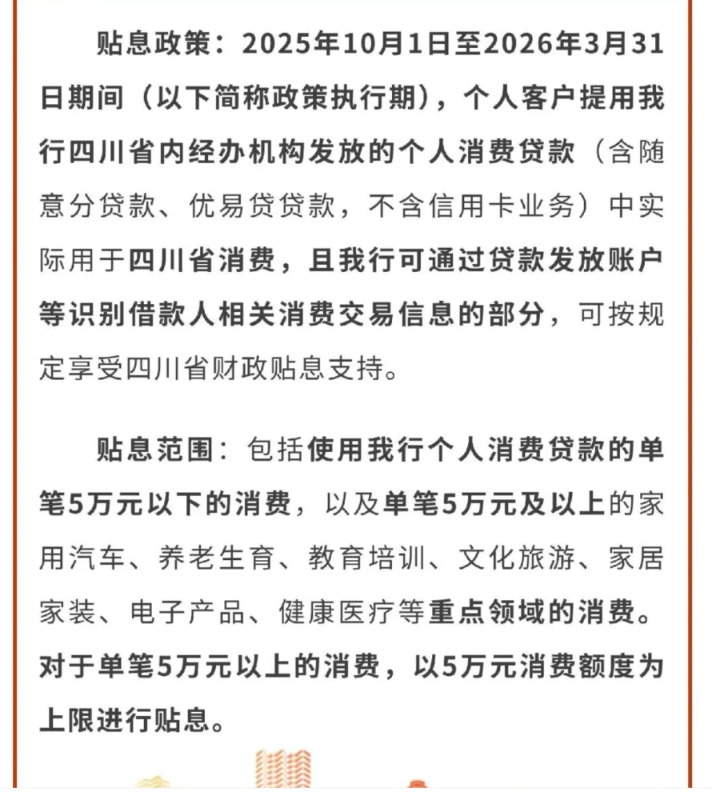
现货黄金站上4200美元/盎司;区域性银行加入消费贷贴息阵营| 金融早参
Mei Ri Jing Ji Xin Wen· 2025-12-10 00:57
| 2025年12月10日星期三 | 12月9日,中国再保险发布公告,公司于近日收到国家金融监督管理总局关于庄乾志先生任职资格的批 复。根据该批复,国家金融监督管理总局于2025年12月8日正式核准庄乾志先生担任董事会董事长的任 职资格,庄乾志先生自该日起正式履行董事长职务,任期至第五届董事会任期届满为止,任期届满可以 连选连任。 NO.4区域性银行加入消费贷贴息阵营 据证券日报,12月份以来,个人消费贷款财政贴息政策在四川、贵州、重庆加速落地。川黔渝三地相继 发布省级贴息实施细则,贵阳银行、贵州银行、成都银行、成都农商行等区域头部城商行、农商行同步 启动业务受理。这标志着此前未被纳入"国补"经办体系的区域性银行,正式加入消费贷补贴阵营,"国 补+地补"的协同发力格局初步形成。 NO.1央行开展1173亿元7天期逆回购操作 12月9日,央行公开市场开展1173亿元7天期逆回购操作,操作利率1.40%。Wind数据显示,当日有1563亿 元逆回购到期。 点评:央行今日开展1173亿元7天期逆回购操作的举措显示出其维持市场流动性稳定的意图。逆回购作 为短期的市场操作工具,能够有效缓解市场资金紧张状况,降低市场利率 ...
2025年国家开发银行


Shang Hai Zheng Quan Bao· 2025-12-09 18:53
Core Insights - The awards for financial bond underwriting and market-making have been announced, recognizing various banks and securities firms for their outstanding performance in the industry [1][2][3][4][5][6][7] Group 1: Outstanding Underwriters - The title of "Outstanding Underwriter" was awarded to several banks, including CITIC Bank, Shanghai Pudong Development Bank, and Industrial and Commercial Bank of China [1][2] - A total of 10 banks were recognized as "Excellent Underwriters," highlighting their contributions to the financial bond market [1] Group 2: Excellent Market Makers - The "Excellent Market Maker" category included firms such as Huatai Securities and CITIC Securities, showcasing their role in enhancing market liquidity [2][4] - A diverse range of banks, including Ping An Bank and Industrial Bank, were acknowledged for their market-making capabilities [2][4] Group 3: Special Awards - Special awards were given for various categories, including "Debt Sea Rising Award" and "Green Low Carbon Award," recognizing banks like Agricultural Bank of China and Postal Savings Bank of China for their innovative approaches [3] - The "Technology Innovation Award" was awarded to banks that demonstrated significant advancements in financial technology [3] Group 4: Individual Recognitions - Individual awards were presented to key personnel from various banks, such as CITIC Bank's Sun Wei and China Everbright Bank's Liu Yan, acknowledging their leadership in driving financial bond initiatives [4][5] - The "Outstanding Underwriting Supervisor" category highlighted individuals from major banks, emphasizing the importance of leadership in underwriting processes [5]
区域性银行 加入消费贷贴息阵营
Xin Lang Cai Jing· 2025-12-09 00:36
Core Viewpoint - The implementation of local consumer loan interest subsidy policies in Sichuan, Guizhou, and Chongqing marks a significant step in enhancing consumer credit support, creating a synergistic effect with national policies to stimulate consumption [1][7]. Group 1: Policy Implementation - Since December, personal consumer loan interest subsidy policies have accelerated in Sichuan, Guizhou, and Chongqing, with local banks starting to process these loans [1][7]. - The local subsidy policies fill the gap left by the national "subsidy" program, allowing regional banks to participate in consumer loan subsidies [1][8]. - The annual subsidy rate is set at 1%, not exceeding 50% of the loan contract interest rate, with differentiated arrangements based on regional consumption needs [1][8]. Group 2: Specifics of Subsidy Policies - In Sichuan, the subsidy policy covers loans under 50,000 yuan and key areas like automobiles and education, with a maximum cumulative subsidy of 1,500 yuan for eligible consumption amounts of 300,000 yuan [2][9]. - Guizhou's policy has a similar subsidy rate but offers a higher cumulative subsidy of up to 3,000 yuan for the same consumption amount, with a maximum of 1,000 yuan for loans under 50,000 yuan [3][10]. Group 3: Future Expectations - More provinces are expected to follow suit in implementing consumer loan subsidy policies, particularly in regions with weak consumption recovery [4][12]. - The policies are anticipated to effectively lower consumer credit costs and directly boost local consumption, with manageable fiscal burdens for local governments [4][12]. Group 4: Industry Impact - The introduction of local policies is expected to create structural effects, further lowering consumer credit rates and stimulating demand [5][12]. - Regional banks will benefit from a more competitive landscape, as these policies provide them with tools to differentiate themselves from larger banks [5][12]. - The policies are likely to encourage financial institutions to innovate products tailored to local consumption characteristics, enhancing the diversity of consumer finance support [5][12]. Group 5: Challenges for Regional Banks - While the policies present growth opportunities for regional banks, they also face challenges in customer base, risk control technology, and product capabilities compared to larger banks [6][13]. - Relying solely on interest subsidies may not ensure long-term competitiveness, as the policies have specific timeframes and regional limitations [6][13].