
REMEGEN(09995)

Search documents
10只科创板股获融资净买入额超1亿元
Zheng Quan Shi Bao Wang· 2026-01-14 02:16
Core Viewpoint - The total margin balance of the Sci-Tech Innovation Board reached 288.907 billion yuan on January 13, showing an increase of 1.127 billion yuan compared to the previous trading day [1] Group 1: Margin Balance - The financing balance amounted to 287.888 billion yuan, increasing by 1.178 billion yuan from the previous trading day [1] - The margin trading balance decreased to 10.19 billion yuan, down by 0.051 billion yuan from the previous trading day [1] Group 2: Individual Stock Performance - On January 13, 311 stocks on the Sci-Tech Innovation Board experienced net financing inflows, with 10 stocks having net inflows exceeding 100 million yuan [1] - Kingsoft Office topped the list with a net financing inflow of 276 million yuan [1] - Other notable stocks with significant net financing inflows include Chengdu Xian Dao, Zhongke Xingtu, Zhongxin International, Rongchang Bio, Western Superconducting, and Green Harmony [1]





创新药出海“火爆”!荣昌生物签订重磅BD,港股创新药ETF(159567)涨超2.5%,开年以来反弹超11%
2 1 Shi Ji Jing Ji Bao Dao· 2026-01-14 02:16
Group 1 - The Hong Kong stock market saw a strong performance in the early session on January 14, with the pharmaceutical sector leading the gains. The Hong Kong Innovative Drug ETF (159567) rose by 2.52%, with trading volume quickly surpassing 300 million yuan [1] - The Hong Kong Innovative Drug ETF (159567) has experienced a rebound since the beginning of 2026, with a cumulative increase of over 11% from January 5 to January 13 [1] - The ETF closely tracks the Guozheng Hong Kong Stock Connect Innovative Drug Index (987018), which reflects the performance characteristics of listed companies in the innovative drug sector within the Hong Kong Stock Connect [1] Group 2 - On January 12, the 44th JPMorgan Global Healthcare Conference officially opened in the United States, attracting significant attention from the biopharmaceutical industry. Several domestic innovative drug companies participated, with seven companies presenting at the main venue [2] - Huatai Securities noted that the liquidity in the Hong Kong innovative drug sector has significantly improved since the beginning of 2026, and the JPMorgan conference has provided a platform for domestic pharmaceutical companies to advance overseas business development (BD) collaborations [2] - The ongoing liquidity recovery is expected to lead to a clear innovative drug beta market, with external demand-driven CXO companies likely to achieve performance that exceeds expectations, resonating with innovative drugs [2]


荣昌生物拿下56亿美元大单 双抗技术缘何频获跨国巨头追捧?
2 1 Shi Ji Jing Ji Bao Dao· 2026-01-13 23:12
Core Insights - The collaboration between AbbVie and Rongchang Biopharma marks a significant shift in the global oncology treatment landscape, highlighting the trend of "Chinese innovation + global market" in drug development [1][2] Group 1: Collaboration Details - AbbVie and Rongchang Biopharma signed an exclusive licensing agreement for the development, production, and commercialization of RC148, a bispecific antibody targeting PD-1 and VEGF [1] - Rongchang Biopharma will receive an upfront payment of $650 million and is eligible for up to $4.95 billion in milestone payments, along with a tiered royalty on net sales outside Greater China [1][2] Group 2: Market Implications - The deal allows Rongchang Biopharma to accelerate clinical trials for RC148 in China and globally, while also supporting the development of other pipelines [2] - AbbVie aims to enhance its product portfolio in immuno-oncology, particularly in the emerging PD-1/VEGF bispecific antibody space, which could improve its competitiveness in solid tumor treatments [2] Group 3: Industry Trends - The PD-1/VEGF bispecific antibody represents a new class of cancer therapies that may overcome tumor resistance mechanisms by simultaneously blocking PD-1 and VEGF [3][5] - Chinese companies are leading in this field, with significant advancements and approvals, such as the launch of Ak112/Ivonescimab by Kangfang Biopharma, which is the first bispecific antibody combining tumor immunity and anti-angiogenesis mechanisms [3] Group 4: Broader Market Dynamics - The global interest in PD-1/VEGF bispecific antibodies is rising, with several Chinese firms successfully engaging in business development (BD) transactions, reflecting the increasing recognition of Chinese innovative drug assets by multinational pharmaceutical companies [6][7] - In 2025, the total value of Chinese innovative drug licensing transactions exceeded $130 billion, accounting for 49% of the global total, indicating a significant shift in the global pharmaceutical landscape [7][8] Group 5: Future Outlook - The increasing number of approved innovative drugs in China, along with the growing bargaining power of Chinese companies in licensing agreements, suggests a transition from a "follow" to a "lead" position in global pharmaceutical innovation [8][10] - The ability of Chinese companies to negotiate favorable terms in BD transactions is becoming crucial, emphasizing the importance of pipeline strength, data quality, and structured deal design [9][10]

荣昌生物频获跨国巨头追捧
2 1 Shi Ji Jing Ji Bao Dao· 2026-01-13 23:08
Core Insights - The collaboration between AbbVie and Rongchang Biopharma marks a significant shift in the global oncology treatment landscape, focusing on the development of the bispecific antibody RC148 targeting PD-1 and VEGF [1][2] Group 1: Collaboration Details - AbbVie and Rongchang Biopharma signed an exclusive licensing agreement for RC148, granting AbbVie rights outside Greater China for development, production, and commercialization [1] - Rongchang Biopharma will receive an upfront payment of $650 million and is eligible for up to $4.95 billion in milestone payments, along with a tiered royalty on net sales outside Greater China [1][2] Group 2: Market Implications - This deal exemplifies the "China innovation + global market" model, providing Rongchang Biopharma with substantial cash flow to accelerate clinical trials for RC148 and support other pipeline developments [2] - The partnership with a top-tier oncology company like AbbVie enhances Rongchang Biopharma's brand and bargaining power in international markets, while AbbVie benefits from expanding its immuno-oncology product portfolio [2] Group 3: Bispecific Antibody Landscape - RC148 represents a new class of cancer therapies aimed at simultaneously blocking PD-1 and VEGF, potentially overcoming tumor resistance mechanisms [5] - The PD-1/VEGF bispecific antibody field is gaining traction, with several Chinese companies, including Kangfang Biopharma and Junshi Biosciences, making significant advancements and entering clinical trials [6][7] Group 4: Industry Trends - The Chinese innovative drug sector is experiencing a surge in licensing deals, with over $130 billion in total transaction value in 2025, surpassing the U.S. for the first time [10] - Factors driving this trend include the impending patent cliff for major drugs and declining R&D efficiency among multinational pharmaceutical companies, leading them to seek external innovations [10][11] Group 5: Future Outlook - The Chinese pharmaceutical industry is transitioning from a follower to a leader in innovation, with a clear direction for future development [14] - Companies are focusing on building a comprehensive value creation logic recognized by international partners, enhancing their negotiation power in licensing agreements [12][13]
“双抗”56亿美元“出海” 荣昌生物资金压力缓解
Bei Jing Shang Bao· 2026-01-13 15:42
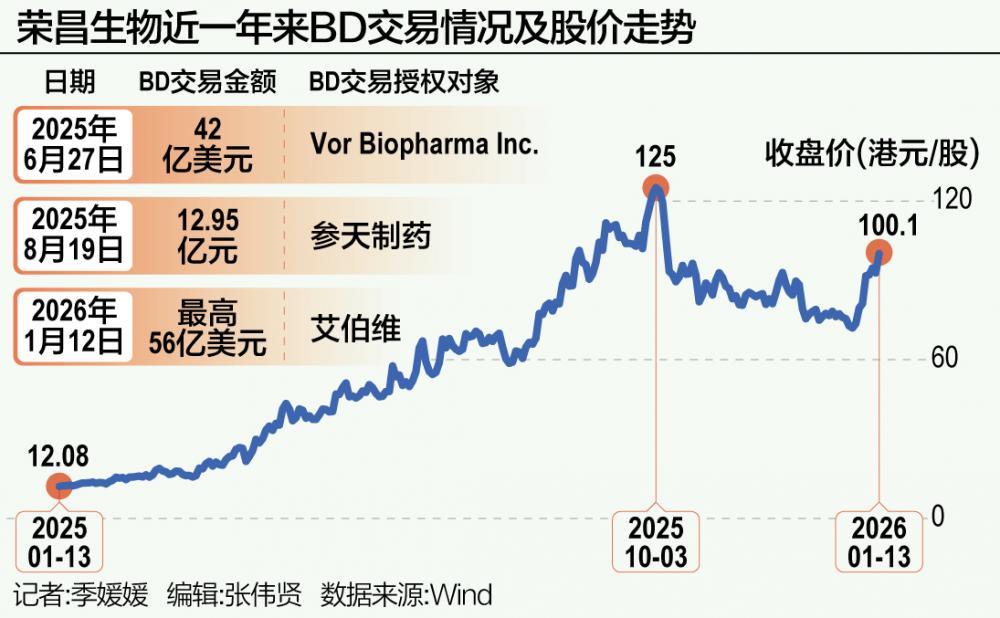
Core Viewpoint - Rongchang Biologics has signed an exclusive licensing agreement with AbbVie for the dual-specific antibody drug RC148, valued at approximately $5.6 billion (about 39.06 billion RMB), marking a significant milestone in the company's business development efforts [1][3]. Group 1: Business Development Transactions - The agreement with AbbVie includes an upfront payment of $650 million (about 4.53 billion RMB) and potential milestone payments of up to $4.95 billion (about 34.53 billion RMB) based on development, regulatory, and commercialization achievements [3]. - This transaction is noted as the highest upfront payment recorded in the innovative drug sector for business development (BD) transactions at the start of the year [3]. - Since 2025, Rongchang Biologics has completed three BD transactions, including the recent agreement with AbbVie, indicating a strategic push for international expansion [5][6]. Group 2: Financial Performance - For the first three quarters of 2025, Rongchang Biologics reported revenue of approximately 1.72 billion RMB, a year-on-year increase of 42.27%, while the net loss narrowed to 551 million RMB [7]. - The company’s cash reserves reached 1.07 billion RMB by the end of Q3 2025, an increase from 743 million RMB and 763 million RMB at the end of 2023 and 2024, respectively [7]. - Despite the increase in cash reserves, the company still faces a high debt ratio of 61.18% as of Q3 2025, indicating ongoing financial pressure [7]. Group 3: Market Reaction - On January 13, following the announcement of the AbbVie deal, Rongchang Biologics' A-shares hit the daily limit, closing at a 20% increase, with a total trading volume of 2.369 billion RMB [2]. - The H-shares also experienced a significant rise, closing up 7.87% [2]. - The market's positive response reflects investor confidence in the potential of the RC148 drug and the strategic partnership with AbbVie [6][8].
荣昌生物涨停 三机构上榜龙虎榜
Zheng Quan Shi Bao Wang· 2026-01-13 14:49
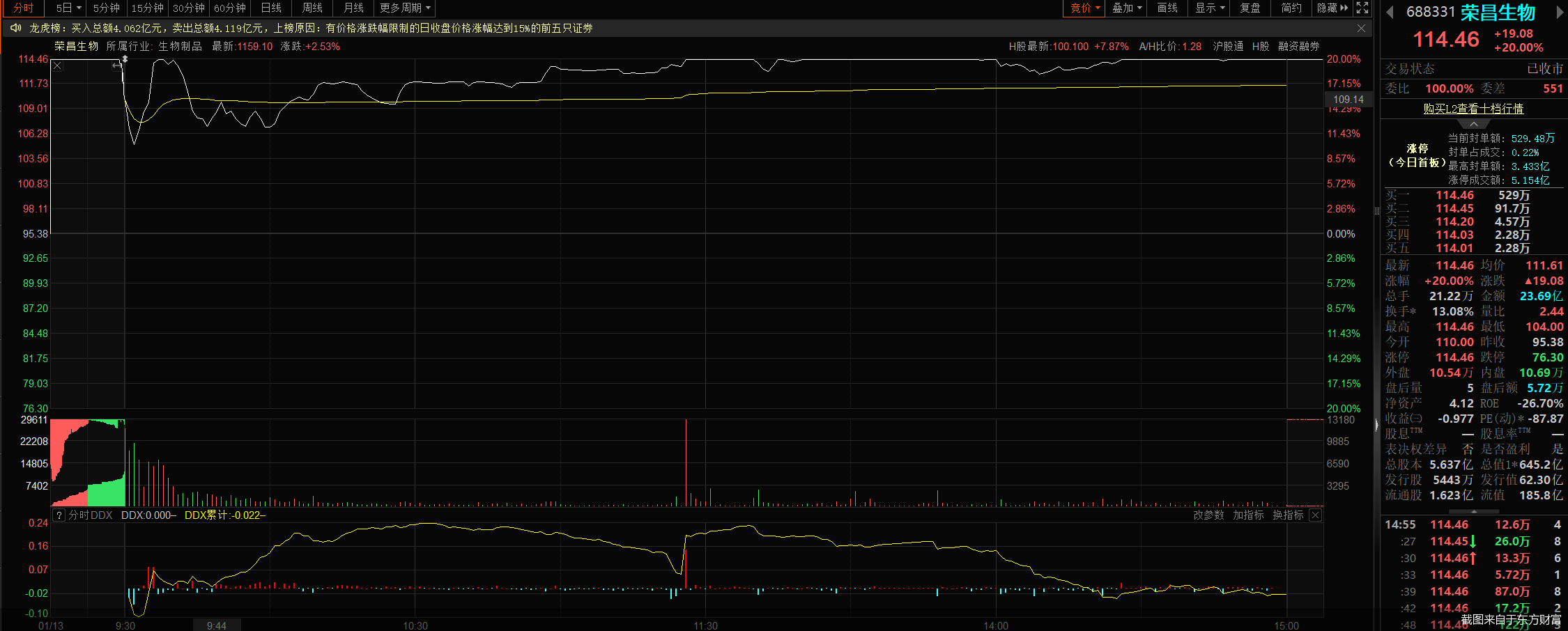
Group 1 - The closing price of Rongchang Biologics (688331) on January 13 was 114.46 yuan, reaching the daily limit with a trading volume of 2.369 billion yuan and a turnover rate of 13.08% [1] - The stock was listed on the daily trading list due to a price increase of 15% at the close [1] - The top five trading departments accounted for a total transaction of 818 million yuan, with a net selling of 5.703 million yuan [1] Group 2 - The main funds for Rongchang Biologics experienced a net outflow of 16.7599 million yuan on the same day [2] - The largest buying department was an institutional special seat with a purchase amount of 174.6668 million yuan, followed by the Shanghai-Hong Kong Stock Connect with 78.6782 million yuan [2] - The largest selling department was the Shanghai-Hong Kong Stock Connect with a selling amount of 145.5486 million yuan, followed by other institutional special seats [2]
港股通1月13日成交活跃股名单





Zheng Quan Shi Bao Wang· 2026-01-13 14:49
Market Overview - On January 13, the Hang Seng Index rose by 0.90%, with total southbound trading amounting to HKD 137.35 billion, including buy transactions of HKD 69.32 billion and sell transactions of HKD 68.03 billion, resulting in a net buying amount of HKD 1.30 billion [1] Southbound Trading Activity - The southbound trading through Stock Connect (Shenzhen) recorded a total trading amount of HKD 54.86 billion, with buy transactions of HKD 28.00 billion and sell transactions of HKD 26.85 billion, leading to a net buying amount of HKD 1.15 billion [1] - The southbound trading through Stock Connect (Shanghai) had a total trading amount of HKD 82.49 billion, with buy transactions of HKD 41.32 billion and sell transactions of HKD 41.17 billion, resulting in a net buying amount of HKD 0.15 billion [1] Active Stocks - Alibaba-W was the most actively traded stock with a total trading amount of HKD 139.06 billion and a net buying amount of HKD 10.71 billion, closing with a price increase of 3.63% [1][2] - Tencent Holdings followed with a total trading amount of HKD 52.93 billion and a net buying amount of HKD 7.56 billion, closing with a price increase of 0.72% [1][2] - Xiaomi Group-W had a total trading amount of HKD 49.62 billion and a net buying amount of HKD 6.07 billion, closing with a price decrease of 1.96% [1][2] Continuous Net Buying and Selling - Three stocks experienced continuous net buying for more than three days, with Xiaomi Group-W, Tencent Holdings, and Kuaishou-W having net buying days of 9, 5, and 3 respectively [2] - Tencent Holdings had the highest cumulative net buying amount of HKD 69.99 billion, followed closely by Xiaomi Group-W with HKD 69.33 billion [2] - Two stocks faced continuous net selling, with China Mobile and Meituan-W having net selling amounts of HKD 52.84 billion and HKD 11.67 billion respectively [2]
中国双抗再迎“高光”:荣昌收获56亿美元交易,康方闯关FDA
Mei Ri Jing Ji Xin Wen· 2026-01-13 12:33
Core Insights - The article highlights significant advancements in China's biopharmaceutical sector, particularly in the PD-1/VEGF dual antibody space, marked by major deals and regulatory submissions that indicate a shift from follower to leader status for Chinese companies in the global market [1][2][3]. Group 1: Major Developments - Rongchang Biopharma announced a $5.6 billion licensing agreement with AbbVie for its PD-1/VEGF dual antibody RC148, with an upfront payment of $650 million and potential milestone payments of up to $4.95 billion [2]. - Summit Therapeutics, a partner of Kangfang Biopharma, submitted a Biologics License Application (BLA) for Ivoris monoclonal antibody to the FDA, targeting EGFR-mutant non-small cell lung cancer, with a decision expected in Q4 2026 [3]. Group 2: Market Dynamics - The PD-1/VEGF dual antibody market is becoming increasingly competitive, with major pharmaceutical companies investing heavily, indicating the high commercial value of this therapeutic area [5][6]. - The termination of a collaboration between Yiming Biotech and Instil Bio serves as a cautionary tale, highlighting challenges faced by Chinese innovative drug companies in global markets, including the need for strong financial backing and execution capabilities [1][7]. Group 3: Future Outlook - The success of Kangfang's Ivoris monoclonal antibody in clinical trials could position it as a leading product in the market, potentially capturing significant market share if it demonstrates strong overall survival data [4][10]. - The increasing number of PD-1/VEGF products in clinical stages, with 14 products linked to Chinese companies, suggests a crowded competitive landscape, which may complicate future business development opportunities for companies like Yiming Biotech [8][9].
再度签订重磅BD!荣昌生物双抗药物56亿美元出海,能否实现资金“突围”
Bei Jing Shang Bao· 2026-01-13 11:42
Core Viewpoint - Rongchang Biologics has signed a significant exclusive licensing agreement with AbbVie for the dual-specific antibody drug RC148, with an upfront payment of $650 million and potential milestone payments up to $4.95 billion, totaling approximately $5.6 billion. This deal has led to a substantial increase in the company's stock prices, with A-shares hitting the daily limit and H-shares also experiencing significant gains [1][3][4]. Financial Impact - On January 13, Rongchang Biologics' A-shares opened 15.33% higher and closed at the daily limit of 114.46 yuan per share, marking a 20% increase and a total market capitalization of 645.2 billion yuan. The trading volume reached 2.369 billion yuan with a turnover rate of 13.08% [3]. - The H-shares also saw a rise, closing at 100.1 HKD per share, up 7.87% [4]. - The $650 million upfront payment from AbbVie is expected to alleviate the company's short-term cash flow issues, which have been a concern due to a high debt ratio of 61.18% and cash reserves of 1.07 billion yuan as of Q3 2025 [10][13]. Business Development Transactions - Since 2025, Rongchang Biologics has completed three major business development (BD) transactions, including the recent agreement with AbbVie. Previous deals included licensing agreements with Vor Bio and Santen Pharmaceutical, which also involved significant upfront and milestone payments [8][9]. - The RC148 drug targets PD-1 and VEGF pathways, aiming to enhance anti-tumor immune responses while inhibiting tumor-driven angiogenesis. Clinical studies are ongoing in China for various advanced malignancies [6][9]. Market Position and Future Outlook - The dual-target PD-1/VEGF antibody has become a popular target among multinational pharmaceutical companies, indicating a competitive landscape for such innovative therapies [7]. - The company aims to balance external licensing ("authorized blood transfusion") with internal development ("self-blood production") to ensure sustainable growth and enhance long-term value [14][15].
智通港股通活跃成交|1月13日

智通财经网· 2026-01-13 11:02
Core Insights - On January 13, 2026, Alibaba-W (09988), Tencent Holdings (00700), and Xiaomi Group-W (01810) were the top three companies by trading volume in the Southbound Stock Connect, with trading amounts of 81.05 billion, 29.45 billion, and 28.57 billion respectively [1] - The same companies also led in trading volume in the Shenzhen-Hong Kong Stock Connect, with trading amounts of 58.01 billion, 23.48 billion, and 21.05 billion respectively [1] Southbound Stock Connect (Shanghai-Hong Kong) - Alibaba-W (09988) had a trading amount of 81.05 billion and a net buy amount of -90.46 million [2] - Tencent Holdings (00700) recorded a trading amount of 29.45 billion with a net buy amount of +6.61 million [2] - Xiaomi Group-W (01810) achieved a trading amount of 28.57 billion and a net buy amount of +3.24 billion [2] - Other notable companies included Goldwind Technology (02208) with 23.07 billion and a net buy of +85.70 million, and SMIC (00981) with 22.72 billion and a net buy of -1.73 billion [2] Southbound Stock Connect (Shenzhen-Hong Kong) - Alibaba-W (09988) had a trading amount of 58.01 billion and a net buy amount of +1.16 billion [2] - Tencent Holdings (00700) recorded a trading amount of 23.48 billion with a net buy amount of +749 million [2] - Xiaomi Group-W (01810) achieved a trading amount of 21.05 billion and a net buy amount of +283 million [2] - Other significant companies included SMIC (00981) with 18.13 billion and a net buy of -661 million, and Kuaishou-W (01024) with 12.21 billion and a net buy of +114 million [2]