NNCI(600301)

Search documents
A股异动丨行业稳增长方案出台,有色金属板块集体强势,锡业股份等多股涨停
Ge Long Hui A P P· 2025-09-30 03:09
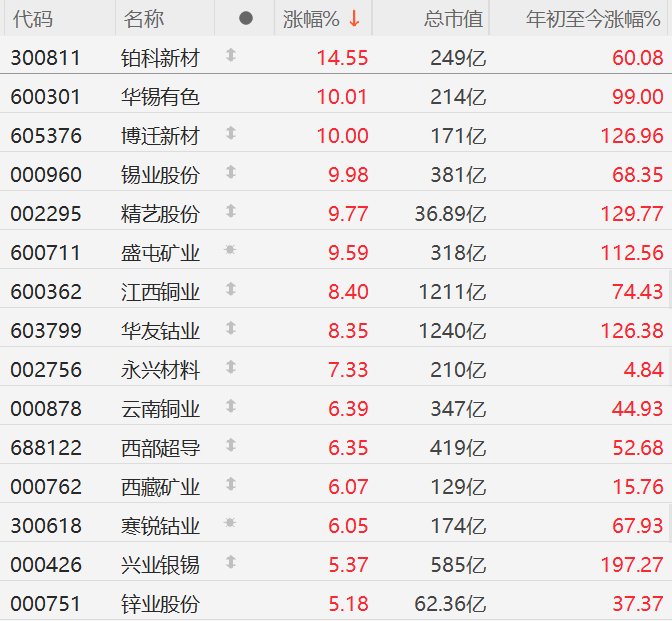
Group 1 - The core viewpoint of the news highlights a strong performance in the A-share market for the non-ferrous metal sector, with significant gains in various companies following the release of a new growth plan for the industry [1] - On September 28, eight departments issued the "Non-Ferrous Metal Industry Stabilization and Growth Work Plan (2025-2026)", aiming for an average annual growth of about 5% in the industry's added value and a 1.5% annual growth in the production of ten non-ferrous metals [1] - The plan emphasizes the need for improved resource development in copper, aluminum, and lithium, with a target of exceeding 20 million tons in recycled metal production and enhancing the supply capacity of high-end products [1] Group 2 - Notable stock performances include: - Platinum Technology Materials up 14.55% with a market cap of 24.9 billion [2] - Huaxi Nonferrous up 10.01% with a market cap of 21.4 billion [2] - Boji New Materials up 10% with a market cap of 17.1 billion [2] - Other companies such as Xiyang Co., Jiangxi Copper, and Huayou Cobalt also saw significant increases, with gains ranging from 5% to over 8% [1][2] - The overall market sentiment is positive, driven by the MACD golden cross signal formation, indicating a favorable trend for these stocks [2]





有色板块强势,钴、镍概念表现亮眼,华友钴业等涨停
Zheng Quan Shi Bao Wang· 2025-09-30 02:41
Group 1 - The core viewpoint of the news is the strong performance of the non-ferrous metal sector, particularly cobalt and nickel concepts, with several companies reaching their daily limit up [1] - The Ministry of Industry and Information Technology, along with seven other departments, has issued a "Non-Ferrous Metal Industry Stabilization Growth Work Plan (2025-2026)" [1] - The plan sets a target for the non-ferrous metal industry to achieve an average annual value-added growth of around 5% from 2025 to 2026, with a 1.5% average annual growth in the production of ten non-ferrous metals [1][2] Group 2 - The plan emphasizes the development of domestic resources for copper, aluminum, and lithium, with a target of exceeding 20 million tons in recycled metal production [2] - It proposes a new round of exploration strategies to enhance resource investigation for copper, aluminum, lithium, nickel, cobalt, and tin, aiming to generate new exploration results [2] - The document also aims to optimize the competitive landscape in oversupplied sectors such as alumina, copper smelting, and lithium carbonate, suggesting a focus on the profit elasticity of related sector companies [2]


有色板块持续走高 盛屯矿业等多股涨停
Xin Lang Cai Jing· 2025-09-30 02:19
Group 1 - The non-ferrous metal sector is experiencing significant gains, with copper, cobalt, and tin leading the rise [1] - Companies such as Shengton Mining, Huayou Cobalt, Huaxi Nonferrous, Xiyu Co., and Boqian New Materials have reached their daily limit increase [1] - Jiangxi Copper, Yunnan Copper, Hanrui Cobalt, and Xingye Silver Tin have all seen their stock prices increase by over 7% [1]
有色金属周报:自由港铜矿超预期减产,看好铜板块机会-20250928
SINOLINK SECURITIES· 2025-09-28 08:25
Investment Rating - The report maintains a positive outlook on copper, aluminum, and precious metals, indicating a high level of market activity and potential for growth in these sectors [13][16]. Core Insights - Copper prices have surged due to unexpected production cuts, leading to significant supply shortages and rapid price increases [13]. - Aluminum is showing signs of recovery with inventory levels decreasing and downstream processing rates improving, suggesting a potential for sustained high profitability [15]. - Precious metals, particularly gold, are expected to rise further due to market anticipation of continuous interest rate cuts [16]. Summary by Sections Copper - This week, LME copper price increased by 2.09% to $10,205.00 per ton, while Shanghai copper rose by 3.20% to 82,500 yuan per ton [14]. - Supply side: The import copper concentrate processing fee index rose to -$40.36 per ton; national copper inventory decreased by 4,400 tons to 140,100 tons [14]. - Consumption side: Brass rod enterprises' operating rate was 48.49%, showing a slight increase of 0.71 percentage points [14]. Aluminum - This week, LME aluminum price decreased by 1.01% to $2,649.00 per ton, and Shanghai aluminum fell by 0.24% to 20,700 yuan per ton [15]. - Supply side: Electrolytic aluminum ingot inventory in major consumption areas dropped by 21,000 tons to 617,000 tons [15]. - Demand side: Downstream processing enterprises' operating rate increased by 0.8 percentage points to 63.0%, driven by pre-holiday stocking [15]. Precious Metals - This week, COMEX gold price rose by 0.23% to $3,789.80 per ounce, with SPDR gold holdings increasing by 5.15 tons to 1,005.72 tons [16]. - The market is experiencing fluctuations due to U.S. tariffs and escalating geopolitical risks, contributing to a volatile trading environment [16]. Rare Earths - The price of praseodymium and neodymium oxide decreased, while the export volume of magnetic materials saw significant growth [32]. - Domestic rare earth separation enterprises are preparing for production halts, indicating potential supply constraints [32]. Antimony - Antimony ingot price is at 174,900 yuan per ton, showing a decrease of 2.26% [33]. - The demand for antimony is expected to recover as the photovoltaic glass market stabilizes [33]. Molybdenum - Molybdenum concentrate price is 4,450 yuan per ton, with a slight decrease of 0.45% [34]. - The demand for molybdenum is expected to rise as major steel mills resume procurement [34]. Tin - Tin ingot price increased by 1.74% to 273,700 yuan per ton, with inventory decreasing by 6.14% [35]. - The supply-demand dynamics are favorable, supported by strong inventory levels and demand from the semiconductor sector [35].


A股小金属概念股普涨,华锡有色涨超6%
Ge Long Hui· 2025-09-24 01:59
Group 1 - The A-share market saw a broad increase in small metal concept stocks, indicating positive market sentiment in this sector [1] - Huaxi Nonferrous Metals surged over 6%, reflecting strong investor interest and potential growth in the company [1] - Haotong Technology rose more than 3%, suggesting a favorable outlook for its business performance [1] Group 2 - Guiyan Platinum Industry increased by over 2%, indicating a positive trend in the precious metals segment [1] - Other companies such as China Rare Earth, Zhongkuang Resources, Guangsheng Nonferrous Metals, and Zhongtung High-tech also experienced gains, highlighting a broader rally in the small metal sector [1]


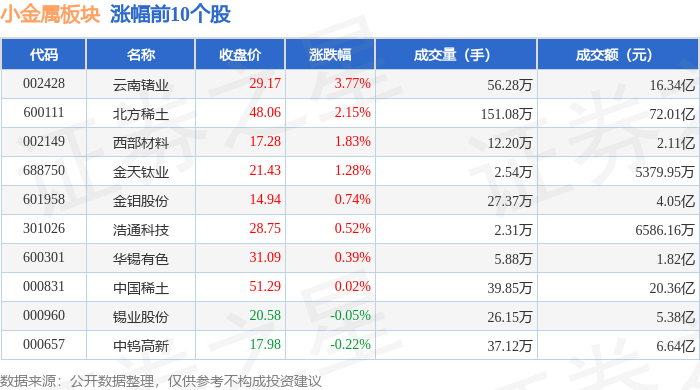
小金属板块9月22日涨0.39%,云南锗业领涨,主力资金净流出6.11亿元
Zheng Xing Xing Ye Ri Bao· 2025-09-22 08:40
Market Overview - The small metals sector increased by 0.39% on September 22, with Yunnan Zhenye leading the gains [1] - The Shanghai Composite Index closed at 3828.58, up 0.22%, while the Shenzhen Component Index closed at 13157.97, up 0.67% [1] Individual Stock Performance - Yunnan Zhenye (002428) closed at 29.17, up 3.77% with a trading volume of 562,800 shares and a turnover of 1.634 billion yuan [1] - Northern Rare Earth (600111) closed at 48.06, up 2.15% with a trading volume of 1,510,800 shares and a turnover of 7.201 billion yuan [1] - Western Materials (002149) closed at 17.28, up 1.83% with a trading volume of 122,000 shares and a turnover of 211 million yuan [1] - Other notable performances include Jintian Titanium (688750) at 21.43, up 1.28%, and China Rare Earth (000831) at 51.29, up 0.02% [1] Capital Flow Analysis - The small metals sector experienced a net outflow of 611 million yuan from institutional investors and 312 million yuan from speculative funds, while retail investors saw a net inflow of 922 million yuan [2] - Yunnan Zhenye had a net inflow of 113 million yuan from institutional investors, but a net outflow of 106 million yuan from speculative funds [3] - Northern Rare Earth saw a net inflow of 70.871 million yuan from institutional investors, while speculative funds had a net outflow of 196 million yuan [3]


化工装置深挖系列二:聚酯产业链上下游配套与边际装置分析
Hua Tai Qi Huo· 2025-09-22 07:54
1. Report Industry Investment Rating No relevant information provided. 2. Core Viewpoints of the Report The report is the second in the series of in - depth studies on chemical plants. It analyzes the upstream - downstream matching of the polyester industry chain and the marginal plants of futures varieties such as PX, PTA, PR, and PF. PTA enterprises with PX or polyester matching account for 91.6% of the production capacity, PX with downstream matching accounts for 82.0% of the production capacity, and polyester with upstream matching accounts for 72.1% of the production capacity. The marginal plants are identified from aspects like old plants, small single - line production capacity or enterprise scale, high production process costs, and long distances for raw material procurement or product sales [3][4]. 3. Summary According to the Directory 3.1 Polyester Industry Chain Upstream - Downstream Matching Analysis 3.1.1 Group - Based Upstream - Downstream Matching As of the end of July 2025, China's PX, PTA, and polyester production capacities were 4367, 9171.5, and 8894 tons respectively. The theoretical annual PX gap was 1640 tons, and the theoretical annual PTA surplus was 1567 tons. PTA enterprises with PX or polyester matching accounted for 91.6% of the production capacity, PX with downstream matching accounted for 82.0% of the production capacity, and polyester with upstream matching accounted for 72.1% of the production capacity. The enterprises in the polyester industry chain can be classified into four types: those with complete PX/PTA/polyester matching; those mainly with polyester and PTA matching but little PX matching; those with only PX and PTA matching; and those with relatively single matching [10][11]. 3.1.2 Region - Based Upstream - Downstream Matching The production capacity of the polyester industry chain is concentrated in Zhejiang, Jiangsu, Liaoning, Guangdong, Fujian, etc. Except for Shandong having a large surplus of PX for sale, most other regions have PX production capacity gaps or are basically balanced. Zhejiang, Jiangsu, and Liaoning have the largest PX gaps. In terms of PTA, Jiangsu and Zhejiang have large PTA production capacity gaps, while Liaoning, Guangdong, and other regions have PTA surpluses [12][15][16]. 3.2 PX Marginal Plant Analysis As of the end of July 2025, China's total PX production capacity was 4367 tons, with an effective operating capacity of 4254 tons. PX production capacity is mainly distributed in Zhejiang, Liaoning, Jiangsu, Guangdong, Shandong, etc. The marginal PX plants are identified from aspects such as production time, single - set scale, and production process. Old plants (over 20 years in production), small - scale plants (less than 100 tons), and medium - short - process plants (accounting for 17.4% of the total production capacity) are more likely to be marginal plants [20][23][30]. 3.3 PTA Marginal Plant Analysis As of the end of July 2025, the total PTA production capacity was 9171.5 tons, with 836.5 tons having been shut down for more than half a year. PTA production capacity is mainly distributed in coastal areas such as Zhejiang, Jiangsu, Liaoning, Guangdong, and Fujian. The marginal PTA plants are mainly those with a production capacity of less than 200 tons and put into production before 2020, with a total capacity of 1295 tons, accounting for 14.1% [34][40][41]. 3.4 PR Marginal Plant Analysis As of the end of July 2025, the total PR production capacity was 2168 tons, mainly distributed in Jiangsu, Hainan, and Liaoning. The top four bottle - chip manufacturers account for 78% of the total production capacity. The marginal bottle - chip plants are those that meet one or more of the following conditions: long production time, small plant scale, lack of upstream - downstream matching ability of the group, and high freight costs due to long distances for raw material procurement or product sales. A total of 326 tons of production capacity may be marginal plants, accounting for 15% [44][51][54]. 3.5 PF Marginal Plant Analysis As of the end of July 2025, the total PF production capacity was 968.5 tons, mainly distributed in Jiangsu, Zhejiang, and Fujian. The top four short - fiber manufacturers account for 46% of the total production capacity. Plants with a production time of over 20 years are mainly concentrated in Jiangsu and Fujian. Small - scale plants (less than 20 tons) are more likely to be marginal plants. The difference in processing costs between new and old plants is not significant, and the survival of old plants depends more on market dynamic balance [55][57][62].



“盛泽织造”:纺织小镇凭何供货爱马仕、HM?丨活力中国调研行
2 1 Shi Ji Jing Ji Bao Dao· 2025-09-16 04:26
Core Insights - The textile industry in Shengze, Suzhou, is thriving despite uncertainties in the international market, with companies like Suzhou Roman Roland Fashion Group and Minsk Trade Co. leading the way in innovation and market expansion [1][2][3] Group 1: Company Performance - Suzhou Roman Roland, a supplier for major brands like LVMH and Nike, has an average fabric price six times higher than its peers, showcasing its focus on high-end, innovative materials [1][3] - Minsk Trade Co. has seen a significant increase in exports to the Middle East, with sales exceeding $50 million in the first seven months of the year, marking a year-on-year growth of over 190% [1][5] - Shengze's industrial output reached nearly 50.8 billion yuan in the first half of the year, with total import and export value at 10.96 billion yuan, including 9.99 billion yuan in exports, reflecting an 8.4% increase year-on-year [2] Group 2: Market Strategy - Roman Roland's transformation from a traditional textile company to an innovative fabric developer has been driven by a commitment to R&D, with 7% of sales revenue reinvested into innovation [3] - Minsk's strategic pivot to the Middle East market has been successful due to its comprehensive production and transportation capabilities, allowing it to meet the specific demands of that region [5][6] - The establishment of the Shengze Oriental Textile City and the cross-border e-commerce industrial park has created a dual market platform, enhancing the region's textile trade capabilities [7][8] Group 3: Industry Development - Shengze has built a complete industrial chain from silk reeling to garment manufacturing, supported by leading companies like Hengli Group and Shenghong Group, which supply advanced raw materials [6][5] - The local government has facilitated the growth of the textile industry through initiatives like the "Shengze Design Boundary" platform, which supports designers and fosters brand development [9] - The region is focused on transitioning to a high-end textile industry, with ongoing efforts to cultivate local brands and enhance the overall market presence [9]
超3300只个股下跌
第一财经· 2025-09-15 07:43
Core Viewpoint - The article discusses the performance of the stock market on September 15, highlighting mixed results among major indices and sector performances, with a focus on active sectors like gaming and pork, while noting the underperformance of certain materials sectors [2][5][10]. Market Performance - The three major indices closed with mixed results: Shanghai Composite Index at 3860.5 points, down 0.26%; Shenzhen Component Index at 13005.77 points, up 0.63%; and ChiNext Index at 3066.18 points, up 1.52% [2][3]. - The total trading volume in the Shanghai and Shenzhen markets was 2.28 trillion yuan, a decrease of 245.8 billion yuan from the previous trading day, with over 3300 stocks declining and more than 1900 stocks rising [2][3]. Sector Performance - Active sectors included pork (+2.82%), gaming (+3.65%), and automotive parts, while superconductors and retail concepts showed weak performance [5][6]. - Notable stocks in the gaming sector included Xinghui Entertainment, which hit a 20% limit up, and Perfect World, which also reached the limit up, with several other gaming stocks rising over 6% [6]. - In the pork sector, stocks like Delisi and Aonong Biological reached their daily limit, while Tiankang Biological rose over 8% [7]. Capital Flow - Main capital inflows were observed in the automotive, electric equipment, and machinery sectors, while there were outflows from electronics, communications, and defense sectors [10]. - Specific stocks with significant net inflows included BYD, Top Group, and Zhongdali De, with net inflows of 840 million yuan, 716 million yuan, and 700 million yuan respectively [11]. - Conversely, stocks like Northern Rare Earth, Wolong Electric Drive, and Zhongji Xuchuang faced substantial net outflows of 2.01 billion yuan, 1.83 billion yuan, and 1.386 billion yuan respectively [12]. Institutional Views - Citic Securities noted that the market is entering a high-level consolidation phase, with macro trading becoming a significant variable affecting market direction [14]. - Huatai Securities expressed a positive mid-term outlook for the domestic fundamentals, suggesting maintaining a high position while focusing on cost-effectiveness and industry prosperity [14].





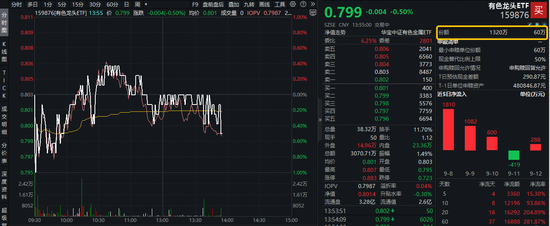
本周!美联储将大幅降息?早有资金进场布局!有色龙头ETF(159876)近20日吸金1.63亿元,规模创新高!
Xin Lang Ji Jin· 2025-09-15 06:11
Group 1 - The core viewpoint of the article highlights the recent performance and investment trends in the non-ferrous metals sector, particularly focusing on the Non-Ferrous Metal Leader ETF (159876) which has seen significant net subscriptions and capital inflow [1][2] - The Non-Ferrous Metal Leader ETF (159876) has attracted a total of 33.6 million yuan in the last five days and 163 million yuan over the past 20 days, reaching a historical high of 263 million yuan as of September 12 [1] - The anticipated interest rate cut by the Federal Reserve is expected to boost non-ferrous metal prices due to increased demand for physical assets, a weaker dollar making metals cheaper, and lower borrowing costs for companies [1][2] Group 2 - The macroeconomic environment is favorable for metal prices due to the Federal Reserve's easing policies and domestic initiatives aimed at optimizing production factors and improving profitability [2][3] - The strategic metals such as rare earths, tungsten, and antimony are expected to benefit from global geopolitical dynamics, while lithium, cobalt, and aluminum are influenced by domestic "anti-involution" policies [3] - The supply-demand balance for industrial metals like copper and aluminum remains tight, driven by demand from emerging industries and limited supply increases [3] Group 3 - In terms of individual stock performance, leading companies in the lithium sector, such as Ganfeng Lithium and Tianqi Lithium, have seen significant gains, while some companies in the non-ferrous sector have experienced declines [4]