
NNCI(600301)

Search documents
华锡有色(600301) - 广西华锡有色金属股份有限公司关于2026年度投资计划的公告
2025-12-31 09:45
证券代码:600301 证券简称:华锡有色 编号:2026-005 本公司董事会及全体董事保证本公告内容不存在任何虚假记载、误导性陈 述或者重大遗漏,并对其内容的真实性、准确性和完整性承担法律责任。 重要内容提示: 广西华锡有色金属股份有限公司(以下简称"公司")及下属子公司 2026 年计划投资金额约 16.67 亿元。 公司 2026 年度投资计划中,新建项目计划投资金额约 12.04 亿元,续建项 目计划投资金额约 4.63 亿元。 | 分类 | 2026 | 年度计划投资(万元) | 占 2026 | 年度计划比例 | | --- | --- | --- | --- | --- | | 新建项目 | | 120,384.43 | | 72.23% | | 续建项目 | | 46,294.22 | | 27.77% | | 合计 | | 166,678.65 | | 100.00% | 2026 年度投资计划概况(按项目性质分类) 1 (二)按项目功能性分类情况 此投资计划为公司及子公司 2026 年度投资的预算安排,投资项目的实施 与公司经营环境、发展战略等诸多因素相关,在具体实施中,可能存在投资计划 ...

华锡有色(600301) - 广西华锡有色金属股份有限公司关于2026年度期货套期保值计划的公告
2025-12-31 09:45
证券代码:600301 证券简称:华锡有色 编号:2026-007 本公司董事会及全体董事保证本公告内容不存在任何虚假记载、误导性陈述 或者重大遗漏,并对其内容的真实性、准确性和完整性承担法律责任。 重要内容提示: 交易主要情况 | | □获取投资收益 | | --- | --- | | 交易目的 | ☑套期保值(合约类别:☑商品;□外汇;□其他:________) | | | □其他:________ | | 交易品种 | 锡 | | 交易金额 | 预计动用的交易保证金和权利金 15,504 上限(单位:万元) | | | 预计任一交易日持有的最高合约 64,600 价值(单位:万元) | | 资金来源 | ☑自有资金 □借贷资金 □其他:___ | | 交易期限 | 2025 年 12 月 31 日至 2026 年 12 月 31 日 | 已履行的审议程序 同时也会存在一定的市场风险、资金风险和交易风险等,敬请广大投资者注意投 资风险。 一、交易情况概述 (一)交易目的 为有效规避和降低公司生产经营相关原料和产品价格波动风险,保证产品成 本的相对稳定,公司按照生产经营计划,结合现货库存、原料、预期采购量或 ...
华锡有色:2026年计划投资约16.67亿元
Xin Lang Cai Jing· 2025-12-31 09:22
华锡有色(600301.SH)公告称,公司及下属子公司2026年计划投资金额约16.67亿元。其中,新建项目计 划投资12.04亿元,续建项目计划投资4.63亿元。公司2026年度投资计划的实施有利于公司强化资源掌控 能力,加强矿山安全环保管理,提高矿山智能化、绿色化水平,提升产品质量,推进强链、补链、延 链,实现公司高质量、可持续发展。 ...
战略金属行业2026年投资策略:供需向好与资源民族主义共振,看好战略金属投资机会
EBSCN· 2025-12-28 01:59
Core Insights - The report highlights the positive outlook for strategic metals investment opportunities due to favorable supply-demand dynamics and resource nationalism [3][5][11]. Market Review: Strategic Metals Lead Nonferrous - From the beginning of the year until December 18, 2025, the nonferrous metals sector has risen by 78.53%, ranking second among all industries. Strategic metals have shown significant gains, with tungsten up 136.7%, cobalt up 69.1%, and rare earth permanent magnets up 56.7% [7]. Cobalt: Supply Tightening from Congo (DRC) - The Democratic Republic of Congo (DRC) has implemented an export quota system for cobalt, leading to a projected supply-demand imbalance of -7.5/-3.3/-3.3 million tons for 2025-2027. The DRC's export ban and subsequent quota system are expected to keep cobalt prices elevated [3][14][16]. Rare Earths: Supply Expectations Tightening - The rare earth sector is experiencing tightening supply due to strategic export controls and a lack of public quota announcements. The price of light rare earths has seen fluctuations, with a peak price of 64.30 million yuan/ton for praseodymium and neodymium oxides in August 2025, followed by a decline [22][26][46]. Tungsten: Continued Supply-Demand Gap - The tungsten market is facing a supply squeeze due to mining restrictions and declining ore grades. Demand remains stable, supported by applications in military and photovoltaic sectors, suggesting that tungsten prices are likely to rise [3][5]. Tin: Supply Tightness and AI Demand Growth - The resumption of tin production in Myanmar is slow, with significant delays expected. However, the rapid development of AI is emerging as a new growth driver for tin demand [3][5]. Antimony: Export Recovery Expected - The suspension of export restrictions to the U.S. is anticipated to boost China's antimony exports, which currently account for 36% of its production. The lifting of these restrictions is expected to enhance export volumes significantly [5]. Investment Recommendations - The report suggests focusing on companies benefiting from the tightening supply of strategic metals, including Huayou Cobalt, China Rare Earth, and Xiamen Tungsten. Specific recommendations include companies with significant cobalt production quotas in the DRC and those involved in rare earth processing [5][3].


长江有色:汇率东风引热钱金属配置逻辑生变 26日锡价或涨跌不大
Xin Lang Cai Jing· 2025-12-26 02:36
Group 1 - The core viewpoint is that the tin market is experiencing unprecedented structural forces, driven by supply constraints from key producing regions and a demand revolution fueled by AI, renewable energy, and photovoltaic applications [2] - Supply growth is facing rigid bottlenecks due to policy, geopolitical issues, and resource depletion in major production areas like Myanmar, Indonesia, and the Democratic Republic of Congo, exposing the fragility of the traditional supply system [2] - A fundamental rebalancing of supply and demand is pushing industry profits and market focus towards companies with resource and high-end manufacturing capabilities, such as China's Xiyu Co., Indonesia's PT Timah, and Huaxin Nonferrous [2] Group 2 - Tin has transitioned from a common industrial metal to a key strategic material essential for the global digital economy and green transition, with short-term prices expected to fluctuate between 330,000 and 340,000 yuan/ton [3] - The market is entering a new phase where pricing is determined by both resource scarcity and technological demand, reflecting the ongoing tension between long-term supply anxiety and emerging demand realities [3] - Multiple favorable factors are resonating in the context of macro liquidity turning accommodative and a weakening dollar, contributing to sustained high price levels for tin [2]


算力金属锡突发异动,半个月暴涨4万元/吨!月内大涨超11%
2 1 Shi Ji Jing Ji Bao Dao· 2025-12-25 18:02
Core Viewpoint - The recent surge in tin prices, driven by supply constraints and geopolitical factors, has raised concerns within the industry regarding the impact on downstream companies and the overall market stability [1][3][11]. Group 1: Price Movements - Tin prices have reached new highs, with LME tin increasing by 11.5% and SHFE tin by over 13% since December 2025, with a notable rise of over 40,000 yuan per ton in just half a month [1][5]. - The LME three-month tin futures contract and SHFE main contract have both set new records, surpassing $43,900 per ton and 349,000 yuan per ton, respectively [5]. - As of December 24, the SHFE main contract saw a decline of over 3%, trading at 335,800 yuan per ton [5]. Group 2: Supply and Demand Dynamics - Supply from major producing countries like the Democratic Republic of Congo and Myanmar is stabilizing, with domestic tin smelting capacity fully utilized, resulting in a production of 189,000 tons from January to November, a year-on-year increase of 6.2% [7]. - Despite growth in emerging sectors like photovoltaics and automotive electronics, traditional demand remains stable, with global tin consumption expected to grow by nearly 3% in 2025, slightly below production growth [7]. - The global tin market is currently experiencing a supply surplus of approximately 10,000 tons, attributed to a slowdown in overseas demand [7]. Group 3: Industry Concerns - The rapid price increase has created significant pressure on downstream tin-consuming industries, such as solder, tinplate, and chemicals, leading to challenges in fulfilling long-term contracts and maintaining product quality [3][11]. - The Tin Industry Association has called for rational market behavior to avoid speculative bubbles and ensure price stability, emphasizing the need for a balanced approach to pricing [11][12]. - Companies like Xiyang Co., Huaxi Nonferrous Metals, and Xingye Silver Tin are positioned differently within the market, with varying potential for performance based on their business models and exposure to tin price fluctuations [11][12].
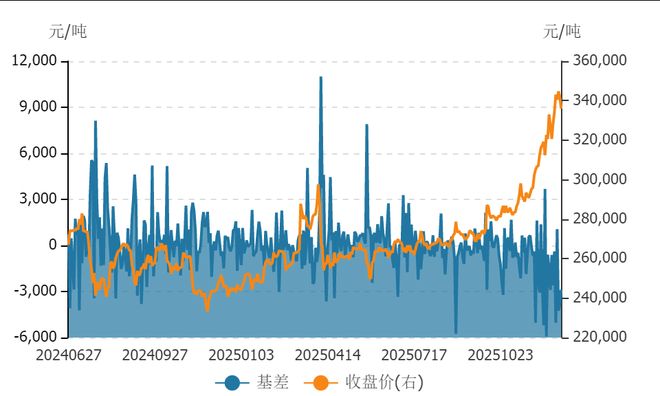
“算力金属”伦锡月涨超过11% 行业协会发文倡议理性谨慎
2 1 Shi Ji Jing Ji Bao Dao· 2025-12-24 23:10
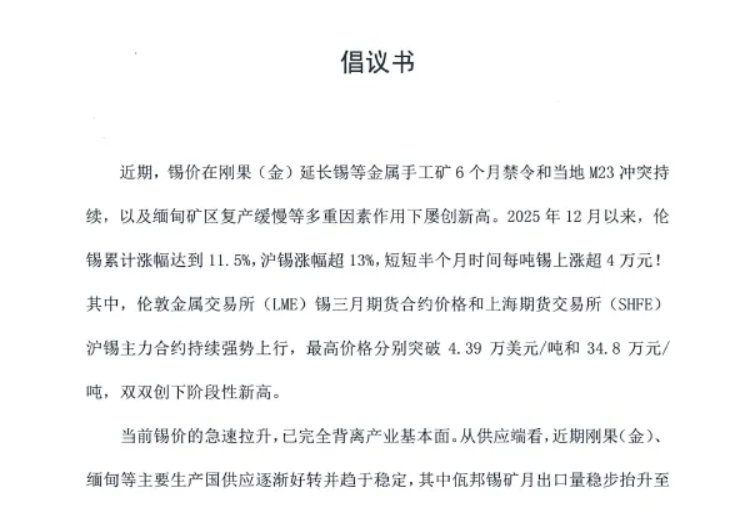
Core Viewpoint - The recent surge in tin prices is driven by multiple factors, including supply disruptions in major producing countries and increased demand from emerging sectors, leading to significant pressure on downstream industries [1][4]. Group 1: Price Movements - Since December 2025, tin prices have increased significantly, with LME tin rising by 11.5% and SHFE tin by over 13%, translating to an increase of more than 40,000 yuan per ton in just half a month [2]. - LME three-month tin futures and SHFE main contracts have reached record highs, surpassing $43,900 per ton and 348,000 yuan per ton, respectively [3][4]. - The price increase has been more pronounced in tin compared to other industrial metals, with the best-performing copper only rising by less than 7% during the same period [2]. Group 2: Supply and Demand Dynamics - Supply from major producing countries like the Democratic Republic of Congo and Myanmar is stabilizing, with domestic tin smelting capacity fully released, resulting in a production of 189,000 tons from January to November, a 6.2% year-on-year increase [4]. - Despite growth in demand from sectors like photovoltaics and automotive electronics, traditional sectors show stable demand, with global tin consumption expected to grow by nearly 3% in 2025, lagging behind production growth [4]. - The global tin market is currently experiencing a supply surplus of approximately 10,000 tons, attributed to a slowdown in overseas demand [4]. Group 3: Industry Challenges - The rapid price increase has created significant pressure on downstream industries, particularly for small and medium-sized enterprises in sectors like solder, tinplate, and chemicals, leading to difficulties in fulfilling long-term contracts and maintaining product quality [2][8]. - The electronic manufacturing sector, a major consumer of tin-based solder, faces acute cost pressures due to soaring tin prices, impacting profit margins in PCB manufacturing and semiconductor packaging [8]. - The Tin Industry Association has called for a rational and cautious approach from all market participants to avoid speculative behavior and to guide prices back to a reasonable range [8].
“算力金属”伦锡月涨超过11%,行业协会发文倡议保持理性谨慎
2 1 Shi Ji Jing Ji Bao Dao· 2025-12-23 11:12
Core Viewpoint - The recent surge in tin prices, driven by supply constraints and geopolitical factors, has raised concerns within the industry, particularly affecting downstream companies that rely on tin for production [1][7]. Group 1: Price Trends and Market Dynamics - Tin prices have reached new highs, with LME tin increasing by 11.5% and SHFE tin by over 13% since December 2025, with a rise of over 40,000 yuan per ton in just half a month [3][5]. - The price of LME three-month tin futures and SHFE main contracts have both surpassed significant thresholds, reaching 43,900 USD per ton and 348,000 yuan per ton, respectively [5]. - The tin industry is experiencing a supply surplus of approximately 10,000 tons, with the recent price increase attributed more to market sentiment and capital flows rather than fundamental supply-demand dynamics [7]. Group 2: Supply and Demand Factors - Supply from major producing countries like the Democratic Republic of Congo and Myanmar is stabilizing, with domestic tin smelting capacity also being fully utilized, resulting in a production increase of 6.2% year-on-year [6]. - Despite growth in emerging sectors such as photovoltaics and automotive electronics, traditional demand remains stable, with global tin consumption expected to grow by nearly 3% in 2025, slightly below production growth [6]. Group 3: Impact on Industry Players - The rapid price increase has created significant pressure on downstream tin-consuming industries, such as solder, tinplate, and chemicals, leading to challenges in fulfilling long-term contracts and maintaining product quality [4][21]. - Companies like Yunnan Tin Company (000960), Huaxi Nonferrous Metals (600301), and Xingye Silver Tin (000426) are positioned differently within the market, with varying degrees of exposure to price fluctuations and potential earnings volatility [13]. - As of December 23, 2025, the stock prices of these companies have reflected the anticipated earnings growth due to rising tin prices, with annual increases of 103%, 127%, and 218% respectively [19]. Group 4: Industry Recommendations - The tin industry association has called for a rational and cautious approach from all market participants to avoid speculative behavior and to guide prices back to a reasonable range, emphasizing the need for a stable market mechanism [21].
华锡有色股价跌5.13%,汇添富基金旗下1只基金重仓,持有13.94万股浮亏损失28.86万元
Xin Lang Cai Jing· 2025-12-23 05:40
Group 1 - The core point of the news is that Guangxi Huaxi Nonferrous Metals Co., Ltd. experienced a decline in stock price by 5.13%, trading at 38.31 yuan per share, with a total market capitalization of 24.234 billion yuan [1] - The company was established on June 15, 1998, and listed on July 12, 2000, primarily engaged in the exploration, mining, and processing of nonferrous metals such as tin, zinc, lead, and antimony [1] - The main revenue composition of the company includes 91.82% from nonferrous metal products, 4.61% from deep processing of nonferrous metals, 2.43% from engineering supervision and other services, 0.89% from other supplementary services, and 0.25% from surveying, design, and consulting services [1] Group 2 - From the perspective of fund holdings, Huaxi Nonferrous is a significant investment for the Huatai-PineBridge Fund, with the Huatai-PineBridge Multi-Asset Income Fund holding 139,400 shares, representing 1.88% of the fund's net value [2] - The fund has incurred an estimated floating loss of approximately 288,600 yuan due to the decline in Huaxi Nonferrous's stock price [2] - The Huatai-PineBridge Multi-Asset Income Fund was established on June 16, 2023, with a current scale of 90.6592 million yuan, and has achieved a year-to-date return of 5.01% [2]
华锡有色涨2.05%,成交额1.94亿元,主力资金净流出596.90万元
Xin Lang Cai Jing· 2025-12-22 04:01
Group 1 - The core viewpoint of the news is that Guangxi Huaxi Nonferrous Metals Co., Ltd. has shown significant stock price growth and trading activity, with a year-to-date increase of 145.50% and a recent trading volume of 1.94 billion yuan [1][2] - As of December 22, the stock price reached 41.76 yuan per share, with a market capitalization of 26.416 billion yuan [1] - The company has experienced a net outflow of main funds amounting to 5.969 million yuan, while large orders showed mixed buying and selling activity [1] Group 2 - Guangxi Huaxi Nonferrous Metals Co., Ltd. was established on June 15, 1998, and listed on July 12, 2000, with its main business involving the exploration, mining, and processing of nonferrous metals such as tin, zinc, lead, and antimony [2] - The revenue composition of the company includes 91.82% from nonferrous metal products, 4.61% from deep processing of nonferrous metals, and 2.43% from engineering supervision and other services [2] - As of September 30, the company reported a revenue of 4.138 billion yuan for the first nine months of 2025, reflecting a year-on-year growth of 21.16%, while the net profit attributable to shareholders decreased by 8.54% to 494 million yuan [2] Group 3 - The company has distributed a total of 350 million yuan in dividends since its A-share listing, with no dividends paid in the last three years [3] - As of September 30, 2025, the top ten circulating shareholders include new entrants such as Yongying Ruixin Mixed A and Yongying Steady Enhanced Bond A, indicating changes in institutional holdings [3] - Hong Kong Central Clearing Limited increased its holdings by 2.489 million shares, while some funds exited the top ten circulating shareholders list [3]