HOMEY(600467)

Search documents
渔业板块9月29日涨0.46%,獐子岛领涨,主力资金净流出658.23万元
Zheng Xing Xing Ye Ri Bao· 2025-09-29 08:39
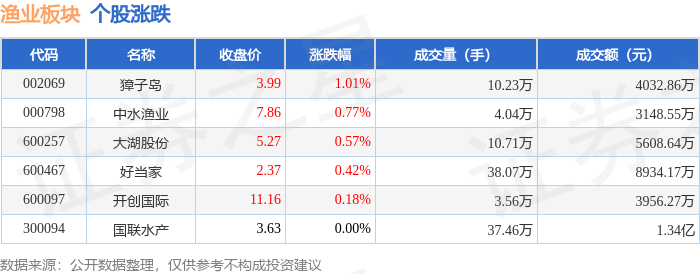
Core Insights - The fishing sector experienced a 0.46% increase on September 29, with Zhangzidao leading the gains [1] - The Shanghai Composite Index closed at 3862.53, up 0.9%, while the Shenzhen Component Index closed at 13479.43, up 2.05% [1] Summary by Category Stock Performance - Zhangzidao (002069) closed at 66.5, up 1.01% with a trading volume of 102,300 shares and a turnover of 40.32 million yuan [1] - Zhongshui Fishery (000798) closed at 7.86, up 0.77% with a trading volume of 40,400 shares and a turnover of 31.49 million yuan [1] - Dahu Co. (600257) closed at 5.27, up 0.57% with a trading volume of 107,100 shares and a turnover of 56.09 million yuan [1] - Haodangjia (600467) closed at 2.37, up 0.42% with a trading volume of 380,700 shares and a turnover of 89.34 million yuan [1] - Kaichuang International (600097) closed at 11.16, up 0.18% with a trading volume of 35,600 shares and a turnover of 39.56 million yuan [1] - Guolian Aquatic Products (300094) closed at 3.63, unchanged with a trading volume of 374,600 shares and a turnover of 13.4 million yuan [1] Capital Flow - The fishing sector saw a net outflow of 6.58 million yuan from institutional investors, while retail investors contributed a net inflow of 1.74 million yuan [1] - The capital flow for individual stocks showed varied trends, with Dahu Co. experiencing a net inflow of 5.27 million yuan from institutional investors but a net outflow from retail investors [2] - Zhangzidao had a net outflow of 0.93 million yuan from institutional investors, while it attracted a net inflow of 2.74 million yuan from speculative funds [2]


渔业板块9月26日涨0.4%,獐子岛领涨,主力资金净流出2143.92万元
Zheng Xing Xing Ye Ri Bao· 2025-09-26 08:41
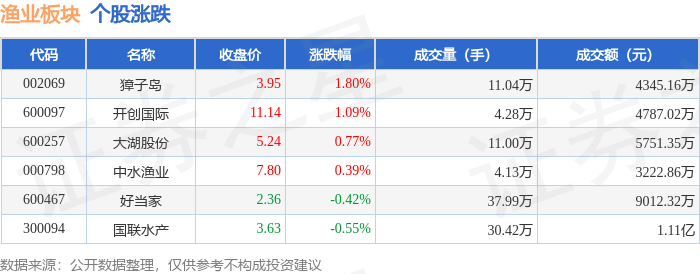
Group 1 - The fishing sector increased by 0.4% on September 26, with Zhangzidao leading the gains [1] - The Shanghai Composite Index closed at 3828.11, down 0.65%, while the Shenzhen Component Index closed at 13209.0, down 1.76% [1] - Key stocks in the fishing sector showed varied performance, with Zhangzidao closing at 3.95, up 1.80%, and other stocks like Haodangjia and Guolian Aquatic experiencing declines [1] Group 2 - The net outflow of main funds in the fishing sector was 21.44 million yuan, while retail investors saw a net inflow of 26.54 million yuan [1] - Detailed fund flow data indicated that major stocks like Haodangjia and Zhangzidao experienced mixed fund inflows and outflows, with significant retail interest in some stocks [2] - The overall trading volume and turnover for key stocks in the fishing sector reflected a diverse investor sentiment, with notable retail participation [2]
渔业板块9月25日跌1.3%,开创国际领跌,主力资金净流出1115.47万元
Zheng Xing Xing Ye Ri Bao· 2025-09-25 08:38
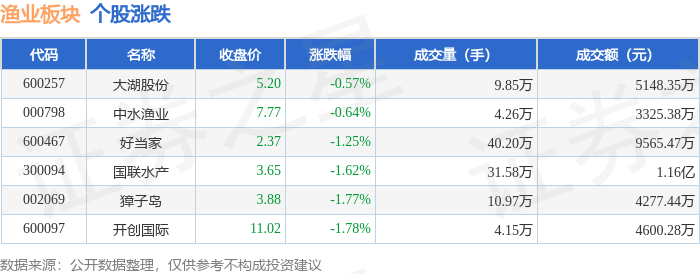
Market Overview - The fishery sector declined by 1.3% on September 25, with KaiChuang International leading the losses [1] - The Shanghai Composite Index closed at 3853.3, down 0.01%, while the Shenzhen Component Index closed at 13445.9, up 0.67% [1] Individual Stock Performance - Major stocks in the fishery sector experienced varied performance, with the following notable declines: - Dahu Co. (600257) closed at 5.20, down 0.57% with a trading volume of 98,500 shares and a turnover of 51.48 million yuan [1] - Zhongshui Fishery (000798) closed at 7.77, down 0.64% with a trading volume of 42,600 shares and a turnover of 33.25 million yuan [1] - Haodangjia (600467) closed at 2.37, down 1.25% with a trading volume of 402,000 shares and a turnover of 95.65 million yuan [1] - Guolian Aquatic Products (300094) closed at 3.65, down 1.62% with a trading volume of 315,800 shares and a turnover of 116 million yuan [1] - Zhangzidao (002069) closed at 3.88, down 1.77% with a trading volume of 109,700 shares and a turnover of 42.77 million yuan [1] - KaiChuang International (600097) closed at 11.02, down 1.78% with a trading volume of 41,500 shares and a turnover of 46.00 million yuan [1] Capital Flow Analysis - The fishery sector saw a net outflow of 11.15 million yuan from main funds, while speculative funds had a net inflow of 21.03 million yuan, and retail investors experienced a net outflow of 9.87 million yuan [1] - Detailed capital flow for individual stocks indicates: - Dahu Co. had a main fund net inflow of over 3.70 million yuan but a net outflow from retail investors of 3.04 million yuan [2] - Zhongshui Fishery had a main fund net inflow of 2.16 million yuan and a net outflow from retail investors of 4.43 million yuan [2] - Haodangjia experienced a main fund net outflow of 2.02 million yuan with a significant net inflow from speculative funds of 9.38 million yuan [2] - KaiChuang International had a main fund net outflow of 3.77 million yuan but a small net inflow from retail investors of 0.52 million yuan [2] - Guolian Aquatic Products faced a main fund net outflow of 10.00 million yuan, indicating significant selling pressure [2]
中韩自贸区概念涨0.28%,主力资金净流入这些股
Zheng Quan Shi Bao Wang· 2025-09-23 10:00
Group 1 - The concept of the China-South Korea Free Trade Zone rose by 0.28%, ranking 6th among concept sectors in terms of growth, with five stocks increasing in value [1] - Notable gainers in the China-South Korea Free Trade Zone sector included Xinhua Jin, which hit the daily limit, and Lianyungang, Qingdao Double Star, and Qingdao Port, which rose by 5.23%, 1.12%, and 0.82% respectively [1] - The sector experienced a net inflow of 0.37 billion yuan, with Xinhua Jin leading the inflow at 44.42 million yuan, followed by Lianyungang and Qingdao Port with net inflows of 26.49 million yuan and 7.94 million yuan respectively [2][3] Group 2 - Xinhua Jin had the highest net inflow ratio at 17.20%, followed by Lianyungang at 4.06% and Qingdao Port at 3.82% [3] - The overall performance of the China-South Korea Free Trade Zone concept was supported by significant trading activity, with Xinhua Jin showing a trading turnover rate of 10.40% [3] - Conversely, stocks such as Qingdao Jinwang and Zhongchuang Logistics faced declines of 4.21% and 1.75% respectively, indicating mixed performance within the sector [4]


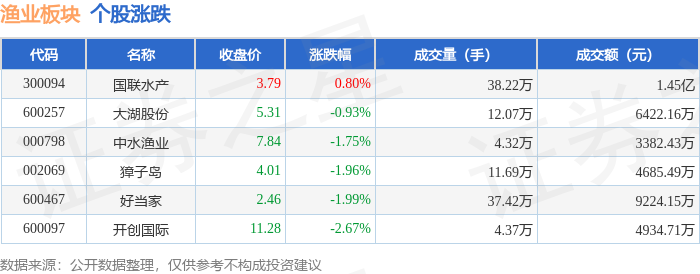
渔业板块9月22日跌1.3%,开创国际领跌,主力资金净流入58.36万元
Zheng Xing Xing Ye Ri Bao· 2025-09-22 08:40
Group 1 - The fishing sector experienced a decline of 1.3% on September 22, with Kaichuang International leading the losses [1] - The Shanghai Composite Index closed at 3828.58, up 0.22%, while the Shenzhen Component Index closed at 13157.97, up 0.67% [1] - The trading performance of key stocks in the fishing sector showed mixed results, with Guolian Aquatic rising by 0.80% and Kaichuang International falling by 2.67% [1] Group 2 - The net inflow of main funds in the fishing sector was 583,600 yuan, while retail investors saw a net outflow of 990,410 yuan [1] - The trading volume and turnover for various stocks in the fishing sector varied significantly, with Guolian Aquatic having a turnover of 145 million yuan [1]
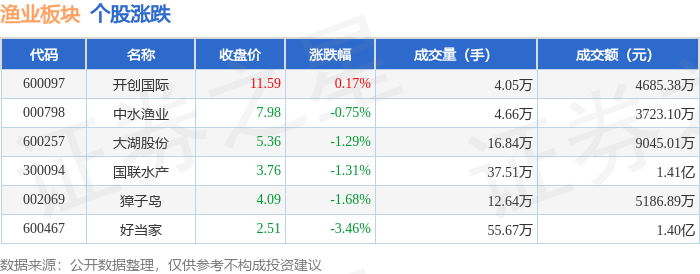
渔业板块9月19日跌1.49%,好当家领跌,主力资金净流出3097.74万元
Zheng Xing Xing Ye Ri Bao· 2025-09-19 08:41
Group 1 - The fishing sector experienced a decline of 1.49% on September 19, with "Hao Dang Jia" leading the drop [1] - The Shanghai Composite Index closed at 3820.09, down 0.3%, while the Shenzhen Component Index closed at 13070.86, down 0.04% [1] - The main funds in the fishing sector saw a net outflow of 30.98 million yuan, while retail investors had a net inflow of 17.96 million yuan [1] Group 2 - "Hao Dang Jia" had a closing price of 2.51 yuan, down 3.46%, with a trading volume of 556,700 shares and a transaction amount of 140 million yuan [1] - "Guo Lian Shui Chan" saw a closing price of 3.76 yuan, down 1.31%, with a trading volume of 375,100 shares and a transaction amount of 141 million yuan [1] - "Zhang Zi Dao" closed at 4.09 yuan, down 1.68%, with a trading volume of 126,400 shares and a transaction amount of 51.89 million yuan [1]
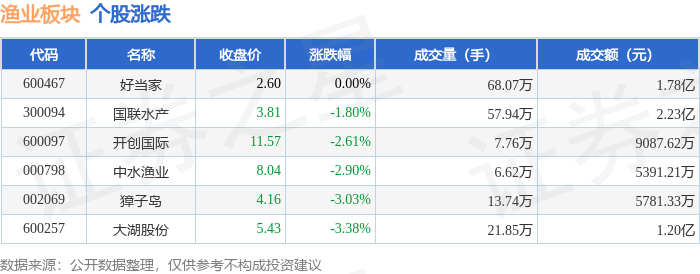
渔业板块9月18日跌2.15%,大湖股份领跌,主力资金净流出480.35万元
Zheng Xing Xing Ye Ri Bao· 2025-09-18 08:46
Core Viewpoint - The fishery sector experienced a decline of 2.15% on September 18, with major stocks like Dahu Co. leading the drop, while the overall market indices also fell [1] Group 1: Market Performance - On September 18, the Shanghai Composite Index closed at 3831.66, down 1.15% [1] - The Shenzhen Component Index closed at 13075.66, down 1.06% [1] Group 2: Individual Stock Performance - The following stocks in the fishery sector showed notable performance: - Haodangjia (600467) closed at 2.60, unchanged at 0.00% [1] - Guolian Aquatic Products (300094) closed at 3.81, down 1.80% [1] - Kaichuang International (600097) closed at 11.57, down 2.61% [1] - Zhongshui Fishery (000798) closed at 8.04, down 2.90% [1] - Zhangzidao (002069) closed at 4.16, down 3.03% [1] - Dahu Co. (600257) closed at 5.43, down 3.38% [1] Group 3: Capital Flow - The fishery sector saw a net outflow of 4.8035 million yuan from main funds, while speculative funds had a net inflow of 24.9195 million yuan, and retail investors experienced a net outflow of 20.116 million yuan [1]
渔业板块9月17日跌1.93%,开创国际领跌,主力资金净流出4749.45万元
Zheng Xing Xing Ye Ri Bao· 2025-09-17 08:42
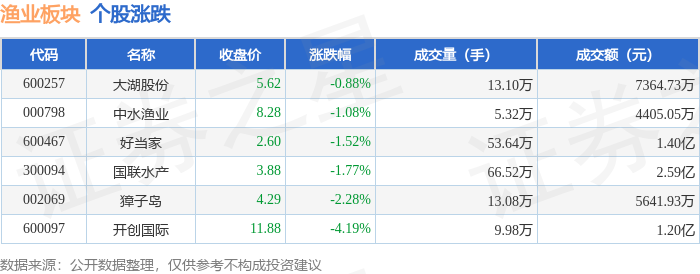
Market Overview - The fishery sector experienced a decline of 1.93% on September 17, with KaiChuang International leading the losses [1] - The Shanghai Composite Index closed at 3876.34, up 0.37%, while the Shenzhen Component Index closed at 13215.46, up 1.16% [1] Individual Stock Performance - Major stocks in the fishery sector showed varied performance, with the following closing prices and changes: - Dahu Co., Ltd. (600257) closed at 5.62, down 0.88% - China Water Fisheries (000798) closed at 8.28, down 1.08% - Good Home (600467) closed at 2.60, down 1.52% - Guolian Aquatic Products (300094) closed at 3.88, down 1.77% - Zhanzi Island (002069) closed at 4.29, down 2.28% - KaiChuang International (600097) closed at 11.88, down 4.19% [1] Capital Flow Analysis - The fishery sector saw a net outflow of 47.49 million yuan from main funds, while retail investors contributed a net inflow of 26.70 million yuan [1] - The capital flow for individual stocks is as follows: - Dahu Co., Ltd. had a main fund net inflow of over 3.32 million yuan, but a retail net outflow of 4.01 million yuan - China Water Fisheries had a main fund net inflow of 0.23 million yuan, with a retail net outflow of 0.40 million yuan - KaiChuang International experienced a main fund net outflow of 0.06 million yuan and a retail net outflow of 0.85 million yuan - Good Home had a significant main fund net outflow of 10.98 million yuan, but a retail net inflow of 8.37 million yuan - Guolian Aquatic Products faced a main fund net outflow of 36.26 million yuan, with a retail net inflow of 31.93 million yuan [2]
风波中的预制菜行业:门槛低竞争加剧,上市公司利润普遍下滑
Sou Hu Cai Jing· 2025-09-15 11:21
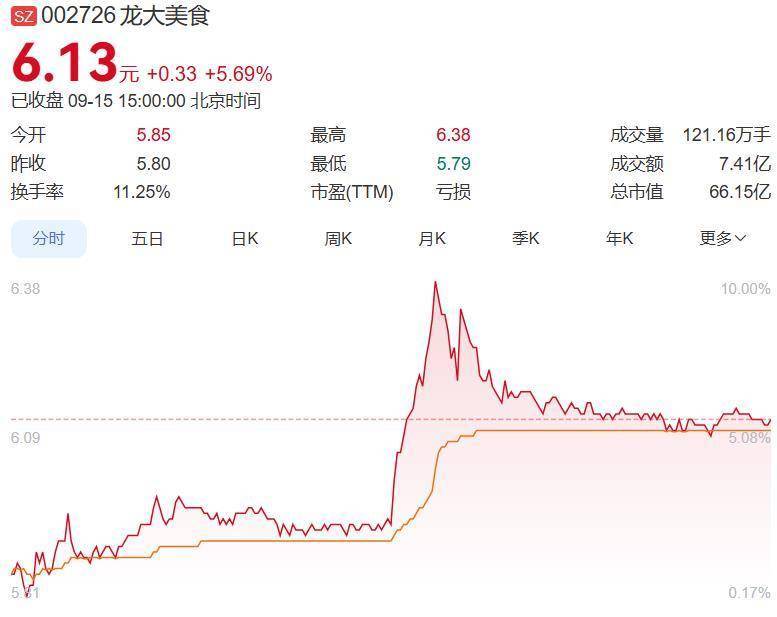
Core Viewpoint - The recent events involving Luo Yonghao and Xibei have sparked renewed consumer interest in the "pre-prepared dishes" industry, leading to significant stock price increases for related listed companies on September 15, 2025 [1][10]. Industry Overview - The pre-prepared dishes industry is gradually entering a path of standardized development, with regulations and standards being established in recent years. However, challenges such as low entry barriers and varying consumer perceptions complicate market entry for new players [3][4]. - In March 2024, a joint notification from several government departments outlined clear definitions and standards for pre-prepared dishes, marking the beginning of a standardized development path for the industry [4]. Market Growth - According to iMedia Consulting, the market size of China's pre-prepared dishes reached 485 billion yuan in 2024, reflecting a year-on-year growth of 33.8%. The market is expected to grow to 749 billion yuan by 2026 due to technological advancements and supportive policies [5]. Competitive Landscape - Despite rapid market growth, the industry faces intense competition, characterized by low entry barriers, product homogeneity, and a crisis of consumer trust, leading to declining profits across many companies [6][9]. - Financial reports from various pre-prepared dish companies for the first half of 2025 indicate a general decline in net profits, with several companies reporting losses. For instance, Guolian Aquatic Products reported a loss of 550 million yuan [7][9]. Company Performance - Key financial metrics from several pre-prepared dish companies for the first half of 2025 include: - Longda Meishi: Revenue of 782 million yuan (-19.5% YoY), gross margin of 12.43% (+1.24% YoY) - Guolian Aquatic Products: Revenue of 1.65 billion yuan (-18.36% YoY), net loss of 550 million yuan - Huifa Food: Revenue of 734 million yuan (-17.75% YoY), net loss of 31 million yuan - Aixin Food: Revenue of 7.604 billion yuan (+0.8% YoY), gross margin of 20.52% (-3.39% YoY) [7][9]. Consumer Insights - Consumers express a desire for transparency and choice regarding pre-prepared dishes, indicating that they are not opposed to the concept but seek better information about the products [10].


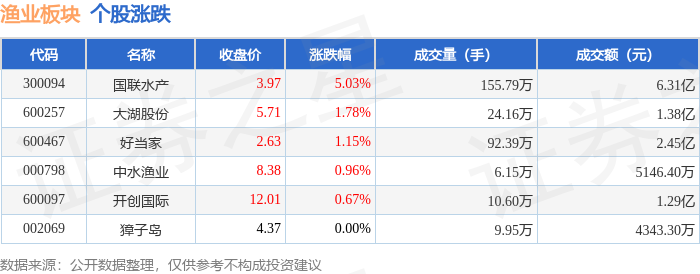
渔业板块9月15日涨1.78%,国联水产领涨,主力资金净流入6437.99万元
Zheng Xing Xing Ye Ri Bao· 2025-09-15 08:35
Core Viewpoint - The fishery sector experienced a rise of 1.78% on September 15, with Guolian Aquatic leading the gains, while the overall market showed mixed results with the Shanghai Composite Index down by 0.26% and the Shenzhen Component Index up by 0.63% [1] Group 1: Market Performance - The fishery sector's main stocks showed varied performance, with Guolian Aquatic closing at 3.97, up by 5.03%, and Dahu Co. rising by 1.78% to 5.71 [1] - The trading volume for Guolian Aquatic reached 1.5579 million shares, with a transaction value of 631 million yuan [1] - The overall trading performance of the fishery sector is summarized in a table, indicating the closing prices and percentage changes for various stocks [1] Group 2: Capital Flow - The fishery sector saw a net inflow of 64.3799 million yuan from main funds, while retail investors experienced a net outflow of 60.4898 million yuan [1] - Guolian Aquatic had a significant net inflow of 72.3959 million yuan from main funds, while retail investors withdrew 64.7718 million yuan [2] - The capital flow data indicates that while main funds were positive, retail investors were largely negative across several stocks in the sector [2]