
Appo(688007)

Search documents
智能眼镜出货量暴增,光峰科技、利亚德等A股企业竞逐 AR 光学赛道
Xin Lang Zheng Quan· 2025-09-25 08:25
Group 1: Industry Overview - AI glasses are emerging as the next potential category following smartphones and smartwatches, with global shipments expected to exceed 10 million units within 2-3 years due to lower price barriers and improved application ecosystems [1] - In the first half of 2025, global smart glasses shipments surged by 110% year-on-year, with AI-enabled smart glasses accounting for 78% of the total, a significant increase from 46% in the first half of 2024 and 66% in the second half of 2024 [1] Group 2: Company Developments - Guangfeng Technology launched an innovative "LCoS + PVG optical waveguide" AR glasses solution, which reduces hardware costs and complexity by using a single optical engine for dual-eye display, potentially lowering retail prices to the range of 1500-2000 yuan [2][3] - Leyard's AR glasses, integrating Micro LED technology and AI, are set to launch in October 2025, targeting B-end customers in sectors like tourism and healthcare, with a focus on customized solutions [4][5] - BOE and Huacan's Micro LED display module was showcased, featuring a peak brightness of 400W nit, indicating advancements in display technology for AR applications [6] - NewXiangwei is expanding its product matrix to include display driver chips for AR glasses, aiming to cover multiple display scenarios and enhance its market presence [8] - OmniVision's LCoS microdisplay is being supplied to Meta's first AR glasses, with an expected shipment of 150,000 to 200,000 units over two years [9] - GoerTek is investing 400 million yuan to strengthen its micro-nano optics layout, enhancing its competitiveness in the VR/AR sector [10][11] - Jiahe Intelligent's acquisition of Beyerdynamic aims to enhance its AR/AI glasses capabilities, leveraging Beyerdynamic's expertise in audio technology [12] - Luxshare Precision showcased a new generation of full-color AR glasses with extended battery life and advanced features, while also ramping up production for Meta's next-generation AR glasses [13][14][15] - Lens Technology is accelerating the mass production of AI glasses, positioning itself as a core supplier in the North American market [16][17] - Crystal Optoelectronics reported a 79% revenue increase in automotive AR applications, indicating strong growth potential in this segment [18] - United Optoelectronics is focusing on building a comprehensive AR glasses production system, collaborating with Yiwentech to enhance its technological capabilities [20]

光峰科技股价跌5.09%,万家基金旗下1只基金重仓,持有2.93万股浮亏损失3.22万元
Xin Lang Cai Jing· 2025-09-23 02:15
Company Overview - Guangfeng Technology Co., Ltd. is located in Shenzhen, Guangdong Province, and was established on October 24, 2006. The company went public on July 22, 2019. Its main business involves the research, production, sales, and leasing of core components and complete products for laser display [1]. Financial Performance - As of September 23, Guangfeng Technology's stock price fell by 5.09% to 20.53 CNY per share, with a trading volume of 164 million CNY and a turnover rate of 1.68%. The total market capitalization is 9.43 billion CNY. The stock has experienced a cumulative decline of 9.54% over the past three days [1]. Revenue Composition - The revenue composition of Guangfeng Technology is as follows: 48.23% from laser optical engines, 44.37% from laser projection machines, 6.98% from other sources, and 0.42% from supplementary sources [1]. Fund Holdings - According to data from the top ten holdings of funds, one fund under Wanjia Fund holds Guangfeng Technology as a significant investment. The Wanjia Technology Quantitative Selection Mixed Fund A (020975) held 29,300 shares in the second quarter, accounting for 1.96% of the fund's net value, ranking as the ninth largest holding. The estimated floating loss today is approximately 32,200 CNY, with a total floating loss of 66,800 CNY during the three-day decline [2]. Fund Manager Performance - The fund manager of Wanjia Technology Quantitative Selection Mixed Fund A is Yin Hang, who has been in the position for 5 years and 66 days. The total asset size of the fund is 468 million CNY, with the best fund return during his tenure being 61.25% and the worst being -9.05% [3].
光峰科技涨2.21%,成交额1.43亿元,主力资金净流入318.88万元
Xin Lang Cai Jing· 2025-09-19 02:47
Company Overview - Guangfeng Technology Co., Ltd. is located in Shenzhen, Guangdong Province, and was established on October 24, 2006. The company went public on July 22, 2019. Its main business involves the research, development, production, sales, and leasing of core components and complete products for laser display [1] - The revenue composition of Guangfeng Technology includes 48.23% from laser optical engines, 44.37% from laser projection machines, and 6.98% from other sources [1] Stock Performance - As of September 19, Guangfeng Technology's stock price increased by 2.21%, reaching 23.13 CNY per share, with a trading volume of 143 million CNY and a turnover rate of 1.38%. The total market capitalization is 10.624 billion CNY [1] - Year-to-date, the stock price has risen by 56.65%, with a 5-day increase of 5.96%, a 20-day increase of 12.50%, and a 60-day increase of 63.69% [1] Financial Performance - For the first half of 2025, Guangfeng Technology reported a revenue of 961 million CNY, a year-on-year decrease of 11.09%. The net profit attributable to shareholders was -131 million CNY, representing a significant decline of 1300.25% [2] - Since its A-share listing, Guangfeng Technology has distributed a total of 174 million CNY in dividends, with 68.14 million CNY distributed over the past three years [3] Shareholder Information - As of June 30, 2025, the number of shareholders increased to 16,800, a rise of 3.72%. The average number of tradable shares per person decreased by 3.58% to 27,298 shares [2] - Among the top ten circulating shareholders, E Fund Stable Income Bond A (110007) is the ninth largest, holding 5.0005 million shares, a decrease of 1.866 million shares compared to the previous period. Hong Kong Central Clearing Limited has exited the top ten shareholders list [3] Market Position - Guangfeng Technology is categorized under the electronic industry, specifically in consumer electronics and brand consumer electronics. It is associated with concepts such as augmented reality, smart glasses, holographic concepts, Huawei, and Xiaomi [1]
光峰科技股价跌5.02%,万家基金旗下1只基金重仓,持有2.93万股浮亏损失3.52万元
Xin Lang Cai Jing· 2025-09-18 06:23
Group 1 - The core viewpoint of the news is that Guangfeng Technology's stock has experienced a decline of 5.02%, with a current price of 22.71 yuan per share and a total market capitalization of 10.431 billion yuan [1] - Guangfeng Technology, established on October 24, 2006, specializes in the research, production, sales, and leasing of laser display core components and complete machine products [1] - The company's main business revenue composition includes: 48.23% from laser optical engines, 44.37% from laser projection complete machines, and 6.98% from other sources [1] Group 2 - According to data from the top ten heavy stocks of funds, one fund under Wanjia Fund holds Guangfeng Technology, specifically the Wanjia Technology Quantitative Stock Mixed Initiation A (020975), which held 29,300 shares in the second quarter, accounting for 1.96% of the fund's net value [2] - The fund has a current scale of 19.3044 million, with a year-to-date return of 37.67%, ranking 1982 out of 8172 in its category [2] Group 3 - The fund manager of Wanjia Technology Quantitative Stock Mixed Initiation A is Yin Hang, who has been in the position for 5 years and 61 days, with a total asset scale of 468 million [3] - During his tenure, the best fund return was 61.87%, while the worst return was -8.78% [3]
深圳光峰科技股份有限公司2025年第一次临时股东大会决议公告
Shang Hai Zheng Quan Bao· 2025-09-15 21:04
Group 1 - The first extraordinary general meeting of shareholders was held on September 15, 2025, at the company's headquarters in Shenzhen [2] - The meeting was convened by the board of directors and utilized a combination of on-site and online voting methods [2][3] - All current directors and supervisors attended the meeting, with a total of 7 directors and 3 supervisors present [3] Group 2 - The following resolutions were passed during the meeting: 1. The proposal to cancel the supervisory board and amend the company's articles of association was approved [4] 2. The proposal to formulate, revise, and abolish certain governance systems was approved [4] 3. The proposal regarding the permanent replenishment of working capital using the remaining funds from the company's initial public offering was approved [5] - The voting process complied with the Company Law and the company's articles of association, with special resolutions requiring more than two-thirds of the voting rights to pass [5] Group 3 - The meeting was witnessed by lawyers from Beijing Zhonglun (Shenzhen) Law Firm, confirming that all procedures and resolutions were legal and compliant with relevant laws and regulations [5]
光峰科技(688007) - 北京市中伦(深圳)律师事务所关于深圳光峰科技股份有限公司2025年第一次临时股东大会的法律意见书
2025-09-15 11:00
法律意见书 二〇二五年九月 北京市中伦(深圳)律师事务所 关于深圳光峰科技股份有限公司 2025 年第一次临时股东大会的 北京市中伦(深圳)律师事务所 关于深圳光峰科技股份有限公司 2025 年第一次临时股东大会的 法律意见书 致:深圳光峰科技股份有限公司 根据中国证券监督管理委员会发布的《上市公司股东会规则》(以下简称"《股 东会规则》")的有关规定,北京市中伦(深圳)律师事务所接受深圳光峰科技 股份有限公司(以下简称"公司")的委托,指派律师出席公司 2025 年第一次 临时股东大会(以下简称"本次股东大会"),并就本次股东大会的召集和召开 程序、召集人资格、出席和列席会议人员资格、表决程序及表决结果等事宜发表 法律意见。 本所律师按照《股东会规则》的要求对公司本次股东大会的合法、合规、真 实、有效进行了充分的核查验证,保证本法律意见书不存在虚假、误导性陈述及 重大遗漏,并对本法律意见书的真实性、准确性、完整性承担相应的法律责任。 本所律师根据《股东会规则》的要求,依照律师行业公认的业务标准、道德 规范及勤勉尽责精神,对公司提供的相关文件和有关事实进行了核查和验证,现 出具如下法律意见: 一、 本次股东大 ...
光峰科技(688007) - 2025年第一次临时股东大会决议公告
2025-09-15 11:00
(二) 股东大会召开的地点:深圳市南山区西丽街道仙洞路 8 号光峰科技总部 大厦 32 楼公司会议室 本公司董事会及全体董事保证公告内容不存在任何虚假记载、误导性陈述或者 重大遗漏,并对其内容的真实性、准确性和完整性依法承担法律责任。 重要内容提示: 本次会议是否有被否决议案:无 一、 会议召开和出席情况 (三) 出席会议的普通股股东、特别表决权股东、恢复表决权的优先股股东及 其持有表决权数量的情况: 证券代码:688007 证券简称:光峰科技 公告编号:2025-047 深圳光峰科技股份有限公司 2025年第一次临时股东大会决议公告 (一) 股东大会召开的时间:2025 年 9 月 15 日 | 1、出席会议的股东和代理人人数 | 109 | | --- | --- | | 普通股股东人数 | 109 | | 2、出席会议的股东所持有的表决权数量 | 162,170,528 | | 普通股股东所持有表决权数量 | 162,170,528 | | 3、出席会议的股东所持有表决权数量占公司表决权数量的比例(%) | 35.5850 | | 普通股股东所持有表决权数量占公司表决权数量的比例(%) | 35.585 ...
消费电子板块9月15日跌1.09%,苏州天脉领跌,主力资金净流出16.73亿元
Zheng Xing Xing Ye Ri Bao· 2025-09-15 08:42
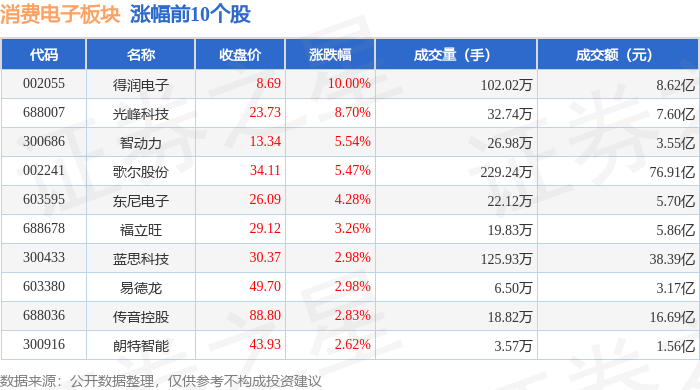
Market Overview - On September 15, the consumer electronics sector declined by 1.09%, with Suzhou Tianmai leading the drop [1] - The Shanghai Composite Index closed at 3860.5, down 0.26%, while the Shenzhen Component Index closed at 13005.77, up 0.63% [1] Stock Performance - Notable gainers in the consumer electronics sector included: - Derun Electronics (002055) with a closing price of 8.69, up 10.00% and a trading volume of 1.02 million shares, totaling 8.62 billion yuan [1] - Guangfeng Technology (688007) closed at 23.73, up 8.70% with a trading volume of 327,400 shares, totaling 7.60 billion yuan [1] - Zhidong Technology (300686) closed at 13.34, up 5.54% with a trading volume of 269,800 shares, totaling 3.55 billion yuan [1] - Conversely, significant decliners included: - Shiwai Dapai (301626) closed at 124.00, down 5.83% with a trading volume of 39,500 shares, totaling 4.95 billion yuan [2] - Huqin Technology (603296) closed at 89.85, down 5.00% with a trading volume of 252,300 shares, totaling 22.82 billion yuan [2] - Xinye Electronics (605277) closed at 24.81, down 4.54% with a trading volume of 213,400 shares, totaling 5.34 billion yuan [2] Capital Flow - The consumer electronics sector experienced a net outflow of 1.673 billion yuan from institutional investors, while retail investors saw a net inflow of 1.55 billion yuan [2] - Key stocks in terms of capital flow included: - Goer Technology (002241) with a net inflow of 674 million yuan from institutional investors, but a net outflow of 274 million yuan from retail investors [3] - Lansi Technology (300433) had a net inflow of 268 million yuan from institutional investors, with a net outflow of 172 million yuan from retail investors [3] - Derun Electronics (002055) saw a net inflow of 264 million yuan from institutional investors, but a significant net outflow of 1.18 billion yuan from retail investors [3]




突破行业应用瓶颈 光峰科技发布新一代消费级水下蓝光激光雷达
Xin Lang Zheng Quan· 2025-09-15 02:20
Core Viewpoint - The application of lidar technology in underwater robotics is undergoing a significant transformation, highlighted by the launch of underwater blue laser lidar products by Guangfeng Technology, marking the entry into a new era of effective underwater measurement capabilities [1][6]. Group 1: Event Overview - The 26th China International Optoelectronic Expo (CIOE) took place from September 10 to 12, gathering over 3,800 exhibitors from more than 30 countries and regions [1]. - Guangfeng Technology made its debut at the expo, announcing the release of two underwater blue laser lidar products, the Yuanmou D10 and Yuanmou T1, targeting both consumer and professional markets [1]. Group 2: Product Features - The Yuanmou D10 is the industry's first consumer-grade underwater blue laser lidar, capable of effective measurement up to 10 meters, thus entering the "10-meter underwater measurement era" [1]. - The Yuanmou T1, aimed at the professional market, has a measurement capability of 10 meters and is designed for high-value applications such as marine surveying and underwater archaeology [13]. Group 3: Market Potential - The market for robotic lidar solutions is projected to grow from 8.2 billion yuan in 2022 to 216.2 billion yuan by 2030, with a compound annual growth rate of 50.6% [7]. - By 2025, the global shipment of lidar units in the robotics sector is expected to reach 400,000 units, with potential demand for lidar in humanoid robots possibly exceeding 10 million units by 2026 [7]. Group 4: Technical Challenges and Solutions - The main challenges for underwater lidar include significant attenuation of infrared lasers in water, effective measurement coverage for large pools, interference from ambient light, and issues with water turbidity [8][9]. - Guangfeng Technology addresses these challenges with three core technological strategies: high-power blue laser, ambient light filtering technology, and self-developed pulse laser algorithms [8][9]. Group 5: Future Plans - Guangfeng Technology aims to achieve mass production of the consumer-grade underwater blue laser lidar by the end of this year and plans to expand its applications into marine economic sectors [16].
光博会引领新“视”界定义,光峰科技新方案亮展
Minsheng Securities· 2025-09-12 14:45
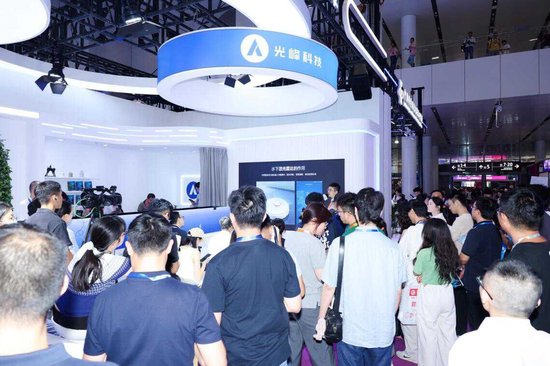
Investment Rating - The report maintains a "Recommended" rating for key companies in the AR glasses and optical technology sector, including GoerTek, Dongmu Co., Jingyan Technology, Tonglian Precision, and Guangfeng Technology [4]. Core Insights - The 2025 CIOE (China International Optoelectronic Exposition) showcased significant advancements in AR technology, with leading companies like JBD, GoerTek, and Luxshare Precision presenting breakthroughs in Micro LED, optical waveguides, and AR optics [1][2]. - Guangfeng Technology and Gudong Intelligent launched a new AR solution that redefines the industry pricing structure, featuring the innovative "LCoS + PVG optical waveguide" technology, which enhances light efficiency by 300% and achieves over 90% transmittance [2][3]. - The report emphasizes the continuous evolution of AR glasses technology, highlighting the importance of display, optics, assembly, and components in the industry [3]. Summary by Sections Event Overview - The 2025 CIOE was held on September 10 in Shenzhen, gathering top global optoelectronic technology and industry trends [1]. - Key exhibitors included JBD, GoerTek, and Luxshare Precision, showcasing cutting-edge products and technologies [1][2]. Technological Breakthroughs - JBD introduced the "Hummingbird II" color light engine, featuring a self-developed 0.1-inch Micro LED micro-display capable of full-color display in a compact size [1]. - GoerTek presented several new products in AR and VR, focusing on lightweight designs and high display performance [2]. - Guangfeng Technology's new AR optical solution supports a large field of view and ensures user comfort during prolonged use [2][3]. Investment Recommendations - The report suggests monitoring companies involved in various segments of the AR technology supply chain, including: - Optical waveguides: GoerTek, Luxshare Precision, Sunny Optical Technology, Crystal Optoelectronics, and Lantech Optical [3]. - Micro LED: HC Semitek, Zhaochi Co., Sanan Optoelectronics, Qianzhao Optoelectronics, and Jucan Optoelectronics [3]. - LCoS: OmniVision Technologies and Guangfeng Technology [3]. - SiC: Tianyue Advanced [3]. - MIM components: Dongmu Co., Jingyan Technology, and Tonglian Precision [3].