
Qi An Xin Technology (688561)

Search documents
两会声音 | 齐向东:建议设立京津冀科创担保基金,开通信用修复“绿色通道”
Jin Rong Jie· 2026-01-26 10:09
财经频道更多独家策划、专家专栏,免费查阅>> 在资金端,他建议实施"精准滴灌"。一方面,设立京津冀科创融资担保基金,扩大知识产权和股权质押 贷款覆盖面,切实降低民营科创企业融资成本;另一方面,完善容错纠错机制,开通科创企业信用修 复"绿色通道", 实现"一键申诉、高效办结",避免非恶意逾期企业信用不受影响,保障优质项目因资 金短缺被"卡脖子"。 责任编辑:安东 "民营科创企业平均融资成本达8%-15%,而国企中长期贷款利率可低至3%以下,这种'冰火两重天'抑制 了创新活力。" 1月19日,北京市政协委员、奇安信集团董事长齐向东在北京两会上,为民营科创企业 的融资与发展难题"把脉开方"。 在政策端,他呼吁打破行政壁垒。建议完善京津冀产业协同机制,推动三地在产业管理标准、产业界 定、审批流程、交通通行优惠等方面达成共识,实现资质互认和"一地审批、三地互认",降低企业跨区 经营制度性成本,促进产业链上下游的高效协作。 在关于激活现代化首都都市圈新动能的提案中,齐向东指出,除了融资成本高,跨区域经营的制度性成 本也为产业协同、企业创新发展带来了难题。京津冀分属三地,发展程度和资源禀赋不同,在产业管理 归口、属性界定、 ...

2026北京两会丨对话市政协委员齐向东:AI助力京津冀科技成果转化“弯道超车”
Bei Jing Shang Bao· 2026-01-25 13:42
FAST IE 4.97 2 CARTY 0 R 1 The 0 11 1 美国人民政治协商会议 4 / 3 / 991 The Base "十五五"时期是北京率先基本实现社会主义现代化的关键阶段,智慧城市建设已迈入深度融合阶段,其中,智慧政务、智慧交通、智慧能源、智慧医疗等场 景深度嵌入城市肌理,成为首都高质量发展的核心引擎。 es Net n a c tion of r - 142 以下为北京商报记者对话齐向东采访实录: Q:创新链、产业链、资金链、人才链是城市建设的关键,您认为在创新链中,要抓住哪些重点? A:近年来,现代化首都都市圈建设成效显著,然而政策协同"衔接难"、融资壁垒"打破难"、成果"转化难"、人才"扎根难"仍制约着都市圈的高质量发展。 产业链、资金链、创新链、人才链深度协同,是构建现代化都市圈的"金钥匙"。 我认为,补强"四链"的题眼是创新链,它能将产业链、资金链、人才链串联成网。如果创新链的转化环节抓不好,会导致成果落地出现梗阻,很多优质科研 成果只能躺在实验室里没有用武之地。这不仅会削弱资金赋能创新的成效,也难以让产业链、人才链高效聚集。 1月25日,在政协北京市第十四届委员会第四次会 ...


北京两会直播间 | 市政协委员齐向东:AI赋能智慧城市,打造网络安全“北京样板”
Xin Lang Cai Jing· 2026-01-24 11:20
Core Viewpoint - The article emphasizes the importance of AI in enhancing smart city initiatives in Beijing, proposing the establishment of a "Beijing model" for cybersecurity during the 14th Five-Year Plan period [1] Group 1: AI and Smart Cities - The integration of AI is expected to drive the development of smart cities in Beijing, marking a new phase of deep integration and comprehensive empowerment [1] - The proposal suggests that AI should be the core driving force behind the advancements in urban infrastructure and services [1] Group 2: Cybersecurity Standards - The establishment of a "Beijing model, Beijing standard, and Beijing sample" for cybersecurity is advocated, highlighting the need for robust security measures in the digital transformation of urban environments [1]
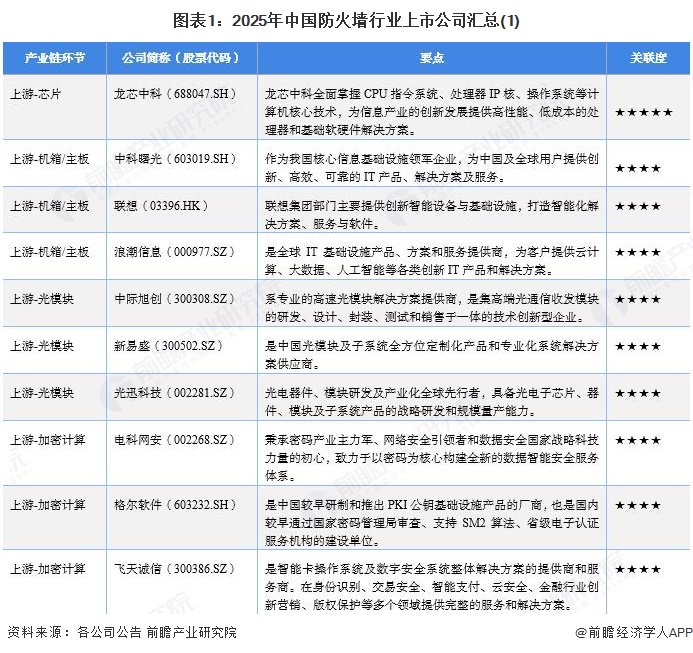
【最全】2025年防火墙行业上市公司全方位对比(附业务布局汇总、业绩对比、业务规划等)
Qian Zhan Wang· 2026-01-24 06:09
Core Insights - The firewall industry in China is a critical component of the network security system, serving as the first line of defense for enterprises and individuals. The industry is characterized by a diverse range of listed companies, primarily concentrated in the upstream and midstream segments of the supply chain [1][5]. Group 1: Company Overview - Major companies in the firewall industry include Sangfor (300454.SZ), Tianrongxin (002212.SZ), Hillstone Networks (688030.SH), Deepin Technology (300768.SZ), Ruijie Networks (301165.SZ), Venustech (002439.SZ), Qihoo 360 (688561.SH), and NSFOCUS (300369.SZ) [1]. - The highest revenue in the firewall industry for 2024 is projected to be from Lenovo, with revenue reaching 114.77 billion yuan, followed closely by Inspur with the same revenue figure [4]. - The registered capital is highest for NSFOCUS, while Tianrongxin is the oldest company in the industry. Ruijie Networks has the most bidding information, totaling 7,141 entries [8]. Group 2: Revenue and Profitability - In terms of revenue from firewall-related business, Sangfor is expected to generate 3.629 billion yuan in 2024, ranking second in the domestic market for unified threat management. Qihoo 360 follows with an expected revenue of 2.653 billion yuan [9]. - The gross profit margin for representative companies in the firewall industry is projected to be around 60% in 2024, with Sangfor achieving the highest margin at 79.31% and Hillstone Networks at 71.97% [11]. Group 3: Business Layout - The firewall business layout of listed companies shows a combination of regional focus and nationwide outreach, with technological innovation and scenario deepening being key characteristics. Sangfor focuses on South China, covering over 30 countries and regions, while Qihoo 360 is centered in Beijing, targeting government and state-owned enterprises [13][15]. - Companies like Tianrongxin and Venustech are also focusing on specific sectors such as industrial internet and government services, respectively, to enhance their market presence [15]. Group 4: Business Planning - Future business plans for firewall companies emphasize technological iteration and scenario deepening. Sangfor aims to integrate network security with cloud computing and transition to a subscription model by 2026 [17]. - Qihoo 360 plans to allocate 25% of its R&D budget to encryption firewall research, while Tianrongxin is focusing on smart solutions for industrial firewalls [17].


奇安信安全机器人中标某电网公司巡检智能体项目
Xin Lang Cai Jing· 2026-01-22 10:44
Core Viewpoint - Qianxin Group has recently won a bid for a network security inspection intelligent system project for a certain power grid company, which includes key components such as the QAX-GPT security robot and application inspection intelligent agents [1] Group 1 - The project won by Qianxin Group involves the implementation of advanced network security solutions [1] - The core components of the project include the QAX-GPT security robot and application inspection intelligent agents, indicating a focus on automation and intelligence in cybersecurity [1]
软件开发板块1月22日涨1.04%,深信服领涨,主力资金净流出2.3亿元
Zheng Xing Xing Ye Ri Bao· 2026-01-22 09:01
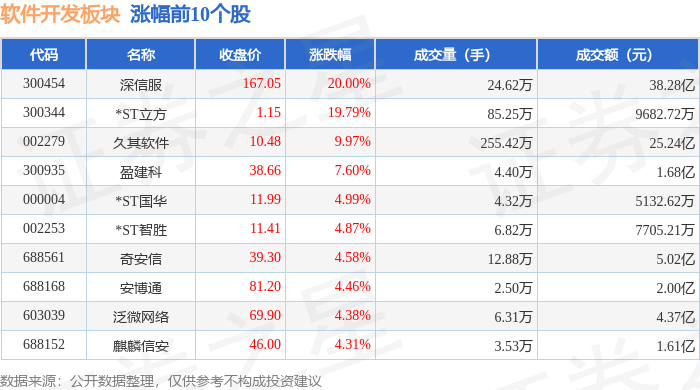
Market Performance - The software development sector increased by 1.04% on January 22, with Shenxinfu leading the gains [1] - The Shanghai Composite Index closed at 4122.58, up 0.14%, while the Shenzhen Component Index closed at 14327.05, up 0.5% [1] Top Gainers in Software Development Sector - Shenxinfu (300454) closed at 167.05, up 20.00% with a trading volume of 246,200 shares and a transaction value of 3.828 billion [1] - ST Lifang (300344) closed at 1.15, up 19.79% with a trading volume of 852,500 shares [1] - Jiuqi Software (002279) closed at 10.48, up 9.97% with a trading volume of 2,554,200 shares and a transaction value of 2.524 billion [1] - Other notable gainers include Lei Jianke (300935) up 7.60% and Qi Anxin (688561) up 4.58% [1] Market Capital Flow - The software development sector experienced a net outflow of 230 million from institutional investors, while retail investors saw a net inflow of 264 million [2] - Retail investors had a net outflow of 34.18 million [2] Individual Stock Capital Flow - Jiuqi Software (002279) had a net inflow of 301 million from institutional investors, while it faced a net outflow of 126 million from retail investors [3] - Shenxinfu (300454) saw a net inflow of 184 million from institutional investors but a net outflow of 45.1 million from retail investors [3] - Other stocks like Keda Guochuang (300520) and Wanxing Technology (300624) also showed significant net inflows from institutional investors [3]


奇安信:公司推出了大模型安全评估、大模型卫士系统等相关产品和服务
Zheng Quan Ri Bao Zhi Sheng· 2026-01-21 13:37
Group 1 - The core viewpoint of the article highlights that large model security governance is a pressing need for government and enterprise institutions [1] - The company has launched products and services such as large model security assessment and large model guardian system to better address AI security risks [1] - The company has successfully implemented these solutions in various sectors, including telecommunications and government, demonstrating real-world applications [1]
奇安信:目前公司的一批核心产品已完成了全面国产化适配或全栈国产化适配
Zheng Quan Ri Bao· 2026-01-21 11:43
Group 1 - The core viewpoint of the article is that Qihoo 360 has completed the full domestic adaptation of several key products, indicating a significant step towards localization in its offerings [2] Group 2 - The company has achieved full-stack domestic adaptation for its core products in the security operation field, such as the "Tianyan" system [2] - In the boundary security field, the company has also completed the domestic adaptation of its traffic decryption orchestrator [2]
公司问答丨奇安信:目前公司的一批核心产品已完成了全面国产化适配或全栈国产化适配
Ge Long Hui A P P· 2026-01-21 08:38
Core Insights - The company has completed full-stack localization adaptation for several core products, including "Tianyan" in the security operation field and the traffic decryption orchestrator in the boundary security field [1] Group 1 - Investors inquired about the company's progress on full-stack product localization adaptation for domestic chips such as Kunpeng, Haiguang, and Longxin [1] - The company confirmed that a batch of core products has achieved comprehensive localization adaptation [1]
智能网联汽车云平台漏洞分析报告
奇安信· 2026-01-21 01:55
Investment Rating - The report indicates a critical investment rating for the smart connected vehicle cloud platform industry due to the high vulnerability detection rates and significant security risks identified [5][10]. Core Insights - The analysis conducted by Qihoo 360's Code Security Laboratory on 30 automotive manufacturers revealed that 93.3% of the cloud platforms had vulnerabilities, with a total of 207 vulnerabilities identified, including 66 critical and high-risk vulnerabilities, accounting for 31.9% [5][10]. - The report highlights that over 70% of the automotive manufacturers' cloud platforms have critical/high-risk vulnerabilities that pose severe threats to vehicle security, including unauthorized vehicle unlocking and sensitive information leakage [11][12]. - A significant portion of vulnerabilities (65.2%) stem from basic errors such as lack of identity verification and interface authentication, indicating a low overall security level in the industry [14]. - The report emphasizes the complexity and severity of vulnerability risks, with over 70% of platforms having identity authentication and access control vulnerabilities, and half exhibiting excessive data exposure vulnerabilities [5][31]. Summary by Sections Overall Vulnerability Status Analysis - Among the 30 automotive manufacturers analyzed, 28 platforms were found to have vulnerabilities, with a detection rate of 93.3% and a total of 207 vulnerabilities identified [10]. - 76.7% of the platforms had critical or high-risk vulnerabilities, which could lead to severe consequences such as remote unlocking of vehicles and unauthorized driving [11][12]. Major Vulnerability Types Analysis - 60% of the platforms exhibited broken access control vulnerabilities, while 50% had excessive data exposure vulnerabilities [16]. - 73.3% of the platforms were affected by both broken access control and authentication failures, indicating systemic issues in security management processes [17][18]. Major Vulnerability Hazard Analysis - 73.3% of the platforms experienced sensitive information leakage due to various vulnerabilities, including excessive data exposure and broken access control [45]. - 66.7% of the manufacturers' vehicles could be unlocked without authorization, directly threatening vehicle property security [47]. - 40% of the platforms had vulnerabilities that allowed unauthorized operations through account impersonation, leading to potential financial losses for users [49][50]. Summary and Recommendations - The report concludes that the network information security of smart connected vehicles is a complex systemic issue, with many foundational vulnerabilities indicating a lack of comprehensive security management [51]. - Recommendations include elevating security responsibility to the strategic level, integrating security into the product development lifecycle, and enhancing collaboration between vehicle and cloud security teams [52][56].