
TYN(000591)

Search documents
马斯克:太阳能是唯一答案!
Sou Hu Cai Jing· 2026-01-14 01:15
Core Insights - Elon Musk predicts that Starlink will transport 300 to 500 GW of solar photovoltaic components to space annually for AI computing, potentially exceeding the total computing power of the United States within two years [1] - Musk emphasizes the rapid advancement of AI, forecasting that by 2030, AI intelligence will surpass the combined intelligence of all humans [3] - He asserts that within three years, robotic surgeons will outperform top human surgeons, rendering medical school obsolete [4][5] Group 1: AI Advancements - Musk describes the exponential growth of AI, stating that breakthroughs occur so rapidly that he is frequently astonished [3] - He predicts the arrival of AGI (Artificial General Intelligence) by 2026, with AI intelligence surpassing human capabilities by 2030 [3] - The potential for robotic doctors to provide superior medical care is attributed to three factors: AI capability growth, chip performance improvements, and mechanical dexterity advancements [4] Group 2: US-China AI Competition - Musk highlights that China is set to surpass other regions in AI computing power, citing three main advantages: significant electricity generation capacity, diminishing chip performance gaps, and unmatched execution speed of Chinese engineers [5][6][7] - By 2026, China's electricity generation is expected to reach three times that of the US, with a substantial portion derived from solar energy [6] - The decline of Moore's Law indicates that the performance gap in chip technology is narrowing, making it easier for China to catch up [6] Group 3: Economic Predictions - Musk suggests that in 10 to 20 years, traditional concepts of money may become irrelevant, as AI and robotics will drastically reduce production costs, leading to a new economic paradigm of "Universal High Income" [8] - He warns of a tumultuous transition period over the next 3 to 7 years, characterized by radical changes and societal upheaval [8] Group 4: Energy Solutions - Musk advocates for solar energy as the key to human energy independence, proposing a three-step plan: improving existing grid efficiency, launching solar AI satellites into space, and establishing satellite manufacturing facilities on the Moon [9][10][11] - He emphasizes the vast potential of solar energy, arguing that utilizing solar power from space is more efficient than terrestrial nuclear fusion [9] Group 5: Future of Currency - Musk concludes that the future of currency will fundamentally be energy, as it will drive AI and enable the production of goods [13]


我国科学家成功研发叠层柔性太阳能电池
Xin Lang Cai Jing· 2026-01-13 23:41
Core Viewpoint - The research team led by Professor Zhang Xiaohong from Suzhou University has successfully developed flexible silicon-perovskite tandem solar cells, addressing key challenges in efficiency and stability for flexible tandem cells, which will provide power support for long-term operations of spacecraft and space data centers [1] Group 1 - The new solar cell technology enhances efficiency and stability, which are critical for flexible applications [1] - The research findings have been published in the prestigious international journal "Nature," indicating the significance of the achievement in the scientific community [1]
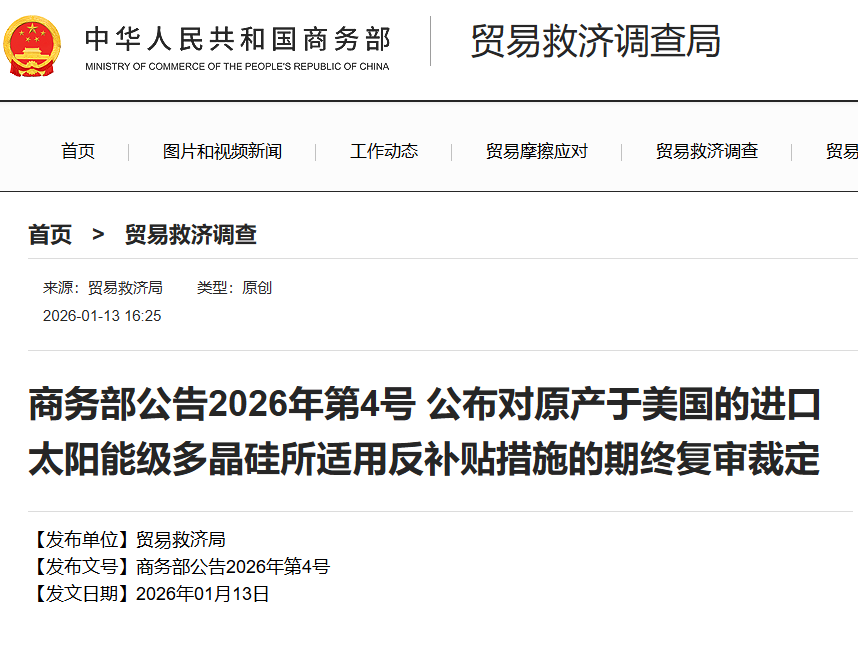
中国对原产于美韩的进口太阳能级多晶硅继续征收反倾销税
Zhong Guo Xin Wen Wang· 2026-01-13 17:22
Core Viewpoint - The Chinese Ministry of Commerce announced the continuation of anti-dumping duties on imported solar-grade polysilicon from the United States and South Korea, effective January 14, 2026, for a period of five years, with rates ranging from 53.3% to 57% for U.S. companies and 4.4% to 113.8% for South Korean companies [1] Group 1 - The Ministry of Commerce will conduct a final review investigation of the anti-dumping measures applicable to imported solar-grade polysilicon from the U.S. and South Korea starting January 14, 2025 [1] - The Ministry determined that if the anti-dumping measures are terminated, the dumping of solar-grade polysilicon from the U.S. and South Korea may continue or recur, potentially causing further harm to China's solar-grade polysilicon industry [1] - The Ministry also announced the continuation of countervailing duties on imported solar-grade polysilicon from the U.S., effective January 14, 2026, for five years, with rates ranging from 0% to 2.1% for U.S. companies [1] Group 2 - Solar-grade polysilicon is primarily used in the production of solar-grade monocrystalline silicon rods and directional solidification multicrystalline silicon ingots, serving as the main raw material for crystalline silicon photovoltaic cells [1]
商务部最新公告!对美韩太阳能级多晶硅继续征收反倾销税 ,实施期限为5年
Hua Xia Shi Bao· 2026-01-13 16:38
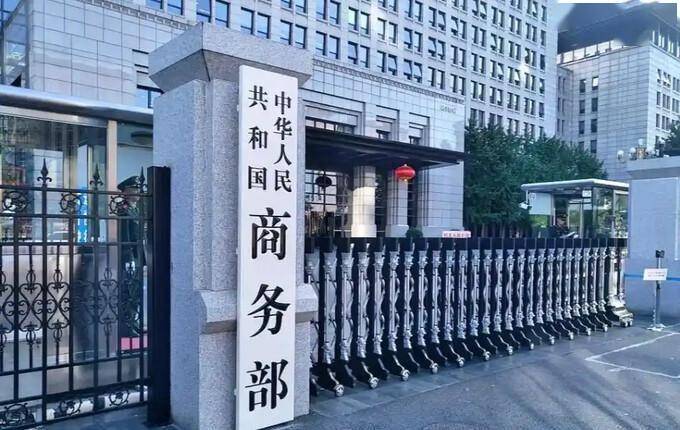
Core Viewpoint - The Ministry of Commerce of China has announced the final review ruling on anti-dumping measures applicable to imported solar-grade polysilicon from the United States and South Korea, deciding to continue imposing anti-dumping duties for another five years starting January 14, 2026, due to potential continued or renewed dumping and damage to China's solar-grade polysilicon industry [1][5][6]. Group 1: Anti-Dumping Measures - The Ministry of Commerce determined that if the anti-dumping measures are terminated, the dumping of solar-grade polysilicon from the U.S. and South Korea may continue or reoccur, potentially causing further damage to China's solar-grade polysilicon industry [5][6]. - The anti-dumping duties will be imposed at rates of 53.3% to 57% for U.S. companies and 2.4% to 113.8% for South Korean companies, as established in previous announcements [4][10]. Group 2: Historical Context - The initial anti-dumping duties were imposed on January 20, 2014, with a five-year implementation period, and have been reviewed and adjusted multiple times since then, including significant adjustments in 2017 and 2020 [4][5]. - The latest review was initiated on January 14, 2025, at the request of China's solar-grade polysilicon industry [4]. Group 3: Product Description - The investigated product is solar-grade polysilicon, produced using chlorosilane as raw material through processes such as the improved Siemens method and silane method, primarily used for manufacturing crystalline silicon photovoltaic cells [8][9].
中国为何对美韩太阳能多晶硅征税五年?背后有何深意?
Sou Hu Cai Jing· 2026-01-13 15:10
Core Viewpoint - The Ministry of Commerce's decision to continue anti-dumping duties on U.S. and South Korean polysilicon is a significant move that sets the development path for China's photovoltaic industry over the next five years, reflecting complex industry dynamics and strategic considerations [1][3]. Industry Dynamics - The anti-dumping duties, which have been in place for twelve years, were initially introduced in response to U.S. and South Korean companies capturing nearly half of the Chinese market with prices 20 to 32 USD per kilogram below market rates, severely impacting domestic companies [1][3]. - Currently, China's self-sufficiency in polysilicon has exceeded 80%, while the import share from the U.S. and South Korea has dropped to less than 4% [3]. Strategic Implications - The core purpose of the recent decision is to prevent the resurgence of dumping behavior during a critical adjustment period in the industry, as global polysilicon production capacity is significantly oversupplied [3][5]. - This policy is not merely a trade protection measure; it aims to create a stable environment for technological iteration and R&D investments in advanced domestic capacities [3][5]. Market Environment - The stable market conditions allow leading companies to focus on technological breakthroughs, such as lower energy consumption in granular silicon technology, while eliminating market noise from less competitive players [3][5]. - The supply security of polysilicon, as a crucial raw material for photovoltaic cells, is essential for the entire industry chain, emphasizing the importance of self-sufficiency [3][5]. Future Outlook - The continuation of these tariffs acts as a "safety lock" on the established industrial chain advantages, preventing external low-priced products from disrupting the market during sensitive periods of capacity clearance and technological advancement [5][7]. - This policy is expected to accelerate the capacity clearance process and increase industry concentration, with resources shifting towards technologically advanced leading companies [7]. - The global competitive landscape for China's photovoltaic industry will transition from scale advantages to technology leadership, prompting international partners to reassess their cooperation models with China [7].
今日晚间重要公告抢先看——杭萧钢构称公司不存在“商业航天”业务 天龙集团称当前未因AI工具产生额外收入



Jin Rong Jie· 2026-01-13 13:54
Group 1 - Hangxiao Steel Structure announced that it does not have a "commercial aerospace" business, with its main operations focused on steel structure contracting and related services, and a recent project contributing less than 1% to its 2024 audited revenue [1] - Tianlong Group stated that it has not generated additional revenue from AI tools, which are currently used internally for advertising content creation, and that the overall business operations remain unaffected [1] - Wanxing Technology confirmed that there are no undisclosed significant matters affecting its operations, and its business environment remains stable [2] Group 2 - Yaxing Chemical announced the termination of a share issuance and cash purchase of assets due to market changes and disagreements on asset valuation [2] - Zhejiang Shuculture clarified that its subsidiaries do not engage in GEO business, which has been misreported by media [2] - Luxshare Precision terminated the acquisition of assets from Wintime Technology due to delivery restrictions, with a request for the return of 1.53 billion RMB [3] Group 3 - Jinyu Group reported that its subsidiaries' revenues from specific projects are minimal compared to its overall revenue, with a small contribution from recent contracts [4] - Tongyu Communication highlighted that its stock price has significantly outpaced its fundamentals, indicating potential risks of a price correction [4] - Dongfang Mingzhu noted that the listing process for its investment in Chaoguhuan has uncertainties but currently does not impact its performance [5] Group 4 - Luyin Investment warned of risks associated with its stock price surge, which has increased by 86.92% over the last ten trading days [5] - Puyuan Information stated that its AI software platform is in the early commercialization stage, with limited revenue impact expected [6] - Zhejiang Wenhu Intermediary reported that its GEO business has not yet generated revenue, reflecting uncertainties in market acceptance [6] Group 5 - Xinhua News confirmed that its GEO business lacks a mature profit model and has not generated income [7] - People's Daily stated that it does not engage in GEO business and has not been affected by market rumors [7] - China First Heavy Industries reported minimal involvement in controllable nuclear fusion projects, with no significant revenue generated [8] Group 6 - Xibu Mining announced an increase in copper resources at the Yulong Copper Mine, adding 131.42 million tons of copper metal resources [8] - Jiurui New Materials commenced trial production of a new photoinitiator project, expected to cater to mainstream markets [9] - Tongda Sea indicated that AI-related revenue is low and does not significantly impact overall business performance [10] Group 7 - Zhenai Meijia's stock price has deviated significantly from market indices, prompting caution for investors [11] - Guizhou Moutai approved a new marketing strategy to enhance its sales channels and adapt to consumer demands [12] - Shunhao Co. plans to increase its stake in a subsidiary, reflecting confidence in future business prospects [14] Group 8 - A number of companies, including TCL Technology and Dazhu CNC, forecast significant profit increases for 2025, driven by operational improvements and market demand [19][22] - Long Cable Technology expects a profit increase due to changes in its employee stock plan and market conditions [22] - Jiangsu Electric Power reported a profit increase attributed to higher sales and reduced financial costs [29]
云南锗业:近年来全球太阳能锗晶片用量表现出较好增长势头
Zheng Quan Ri Bao· 2026-01-13 13:13
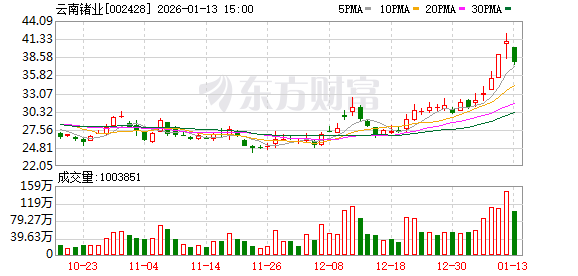
Group 1 - The core viewpoint of the article highlights the rapid growth in demand for commercial satellites, particularly low Earth orbit communication satellites, which has significantly increased the demand for space solar cells and consequently the usage of solar germanium wafers globally [2] Group 2 - The company, Yunnan Germanium, responded to investor inquiries on an interactive platform, indicating a positive growth trend in the usage of solar germanium wafers due to the rising demand in the satellite industry [2]

亚玛顿:公司暂不涉及太空太阳能相关技术领域
Zheng Quan Ri Bao Wang· 2026-01-13 13:10
Core Viewpoint - The company, Yamaton (002623), focuses on ultra-thin photovoltaic glass and optoelectronic glass, and does not currently engage in space solar energy technologies [1] Group 1 - The company emphasizes its commitment to the ultra-thin photovoltaic glass and optoelectronic glass sectors [1] - The company plans to closely monitor technological trends and market changes in response to customer needs [1] - The company aims to enhance its research and development efforts to strengthen its technological reserves [1]

太阳能:收到应收国家可再生能源补贴资金33.18亿元
Xin Lang Cai Jing· 2026-01-13 11:31
Core Viewpoint - The company announced that its photovoltaic power generation projects received renewable energy subsidy funds amounting to 3.318 billion yuan for the year 2025, representing a significant increase compared to the previous year [1] Group 1: Financial Performance - The total renewable energy subsidy funds received increased by 142.90% year-on-year [1] - The national renewable energy subsidy funds specifically amounted to 3.152 billion yuan, which is an increase of 155.64% compared to the same period last year [1]
1月13日晚间重要公告一览
Xi Niu Cai Jing· 2026-01-13 10:24
Group 1 - Shoukai Co. achieved a signed area of 125.72 million square meters and a signed amount of 17.845 billion yuan in 2025 [1] - Tongda Hai expects a net loss for the year 2025 [2] - Jiuri New Materials' subsidiary has entered the trial production phase for a project with an annual capacity of 350 tons of hydroxy ketone [3] Group 2 - Jixin Technology's shareholder plans to reduce their stake by up to 1% [4] - Fulai New Materials received approval from the CSRC for a stock issuance [5] - Yaqi International plans to sign a strategic cooperation framework agreement with Zhongnong Holdings [6] Group 3 - Sanwei Co.'s controlling shareholder plans to transfer up to 5.10% of shares [7] - Lekai Film's subsidiary plans to invest 97.6675 million yuan in a TAC functional film production line [8] - China Power Construction's subsidiary signed two major contracts totaling approximately 15.589 billion yuan [9] Group 4 - Shunhao Co. plans to increase its investment in a subsidiary by 74.98 million yuan [10] - Jieneng Wind Power reported a cumulative power generation of 12.417 billion kWh in 2025, a year-on-year increase of 1.43% [11] - Zhongjian Technology's H-share issuance application has been accepted by the CSRC [12] Group 5 - Hendi Pharmaceutical expects a net profit decrease of 57.4% to 66.14% in 2025 [13] - Haopeng Technology anticipates a net profit increase of 113.69% to 141.09% in 2025 [14] - Lingang Co. expects a net loss of 1.45 billion to 1.67 billion yuan in 2025 [15] Group 6 - Chuan Investment Energy reported a cumulative power generation of 6.627 billion kWh in 2025, a year-on-year increase of 13.85% [16] - Tengyuan Cobalt expects a net profit increase of 50.02% to 69.87% in 2025 [17] - Huazhi Jie plans to repurchase shares worth 30 million to 50 million yuan [18] Group 7 - Opto has won a bid for a 120 million yuan project from GoerTek [19] - Shanghai Construction reported a new contract amount of 252.942 billion yuan in 2025, a year-on-year decrease of 34.98% [20] - Hangfa Control expects a net profit decrease of 52.02% to 58.02% in 2025 [22] Group 8 - Shimao Energy is planning a change in control and will continue to suspend trading [23] - Shenwan Hongyuan Securities received approval for a bond issuance of up to 60 billion yuan [24] - Jingjiawei signed a strategic cooperation letter of intent with Jing'an Technology [25] Group 9 - Pianzaihuang completed the first subject enrollment for a clinical trial of a new drug [26] - Placo's subsidiary received a new veterinary drug registration certificate [27] - Zhongli Co. plans to reduce its stake by up to 0.75% [28] Group 10 - Solar Energy received renewable energy subsidies of 3.318 billion yuan in 2025, a year-on-year increase of 142.9% [29] - Palm Co. has filed a lawsuit to recover 144 million yuan in project payments [30][31] - Yongjin Co. plans to invest 2.658 billion yuan in a new stainless steel project [32] Group 11 - BAIC Blue Valley plans to increase its stake by 14.5 million to 16.4 million yuan [33] - Lingyun Light's stock issuance application has been approved by the CSRC [34] - Hongbo New Materials expects a net loss in 2025 [35] Group 12 - Shanghai Pharmaceuticals received approval for the listing of a new antifungal drug [36] - Changjiang Electric reported a net profit of 34.167 billion yuan in 2025, a year-on-year increase of 5.14% [37] - Weilan Bio received a new veterinary drug registration certificate [38] Group 13 - Pingzhi Information's subsidiary is expected to win a procurement project worth approximately 37.5884 million yuan [39]


