MJNY(000723)

Search documents
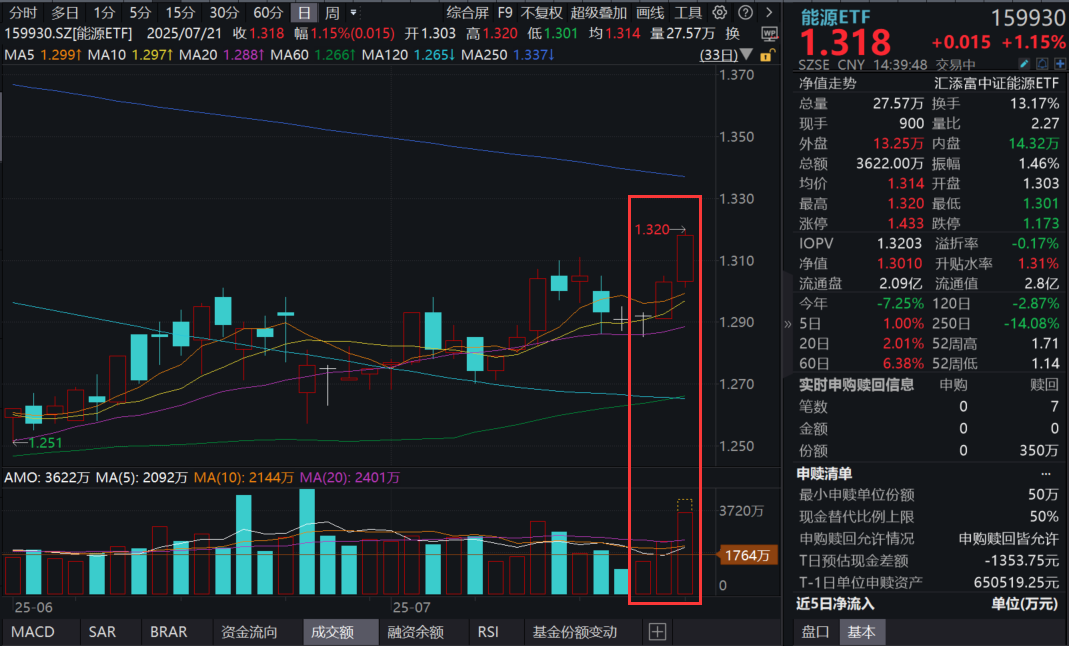
A股全面爆发量价齐升,煤炭、油气股冲高!能源ETF(159930)、油气资源ETF(159309)双双涨超1%,“反内卷”来袭,后市将如何演绎?
Xin Lang Cai Jing· 2025-07-21 08:45
Group 1: Market Overview - The A-share market experienced a significant surge on July 21, with over 4,000 stocks rising and a trading volume increase of 133.8 billion yuan, leading to a new high for the Shanghai Composite Index this year [1] - Key sectors such as building materials, coal, and oil saw substantial gains, with Energy ETFs (159930) rising over 1% for three consecutive days, and Oil and Gas Resource ETFs (159309) also increasing over 1% for four consecutive days [1] Group 2: Coal and Oil Sector Performance - Major coal and oil stocks saw significant increases, with companies like Yanzhou Coal Mining and Shanxi Coking Coal rising over 3%, while Meijin Energy and China United Coalbed Methane increased over 2% [3] - The top ten components of the Energy ETF (159930) included major players like China Petroleum and China Shenhua, with respective trading volumes of 757 million yuan and 968 million yuan [4] - The top ten components of the Oil and Gas Resource ETF (159309) also featured significant players, with China Petroleum and China Petrochemical leading in trading volumes [4] Group 3: Policy and Market Dynamics - On July 18, government officials announced a new round of growth stabilization plans for key industries, including steel, non-ferrous metals, petrochemicals, and building materials, aimed at optimizing supply and eliminating outdated production capacity [5] - The China Coal Transportation and Marketing Association emphasized the need for coal companies to understand market changes and ensure compliance with long-term contracts to maintain market balance [5] - The "anti-involution" policy is expected to resonate with the coal sector, potentially leading to valuation increases as the market stabilizes [6] Group 4: Price Trends and Future Outlook - Short-term coal prices are expected to remain bullish due to seasonal demand, with supply constraints from safety regulations and stricter import controls [6] - In the medium to long term, coal prices are projected to gradually return to a "reasonable center," which would stabilize profitability for coal companies and reshape market perceptions of the coal sector [7] - The oil sector may face challenges related to overcapacity, necessitating a focus on controlling operating rates and project approvals [8]







煤炭行业周报(7月第3周):中报利空出尽,基本面仍向上-20250720
ZHESHANG SECURITIES· 2025-07-20 06:05
Investment Rating - The industry rating is "Positive" [1] Core Viewpoints - The report indicates that the negative impact from the mid-year report has been fully absorbed, and the fundamentals of the coal industry remain upward [1] - The coal sector has underperformed the CSI 300 index, with a decline of 0.74% compared to a 1.09% increase in the index, resulting in a relative underperformance of 1.83 percentage points [2] - Key monitored enterprises reported an average daily coal sales volume of 7.31 million tons, which is a week-on-week increase of 2.8% and a year-on-year increase of 4.7% [2] - The report highlights a decrease in coal inventory by 4% week-on-week, while year-on-year inventory has increased by 19.8% [2] Summary by Sections Coal Market Performance - The coal sector saw 6 stocks rise and 31 stocks fall during the week, with ST Dazhou showing the highest increase of 4.89% [2] - The average daily sales of thermal coal increased by 3.2% week-on-week, while coking coal sales rose by 1.9% [2] Price Trends - As of July 18, 2025, the price index for thermal coal (Q5500K) in the Bohai Rim was 663 RMB/ton, reflecting a week-on-week increase of 0.15% [3] - The price of coking coal at Jing Tang Port was 1420 RMB/ton, with a week-on-week increase of 8.4% [4] Investment Recommendations - The report suggests that social inventory continues to decline, and current demand remains promising, with domestic power plants showing a significant increase in daily coal consumption [6] - The report recommends focusing on high-dividend thermal coal companies and coking coal companies that are experiencing turnaround potential, such as China Shenhua, Shaanxi Coal, and others [6]



美锦能源上半年预亏逾4.8亿元 氢能业务遇成长阵痛
Zhong Guo Jing Ying Bao· 2025-07-18 20:21
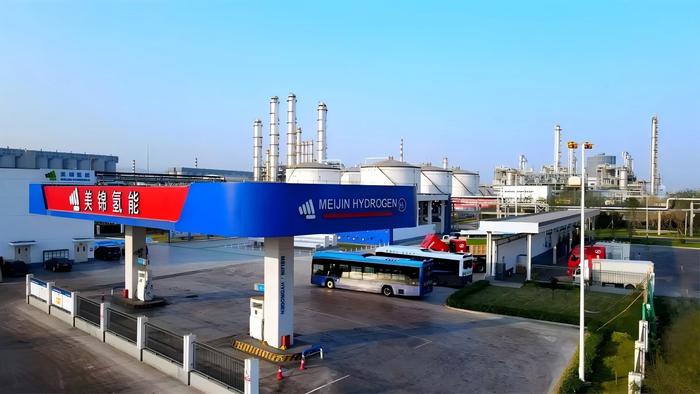
Core Viewpoint - Meijin Energy (000732.SZ) is expected to report a net loss of 480 million to 700 million yuan for the first half of 2025, showing a slight improvement from a loss of 683 million yuan in the same period last year, primarily due to declining coal and coke prices impacting profit margins [2] Group 1: Financial Performance - In 2022, Meijin Energy reported a net profit of 2.209 billion yuan, which plummeted to 289 million yuan in 2023, and further to a loss of 1.143 billion yuan in 2024, marking a year-on-year decline of 495.31% [2] - Revenue decreased from 24.6 billion yuan in 2022 to 19.031 billion yuan in 2024 [2] Group 2: Business Structure and Market Sensitivity - In 2024, Meijin Energy's coal and coke business accounted for 95.84% of its revenue, making it highly sensitive to fluctuations in coal and coke prices [3] - The International Energy Agency (IEA) predicts a 27% decline in global coal prices in 2025, further compressing traditional business profit margins [3] Group 3: Coke Price Trends - By the end of June 2025, the price of Shanxi premium dry coke fell to 1,225 yuan per ton, a decrease of 460 yuan per ton or 27.3% since early January, and down 845 yuan per ton or 40.82% year-on-year [3][4] - The decline in coke prices is attributed to weak demand from the steel industry and a surplus in supply, with expectations of a slow recovery in the second half of 2025 [4] Group 4: Hydrogen Energy Business - Meijin Energy has been strategically investing in the hydrogen energy sector since 2017, aiming to leverage its coke production to develop a complete hydrogen energy supply chain [5] - Despite being a leader in the hydrogen energy sector, the revenue contribution from this business remains low at 4.16% in 2024 [5] Group 5: Production and Sales Challenges - In 2024, the combined production of commercial vehicles from subsidiaries Feichi Technology and Qingdao Meijin was only 208 units, with total sales of 634 units, both showing a decline [6] - The hydrogen energy segment faced challenges due to policy changes, high hydrogen costs, and slow infrastructure development, leading to losses for both subsidiaries [6] Group 6: Project Delays - The completion of the Meijin Hydrogen Energy Headquarters Base Phase I has been postponed from June 2025 to June 2026 due to various construction delays [7] - The company has implemented measures to expedite project progress, including enhanced communication with contractors and increased resource allocation [7][8]
14日投资提示:美锦能源预计2025年半年度亏损7亿至4.8亿




集思录· 2025-07-13 14:10
Group 1 - The core viewpoint of the articles highlights various companies' shareholder actions, financial forecasts, and market activities, indicating potential investment opportunities and risks in the market [1][2]. Group 2 - Qingyuan Co., Ltd. plans to reduce its shareholding by no more than 1% of the company's total shares [1] - Jiamei Packaging also intends to collectively reduce its shareholding by no more than 1% [1] - ST Dongshi is publicly recruiting investors for restructuring [1] - Hongcheng Convertible Bond will not be forcibly redeemed [1] - Jintian Co., Ltd. expects a net profit of 340 million to 400 million for the first half of 2025, representing a year-on-year increase of 176.66% to 225.48% [1] - Meijin Energy anticipates a loss of 700 million to 480 million for the first half of 2025 [1] - Zhonglu Convertible Bond and Kuitian Convertible Bond will not undergo adjustments [1] - Xizhen Convertible Bond has been listed [1] - Shanda Electric Power and Jiyuan Group are new stocks available for subscription on the Shanghai and Shenzhen exchanges [1] - Southern Universal Data Center REIT (508060) and Southern Runze Technology Data Center REIT (180901) are available for subscription [1]
煤炭行业周报(7月第2周):社会库存首次下降,夏季需求持续可期-20250713
ZHESHANG SECURITIES· 2025-07-13 08:09
Investment Rating - The industry rating is "Positive" [1] Core Views - Social inventory has decreased for the first time, and summer demand is expected to remain strong. Domestic power plants are increasing daily coal consumption, leading to rising coal prices. Policies to control production and improve quality are being emphasized, supporting the fundamentals of both coking coal and thermal coal [6][29] - The report highlights that the overall level of social inventory is stable, with a significant increase in daily consumption expected due to hot weather and ongoing replenishment needs at power plants. The coking coal sector may see marginal improvements in performance due to potential declines in capacity utilization driven by environmental factors [6][29] Summary by Sections Coal Sector Performance - The coal sector saw a weekly increase of 0.71%, underperforming the CSI 300 index, which rose by 0.82%. A total of 34 stocks in the sector increased in price, while 3 declined. Meijin Energy had the highest weekly increase at 10.8% [2] - Key monitored enterprises reported an average daily coal sales volume of 7.21 million tons from July 4 to July 10, 2025, a week-on-week increase of 3.7% and a year-on-year increase of 2.8% [2] Price Trends - As of July 11, 2025, the price of thermal coal (Q5500K) in the Bohai Rim was 662 CNY/ton, a week-on-week decrease of 0.3%. The price index for imported thermal coal rose by 1.21% to 750 CNY/ton [3] - The price of coking coal at Jingtang Port was 1310 CNY/ton, up 4.8% week-on-week, while the price of metallurgical coke remained stable at 1320 CNY/ton [4] Supply and Demand Dynamics - The cumulative coal sales volume for key monitored enterprises was 131.73 million tons as of July 10, 2025, a year-on-year decrease of 3.8%. The demand from the power and chemical industries showed a year-on-year decrease of 3% and an increase of 16.6%, respectively [2][28] - The report indicates that the daily coal consumption in the power sector is expected to rise significantly, with the total social inventory of coal at 32.86 million tons, a week-on-week decrease of 2.6% [2][28] Investment Recommendations - The report suggests focusing on high-dividend thermal coal companies and coking coal companies that may experience a turnaround. Key companies to watch include China Shenhua, Shaanxi Coal and Chemical Industry, and Meijin Energy among others [6][29]
煤炭行业今日净流出资金2.90亿元,美锦能源等14股净流出资金超千万元
Zheng Quan Shi Bao Wang· 2025-07-11 09:24
Market Overview - The Shanghai Composite Index rose by 0.01% on July 11, with 19 sectors experiencing gains, led by non-bank financials and steel, which increased by 2.02% and 1.93% respectively [1] - Conversely, the banking and building materials sectors saw declines of 2.41% and 0.67% [1] - The coal industry ranked third in terms of decline for the day [1] Capital Flow Analysis - The main capital outflow from the two markets totaled 6.21 billion yuan, with 7 sectors seeing net inflows [1] - The non-bank financial sector led with a net inflow of 8.21 billion yuan, corresponding to its 2.02% increase [1] - The computer sector followed with a daily increase of 1.93% and a net inflow of 6.20 billion yuan [1] Coal Industry Performance - The coal industry experienced a decline of 0.60% with a net capital outflow of 290 million yuan [2] - Among the 37 stocks in the coal sector, 14 stocks rose while 19 stocks fell [2] - Notably, Shanxi Coking Coal had the highest net inflow of 63.39 million yuan, followed by Xinji Energy and Anyuan Coal with inflows of 50.73 million yuan and 28.34 million yuan respectively [2][3] Individual Stock Movements in Coal Sector - Major stocks with significant capital outflows included Meijin Energy, China Shenhua, and Zhengzhou Coal Electricity, with outflows of 205 million yuan, 59.98 million yuan, and 38.00 million yuan respectively [2][3] - The capital flow data for the coal sector indicates a mixed performance among individual stocks, with some stocks like Anyuan Coal and Xinji Energy showing positive inflows despite the overall sector decline [2][3]

美锦能源:预计2025年上半年净利润亏损4.8亿元-7亿元
news flash· 2025-07-11 09:06
Group 1 - The company, Meijin Energy (000723), expects a net profit loss attributable to shareholders of 480 million to 700 million yuan for the period from January 1, 2025, to June 30, 2025 [1] - The net profit loss, after deducting non-recurring gains and losses, is projected to be between 490 million and 710 million yuan, with a basic earnings per share loss of 0.11 to 0.16 yuan [1] - The primary reason for the loss is attributed to the market environment, specifically the decline in coal and coke prices, which has pressured the gross profit margin of the company's main products [1]
沪指重回3500点 超2900只个股上涨
Mei Ri Shang Bao· 2025-07-10 22:49
Market Overview - The A-share market experienced a steady upward trend, with the Shanghai Composite Index reaching a new high of 3526.59 points since October 9, 2024, closing at 3509.68 points, marking a 0.48% increase [1] - The total market turnover was approximately 1.52 trillion yuan, with over 2900 stocks rising [1] Real Estate Sector - The real estate sector saw a collective surge, with a 3.21% increase, leading all industry sectors for the day, and 87 out of 91 constituent stocks rising [2] - Notable stocks such as 华夏幸福, 南山控股, and others hit the daily limit up, indicating a strong recovery in the previously dormant real estate market [2] - The Ministry of Housing and Urban-Rural Development emphasized the importance of stabilizing and promoting healthy development in the real estate market, advocating for tailored policies to enhance effectiveness [2] Debt Restructuring in Real Estate - There has been a noticeable acceleration in debt restructuring among real estate companies, with over ten firms, including 融创 and 富力, receiving approval for restructuring [3] - The restructuring efforts aim to alleviate short-term cash flow pressures, although long-term debt repayment remains a concern if operational cash flow does not improve [3] Financial Sector Performance - Major banks, including 工商银行 and 建设银行, reached historical highs, contributing to the Shanghai Composite Index's performance [5] - The securities sector also showed strong performance, with 中银证券 hitting the daily limit up and an overall increase of 1.44% in the sector [6] - Analysts noted that the economic recovery expectations have eased concerns over bank asset quality, with a positive outlook for high-dividend stocks [6] Hydrogen Energy Sector - The hydrogen energy sector experienced a sudden surge, with stocks like 美锦能源 and 京城股份 hitting the daily limit up, influenced by a significant rise in the US hydrogen sector [7] - The hydrogen energy index has increased over 100% since April, indicating strong market interest [7] - Analysts expect further policy support for the hydrogen industry, particularly in 2025, which may catalyze commercial progress and project implementation [8]






中证沪港深互联互通中小综合能源指数报1985.04点,前十大权重包含洲际油气等
Jin Rong Jie· 2025-07-10 08:55
Group 1 - The China Securities Index series includes the CSI 500, CSI Hong Kong-Shanghai-Shenzhen Small Comprehensive Index, and CSI Hong Kong-Shanghai-Shenzhen Comprehensive Index, categorized into 11 industries to reflect the overall performance of different industry securities [1][2] - The CSI Hong Kong-Shanghai-Shenzhen Small Comprehensive Energy Index has shown a 2.88% increase over the past month, a 7.73% increase over the past three months, and a 6.22% decrease year-to-date [1] - The top ten holdings in the CSI Hong Kong-Shanghai-Shenzhen Small Comprehensive Energy Index include China Coal Energy (11.12%), Jereh Oilfield Services (6.61%), Meijin Energy (4.44%), and others [1] Group 2 - The market share of the CSI Hong Kong-Shanghai-Shenzhen Small Comprehensive Energy Index is distributed as follows: Shanghai Stock Exchange 52.20%, Shenzhen Stock Exchange 24.29%, and Hong Kong Stock Exchange 23.51% [2] - The industry composition of the index shows that coal accounts for 37.32%, coke for 18.96%, fuel refining for 12.62%, oil and gas extraction for 12.35%, and oilfield services for 9.14% [2] - The index samples are adjusted biannually, with adjustments occurring on the next trading day after the second Friday of June and December [2]


指数暴涨超100%!8.5万亿赛道,迎多重利好!
券商中国· 2025-07-10 06:28
Core Viewpoint - The hydrogen energy sector has experienced a significant surge in both A-share and Hong Kong markets, driven by positive developments in the U.S. market and favorable domestic policies [1][2][3]. Group 1: Market Performance - A-share hydrogen energy stocks saw a sudden rise, with companies like Meijin Energy and Jingcheng Shares hitting the daily limit, while others like Zhuoyue New Energy and Yihua Tong also experienced rapid gains [1][3]. - The U.S. hydrogen energy sector surged by 18%, with the hydrogen index increasing over 100% since April 21, driven by key players like Plug Power, which saw a 25% increase [2]. Group 2: U.S. Developments - The U.S. proposed expanding natural gas-based aviation fuel types, particularly synthetic kerosene produced from hydrogen and captured CO2, which could streamline hydrogen production at military bases [2]. - The U.S. Senate extended the 45V clean hydrogen production tax credit until the end of 2027, contributing to a significant rise in hydrogen stocks, including a 28.45% increase for Plug Power [2]. Group 3: Domestic Policy and Developments - Recent domestic developments include a strategic cooperation agreement between CIMC Anrui and Jiangsu Zhongchun Hydrogen Energy, focusing on green hydrogen and hydrogen transportation [4]. - Various provinces, including Fujian and Hunan, have released plans to accelerate hydrogen energy development, emphasizing the importance of hydrogen equipment and fuel cell vehicles [4][5]. - The national focus on transitioning the coal industry towards high-value products includes the development of hydrogen energy as part of a new energy system [5]. Group 4: Future Expectations - Analysts predict that 2025 will be a pivotal year for hydrogen energy policies, with expectations for increased project activity and commercialization in the sector [6]. - The year is also seen as crucial for fuel cell vehicle applications, with potential policy developments that could drive stock prices in the hydrogen sector [6].