
TZE(002129)

Search documents
TCL中环或入主一道新能,后者IPO折戟、曾与“宁王”传绯闻
2 1 Shi Ji Jing Ji Bao Dao· 2026-01-17 10:55
Group 1 - TCL Zhonghuan announced an investment in Yida New Energy Technology Co., Ltd. to enhance its integration strategy and optimize its solar cell and module production capacity [3][5] - Yida New Energy has established a production capacity of 30GW for high-efficiency batteries and modules in 2023, with plans to increase to 40GW by the end of 2025, surpassing TCL Zhonghuan's current capacity of 24GW [4] - The investment is seen as a market-driven response to the current challenges in the solar industry, with TCL Zhonghuan aiming to strengthen its competitive position amid a trend of market consolidation [5][6] Group 2 - The investment involves acquiring shares and possibly controlling interest in Yida New Energy, with major shareholders expected to transfer their stakes [6] - Prior to this investment, Yida New Energy had sought to go public but its IPO was terminated in August 2024, leading to speculation about potential acquisition by other companies [7] - TCL Zhonghuan anticipates that this investment will enhance its technological capabilities and support its BC battery business, which is crucial for maintaining a leading position in the global solar industry [8]


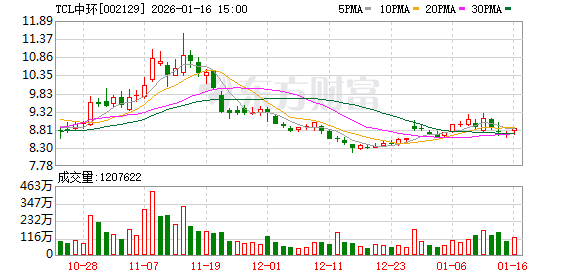
光伏行业或再启重磅整合 硅片龙头TCL中环拟投资一道新能源 |速读公告
Xin Lang Cai Jing· 2026-01-17 01:12
Core Viewpoint - TCL Zhonghuan plans to invest in Yida New Energy Technology Co., aiming to strengthen its position in the photovoltaic industry and address downstream product gaps [1][5]. Group 1: Investment Details - TCL Zhonghuan intends to acquire shares from Yida New Energy's major shareholders through various methods, including share transfer and capital increase [2]. - Yida New Energy, established in August 2018, reported revenues of 1.894 billion, 8.606 billion, and 22.724 billion yuan from 2021 to 2023 [2]. - The IPO process for Yida New Energy was terminated in August 2024 due to market conditions and financing challenges [2][3]. Group 2: Market Context - The photovoltaic industry is experiencing a supply-demand imbalance, with a consensus on the need for market-driven mergers and acquisitions to optimize capacity [1][4]. - Despite the industry's upward cycle, no successful mergers among leading companies have occurred to date [4]. - Yida New Energy's high asset-liability ratios of 87.71%, 86.54%, and 86.89% from 2021 to 2023 indicate significant financial pressure [3]. Group 3: Strategic Implications - The acquisition aims to enhance TCL Zhonghuan's downstream capabilities in photovoltaic products, particularly in solar cells and modules [3][5]. - TCL Zhonghuan's recent performance indicates a slight narrowing of losses, with an expected net loss of 8.2 billion to 9.6 billion yuan for 2025 [5]. - The company plans to improve its competitive edge in solar materials and components, targeting significant operational improvements by 2026 [6].
新华财经早报:1月17日
Xin Hua Cai Jing· 2026-01-17 00:57
Group 1 - Canada will grant China an annual quota of 49,000 electric vehicles, which will enjoy a 6.1% Most Favored Nation tariff rate, with the quota increasing at a certain rate each year [1] - The Ministry of Commerce of China expects both countries' industries to seize opportunities for mutual benefit and win-win cooperation [1] - The State Council of China is focusing on boosting consumption and supporting new service consumption growth points, aiming to enhance service quality and consumer willingness [1] Group 2 - The China Securities Regulatory Commission (CSRC) is strengthening market monitoring and regulation to prevent excessive speculation and market manipulation [1] - The CSRC is drafting a trial management method for derivative trading, emphasizing prudent regulation and maintaining reasonable leverage levels in the derivatives market [1] - The market supervision authority approved the acquisition of Dole Group by American Axle Manufacturing with additional restrictive conditions to ensure fair competition in the automotive parts sector [2] Group 3 - TCL Zhonghuan signed a cooperation framework agreement to invest in a new energy project [4] - Huatai Hotel's controlling shareholder is planning a merger and reorganization, which may lead to a change in actual control [4] - Cheng Tian Wei Ye plans to raise no more than 800 million yuan through a private placement for liquid cooling system projects [4]


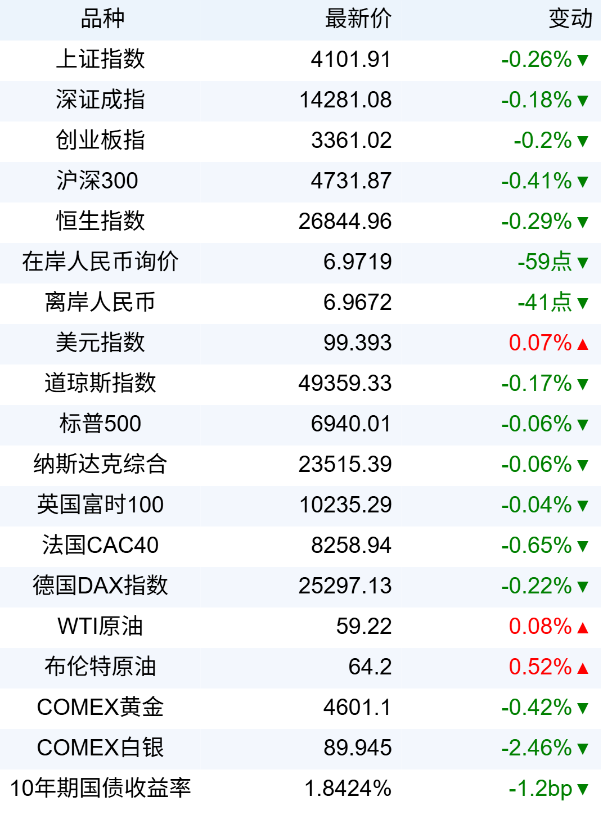
TCL中环:拟投一道新能源,推进一体化战略
Sou Hu Cai Jing· 2026-01-16 15:41
Group 1 - The core viewpoint of the article is that TCL Zhonghuan plans to invest in Yida New Energy Technology Co., Ltd. to accelerate its moderately integrated strategy by leveraging advantages in technology, scale, and efficiency [1] - Yida New Energy is engaged in the research, manufacturing, and sales of high-efficiency solar cells, and has ranked among the top in the national bidding volume for N-type modules in 2023 [1] - The investment aims to optimize existing production capacity, extend the industrial chain, and address business shortcomings, while also enhancing the collaboration with the subsidiary BC for patent technology and production capacity advantages [1] Group 2 - The investment will be executed through share transfer, with major shareholders planning to transfer all or part of the shares of the target company, with the transfer price and transaction method to be agreed upon later [1]
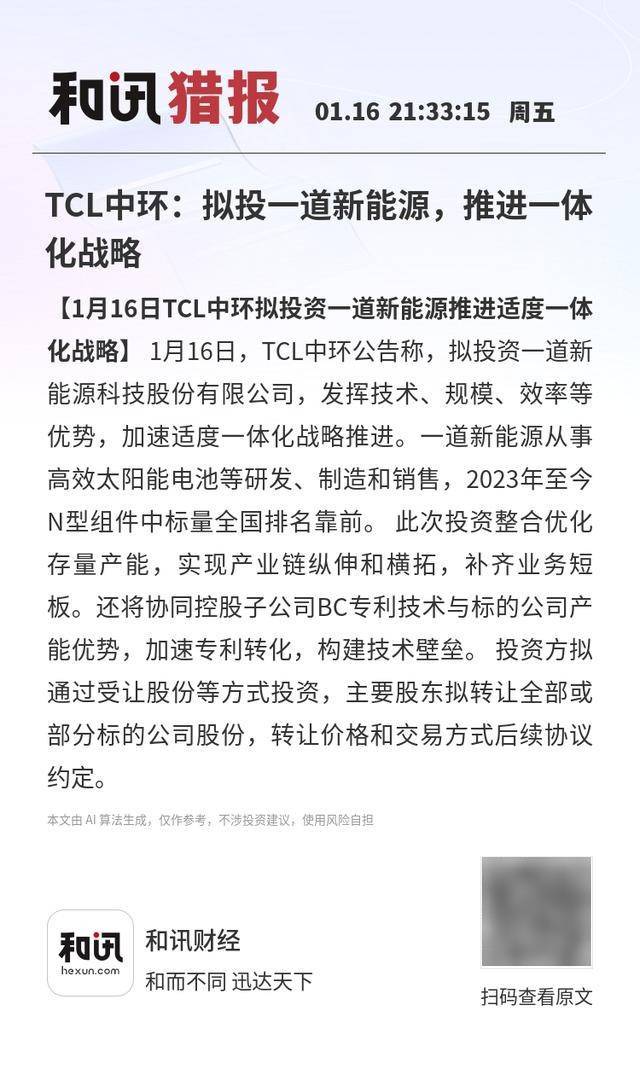
TCL中环:拟投资一道新能源 加速适度一体化战略推进
Xin Lang Cai Jing· 2026-01-16 14:44
Core Viewpoint - TCL Zhonghuan announced plans to invest in Yidao New Energy Technology (Quzhou) Co., Ltd. to enhance its vertical and horizontal integration in the solar energy sector, aiming to optimize production capacity and accelerate the conversion of patented technologies [1][2][3] Group 1: Investment Details - TCL Zhonghuan intends to invest in Yidao New Energy through share acquisition, voting rights delegation, and capital increase, with the main shareholder, Quzhou Zhidao Enterprise Management Partnership, planning to transfer all or part of its shares [1][3] - The investment aims to integrate and optimize existing production capacity, quickly address business shortcomings, and build a complete technological barrier through collaboration on BC patented technology and production advantages [1][2] Group 2: Strategic Objectives - The investment is part of TCL Zhonghuan's strategy to accelerate moderate integration, optimize solar cell component production capacity, and enrich product and customer structures [2][4] - The collaboration is expected to enhance the integration of product technology capabilities and accelerate breakthroughs in new technologies and products, such as BC batteries [2][4] Group 3: Exclusivity and Negotiation Rights - TCL Zhonghuan will have exclusive negotiation rights for similar transactions within 90 days of signing the letter of intent, preventing Yidao New Energy's founders and major shareholders from negotiating or signing any documents regarding the target equity without prior written consent [4]
TCL中环拟投资一道新能源 加速公司适度一体化战略推进
Zhi Tong Cai Jing· 2026-01-16 14:41
Core Viewpoint - TCL Zhonghuan plans to invest in Yidao New Energy Technology Co., Ltd. to leverage its technological, scale, and efficiency advantages, accelerating the company's moderate integration strategy [1] Group 1: Investment Details - The investment aims to optimize existing production capacity and achieve vertical and horizontal expansion of the company's industrial chain [1] - Yidao New Energy specializes in the R&D, manufacturing, and sales of high-efficiency solar cells, photovoltaic modules, and system applications, ranking high in N-type module bidding volume in 2023 [1] Group 2: Strategic Goals - The investment will enhance the synergy between TCL Zhonghuan's BC patent technology and Yidao's BC battery module processing and production capacity, accelerating the conversion of patent technology and building a complete technological barrier [1] - The global layout and multi-scenario applications are key strategies for capacity reduction, with the investment expected to create synergies in products, brands, and channels, providing comprehensive solutions to customers [1] Group 3: Operational Improvements - Both parties will gradually implement the clearance of inefficient production capacity during and after the transaction, aiming to establish a new technology and application industrial ecosystem [1] - The plan includes improving operational conditions through empowerment and collaboration, contributing to the healthy development of the industry [1]
TCL中环(002129.SZ)拟投资一道新能源 加速公司适度一体化战略推进
智通财经网· 2026-01-16 14:41
Core Viewpoint - TCL Zhonghuan plans to invest in Yidao New Energy Technology Co., Ltd. to leverage its technological, scale, and efficiency advantages, accelerating the company's moderate integration strategy [1] Group 1: Investment Rationale - Yidao New Energy specializes in the R&D, manufacturing, and sales of high-efficiency solar cells, photovoltaic modules, and system applications, ranking among the top in the country for N-type module bids in 2023 [1] - The investment aims to optimize existing production capacity, achieving vertical and horizontal expansion of the company's industrial chain, and quickly addressing business shortcomings [1] Group 2: Strategic Benefits - The investment will synergize the company's BC patent technology with Yidao's BC battery module processing and production capacity advantages, accelerating patent technology conversion and building a complete technological barrier [1] - Global layout and multi-scenario applications are key strategies for capacity reduction, with the investment expected to enhance product, brand, and channel synergies, providing customers with more comprehensive products and solutions [1] Group 3: Operational Improvements - Both parties will gradually implement the clearance of inefficient production capacity during and after the transaction, constructing an industrial ecosystem for new technologies and applications [1] - The plan includes improving operational conditions through empowerment and collaboration, contributing to the healthy development of the industry [1]
光伏龙头大动作!TCL中环拟投资一道新能源,后者曾IPO未果
Bei Jing Shang Bao· 2026-01-16 14:20
Group 1 - TCL Zhonghuan announced an investment in Yida New Energy Technology Co., Ltd., which specializes in the research, manufacturing, and sales of high-efficiency solar cells and photovoltaic modules [1] - Yida New Energy has ranked high in the national bidding for N-type modules in 2023 and has accumulated years of R&D reserves in various application scenarios and BC battery technology [1] - The transaction aims to gradually eliminate inefficient production capacity and build a new technology and application ecosystem, with plans to improve operational conditions through empowerment and collaboration [1] Group 2 - TCL Zhonghuan released a profit forecast for 2025, expecting a net loss attributable to shareholders between 8.2 billion to 9.6 billion yuan, compared to a loss of 9.818 billion yuan in the previous year [2] - The company anticipates a non-recurring net profit loss between 8.6 billion to 9.8 billion yuan for the same period [2]
TCL中环:拟投资一道新能源,加速突破BC电池等新技术和产品能力
Xin Lang Cai Jing· 2026-01-16 13:55
Core Viewpoint - TCL Zhonghuan announced plans to invest in Yidao New Energy Technology Co., Ltd. to leverage its technological, scale, and efficiency advantages, accelerating the company's moderate integration strategy [1] Group 1: Company Overview - Yidao New Energy Technology Co., Ltd. specializes in the research, manufacturing, and sales of high-efficiency solar cells, photovoltaic modules, and system applications [1] - The company has ranked among the top in the national bidding volume for N-type modules in 2023, indicating strong market presence [1] Group 2: Strategic Implications - The investment aims to enhance TCL Zhonghuan's competitive edge in the renewable energy sector by utilizing Yidao's accumulated technological reserves in various application scenarios and BC battery technology [1]

TCL中环:拟投资一道新能源,后者从事高效太阳能电池、光伏组件及系统应用的研发等业务
Ge Long Hui A P P· 2026-01-16 13:46
Core Viewpoint - TCL Zhonghuan announced an investment in Yida New Energy Technology Co., Ltd. to leverage its technological, scale, and efficiency advantages, accelerating the company's moderate integration strategy [1] Group 1: Investment Details - The investment aims to optimize existing production capacity and achieve vertical and horizontal expansion of the company's industrial chain [1] - Yida New Energy specializes in the research, manufacturing, and sales of high-efficiency solar cells, photovoltaic modules, and system applications, ranking among the top in the country for N-type module bids in 2023 [1] Group 2: Strategic Objectives - The investment will synergize with the patented technology of the company's controlling subsidiary and the production capacity advantages of Yida New Energy's BC battery module process, accelerating the conversion of patented technology and building a complete technological barrier [1] - The investment will be executed through share acquisition, voting rights delegation, and capital increase, with the main shareholders planning to transfer all or part of their shares in Yida New Energy [1]
