
TZE(002129)

Search documents
TCL中环股价跌5.1%,中金基金旗下1只基金重仓,持有7.26万股浮亏损失3.63万元
Xin Lang Cai Jing· 2026-01-30 02:21
中金华证清洁能源指数发起A(016915)成立日期2022年10月27日,最新规模1151.49万。今年以来收益 13.2%,同类排名667/5557;近一年收益55%,同类排名1049/4285;成立以来亏损27.6%。 中金华证清洁能源指数发起A(016915)基金经理为刘重晋。 截至发稿,刘重晋累计任职时间8年184天,现任基金资产总规模23.14亿元,任职期间最佳基金回报 33.91%, 任职期间最差基金回报-26.57%。 声明:市场有风险,投资需谨慎。 本文基于第三方数据库自动发布,不代表新浪财经观点,任何在本 文出现的信息均只作为参考,不构成个人投资建议。如有出入请以实际公告为准。如有疑问,请联系 biz@staff.sina.com.cn。 责任编辑:小浪快报 1月30日,TCL中环跌5.1%,截至发稿,报9.31元/股,成交8.63亿元,换手率2.24%,总市值376.41亿 元。 资料显示,TCL中环新能源科技股份有限公司位于天津新技术产业园区华苑产业区(环外)海泰南道10 号,成立日期1988年12月21日,上市日期2007年4月20日,公司主营业务涉及半导体电子信息产业、半 导体节能产 ...

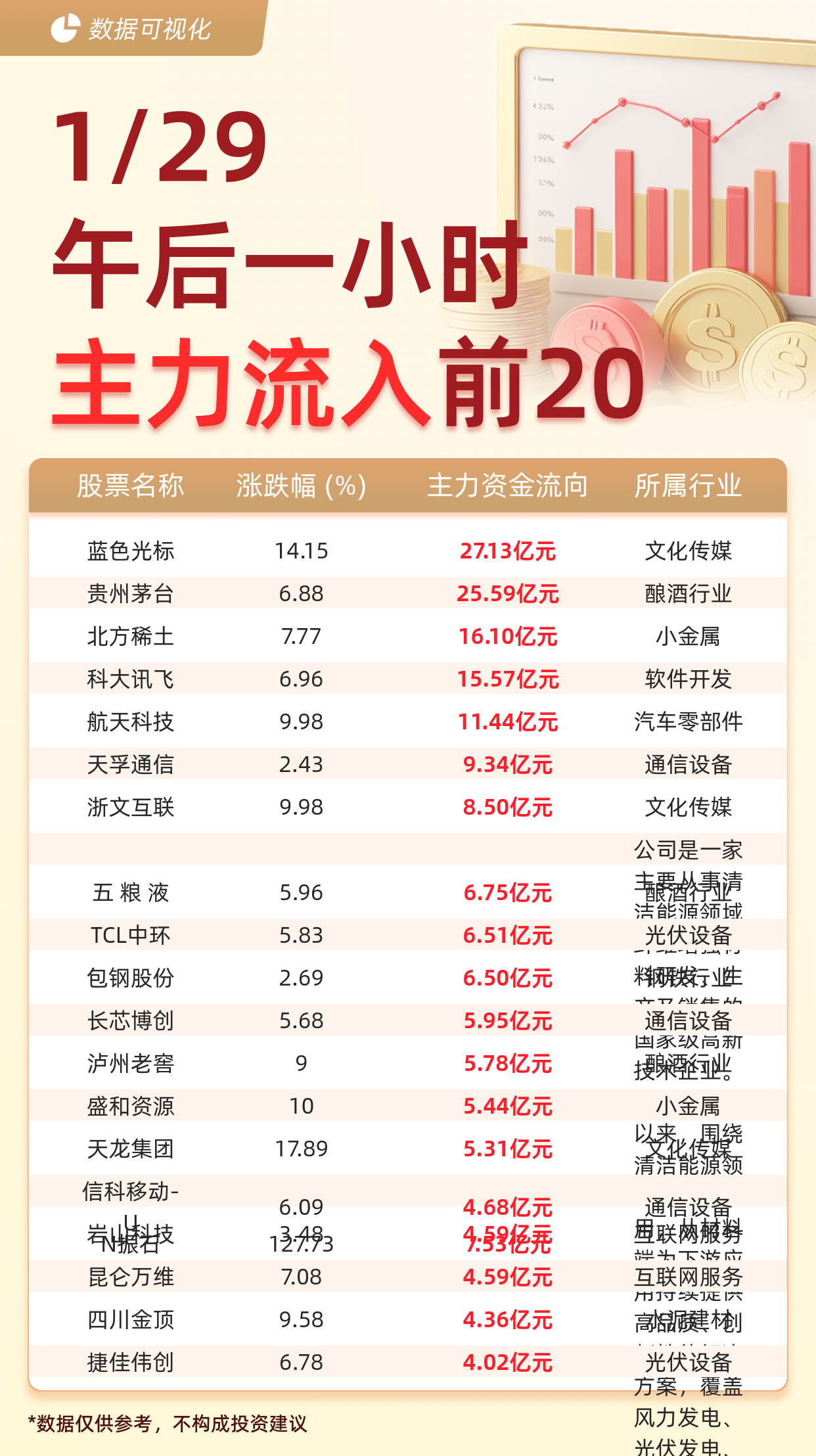
主力资金流入前20:蓝色光标流入27.13亿元、贵州茅台流入25.59亿元
Jin Rong Jie· 2026-01-29 06:15
Core Viewpoint - The data indicates significant capital inflows into various stocks, highlighting investor interest in specific sectors and companies, particularly in cultural, beverage, and technology industries [1][2][3] Group 1: Stock Performance and Capital Inflows - BlueFocus has seen a capital inflow of 2.713 billion, with a price increase of 14.15% [2] - Kweichow Moutai attracted 2.559 billion in capital, reflecting a 6.88% rise [2] - Northern Rare Earth experienced a 7.77% increase with 1.610 billion in inflows [2] - iFlytek recorded a capital inflow of 1.557 billion, with a 6.96% rise [2] - Aerospace Science and Technology saw 1.144 billion in inflows, with a notable increase of 9.98% [2] Group 2: Sector Analysis - The cultural sector, represented by BlueFocus and Zhejiang Wenlian, shows strong investor interest, with inflows of 2.713 billion and 0.850 billion respectively [2][3] - The beverage industry, particularly Kweichow Moutai and Wuliangye, continues to attract significant capital, indicating robust consumer demand [2][3] - The technology sector, including companies like iFlytek and Tianfu Communication, demonstrates growth potential with substantial capital inflows [2][3] Group 3: Additional Notable Stocks - TCL Zhonghuan in the photovoltaic equipment sector attracted 0.651 billion, with a 5.83% increase [2] - Baosteel shares saw inflows of 0.650 billion, reflecting a 2.69% rise [2] - Other notable stocks include Longxin Bochuang and Luzhou Laojiao, with inflows of 0.595 billion and 0.578 billion respectively, indicating diverse investment interests across sectors [3]



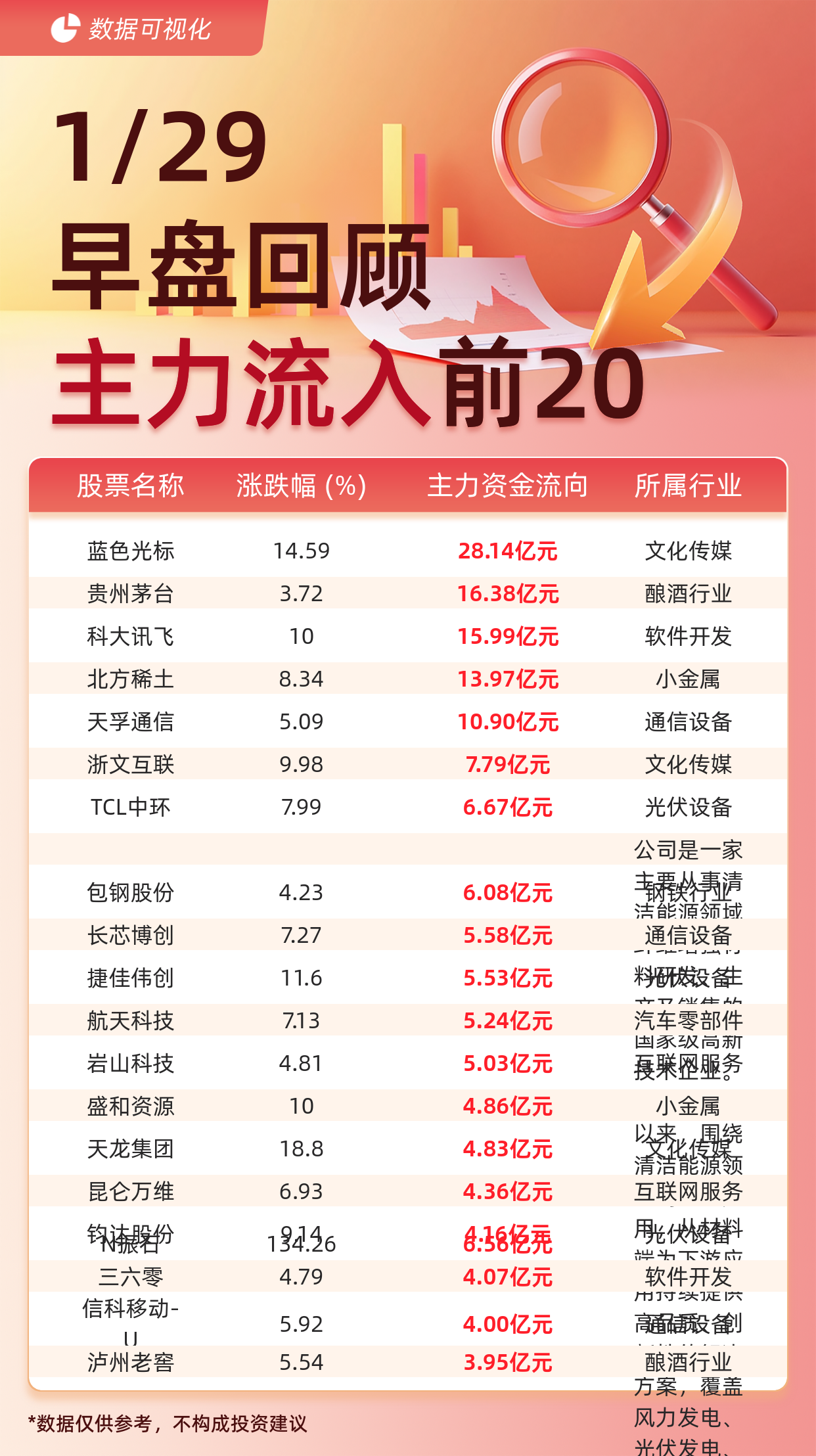
主力资金流入前20:蓝色光标流入28.14亿元、贵州茅台流入16.38亿元
Jin Rong Jie· 2026-01-29 04:10
Core Viewpoint - The data indicates significant capital inflows into various stocks, highlighting investor interest in specific sectors and companies, with notable amounts flowing into BlueFocus and Kweichow Moutai among others [1][2][3] Group 1: Stock Performance and Capital Inflows - BlueFocus saw a capital inflow of 2.814 billion, with a price increase of 14.59% [2] - Kweichow Moutai experienced a capital inflow of 1.638 billion, with a price increase of 3.72% [2] - iFlytek had a capital inflow of 1.599 billion, with a price increase of 10% [2] - Northern Rare Earth attracted 1.397 billion in capital inflow, with a price increase of 8.34% [2] - Tianfu Communication received 1.090 billion, with a price increase of 5.09% [2] - Zhejiang Wenhu Interconnect had a capital inflow of 0.779 billion, with a price increase of 9.98% [2] - TCL Zhonghuan saw a capital inflow of 0.667 billion, with a price increase of 7.99% [2] - Baosteel received 0.608 billion, with a price increase of 4.23% [3] - Changxin Bochuang attracted 0.558 billion, with a price increase of 7.27% [3] - Jiejia Weichuang had a capital inflow of 0.553 billion, with a price increase of 11.6% [3] - Aerospace Science and Technology received 0.524 billion, with a price increase of 7.13% [3] - Yanshan Technology attracted 0.503 billion, with a price increase of 4.81% [3] - Shenghe Resources had a capital inflow of 0.486 billion, with a price increase of 10% [3] - Tianlong Group saw a capital inflow of 0.483 billion, with a price increase of 18.8% [3] - Kunlun Wanwei received 0.436 billion, with a price increase of 6.93% [3] - Junhai received 0.416 billion, with a price increase of 34.46% [3] - 360 had a capital inflow of 0.407 billion, with a price increase of 4.79% [3] - Xinke Mobile U attracted 0.400 billion, with a price increase of 5.92% [3] - Luzhou Laojiao received 0.395 billion, with a price increase of 5.54% [3]



预计2025年天津新能源产业实现产值800亿元
Zhong Guo Chan Ye Jing Ji Xin Xi Wang· 2026-01-29 00:35
Group 1 - The core viewpoint of the articles highlights Tianjin's ambition to establish a comprehensive "wind, solar, lithium, hydrogen" new energy industry chain by 2025, with projected output value exceeding 74 billion yuan in the first 11 months of 2025, representing a 10% year-on-year growth [1] - The new energy industry in Tianjin is characterized by a long industrial chain, high relevance, and strong driving force, serving as a crucial vehicle for high-quality manufacturing development [1] - Tianjin currently has over 110 enterprises in the new energy industry chain, indicating a robust industrial presence [1] Group 2 - In 2025, Tianjin plans to implement specific measures to enhance the photovoltaic industry, supporting TCL Zhonghuan in N-type high-efficiency silicon wafer research and other key technological advancements [2] - The city aims to accelerate technological iteration and model innovation in the new energy sector by 2026, promoting a transition towards a "manufacturing + service" model [2] - Key focus areas for technological innovation include improving photovoltaic conversion efficiency and advancing next-generation solar cell technologies, with an emphasis on collaboration between research institutions and enterprises like TCL Zhonghuan [2]
家电龙头布局新能源四五年后谋质变,“下半场”才刚开始
第一财经· 2026-01-28 12:25
Core Viewpoint - Leading home appliance companies are deepening their investments in the trillion-yuan new energy sector as traditional markets mature and growth slows, with new energy businesses becoming significant growth drivers for these companies [3][4][8]. Group 1: Company Developments - Skyworth Group plans to delist and spin off its solar business, with expectations that solar revenue will surpass TV revenue by 2025, driven by a 53.5% year-on-year growth in solar revenue to 13.836 billion yuan in the first half of 2025 [4]. - Midea Group has established a new energy division and aims to integrate solar, storage, and heat pump technologies, with annual revenue from its new energy business reaching approximately 10 billion yuan [5]. - TCL's subsidiary, TCL Zhonghuan, reported revenues of 21.57 billion yuan in the first three quarters of the previous year and is investing in new energy to enhance its product offerings [6]. - Haier New Energy recently secured over 1 billion yuan in Series B funding and aims to create an AI-driven energy internet ecosystem [6]. Group 2: Market Trends and Challenges - The Chinese home appliance market is expected to see a decline in retail sales by 6.7% in 2026, highlighting the need for companies to pivot towards new energy for growth [8]. - The competition in the solar and storage sectors is intensifying, with companies facing challenges in profitability despite the potential for significant market expansion [10][11]. - The shift towards new energy is seen as a "second growth curve" for these companies, with a focus on integrating new energy solutions into smart home and manufacturing sectors [9][10]. Group 3: Future Outlook - Companies like Gree Electric are expanding into silicon carbide chip production to enhance energy efficiency in their products, with plans to mass-produce these chips by 2026 [9]. - The energy landscape is evolving, with expectations that by 2030, renewable energy will account for approximately 30% of total power generation in China [8]. - The transition from hardware sales to operational capabilities in the storage sector is crucial for maintaining competitive advantages as market dynamics shift [11].


家电龙头布局新能源四五年后谋质变,“下半场”才刚开始
Di Yi Cai Jing· 2026-01-28 07:31
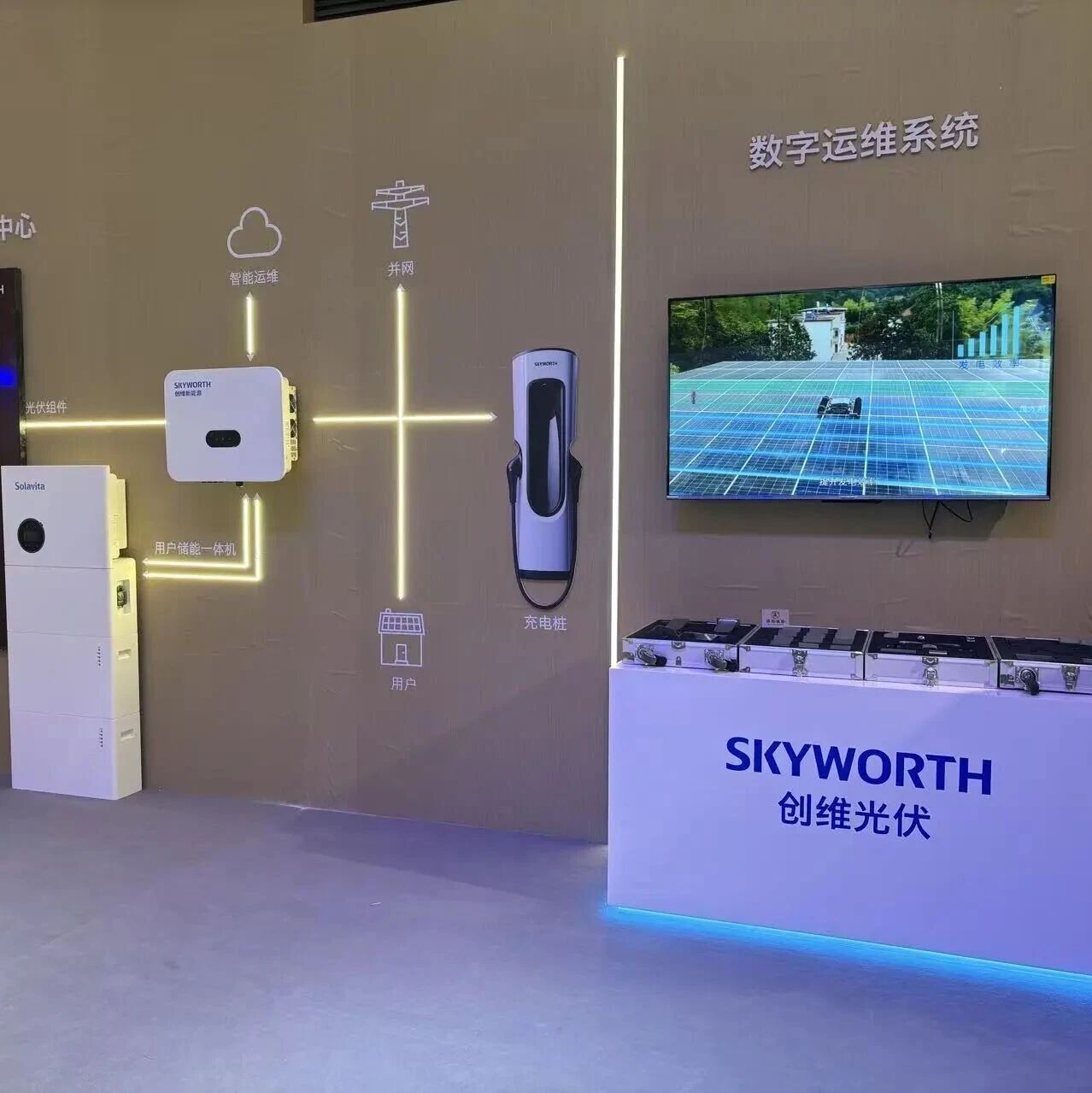
光伏、储能等新能源业务正逐步成为一批以家电起家的龙头企业的新增长点,但其规模、盈利仍有待提升。 近日,创维集团(00751.HK)拟退市并分拆创维光伏上市,海尔新能源获B轮超10亿元融资,美的集团(000333.SZ)旗下电动重卡充电桩业务上线,格力 电器(000651.SZ)今年将量产光伏储能用碳化硅芯片消息曝光,TCL中环(002129.SZ)拟投资一道新能源……家电起家的龙头企业2026年都在深化布局新 能源的万亿赛道。 经历了四五年的孵化和发展,新能源业务已经成为这些龙头企业的新增长点,但是发展规模、业务布局、盈利水平仍有待进一步提升或完善。创维光伏董事 长范瑞武1月27日向第一财经记者表示,"新能源是长坡厚雪,才刚刚开始。" 向"光"而行,欲从量变到质变 家电市场已进入成熟期,增速放缓。在国家"碳中和"战略下,家电龙头四五年前已开始布局新能源业务,部分企业的光伏、储能业务已到了从量变到质变的 临界点。 创维集团创始人黄宏生透露,创维2025年光伏业务的收入预计将首次超过彩电业务收入。创维集团从2020年开始涉足光伏领域,先利用国内彩电销售网络, 在农村发展户用分布式光伏业务,后来延伸到组件、支架、逆 ...
多数光伏企业2025年延续亏损状态,部分企业锚定2026年业绩扭亏
第一财经· 2026-01-27 12:49
Core Viewpoint - The photovoltaic (PV) industry in A-shares is facing significant losses, with many leading companies projecting substantial pre-loss figures for 2025 due to a challenging operating environment and supply-demand imbalances [2][3]. Group 1: Financial Performance and Projections - Major PV companies are expected to report significant pre-loss figures for 2025, including Tongwei Co. with a projected loss of 9 to 10 billion yuan, LONGi Green Energy with 6 to 6.5 billion yuan, and JinkoSolar with 5.9 to 6.9 billion yuan [2]. - The overall operating environment remains difficult, with many companies experiencing nine consecutive quarters of losses since Q4 2023, driven by price declines and insufficient end-demand [3]. Group 2: Industry Dynamics - The PV module prices are under pressure due to "involutionary competition" and a lack of terminal demand, with market transaction prices around 0.6 yuan per watt expected in mid-2025 [3]. - The industry is witnessing a supply surplus, with production rates declining across various segments, while core material prices, such as silver, continue to rise [3]. Group 3: Recovery Efforts and Future Goals - Some companies are beginning to emerge from the loss cycle, with LONGi Green Energy projecting a maximum reduction in losses of 30.38% and Aiko Solar up to 77.44% compared to 2024 [4]. - The China Photovoltaic Industry Association noted a 16.9% year-on-year decline in revenue for the main industry chain in the first three quarters of 2025, but an improvement in gross margins to 3.64% [4]. - Several leading PV companies have set profit targets for 2026, with Trina Solar aiming for a net profit of no less than 200 million yuan and LONGi Green Energy targeting positive net profits in subsequent years [5].






多数光伏企业2025年延续亏损状态,部分企业锚定2026年业绩扭亏
Di Yi Cai Jing· 2026-01-27 10:56
Core Viewpoint - The keyword "pre-loss" has become prominent in the 2025 performance forecasts of various photovoltaic companies, indicating that most firms continue to face losses due to operational challenges and supply-demand imbalances in the industry [1] Group 1: Financial Performance - Leading photovoltaic companies are forecasting significant losses for 2025, with Tongwei Co. expecting a loss of 9 to 10 billion yuan, LONGi Green Energy forecasting a loss of 6 to 6.5 billion yuan, and JinkoSolar projecting a loss of 5.9 to 6.9 billion yuan [1] - The overall photovoltaic industry has experienced nine consecutive quarters of losses since Q4 2023, driven by a decline in component prices due to intense competition and insufficient end-user demand [1][2] Group 2: Industry Challenges - The photovoltaic industry is facing a supply surplus, with core raw material prices rising while product prices continue to decline, leading to significant operational pressure on companies [2] - The ongoing low operating rates and the deepening market reforms in the domestic electricity sector, along with increasing trade barriers abroad, have created a complex and challenging operating environment for photovoltaic companies [2] Group 3: Recovery Efforts - Some companies are beginning to emerge from the loss cycle, with LONGi Green Energy expecting to reduce losses by up to 30.38% and Aiko Solar by up to 77.44% compared to 2024 [2] - The China Photovoltaic Industry Association reported a 16.9% year-on-year decline in revenue for the main industry chain in the first three quarters of 2025, although gross margins improved to 3.64% [2] Group 4: Future Goals - Companies like Trina Solar have set profit targets for 2026, aiming for a net profit of no less than 200 million yuan, with increasing targets for subsequent years [3] - LONGi Green Energy's employee stock ownership plan also includes targets for positive net profit in 2026, with specific profit goals for 2027 and 2028 [3] Group 5: Price Adjustments - Trina Solar has raised its component prices three times this month, with prices now ranging from 0.88 to 0.92 yuan per watt, reflecting a response to industry self-discipline [4] - Major component manufacturers are increasing prices by 0.02 to 0.04 yuan per watt, and there is a growing willingness among intermediate suppliers to support price increases [4]
股市面面观丨1123家上市公司发布2025年业绩预告 哪些赛道公司“最赚钱”?
Zhong Guo Jin Rong Xin Xi Wang· 2026-01-27 03:49
Group 1 - A total of 1123 A-share listed companies have released their 2025 performance forecasts, with 602 companies expecting profits and 521 companies anticipating losses [1][2] - Among the companies predicting profits, Zijin Mining leads with a forecasted net profit of 52 billion yuan, followed by Luoyang Molybdenum with 20.8 billion yuan [2][3] - The automotive sector, represented by SAIC Motor, is expected to see a significant profit increase of 438%-558%, the highest growth rate among the top ten profit forecast companies [2][3] Group 2 - The real estate sector dominates the list of companies forecasting significant losses, with China Fortune Land Development expected to lose between 16 billion and 24 billion yuan [3][4] - Other sectors facing losses include the photovoltaic industry, with Tongwei Co., TCL Zhonghuan, and Trina Solar among the top ten companies predicting losses [4][5] - JinkoSolar is projected to experience the largest decline in net profit, with a decrease of 6063.96%-7074.8% due to price fluctuations in the global photovoltaic industry [9][10] Group 3 - Companies like *ST Weir and Tonghua Dongbao are expected to see substantial profit growth, with *ST Weir forecasting a net profit increase of 8303.8%-9599.14% [6][8] - Approximately 260 companies are expected to have a net profit growth rate exceeding 100%, accounting for about one-fifth of the companies that have released forecasts [7][8] - The performance of companies in the photovoltaic sector is under pressure due to market conditions, impacting their profitability despite efforts to innovate and upgrade technology [9][10]






如何看待本轮被动元器件涨价行情
2026-01-26 02:49
Summary of Conference Call on Passive Component Price Trends Industry Overview - The passive components market is experiencing price increases across nearly all categories, including capacitors, resistors, diodes, inductors, and ferrite beads, driven primarily by raw material inflation [1][2][3] - The current price increase is characterized by a more rational market behavior compared to the previous cycle from 2017 to 2022, where speculative hoarding was prevalent [1][6] Key Points and Arguments - **Price Transmission**: Price increases are transmitted in layers; small and medium-sized end customers face price hikes of 30%-40%, while large customers with long-term contracts experience increases of less than 10% [4][2] - **MLCC Market Dynamics**: Although MLCC (Multi-layer Ceramic Capacitors) prices have not officially increased, high-capacity products have seen price rises. Manufacturers are cautious to avoid past mistakes of rapid price hikes [7][8] - **Market Share Concentration**: The MLCC market is dominated by four major players: Murata, Samsung, Yageo, and Sanhua, which together hold 80% of the market share. Strategies include reducing production and increasing agent thresholds [9] - **Domestic Brand Growth**: Domestic brands like Chaozhou Sanhua are gaining market share as customers shift from foreign brands to more cost-effective local options [10][12] - **Future Price Trends**: The trajectory of component prices will largely depend on raw material costs, with increases in silver and copper prices likely to push costs higher [13] Additional Important Insights - **Inventory Management**: Unlike the panic buying seen in previous years, current stakeholders are managing inventory more rationally, purchasing based on actual orders rather than speculation [5] - **Historical Context**: The last significant price surge occurred from July 2017 to the end of 2022, driven largely by human factors and market manipulation, whereas the current situation is primarily influenced by raw material costs [6][14] - **Cautious Market Sentiment**: Despite expectations of price increases, companies are hesitant to expand production capacity significantly, reflecting a cautious approach to market dynamics [11] - **Emerging Demand Areas**: While AI servers and storage are currently stable, the AI glasses sector may emerge as a new growth point in the future [18][16] Conclusion The passive components market is currently undergoing a price increase driven by raw material inflation, with a more rational market response compared to previous cycles. The focus on domestic brands and cautious inventory management reflects a significant shift in market dynamics. Future price trends will depend heavily on raw material costs and the evolving demand landscape, particularly in emerging technologies.