Visionox(002387)

Search documents
维信诺:为控股孙公司2亿元融资租赁合同提供担保
Xin Lang Cai Jing· 2026-02-11 08:04
维信诺公告称,公司控股孙公司国显光电与江西金租开展2亿元售后回租赁业务,租赁期限24个月,公 司为该业务提供连带责任保证担保。本次担保前公司对国显光电担保余额37.13亿元,担保后为39.13亿 元,国显光电2025年度可用担保额度剩余20.79亿元。本次担保后,公司及控股子公司对外担保总余额 172.20亿元,占2024年经审计净资产的310.30%。 ...

维信诺:OLED领军厂商将进入国资时代-20260211
Zhong Guo Yin He Zheng Quan· 2026-02-11 06:24
Investment Rating - The report assigns a "Cautious Recommendation" rating for the company, Visionox [3][56]. Core Insights - Visionox is a leading global supplier of OLED products, focusing on small and medium-sized display devices, as well as Micro-LED displays. The company has a significant market share in the AMOLED panel market for smartphones and wearables [6][8]. - The company is expected to benefit from entering a state-owned enterprise era, which will enhance operational stability and reduce financial risks [6][54]. - Revenue projections for 2025-2027 are estimated at 81.5 billion, 80.7 billion, and 86.8 billion yuan, with corresponding growth rates of +2.8%, -1%, and +7.6% [6][56]. Company Overview - Visionox was established in 2001 and has been focused on the industrialization of OLED technology for nearly 30 years. The company has developed a strong presence in various applications, including smartphones, wearables, and automotive displays [6][8]. - The company has adopted a strategy of investing in new production lines through equity participation to alleviate cash flow pressures, particularly in a capital-intensive industry [6][13]. Industry Trends - The penetration rate of AMOLED technology in smartphones is projected to exceed 60% by 2025, driven by the increasing adoption of foldable screens and competitive pricing [18][22]. - The medium-sized display market presents significant growth opportunities, with OLED technology expected to gain traction in high-end IT and automotive applications [28][29]. Investment Highlights - Visionox is steadily increasing its market share in the small-sized display market, with a reported 12.7% share in Q3 2025, marking a 0.5 percentage point increase year-on-year [48]. - The company is leveraging innovative technologies in the medium-sized display market, such as its proprietary Vip technology, which enhances production efficiency and reduces costs [48][51]. - The quality of the company's financial reports is expected to improve as the depreciation of fixed assets stabilizes and revenue from small-sized OLED products continues to grow [52]. Financial Projections - The company is projected to incur net losses of 21.2 billion, 21.3 billion, and 18.1 billion yuan for the years 2025-2027, reflecting ongoing challenges in profitability [6][56]. - The report anticipates a gradual improvement in the company's financial metrics, including a decrease in research and financial expense ratios over the forecast period [56].
维信诺(002387):OLED领军厂商将进入国资时代
Yin He Zheng Quan· 2026-02-11 06:05
Investment Rating - The report assigns a "Cautious Recommendation" rating for the company, Visionox [3][56]. Core Insights - Visionox is a leading global supplier of OLED products, focusing on small and medium-sized displays, as well as Micro-LED screens, with applications in smartphones, wearables, tablets, laptops, and automotive displays [6][8]. - The company is expected to benefit from entering a state-owned enterprise era, which will enhance operational stability and reduce financial risks [6][54]. - Revenue projections for 2025-2027 are estimated at 81.5 billion, 80.7 billion, and 86.8 billion yuan, with year-on-year growth rates of +2.8%, -1%, and +7.6% respectively [6][56]. Company Overview - Visionox was established in 2001, evolving from a Tsinghua University OLED project group founded in 1996, and has focused on OLED industrialization for nearly 30 years [6][8]. - The company has a significant market share, ranking third in the global smartphone AMOLED panel market and first in the wearable AMOLED panel market as of 2024 [6][8]. Industry Trends - The penetration rate of AMOLED in smartphones and wearables has exceeded 60%, while the medium-sized display market remains under 20%, indicating substantial growth potential [18][19]. - The introduction of foldable screens is expected to drive further penetration of AMOLED technology in the smartphone market, with a projected increase in shipments [27][22]. - The medium-sized display market is anticipated to expand significantly, particularly in high-end IT and automotive applications, as OLED technology offers superior quality and efficiency compared to traditional LCDs [28][29]. Investment Highlights - Visionox is expected to steadily increase its market share in the small-sized display market, with a projected growth in AMOLED smartphone panel shipments by 16.7% year-on-year [48]. - The company is innovating in the medium-sized display market with proprietary technologies, such as the ViP technology, which enhances production efficiency and reduces costs [48][51]. - The financial quality of the company's reports is expected to improve as the depreciation of fixed assets stabilizes and market conditions become more favorable [52]. Financial Forecast - The company is projected to incur net losses of 21.2 billion, 21.3 billion, and 18.1 billion yuan for the years 2025-2027, reflecting ongoing challenges in profitability [6][56]. - The report anticipates a gradual improvement in the company's financial ratios, including a decrease in research and financial expense ratios over the forecast period [56].
中国屏x柔性芯片突破,维信诺-清华北大登上《Nature》顶刊
Xin Lang Cai Jing· 2026-02-10 12:40
Core Insights - The development of the world's first flexible storage-computing chip, FLEXI, by Tsinghua University in collaboration with Peking University and Visionox, marks a significant breakthrough in flexible electronics and edge AI hardware, filling a technological gap in high-performance flexible AI computing chips and opening up infinite possibilities for next-generation smart hardware [1][10]. Group 1: Technological Breakthrough - FLEXI chip utilizes complementary metal-oxide-semiconductor (CMOS) low-temperature polycrystalline silicon (LTPS) technology, allowing it to be manufactured directly on flexible substrates, offering advantages of low power consumption, low cost, and high integration [3][13]. - The chip incorporates an innovative digital "in-memory computing" architecture, which integrates computation into storage units, significantly enhancing computational speed and energy efficiency, enabling the chip to run AI models locally and in real-time for the first time [6][14]. Group 2: Performance and Reliability - The chip has demonstrated stability after over 40,000 bends and zero errors in over 10 billion operations, maintaining stable performance under voltage fluctuations of 2.5-5.5V, temperature variations from -40°C to 80°C, 90% relative humidity, and UV exposure [7][14]. - Application validation shows the chip's potential in low-power local intelligent processing, achieving a 99.2% accuracy in arrhythmia detection and 97.4% accuracy in human activity classification, indicating its capability to transition from "sensing" to "thinking" [7][14]. Group 3: Industrial Implications - Visionox, as a leading flexible display company, provided critical industrial support and core process platforms for the successful development and commercialization of the FLEXI chip [8][15]. - The chip's manufacturing process, based on Visionox's proprietary CMOS LTPS panel technology, has proven the feasibility of producing high-performance flexible integrated circuits, establishing a solid foundation for flexible electronics [15]. - The collaboration between Tsinghua University and Visionox has paved the way for rapid development and mass production of more flexible smart devices, facilitating the transition of flexible electronic technology from the laboratory to widespread application [15][16]. Group 4: Future Applications - The success of the FLEXI chip points towards a future where flexible intelligence is ubiquitous, with potential applications in smart medical devices, flexible robotics, pervasive IoT, and next-generation human-computer interaction, enabling intelligent sensing and computing capabilities on any surface [9][16].


维信诺联合清华北大开发全球首款柔性存算芯片 填补我国技术空白
Jin Rong Jie· 2026-02-10 05:58
《自然》期刊对该研究进行评论,未来通过新型半导体材料应用、功率门控技术优化等,有望进一步提 升性能。若能持续优化生产良率与芯片尺寸,将推动可穿戴健康设备、物联网终端等领域的产业升级与 技术革新。 同时,此次研发合作不仅实现了柔性芯片的研制,更验证了将复杂IC功能模块向柔性面板端转移的可行 路径,积累了"工艺-电路-设计"协同优化经验,为未来更多柔性智能器件的快速开发与规模量产铺平了 道路,将有力推动柔性电子技术从实验室走向广泛应用。 从柔性感知到柔性思考,电子设备的形态边界被彻底打破。作为柔性显示领军企业,维信诺为FLEXI芯 片的成功研制与落地提供了关键的产业化支撑与核心工艺平台,未来将继续深耕柔性技术,拓展更多创 新价值。 维信诺近日官方消息显示,1月28日,清华大学联合北京大学与维信诺合作开发的世界首款柔性存算芯 片——FLEXI,在国际顶级期刊《自然》(Nature)上发表。这标志着我国在柔性电子与边缘人工智能 硬件领域取得重要突破,填补了高性能柔性AI计算芯片的技术空白。 当前,人工智能正与物联网、具身智能深度融合,从可穿戴健康监护到柔性机器人,从环境智能感知到 嵌入式设备,无不呼唤着轻量、高能效且 ...
OLED显示器持续高增速放量 产业链公司加速布局
Zheng Quan Ri Bao Wang· 2026-02-09 13:00
Group 1 - UBI Research forecasts that OLED display shipments will reach 3.2 million units in 2025, a significant increase of 64% compared to 1.95 million units in 2024, with a growth rate of over 50% expected for this year [1] - The rapid penetration of OLED in high-end IT applications, driven by leading manufacturers like Apple and Huawei, is also expanding into automotive displays and smart wearables, contributing to the growth of OLED displays [1] - Companies in the OLED supply chain are accelerating technological innovation and capacity expansion, which is expected to drive down costs and further enhance market penetration [1] Group 2 - China currently leads the global OLED shipment market, with AMOLED smartphone panel shipments accounting for 50.6% of the market share [2] - Some panel manufacturers have begun production on their 8.6-generation OLED production lines, with increasing domestic production rates of organic light-emitting materials and PCB components, indicating a shift towards mid-to-high-end products [2] - BOE Technology Group announced that its 8.6-generation AMOLED production line will begin mass production in the second half of 2026, enhancing its competitiveness in the display industry [2] Group 3 - Visionox's 8.6-generation AMOLED production line project in Hefei is set to start cleanroom delivery in the second quarter of this year [3] - The upstream material companies in the OLED supply chain are also accelerating their development, with companies achieving breakthroughs in domestic OLED terminal materials [3] - The company is focusing on the development of new generation narrow-spectrum dopant materials and other advanced technologies to promote domestic substitution and strengthen the supply chain's autonomy [3] Group 4 - OLED is expanding from consumer electronics into more diverse and high-value fields, with a clear trend towards high-end consumer electronics and commercial applications [4] - Domestic OLED is transitioning from merely existing to focusing on quality, with the industry collectively pushing towards high-end markets and increasing international market share [4] - Technological innovation is identified as a key factor for companies to overcome competition and meet high-end demands [4]


群智咨询:2025年全球OLED手机面板整体出货8.9亿片 同比增长5.2%
智通财经网· 2026-02-09 10:51
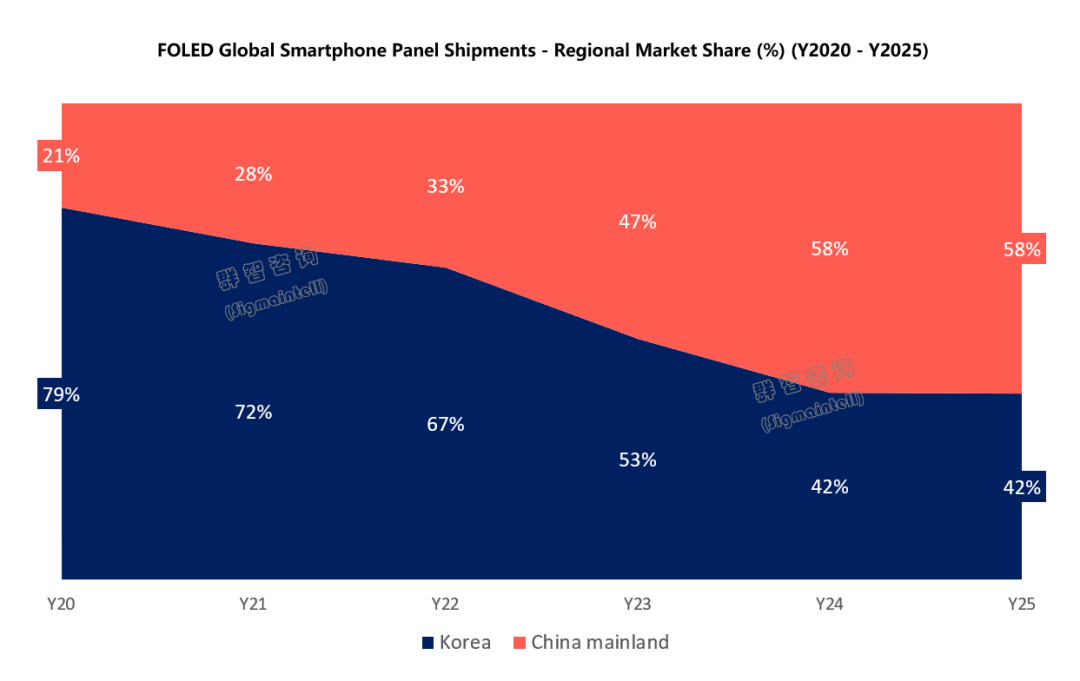
Core Insights - The global OLED smartphone panel shipment is projected to reach approximately 890 million units in 2025, marking a year-on-year growth of 5.2%, driven by product structure upgrades, capacity expansion, cost optimization, domestic policy support, and technological advancements [1] - Flexible OLED shipments are expected to be around 690 million units, with a year-on-year increase of approximately 9.6%, while rigid OLED shipments are forecasted to decline by 7.7% to about 200 million units [1] Market Dynamics - Korean manufacturers, being core suppliers to Apple and Samsung, are expected to maintain over 50% of the OLED market share in 2025, with flexible OLED market share remaining stable at approximately 42.1% [2] - Chinese manufacturers are gaining ground, with a total OLED panel shipment share of 49.3%, an increase of 1 percentage point year-on-year, and a flexible OLED market share of 57.9% in 2025 [2] Company Performance - Samsung Display (SDC) is projected to lead the global OLED panel market with shipments of about 380 million units, a slight increase of 1.5%, while rigid OLED shipments are expected to decline by 6.6% to approximately 160 million units [5] - BOE is anticipated to ship around 150 million units, achieving a market share of 21.1%, driven by penetration in the mid-range market and breakthroughs in the high-end market [5] - Tianma is expected to see the fastest growth among OLED manufacturers, with shipments of approximately 97 million units, a year-on-year increase of 19.4%, elevating its market share to 10.8% [6] Competitive Landscape - The OLED market is characterized by significant competition, with major players focusing on capacity expansion and technological advancements to enhance competitiveness [8] - The industry is facing challenges such as weakened demand in the smartphone market and increased price competition due to rising supply [8] - Long-term strategies are shifting towards collaborative innovation and system-level performance optimization, moving beyond traditional hardware supply roles [8]


打破长期垄断,擦亮“中国屏”!我国成功攻克这一关键材料
Huan Qiu Wang Zi Xun· 2026-02-09 10:36
来源:科技日报 近日 清华大学团队 与江苏三月科技股份有限公司 合作研发的 基于pTSF技术 (磷光辅助热活化敏化荧光) 的屏幕实现量产 我国OLED关键材料 完成从长期跟跑到自主引领的跨越 高效率、长寿命和高色纯度 一直是显示产业长期追求的目标 合肥鼎材科技有限公司等材料厂商 以及维信诺科技股份有限公司等 也是OLED材料领域的"不可能三角" 2011年,清华大学化学系教授段炼 在第三代热活化延迟荧光(TADF)材料的基础上 着手研发热活化敏化荧光(TSF)技术 选择不用TADF材料发光 而是让其作为敏化剂 将光能量传递给高色纯度荧光染料 经过多年尝试 团队确定在发光层中 添加少量磷光敏化剂的方案 能让器件效率高、寿命长、颜色更鲜艳 是三者兼得的最优解 这是一条从来没有人走过的路 研制方案被反复推倒重来 2019年 团队在国际上 率先研发出窄光谱绿色荧光材料 使pTSF技术从原理可行走向制造可行 接下来,多方深度合作研制成品 然而,"理论可行"和"现实执行"之间 往往存在巨大鸿沟 现实中,科研人员必须从无到有 创制出适合pTSF机制的发光材料 经过不断反馈、持续迭代 最终成品经测试显示 与上一代屏幕相比 搭 ...
颀中科技:公司主要终端客户为京东方、华星光电、天马、维信诺等
Zheng Quan Ri Bao· 2026-02-05 13:16
Group 1 - The core viewpoint of the article is that Qizhong Technology's main end customers include BOE Technology Group, Huaxing Optoelectronics, Tianma Microelectronics, and Visionox [2] Group 2 - Qizhong Technology is actively engaging with investors and responding to inquiries during research sessions [2]

东方证券:供需格局向好 大尺寸面板涨价有望持续
Zhi Tong Cai Jing· 2026-02-05 02:07
Core Viewpoint - The electronic industry panel manufacturers are continuing their production control strategies, leading to price increases for large-sized panels, which are expected to persist due to demand from events like the World Cup [1][2]. Group 1: Panel Price Trends - Large-sized panel prices are expected to continue rising as manufacturers maintain production control, with demand remaining stable [2]. - AVC data indicates that all sizes of TV panels saw price increases in late January, with some monitor panels also experiencing price hikes [1][2]. - The tight supply-demand situation for TV panels is extending to monitor panels, with expectations of price increases in February [2]. Group 2: Capital Expenditure Trends - The large-scale capital expenditure cycle in the panel industry is nearing its end, with leading manufacturers expected to significantly reduce future spending [3]. - According to BOE's announcement, 2025 will be the peak year for capital expenditure, with a significant decline anticipated starting in 2027 [3]. - TCL Technology is focusing on investments aligned with the accelerated penetration of OLED in the mid-size market, with no major new production line investments planned beyond the T8 line [3]. Group 3: Mobile OLED Panel Market - Mobile OLED panel prices are under short-term pressure, but the impact is expected to be manageable [4]. - The penetration rate of mobile OLED panels is anticipated to continue increasing, which may offset the decline in overall smartphone shipments [4]. - Omdia forecasts that global smartphone AMOLED panel shipments will decrease slightly to 810 million units in 2026, a minor decline from 817 million in 2025 [4]. Group 4: Investment Recommendations - The favorable supply-demand relationship and the expected continuation of price increases for large-sized panels suggest potential investment opportunities in panel manufacturers such as TCL Technology, BOE A, and others [5]. - Related material manufacturers and display driver chip manufacturers are also highlighted as potential investment targets [5].