
LB Group(002601)

Search documents
化工复盘:前两轮周期牛市,阿尔法龙头表现几何?
Changjiang Securities· 2026-01-18 09:45
Investment Rating - The industry investment rating is "Positive" and maintained [8] Core Insights - In the previous two cyclical bull markets, alpha leading stocks significantly outperformed the basic chemical sector. These leaders possess both supply-demand improvements and cost advantages, leading to price elasticity and sustainable low-cost expansion. In cyclical bull markets, they exhibit performance drivers of volume and price increases, providing excess returns for investors [2][6][38]. - The report emphasizes the importance of investing in high-quality leading companies such as Wanhua Chemical, Hualu Hengsheng, Longbai Group, Yangnong Chemical, Huafeng Chemical, and Boyuan Chemical [2][6][38]. Summary by Sections Introduction: Why Focus on Leading Stocks in Cyclical Bull Markets? - The PPI (Producer Price Index) has shown a continuous narrowing of decline and is expected to turn positive by October 2025. This indicates a potential recovery in industrial product pricing and an improvement in market demand and supply conditions. The chemical industry, as a key industrial raw material, is likely to reflect these changes first, suggesting a transition from demand stagnation to a new round of inventory replenishment or capacity adjustment [4][14]. Performance of Alpha Leaders in Previous Cyclical Bull Markets - The report analyzes the stock selection and performance of alpha leaders during the last two cyclical bull markets (2016-2018 and 2020-2021). The selected stocks include Wanhua Chemical, Hualu Hengsheng, Longbai Group, and Yangnong Chemical, with the addition of Huafeng Chemical and Boyuan Chemical in the second round. The performance data shows that these leaders significantly outperformed the basic chemical index [5][18]. - In the first cycle (2016-2018), the highest stock price increases for these leaders were 488.9% for Wanhua Chemical, 281.4% for Hualu Hengsheng, 147.7% for Longbai Group, and 247.5% for Yangnong Chemical, with an average increase of 291.4%. The basic chemical index saw a maximum increase of around 39% during the same period [18][19]. - In the second cycle (2020-2021), the highest increases were 311.0% for Wanhua Chemical, 276.5% for Hualu Hengsheng, 314.2% for Longbai Group, 188.0% for Yangnong Chemical, 290.1% for Huafeng Chemical, and 728.7% for Boyuan Chemical, with an average increase of 351.4% compared to a maximum of 136% for the basic chemical index [18][19]. Investment Recommendations - The report suggests focusing on high-quality leading companies for investment opportunities, as they are expected to benefit from supply-demand improvements and cost advantages. The overall chemical sector is currently at a low point, but with anticipated global economic growth, demand for chemical products is expected to increase. The report also highlights the potential for a recovery in PPI and chemical prices in 2026 [6][38][39].



——基础化工行业周报:多晶硅、丁二烯价格上涨,关注反内卷和铬盐-20260111
Guohai Securities· 2026-01-11 13:03
Investment Rating - The report maintains a "Recommended" rating for the chemical industry [1] Core Insights - The chemical industry is expected to experience an upward cycle due to the implementation of "anti-involution" policies in China and the accelerated exit of some European facilities [29] - The report highlights the potential for domestic substitution of semiconductor materials from Japan due to rising geopolitical tensions, which could benefit various companies in the sector [5] - The chromium salt industry is undergoing a value reassessment driven by increased demand from AI data centers and commercial aircraft engines, with a projected supply-demand gap of 340,900 tons by 2028 [8] Summary by Sections Industry Performance - The chemical industry has shown strong relative performance with a 1-month increase of 10.7%, 3-month increase of 9.6%, and a 12-month increase of 45.1%, outperforming the CSI 300 index [3] Price Trends - Key products such as lithium carbonate and polysilicon have seen significant price increases, supported by policy guidance and industry self-discipline [12] - The price of chromium salts has remained stable, with metal chromium priced at 82,000 CNY/ton as of January 9, 2026 [15] Investment Opportunities - Focus on companies with low-cost expansion capabilities, such as Wanhu Chemical and Hualu Hengsheng, as well as those in sectors with improving market conditions like chromium salts and phosphates [6][9] - High dividend yield opportunities are identified in state-owned enterprises like China Petroleum and China National Chemical [10] Key Company Tracking - Companies such as Dongfang Shenghong and Huabei Yihua are highlighted for their earnings potential, with projected EPS growth for 2026 [30] - The report tracks specific price movements for various chemicals, including a notable increase in the price of ammonium phosphate and a stable price for urea [17][19]


2026年化工双登共振向上-再推化工板块
2026-01-07 03:05
Summary of Conference Call Records Industry Overview - The basic chemical sector is likely at the bottom of its cycle, with no need to wait for significant improvements in fundamentals before investing. Stock prices often lead the market, indicating potential investment opportunities when future fundamental changes are anticipated [2][4]. Key Investment Opportunities - Investment opportunities in 2026 are concentrated in traditional cyclical industries and technology materials, particularly in AI-related sectors such as energy storage materials (e.g., lithium carbonate) and storage materials (e.g., Yake Technology) [1][6]. - Recommended leading companies in the chemical industry include Wanhua Chemical, Hualu Hengsheng, and Juhua Co., due to their low valuations and high profit elasticity [1][8]. Company-Specific Insights Wanhua Chemical - Strongly recommended as a top investment choice due to its outlier effect and continuous growth catalysts. Expected revenue for 2026 is projected to reach 400 billion yuan, with a net profit forecast of 16 billion yuan [1][12][14]. - The company has a significant profit increase potential with every 1,000 yuan increase in MDI and TDI prices, translating to a net profit increase of 3.4 billion yuan [12][14]. Hualu Hengsheng - The company is expected to achieve annualized quarterly performance exceeding 5 billion yuan in 2026, supported by multi-category layout and technological upgrades [1][17][18]. Dongcai Technology - Notable for its advantages in new energy materials, with expectations to turn losses into profits as the overall profitability in the new energy sector improves [1][13][15]. Baofeng Energy - Expected to maintain stable annual profits between 12 billion to 13 billion yuan following the release of new capacity at its Ningxia base. The company benefits from the cyclical changes in the coal chemical industry and has diversified its product offerings [3][19][20]. Industry Trends and Signals - The potassium fertilizer industry is expected to experience tight supply and demand in 2026, maintaining high prices, while the phosphate market outlook remains stable with manageable supply increases [3][22][23]. - The tire industry is impacted by EU anti-dumping policies, prompting leading companies to expand overseas to increase market share [3][27][28]. - The spandex industry is at a cyclical bottom, with potential supply-side clearing effects anticipated due to the bankruptcy of a major player, which could improve market conditions [3][34][35]. Additional Insights - Investment in underperforming sectors is justified as they have likely reflected most negative factors in their stock prices, presenting potential for positive marginal changes [11]. - The refrigerant industry, while considered an "old story," shows strong certainty and potential for long-term investment due to ongoing price support [24]. - The organic silicon industry is expected to see price increases driven by domestic demand and external supply constraints, with companies like Dongyue showing significant elasticity [25][26]. Conclusion - The conference call highlighted a range of investment opportunities across various sectors within the chemical industry, emphasizing the importance of leading companies and emerging trends. Investors are encouraged to consider both cyclical recovery and technological advancements when making investment decisions.


钛白粉概念涨5.08% 主力资金净流入这些股
Zheng Quan Shi Bao Wang· 2026-01-06 09:29
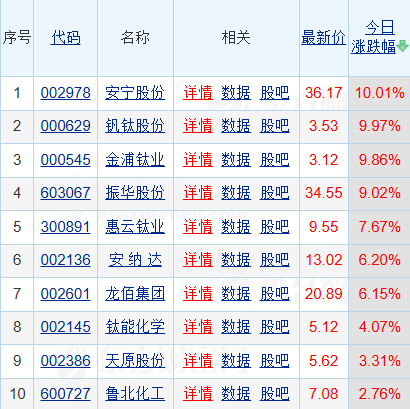
Group 1 - The titanium dioxide concept sector increased by 5.08%, ranking third among concept sectors, with 13 stocks rising, including Anning Co., Vanadium Titanium Co., and Jinpu Titanium Industry reaching the daily limit [1] - The leading stocks in the titanium dioxide sector included Zhenhua Co., Longbai Group, and Huiyun Titanium Industry, which rose by 8.87%, 6.25%, and 6.09% respectively [1] - The main capital inflow into the titanium dioxide sector was 523 million yuan, with 10 stocks receiving net inflows, and 5 stocks seeing inflows exceeding 30 million yuan [2] Group 2 - The top net inflow stock was Vanadium Titanium Co. with a net inflow of 335 million yuan, followed by Longbai Group, Anning Co., and Jinpu Titanium Industry with net inflows of 96.08 million yuan, 89.43 million yuan, and 88.01 million yuan respectively [2] - The net inflow ratios for Jinpu Titanium Industry, Vanadium Titanium Co., and Anning Co. were 34.44%, 24.79%, and 13.02% respectively, indicating strong investor interest [3] - The trading performance of key stocks in the titanium dioxide sector showed significant gains, with Vanadium Titanium Co. rising by 9.97% and Jinpu Titanium Industry by 9.86% [4][5]



13连阳!A股,新纪录
Sou Hu Cai Jing· 2026-01-06 09:08
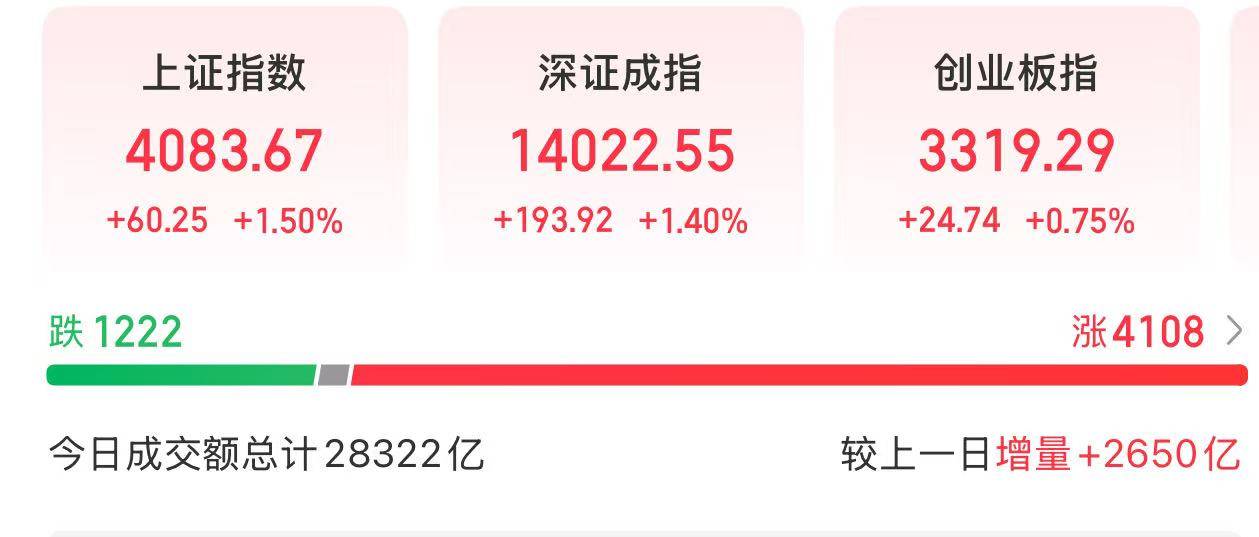
Market Performance - The market saw over 4,100 stocks rise, with more than 100 stocks hitting the daily limit up. The Shanghai Composite Index closed at 4,083.67 points, up 1.50%, marking a 13-day consecutive rise, the longest since March 1992. It also surpassed the previous high of 4,034.08 points from November 14, 2025, reaching a new high in over ten years [1] - The Shenzhen Component Index rose by 1.40%, while the ChiNext Index increased by 0.75% [1] Trading Volume - The total trading volume for the day was approximately 28.3 trillion yuan, an increase of 265 billion yuan compared to the previous day [3] Market Drivers - According to Zhongyin Securities, the main factors supporting the market's upward trend include the increasing attractiveness of RMB assets and expectations for early-year credit issuance and subsequent policies. The corporate profit structure has positively changed, with new economic forces represented by advanced manufacturing and overseas enterprises driving the stabilization and recovery of A-share returns, providing solid fundamental support for the market [3] Sector Highlights - The brain-computer interface concept performed actively on the first trading day of 2026, with related stocks continuing to rise, surpassing their highest levels from 2025. Notably, BeiYikang hit the daily limit up of 30%, while WeiSi Medical and Sanbo Brain Science also saw significant gains [4] - The brain-computer interface industry is expanding from medical necessities into AI applications and robotics. Elon Musk has indicated that with advancements in Neuralink technology, there is potential for remote control of robots through thought, creating an ultimate ecosystem of "human brain + robot" [4] - The titanium dioxide sector has shown strong performance, with multiple stocks hitting the daily limit up. The industry recently issued a price increase notice to reverse previous low profitability, indicating a potential recovery window for industry profits. Leading companies like Longbai Group are expanding overseas, which may enhance the industry's position and international influence [5] - The commercial aerospace sector has also seen explosive growth, with over ten constituent stocks hitting the daily limit up [5] - The financial sector collectively surged, with Huayin Securities and Dazhihui hitting the daily limit up [6]




化学原料板块1月6日涨4.98%,新疆天业领涨,主力资金净流入11亿元
Zheng Xing Xing Ye Ri Bao· 2026-01-06 08:56
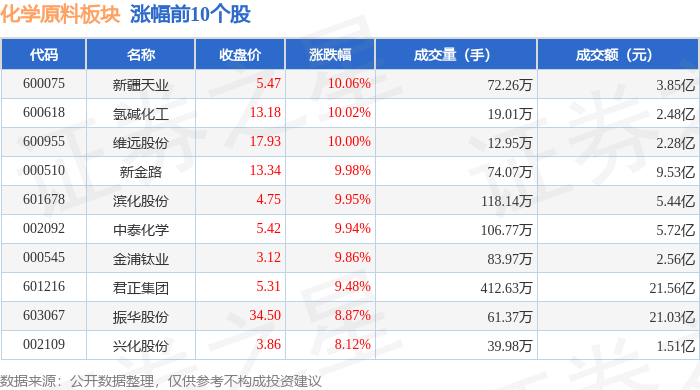
Group 1: Market Performance - The chemical raw materials sector increased by 4.98% compared to the previous trading day, with Xinjiang Tianye leading the gains [1] - The Shanghai Composite Index closed at 4083.67, up 1.5%, while the Shenzhen Component Index closed at 14022.55, up 1.4% [1] Group 2: Individual Stock Performance - Xinjiang Tianye (600075) closed at 5.47, up 10.06%, with a trading volume of 722,600 shares and a transaction value of 385 million [1] - Hydrogen Alkali Chemical (600618) closed at 13.18, up 10.02%, with a trading volume of 190,100 shares and a transaction value of 248 million [1] - Weiyuan Co. (600955) closed at 17.93, up 10.00%, with a trading volume of 129,500 shares and a transaction value of 228 million [1] - New Jinlu (000510) closed at 13.34, up 9.98%, with a trading volume of 740,700 shares and a transaction value of 953 million [1] - Binhu Chemical (601678) closed at 4.75, up 9.95%, with a trading volume of 1,181,400 shares and a transaction value of 544 million [1] Group 3: Capital Flow Analysis - The chemical raw materials sector saw a net inflow of 1.1 billion in main funds, while retail funds experienced a net outflow of 462 million [2] - The main funds' net inflow for Junzheng Group (601216) was 367 million, accounting for 17.04% of its trading volume [3] - New Jinlu (000510) had a main funds' net inflow of 185 million, representing 19.37% of its trading volume [3]


钛白粉行业联合涨价函引爆市场,安宁股份、钒钛股份、金浦钛业涨停
Jin Rong Jie· 2026-01-06 03:26
Core Viewpoint - The titanium dioxide industry is experiencing a strong rally, with several companies seeing significant stock price increases due to a recent price increase announcement aimed at reversing previous low pricing and profitability trends [1][3]. Group 1: Stock Performance - Anning Co., Vanadium Titanium Co., and Jinpu Titanium Industry all reached their daily price limits, while Zhenhua Co. rose over 9%, and Huiyun Titanium Industry increased by over 7% [1]. - Other companies such as Anada and Longbai Group saw stock price increases of over 6%, with Tianneng Chemical, Tianyuan Co., and Luban Chemical also experiencing gains [1][2]. Group 2: Industry Developments - The titanium dioxide industry has jointly issued a price increase notice to improve the low pricing and profitability situation, indicating a potential recovery window for industry profits [3]. - Leading domestic titanium dioxide companies are accelerating their investment in chloride process capacity, with Tianneng Co. announcing a planned investment of 1.483 billion yuan to build a 100,000-ton chloride titanium dioxide project, aligning with the industry's green transformation trend [1].

龙佰集团5亿-10亿元回购计划持续推进 截至12月末累计实施回购
Xin Lang Zheng Quan· 2026-01-05 13:41
Core Viewpoint - Longbai Group has initiated a share repurchase plan with a total budget of 500 million to 1 billion RMB, aimed at employee stock incentives and shareholding plans, and is progressing as scheduled [1][2]. Group 1: Repurchase Plan Overview - The repurchase plan was approved on June 6, 2025, allowing the company to use its own funds and special loans to repurchase A-shares through centralized bidding [2]. - The total repurchase amount is set between 50 million RMB and 100 million RMB, with the maximum repurchase price adjusted from 24.82 RMB to 24.22 RMB per share due to equity distributions [2]. - The implementation period for the repurchase is 12 months from the board's approval, ending on June 5, 2026 [2]. Group 2: Progress as of December End - As of December 31, 2025, the company has successfully executed share repurchases in accordance with the established plan and relevant regulations [3]. Group 3: Compliance Statement - Longbai Group has confirmed that the share repurchase strictly adheres to regulatory requirements, including not repurchasing shares during significant events that could impact stock prices [4]. Group 4: Future Arrangements - The company plans to continue the share repurchase based on market conditions and will fulfill its information disclosure obligations during the repurchase period [5].
龙佰集团(002601) - 关于回购公司股份的进展公告
2026-01-05 09:02
证券代码:002601 证券简称:龙佰集团 公告编号:2026-001 龙佰集团股份有限公司 关于回购公司股份的进展公告 本公司及董事会全体成员保证信息披露内容的真实、准确和完整,没有虚 假记载、误导性陈述或重大遗漏。 龙佰集团股份有限公司(以下简称"公司")于2025年6月6日召开的第八届董 事会第十九次会议,审议通过了《关于回购公司股份方案的议案》,同意公司使 用自有资金及回购专项贷款以集中竞价的方式回购公司股份,回购股份的种类为 公司已发行的人民币普通股(A股)股票,将用于股权激励或员工持股计划。本 次回购股份的资金总额不低于人民币50,000万元(含)且不超过人民币100,000 万元(含),因公司实施了2025年第一季度权益分派和2025年第三季度权益分派 回购股份的价格由不超过人民币24.82元/股(含)调整为不超过人民币24.22元/ 股(含),具体回购股份的数量以回购期满时实际回购的股份数量为准。本次回 购股份的实施期限自公司董事会审议通过本次回购股份方案之日起12个月内。 /股,最低成交价为16.18元/股,成交总金额为25,481,016元(不含交易费用)。 本次回购符合相关法律法规的要求 ...
河南首单民营企业中长期科技创新债券落地
He Nan Ri Bao· 2025-12-31 23:29
Group 1 - The core point of the news is that Longbai Group successfully issued a technology innovation bond worth 500 million yuan, marking the first mid-to-long-term technology innovation bond issued by a private enterprise in Henan Province in the interbank market [1] - The bond has a term of 3 years and a coupon rate of 2.14%, making it the largest, longest, and most subscribed technology innovation bond benchmark project in the province [1] - Since the launch of the "Technology Board" policy in May 2025, the People's Bank of China Henan Branch has actively promoted the issuance of technology innovation bonds, with 10 technology companies and 2 equity investment institutions in the province having issued a total of 19.12 billion yuan in such bonds [1] Group 2 - Longbai Group, a global leader in the titanium industry, holds over 280 core patents and has successfully addressed critical technical challenges in the preparation of aerospace-grade titanium [1] - The successful issuance of the technology innovation bond will significantly enhance Longbai Group's asset-liability structure and boost its capabilities in core technology research and development, particularly in new energy materials [1] - The issuance is expected to encourage more technology companies in the province to raise funds in the bond market, thereby increasing investment in technological innovation [1]