RINGPU(300119)

Search documents
瑞普生物:拟与专业投资机构共同投资设立并购产业基金
Ge Long Hui· 2026-02-12 09:55
Core Viewpoint - Reap Bio (300119.SZ) has signed a partnership agreement to establish a new investment fund aimed at expanding its business boundaries and industry influence in key sectors such as animal health, synthetic biology, pets, and biomedicine [1] Group 1 - The partnership involves Reap Bio, Haitong M&A (Shanghai) Private Equity Fund Management Co., Haitong Kaiyuan Investment Co., Gaoyou Industrial Guidance Fund, and Tianjin Ruisheng Private Fund Management Co. [1] - The total committed capital for the partnership is RMB 1 billion, with Reap Bio contributing RMB 295 million, representing 29.5% of the total [1]

产学研用同频发力!生物制造解锁万亿增长空间
Zhong Guo Zheng Quan Bao· 2026-02-10 00:36
Core Insights - The biomanufacturing sector is gaining momentum with strong policy support and technological advancements, positioning it as a key future industry in China [1][2] - The market size of China's biomanufacturing industry is projected to reach approximately 1.8 trillion yuan by 2030, with significant contributions from food additives and biopharmaceuticals [1][2] Industry Developments - The Ministry of Industry and Information Technology has reported that during the 14th Five-Year Plan, China's biomanufacturing industry is expected to expand steadily, reaching a total scale of 1.1 trillion yuan, with bioproducts accounting for over 70% of global production [1] - The focus of the 14th Five-Year Plan is on the industrialization of technology, emphasizing pilot testing, process scaling, and demonstration line construction [2] Company Initiatives - Ruipu Biotech is investing 680 million yuan in a large-scale microbial protein industrialization demonstration project, aiming for trial production by Q4 2026 [3] - Fuxiang Pharmaceutical is leveraging its expertise in high-end antibiotic fermentation to enhance its microbial protein project, focusing on domestic and international expansion [4] - Yikela Biotech is targeting high-value aquatic feed proteins through a collaboration with Fudan University, aiming to reduce reliance on imported fishmeal [5] Technological Advancements - Synthetic biology is identified as a core technology driving low-carbon production and increased labor productivity across various sectors, including healthcare and industrial manufacturing [2] - The integration of AI with synthetic biology is expected to shift the competitive landscape from single-point breakthroughs to platform-based competition, enhancing R&D efficiency [7] Market Trends - The most promising sub-sectors in biomanufacturing during the 14th Five-Year Plan include high-value biomanufactured products in healthcare, bio-based materials, and service-oriented platforms [6] - The industry is anticipated to experience differentiation and improved quality as companies focus on scalable processes, cost control, and clear downstream applications [2][6]

产学研用同频发力 生物制造解锁万亿增长空间
Zhong Guo Zheng Quan Bao· 2026-02-09 20:25
Core Insights - The biomanufacturing sector is gaining momentum with strong policy support and corporate initiatives, positioning it as a key future industry with significant growth potential [1][2][4] Industry Overview - The biomanufacturing industry in China is projected to reach a scale of 1.1 trillion yuan during the 14th Five-Year Plan, with a forecasted growth to nearly 1.8 trillion yuan by 2030 [1] - The industry is characterized by a focus on low-carbon production and increased labor productivity through synthetic biology technologies, which are applicable across various sectors including healthcare, energy, and environmental protection [2] Policy and Market Dynamics - The "14th Five-Year Plan" emphasizes the transition from laboratory technologies to marketable solutions, highlighting the importance of pilot testing, process scaling, and demonstration line construction [2][6] - The integration of technology, policy, and market forces is essential for driving explosive growth in specific sub-sectors of biomanufacturing [2][6] Corporate Initiatives - Companies like Ruipu Biotech and Fuxiang Pharmaceutical are actively investing in biomanufacturing, focusing on microbial protein production and leveraging existing fermentation technologies for scale [3][4] - Ruipu Biotech is set to launch a 680 million yuan microbial protein industrialization project by 2025, aiming for high-quality production capabilities [3] Emerging Trends - The focus on marine biotechnology and high-value functional proteins is becoming a significant direction for the development of the marine economy [4] - The integration of AI with synthetic biology is expected to shift the competitive landscape from isolated breakthroughs to platform-based competition, enhancing R&D efficiency [6] Future Growth Areas - High-value biomanufactured products in the pharmaceutical sector, bio-based materials, and service-oriented platforms are identified as the most promising sub-sectors during the "14th Five-Year Plan" [5][6] - Addressing industrial bottlenecks through a complete chain from basic research to industrial application is crucial for enhancing international competitiveness [7]
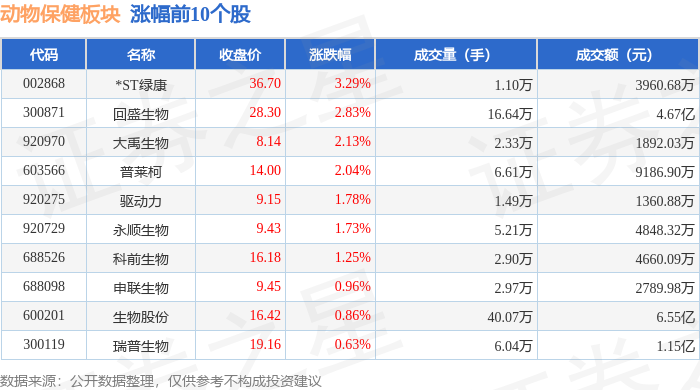
动物保健板块2月3日涨1.15%,*ST绿康领涨,主力资金净流出1.55亿元
Zheng Xing Xing Ye Ri Bao· 2026-02-03 08:56
Core Viewpoint - The animal health sector experienced a rise of 1.15% on February 3, with *ST Green康 leading the gains, while the overall market indices also showed positive performance [1]. Group 1: Market Performance - The Shanghai Composite Index closed at 4067.74, up by 1.29% [1]. - The Shenzhen Component Index closed at 14127.1, up by 2.19% [1]. Group 2: Individual Stock Performance - *ST Green康 (002868) closed at 36.70, with a gain of 3.29% and a trading volume of 11,000 lots, amounting to 39.61 million yuan [1]. - 回盛生物 (300871) closed at 28.30, up by 2.83%, with a trading volume of 166,400 lots and a turnover of 467 million yuan [1]. - 大禹生物 (920970) closed at 8.14, increasing by 2.13%, with a trading volume of 23,300 lots and a turnover of 18.92 million yuan [1]. - 普莱柯 (603566) closed at 14.00, up by 2.04%, with a trading volume of 66,100 lots and a turnover of 91.87 million yuan [1]. - 驱动力 (920275) closed at 9.15, increasing by 1.78%, with a trading volume of 14,900 lots and a turnover of 13.61 million yuan [1]. - 永顺生物 (920729) closed at 9.43, up by 1.73%, with a trading volume of 52,100 lots and a turnover of 48.48 million yuan [1]. - 科前生物 (688526) closed at 16.18, increasing by 1.25%, with a trading volume of 29,000 lots and a turnover of 46.60 million yuan [1]. - 申联生物 (688098) closed at 9.45, up by 0.96%, with a trading volume of 29,700 lots and a turnover of 27.90 million yuan [1]. - 生物股份 (600201) closed at 16.42, increasing by 0.86%, with a trading volume of 400,700 lots and a turnover of 655 million yuan [1]. - 瑞普生物 (300119) closed at 19.16, up by 0.63%, with a trading volume of 60,400 lots and a turnover of 115 million yuan [1]. Group 3: Capital Flow - The animal health sector saw a net outflow of 155 million yuan from institutional investors, while retail investors contributed a net inflow of 119 million yuan [2]. - The main capital flow data indicates that 中牧股份 (600195) had a net inflow of 5.91 million yuan from institutional investors [3]. - 普莱柯 (603566) experienced a net inflow of 5.90 million yuan from institutional investors, while retail investors had a net outflow of 12.09 million yuan [3]. - *ST Green康 (002868) had a net inflow of 2.82 million yuan from institutional investors, with retail investors contributing a net inflow of 2.25 million yuan [3].



仔猪价格的秘密
GUOTAI HAITONG SECURITIES· 2026-01-31 07:02
Investment Rating - The report assigns an "Accumulate" rating for the industry [3] Core Insights - The price of piglets follows a clear historical pattern, with expectations for continued price increases followed by a decline around May/June. A significant capacity reduction cycle is anticipated in 2026, primarily occurring in the second half of the year, while stock prices are expected to start rising in the first half [5][6] - The report emphasizes that piglet prices are influenced by production patterns, with December and January being peak slaughter months, leading to increased demand for piglets. Conversely, supply remains relatively stable, which can lead to price increases when demand surges [7] - The report highlights that piglet prices do not correlate with pig price expectations and cannot be used to predict pig prices. The annual variations in piglet prices are consistent, while pig prices fluctuate yearly, indicating a lack of direct relationship [7] - The report recommends focusing on the pig farming sector, predicting a significant capacity reduction cycle in 2026. It suggests that the first half of 2026 will resemble the first half of 2023, with losses in fat pigs but profits in piglets, leading to a smoother capacity reduction after the anticipated price drop in May/June [7] - Key companies to watch include Muyuan Foods, Wens Foodstuff Group, Tiankang Biological, Juxing Agriculture, and Shennong Group, as their valuations are currently at the bottom, with potential for stock price increases as the industry faces losses and clearer capacity reduction trends [7][8] Summary by Sections Historical Price Trends - Piglet prices exhibit a clear historical trend, typically bottoming out in December/January and peaking in May/June. The fluctuations are tied to seasonal production patterns and demand cycles [5][7] Production and Supply Dynamics - The report discusses the relationship between supply and demand, noting that while supply is stable, demand spikes during certain months can lead to price increases. The cyclical nature of pig farming is highlighted, with adjustments made to align production with demand [7] Investment Opportunities - The report identifies a significant capacity reduction cycle in the pig farming industry for 2026, suggesting that investors should focus on companies with strong fundamentals and current low valuations, as they are likely to benefit from the anticipated market changes [7][8]





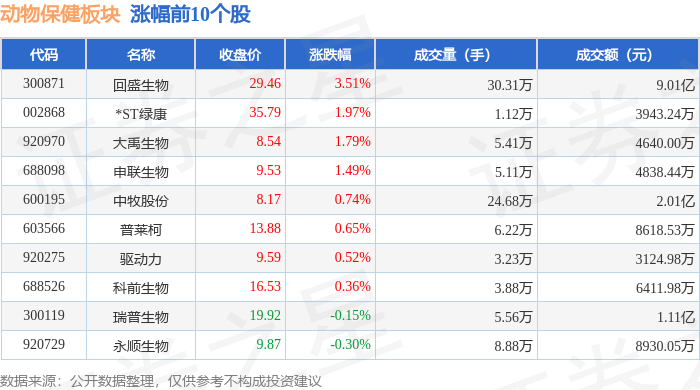
动物保健板块1月30日跌0.23%,金河生物领跌,主力资金净流入5981.69万元
Zheng Xing Xing Ye Ri Bao· 2026-01-30 08:54
Core Viewpoint - The animal health sector experienced a slight decline of 0.23% on January 30, with Jinhe Biological leading the drop. The Shanghai Composite Index closed at 4117.95, down 0.96%, while the Shenzhen Component Index closed at 14205.89, down 0.66% [1]. Group 1: Stock Performance - The closing prices and performance of key stocks in the animal health sector showed varied results, with Huisheng Biological rising by 3.51% to 29.46, while Jinhe Biological fell by 2.98% to 6.51 [1][2]. - The trading volume for Huisheng Biological was 303,100 shares, with a transaction value of 901 million yuan, indicating strong market interest [1]. Group 2: Capital Flow - The animal health sector saw a net inflow of 59.82 million yuan from institutional investors, while retail investors experienced a net outflow of 81.83 million yuan, indicating a shift in investor sentiment [2][3]. - Among individual stocks, Huisheng Biological attracted a significant net inflow of 1.23 billion yuan from institutional investors, while Jinhe Biological faced a net outflow of 543.32 million yuan [3].


瑞普生物(300119.SZ):公司目前无尼帕病毒相关的针对性疫苗、药品
Ge Long Hui· 2026-01-29 07:16
Core Viewpoint - The company, Reap Bio (300119.SZ), currently does not have any targeted vaccines or drugs related to the Nipah virus and will continue to monitor the virus dynamics to assess research and development opportunities [1] Company Summary - Reap Bio has stated that it is not involved in the development of any Nipah virus-related vaccines or treatments at this time [1] - The company emphasizes its commitment to keeping an eye on the developments related to the Nipah virus [1] - Future research and development opportunities will be evaluated based on the ongoing situation of the virus [1]
瑞普生物:公司目前无尼帕病毒相关的针对性疫苗、药品
2 1 Shi Ji Jing Ji Bao Dao· 2026-01-29 07:13
Core Viewpoint - The company, Reap Bio, announced on January 29 that it currently does not have any targeted vaccines or drugs related to the Nipah virus and will continue to monitor the virus dynamics to assess research and development opportunities [1]. Company Summary - Reap Bio is actively monitoring the Nipah virus situation and is open to evaluating potential R&D opportunities in response to the virus [1].
动物保健板块1月28日跌0.2%,永顺生物领跌,主力资金净流入1802.32万元
Zheng Xing Xing Ye Ri Bao· 2026-01-28 08:56
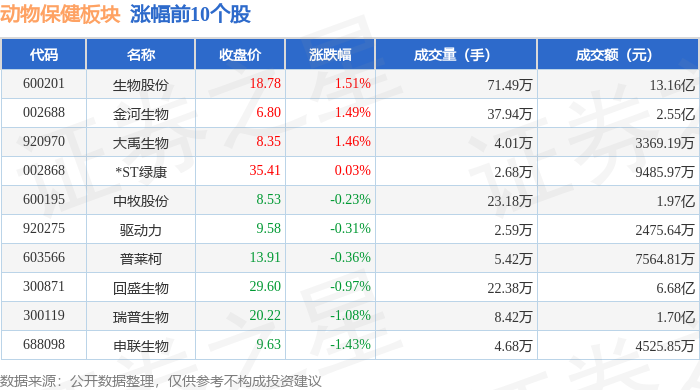
Core Viewpoint - The animal health sector experienced a slight decline of 0.2% on January 28, with Yongshun Biological leading the drop, while the overall market indices showed minor gains [1]. Group 1: Market Performance - The Shanghai Composite Index closed at 4151.24, up by 0.27% [1]. - The Shenzhen Component Index closed at 14342.9, up by 0.09% [1]. - The animal health sector's performance is summarized in a table showing individual stock movements, with notable gainers including Biological Shares and Jinhai Biological, which rose by 1.51% and 1.49% respectively [1]. Group 2: Stock Performance - Yongshun Biological saw a significant decline of 7.49%, closing at 10.13, with a trading volume of 141,500 shares and a turnover of 145 million yuan [2]. - Other notable decliners included Shoufeng Holdings and Haili Biological, which fell by 2.21% and 2.08% respectively [2]. - The trading volume and turnover for various stocks in the animal health sector are detailed, indicating varied investor interest [2]. Group 3: Capital Flow - The animal health sector experienced a net inflow of 18.02 million yuan from institutional investors, while retail investors saw a net inflow of 9.33 million yuan [2]. - However, there was a net outflow of 27.35 million yuan from speculative funds, indicating a mixed sentiment among different investor types [2]. - A detailed table shows the net capital flow for individual stocks, highlighting significant movements in and out of various companies [3].

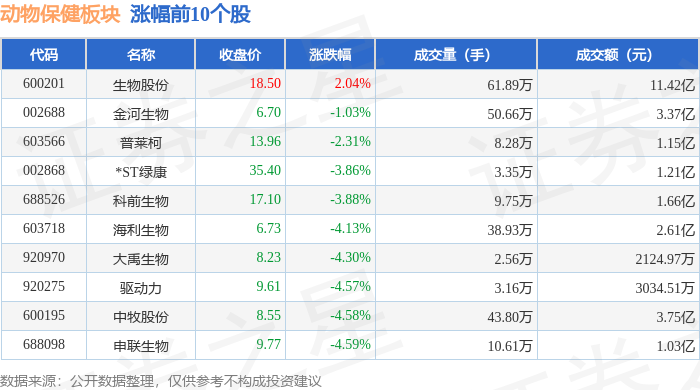
动物保健板块1月27日跌2.78%,回盛生物领跌,主力资金净流出4570.33万元
Zheng Xing Xing Ye Ri Bao· 2026-01-27 08:49
Market Overview - The animal health sector experienced a decline of 2.78% on January 27, with Huisheng Biological leading the drop [1] - The Shanghai Composite Index closed at 4139.9, up 0.18%, while the Shenzhen Component Index closed at 14329.91, up 0.09% [1] Stock Performance - Key stocks in the animal health sector showed varied performance, with the following notable changes: - Huisheng Biological (300871) closed at 29.89, down 8.37% with a trading volume of 376,900 shares and a transaction value of 1.148 billion [2] - Other significant declines included: - ST Lvkang (002868) down 3.86% to 35.40 [1] - Kexin Biological (688526) down 3.88% to 17.10 [1] - Haili Biological (603718) down 4.13% to 6.73 [1] Capital Flow - The animal health sector saw a net outflow of 45.7033 million from institutional investors, while retail investors experienced a net outflow of 59.3359 million [2] - Conversely, speculative funds recorded a net inflow of 105 million [2] Individual Stock Capital Flow - Notable capital flow for specific stocks included: - ST Lvkang (002868) had a net inflow of 29.8876 million from institutional investors, but a net outflow of 40.6641 million from speculative funds [3] - Zhongmu Co. (600195) saw a net inflow of 21.2767 million from institutional investors, with a significant net outflow of 66.5383 million from retail investors [3] - Jinhe Biological (002688) had a net inflow of 19.2937 million from institutional investors, but also faced a net outflow from retail investors [3]