Arm plc(ARM)

Search documents
Why Arm Holdings Plunged Nearly 20% in December
The Motley Fool· 2026-01-07 18:58
Core Viewpoint - Arm Holdings faced a significant decline in share price due to an analyst downgrade and concerns over potential selling pressure from its largest shareholder, Softbank [1][2]. Group 1: Analyst Downgrade and Market Reaction - Analyst Jim Schneider from Goldman Sachs downgraded Arm shares from "Neutral" to "Sell," indicating a pessimistic outlook [3]. - The downgrade was part of a broader skepticism among investors, leading to a 19.4% drop in Arm's shares in December [1][2]. - The market reacted negatively despite Arm's revenue growth of 34% in the last quarter, suggesting that the high valuation is a primary concern [5]. Group 2: Valuation and Shareholder Influence - Arm's shares are trading at 66 times 2026 earnings estimates and over 50 times 2027 estimates, reflecting a high valuation that raises concerns [5]. - Softbank owns approximately 87% of Arm, which contributes to the stock's volatility and potential selling pressure due to Softbank's financial commitments [6]. - Softbank's $22.5 billion funding commitment to OpenAI and the associated $8.5 billion margin loan on Arm stock heighten the risk of a sell-off [6][7]. Group 3: Competitive Landscape and Future Outlook - Arm remains a leader in low-power applications and is favored by cloud computing giants, but faces increased competition from the x86 architecture, which is becoming more power-efficient [8]. - Despite competition, the demand for computing is expected to remain high, suggesting that Arm could perform well in the AI era [9]. - The key question remains whether Arm's current high valuation accurately reflects its growth potential and the implications of Softbank's ownership stake [9].



ARM Stock Down 20% in a Year vs Industry Gains: Buy Signal or Caution?
ZACKS· 2026-01-06 18:50
Core Insights - Arm Holdings plc (ARM) shares have decreased by 20% over the past year, contrasting with a 38% increase in the industry, indicating a need for reassessment of the stock's prospects [1][6] - The current weakness in ARM's stock may reflect either deeper structural issues or a temporary disconnect from its fundamentals, necessitating a closer examination of the company's strategic direction and market trends [2] Strategic Positioning - Arm Holdings has transitioned from a traditional chip designer to a leader in energy-efficient AI computing, facilitating seamless intelligence scaling from edge devices to cloud data centers [3] - The company's RISC-based architecture provides superior performance per watt, which is crucial as AI adoption grows under power constraints [3] - ARM's Neoverse V-Series CPUs are pivotal in modern AI infrastructure, enhancing inference speed and machine-learning efficiency without the high energy costs of legacy systems [3] Competitive Advantages - ARM's architectural consistency across mobile, cloud, and edge environments allows for frictionless AI application deployment, creating long-term strategic leverage [4] - Partnerships, such as with Meta, highlight ARM's increasing importance in data-center efficiency, while new leadership from Amazon indicates a focus on advanced chipset innovation [4] - The establishment of an AI chip division marks a strategic shift towards becoming a key infrastructure provider, potentially enhancing ARM's influence in AI performance economics [4] Ecosystem Dynamics - ARM benefits from a dual-sided network effect that connects software developers and hardware manufacturers, making its architecture attractive due to its compatibility with a vast software ecosystem [7] - Device makers prefer ARM's architecture for its reduced integration risk and faster time to market, while developers are drawn to the extensive installed base of ARM-compatible devices [8] - This virtuous cycle has created significant barriers to entry, with ARM's intellectual property embedded in nearly every smartphone globally, solidifying its dominance in mobile CPU architecture [8] Financial Outlook - Arm Holdings is projected to experience solid earnings and revenue growth, with fiscal 2026 earnings estimated at $1.72, reflecting a 5.5% increase from the previous year [10] - Earnings are expected to grow nearly 30% year-over-year in fiscal 2027, while revenue is forecasted to rise over 21% in both fiscal 2026 and 2027 [10] - The Zacks Consensus Estimate indicates a current quarter revenue of $1.23 billion, with year-over-year growth estimates of 25.33% for the current quarter [11] Valuation Concerns - ARM's stock is trading at approximately 55 times forward 12-month earnings, significantly higher than the industry average of about 34 times, indicating a demanding valuation [13] - The trailing EV-to-EBITDA multiple is around 93 times, well above the industry norm of approximately 25 times, suggesting that much of the future growth is already priced in [13] Investment Considerations - Arm Holdings is recognized as a high-quality company with significant exposure to long-term AI and computing trends, making it a hold for current investors [14] - However, the current valuation limits near-term returns, suggesting that new investors may benefit from waiting for a more favorable entry point [14]

Nvidia Has 91% of Its Portfolio Invested in 2 Brilliant Artificial Intelligence (AI) Stocks
The Motley Fool· 2026-01-06 10:06
Core Insights - Nvidia has significant equity stakes in CoreWeave and Arm Holdings, with 91% of its equity portfolio allocated to these two AI stocks as of September 2025 [2] - CoreWeave accounts for 86% of Nvidia's portfolio, focusing on cloud computing services tailored for AI and compute-intensive workloads [4][2] - Arm Holdings represents 5% of Nvidia's portfolio, specializing in CPU design and licensing intellectual property for custom chip development [10][2] CoreWeave Overview - CoreWeave's data centers are purpose-built for AI, outperforming traditional data centers in handling power, memory, and heat generated by GPUs [4] - The company has achieved record-breaking results in MLPerf benchmarks, ranking it as the best AI cloud provider, surpassing major competitors like Amazon and Microsoft [5][6] - In Q3, CoreWeave reported a 134% revenue increase to $1.4 billion and a 121% rise in adjusted EBITDA to $838 million, with a revenue backlog growing 271% to $55.6 billion [7] - CoreWeave's stock trades at 7.7 times sales, with projected revenue growth of 82% annually through 2027, and a median target price of $125 per share indicating a 58% upside from its current price of $79 [8] Arm Holdings Overview - Arm's CPUs are known for their power efficiency, holding a 99% market share in smartphone chips and gaining market share in data centers due to cost-effective AI solutions [11][13] - The company has a compelling business model by licensing its architecture, attracting major clients like Apple, Amazon, and Microsoft [12] - Arm's adjusted earnings grew 30% in the last quarter, with expectations for a 23% annual increase through March 2027, despite a high current valuation of 68 times earnings [14] - Analysts project a median target price of $180 per share for Arm, suggesting a 57% upside from its current price of $115 [15]


今夜 美股暴涨!见证历史!
Zhong Guo Ji Jin Bao· 2026-01-05 16:16
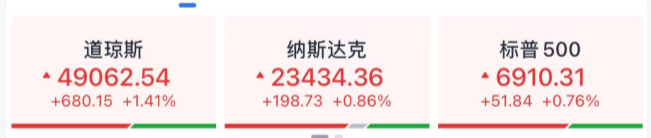
Market Performance - The Dow Jones Industrial Average surged nearly 700 points, breaking the 49,000 mark for the first time, marking a new high for the index [1] - The Nasdaq index rose by nearly 1%, while the S&P 500 index increased by approximately 0.7% [1] Geopolitical Impact - Despite concerns over geopolitical risks following the ousting of Venezuelan President Maduro, the market showed resilience, particularly in technology stocks [2][5] - The energy sector performed strongly, with major U.S. oil companies seeing gains, such as Chevron rising by 4.4% due to proposals for revitalizing Venezuela's oil and gas industry [5] Technology Sector - Chip stocks led the market rally, with ASML shares hitting a record high, increasing by over 5%, and TSMC shares also rising significantly after a 35% target price increase by Goldman Sachs analysts [3] Venezuelan Bonds - Venezuelan government and state oil company PdVSA's international bonds saw a collective price increase as investors speculated that the U.S. government's actions against Maduro would facilitate debt restructuring [6] - A 2031 maturity Venezuelan government dollar bond price rose from 34 cents to 40 cents on the dollar, while a 2027 maturity PdVSA dollar bond increased from 28 cents to 30 cents [9] Future Outlook - Analysts suggest that the ideal scenario for international bondholders would be for Maduro's vice president, Delcy Rodriguez, to assume leadership with U.S. support, which could lead to a recovery in Venezuela's oil and gas sector benefiting creditors [12]


中国资产深夜爆发,百度狂飙12%,美股芯片巨头创历史新高
2 1 Shi Ji Jing Ji Bao Dao· 2026-01-02 23:17
Group 1: Semiconductor Stocks Performance - U.S. semiconductor stocks experienced a significant rally, with the Philadelphia Semiconductor Index rising over 4.5% [2] - ASML surged more than 8%, reaching a historical high, while Micron Technology and Intel both increased by approximately 8% [2] - Other notable gainers included ARM and AMD, which rose nearly 6% [2] Group 2: Chinese Stocks Surge - Chinese stocks listed in the U.S. saw a collective surge, with the Nasdaq Golden Dragon China Index increasing by nearly 3.9% [5] - Baidu's stock skyrocketed over 12% after submitting a mainboard listing application for its subsidiary Kunlun Chip [5] - Other Chinese companies like Yatsen and NetEase also saw significant gains, with increases around 7% [5] Group 3: Precious Metals and Commodities - Precious metals, particularly gold, experienced a sudden pullback after reaching $4,400, currently hovering around $4,336, with a slight increase of 0.4% [7] - Silver also saw a rise of 4% at one point but later adjusted to a 2% increase [7] Group 4: Oil Market Decline - Crude oil futures collectively declined, with WTI and ICE Brent both dropping over 1.2% [11] - Current prices for WTI and ICE Brent are $56.70 and $60.11, reflecting decreases of 1.25% and 1.22% respectively [11] Group 5: Cryptocurrency Market Recovery - The cryptocurrency market is witnessing a rebound, with Bitcoin surpassing $89,000 and Ethereum, SOL, and XRP all increasing by over 2% [12] - Dogecoin saw a notable rise of over 10% [12] - A total of over 90,000 individuals faced liquidation, amounting to $235 million, with more than 78% being short liquidations [12]


深夜!中国资产,大爆发!
券商中国· 2026-01-02 15:34
Core Viewpoint - Chinese assets experienced a strong start in 2026, with significant gains in various indices and stocks, indicating a continuation of the structural bull market from 2025 and a clear investment theme for the year ahead [1][2]. Group 1: Performance of Chinese Assets - The Nasdaq Golden Dragon China Index surged nearly 4%, while leveraged ETFs for Chinese stocks saw increases of over 10% and 8% respectively [2]. - Major Chinese stocks performed well, with Baidu Group rising over 12%, and other notable gains from companies like WanGuo Data and JinkoSolar, which increased by over 8% and 7% respectively [2]. - The Hong Kong market also showed strong performance, with the Hang Seng Index up 2.76% and the Hang Seng Technology Index up 4% [2]. Group 2: Currency Movements - The offshore RMB/USD exchange rate broke above 6.97, reaching a high of 6.9662, marking the strongest level since May 2023 [3]. - Factors contributing to the RMB appreciation include a strong Chinese stock market, increased demand for currency conversion from export companies, and a weakening US dollar [4]. Group 3: Global Market Trends - Global markets continued their strong performance from 2025, with Asian markets achieving their best opening since 2012, led by gains in AI and semiconductor stocks [5]. - Major US tech stocks also saw gains, with the Philadelphia Semiconductor Index rising over 4% and ASML ADR increasing by over 8% [6]. - Investor sentiment remains optimistic, with significant net inflows into global equity funds, totaling $26.54 billion in the last week of 2025 [6].

PLTR vs. ARM: Which AI-Tech Stock is the Better Buy Now?
ZACKS· 2025-12-30 19:11
Core Insights - Palantir Technologies (PLTR) and Arm Holdings (ARM) are both integral to the accelerating global adoption of artificial intelligence (AI) [1][2] Palantir Technologies (PLTR) - Palantir supports AI deployment through advanced data integration, analytics, and decision-making platforms, enabling organizations to operationalize complex data [2] - The company's Artificial Intelligence Platform allows businesses to structure and organize data effectively, enhancing AI's ability to process tasks [4] - As of September 30, 2025, Palantir held $6.4 billion in cash with zero debt, indicating strong financial health and liquidity for growth initiatives [5] - In Q3 2025, Palantir's revenues increased by 63% year over year, with U.S. revenues up 77% and U.S. commercial business growing by 121% [6] - The company achieved an adjusted operating margin of 51%, with GAAP operating income of $393 million and net income of $476 million, resulting in a GAAP EPS of 18 cents and adjusted EPS of 21 cents, a 110% increase year over year [7] - The Zacks Consensus Estimate for PLTR indicates a 54% year-over-year growth in sales and a 78% increase in EPS for 2025 [13][15] - Palantir is positioned as a key player in enterprise AI, with its platforms embedded in critical operations across commercial and government sectors, creating durable demand [20] Arm Holdings (ARM) - Arm Holdings is known for its energy-efficient chip architecture, which is essential for mobile computing and increasingly important for AI and IoT applications [8][12] - The company's architecture is ideal for high-performance, low-power applications, making it suitable for a wide range of devices from wearables to cloud infrastructure [9] - Major tech players like Apple, Qualcomm, and Samsung are increasingly reliant on ARM as they expand their AI and IoT initiatives [11] - The Zacks Consensus Estimate for ARM indicates a 21.5% year-over-year growth in sales and a 5.5% increase in EPS for fiscal 2026 [16][18] - ARM's valuation appears attractive with a forward 12-month P/E of 52.93X, suggesting potential undervaluation compared to its historical range [19] Comparative Analysis - Palantir is favored in the current AI-driven market due to its direct involvement in AI execution and enterprise decision-making, while ARM serves as a supporting technology layer [10][20] - Palantir's stronger momentum and clearer AI monetization strategy provide greater upside for investors compared to ARM, which has a Hold rating [20][21]


The 3 Fastest-Growing Stocks Heading Into 2026
Yahoo Finance· 2025-12-23 13:27
Core Insights - Arm Holdings is solidifying its position in the AI sector, with significant growth in licensing revenue and profitability driven by increased demand for AI-optimized systems [1][4] - The company reported a record revenue of $1.14 billion in Q2 of fiscal 2026, marking a 34% year-over-year increase, with royalties reaching $620 million [3] - Strategic collaborations with major tech companies like Meta and Samsung are enhancing Arm's AI capabilities across various devices [1][4] Financial Performance - Licensing revenue increased by 56% to $515 million, reflecting strong relationships and interest in AI systems [1] - Adjusted earnings per share (EPS) rose by 30% to $0.39, indicating improved profitability [1] - Arm's annualized contract value for licenses increased by 28%, showcasing robust demand for next-generation designs [3] Market Position and Growth Drivers - The Neoverse platform has surpassed 1 billion CPUs deployed globally, with major tech firms developing custom processors based on Arm architecture [2] - AI workloads are driving growth in data centers, smartphones, automotive systems, and IoT, expanding Arm's royalty base [2][3] - Management anticipates third-quarter revenue of approximately $1.22 billion, indicating continued growth momentum [6] Strategic Collaborations - Collaborations with companies like Meta and Samsung aim to enhance AI efficiency in wearables and smartphones [1] - New platforms such as Lumex CSS are providing powerful on-device AI capabilities, further expanding Arm's market reach [1] Analyst Sentiment - Wall Street analysts have a consensus rating of "Moderate Buy" for ARM stock, with an average target price suggesting a potential upside of nearly 50% [7] - The highest price estimate indicates a possible 90% rally over the next 12 months, reflecting strong investor interest [7]


英伟达持仓概念股集体拉升 NEBIUS(NBIS.US)涨超6%
Zhi Tong Cai Jing· 2025-12-22 15:23
Group 1 - Nvidia's related stocks experienced a collective surge, with NEBIUS (NBIS.US) rising over 6%, Applied Digital (APLD.US) increasing over 5%, and Recursion Pharmaceuticals (RXRX.US) up over 4.8% [1] - CoreWeave (CRWV.US) also saw an increase of over 4.8%, while Arm Holdings (ARM.US) rose by over 1.5%, and Wenyan Zhixing (WRD.US) increased by over 1.2% [1] - Nvidia (NVDA.US) itself saw a rise of 1.25% [1] Group 2 - Reports indicate that Nvidia plans to begin the first deliveries of its H200 artificial intelligence chips to China by mid-February next year [1]



Top 3 Tech Stocks That May Rocket Higher This Quarter
Benzinga· 2025-12-22 11:13
Core Insights - The information technology sector has several oversold stocks, presenting potential buying opportunities for undervalued companies [1] Group 1: Oversold Stocks - Arm Holdings PLC has an RSI of 27.3, with a recent stock price of $114.03, and has seen a 15% decline over the past month [7] - Crane NXT Co has an RSI of 26.7, closing at $47.20, and has experienced a 14% drop in the last month [7] - BlackBerry Ltd has an RSI of 24, with shares closing at $3.77 after a 13% decrease over the past five days [7] Group 2: Analyst Ratings and Performance - Goldman Sachs downgraded Arm Holdings from Neutral to Sell, lowering the price target from $160 to $120 [7] - Baird maintained an Outperform rating for Crane NXT, reducing the price target from $88 to $82 [7] - BlackBerry reported Q3 revenue of $141.8 million, exceeding estimates, and achieved its strongest GAAP profitability in nearly four years [7]