
American Express(AXP)

Search documents
Payments Power Play: MA or AXP, Who Has the Deeper Moat in 2026?
ZACKS· 2026-02-18 16:21
Core Insights - The global payments landscape is evolving with digital transactions replacing cash and cross-border commerce increasing, with Mastercard and American Express playing pivotal roles but differing in business models [1][2] Group 1: Mastercard Overview - Mastercard operates an asset-light global card network with a market cap of $465.5 billion, earning fees from transaction processing and cross-border activities without taking on credit risk [4] - In Q4 2025, Mastercard achieved 18% net revenue growth, driven by a 14% year-over-year increase in cross-border volume and a 140 basis point improvement in adjusted operating margin to 57.7% [5][10] - The company invests in value-added services, generating $3.9 billion in Q4 revenues, up 26% year over year, which diversifies revenue streams beyond traditional fees [6] Group 2: American Express Overview - American Express has a market cap of $231.7 billion and operates a closed-loop model that captures both transaction fees and interest income, appealing to affluent customers [8][9] - In Q4 2025, AmEx reported 10% revenue growth, supported by increased cardmember spending and net interest income, but faces credit risk due to its lending exposure [11][14] - The company has a return on capital of 12.1% and relies heavily on its U.S. market, contrasting with Mastercard's broader international diversification and higher return on capital of 58.2% [12] Group 3: Financial Performance and Valuation - Mastercard's forward P/E ratio is 26.38X, indicating higher investor confidence compared to AmEx's 19.29X, reflecting a preference for Mastercard's stability and diversified growth [10][15] - Zacks Consensus Estimates project Mastercard's revenues to reach $36.97 billion in 2026 and $41.34 billion in 2027, with EPS growth of 13.9% and 15.6% respectively [13] - In contrast, AmEx's revenue estimates for 2026 and 2027 are $78.76 billion and $84.98 billion, with lower growth rates of 9% and 7.9% [14] Group 4: Market Performance - Over the past month, Mastercard shares declined by 3.3%, performing better than AmEx, which fell 5.6%, and the industry average decline of 6.4% [17]



巴菲特,最新调仓曝光!
Zhong Guo Ji Jin Bao· 2026-02-18 06:09
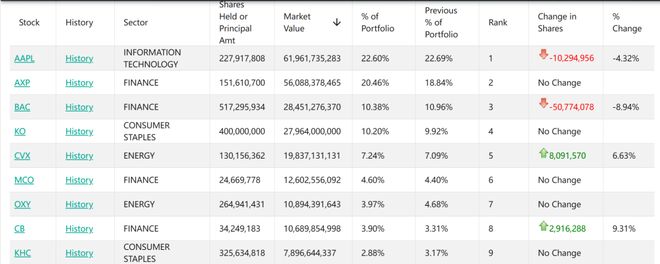
Core Viewpoint - The article reveals the portfolio adjustments made by Berkshire Hathaway during Warren Buffett's last quarter as CEO, highlighting a shift in holdings with reductions in technology stocks and increases in energy, consumer, and financial sectors [2][4]. Group 1: Overall Portfolio Changes - As of the end of Q4 2025, Berkshire's total portfolio size increased to $274 billion from $267 billion in the previous quarter, with the top ten holdings accounting for 88.26% of the portfolio [2]. - The top ten holdings remained unchanged in terms of companies, but there were slight adjustments in their rankings [2]. Group 2: Major Stock Adjustments - Berkshire reduced its stake in Apple by over 10.29 million shares, a decrease of 4.32%, marking the third consecutive quarter of reduction, with a market value decline of approximately $2.8 billion [4][7]. - A significant reduction in Amazon shares was noted, with a 77.24% decrease in holdings, dropping its portfolio share from 0.82% to 0.19%, leaving nearly 2.3 million shares [5]. - The stake in Bank of America was also reduced, with nearly 50.8 million shares sold, resulting in an 8.94% decrease in holdings [6]. Group 3: New Investments and Increases - Berkshire initiated a new position in The New York Times, purchasing 5.0657 million shares valued at over $350 million, ranking it 30th in the portfolio [8]. - The company increased its holdings in Chevron by over 8.09 million shares, a 6.63% increase, and in Chubb Limited by nearly 2.92 million shares, a 9.31% increase [9]. - Additionally, there was a 12.34% increase in holdings of Domino's Pizza, raising its market value to $1.4 billion [9]. Group 4: Stable Holdings - Coca-Cola and Kraft Heinz holdings remained unchanged, with Coca-Cola valued at $27.96 billion, maintaining its position as the fourth-largest holding [11]. - Berkshire is the largest shareholder of Kraft Heinz, holding approximately 27.5% of the company, which is undergoing a split into two independent publicly traded companies [11].


巴菲特“收官之作”曝光:新建仓这只股票
Zhong Guo Zheng Quan Bao· 2026-02-18 05:53
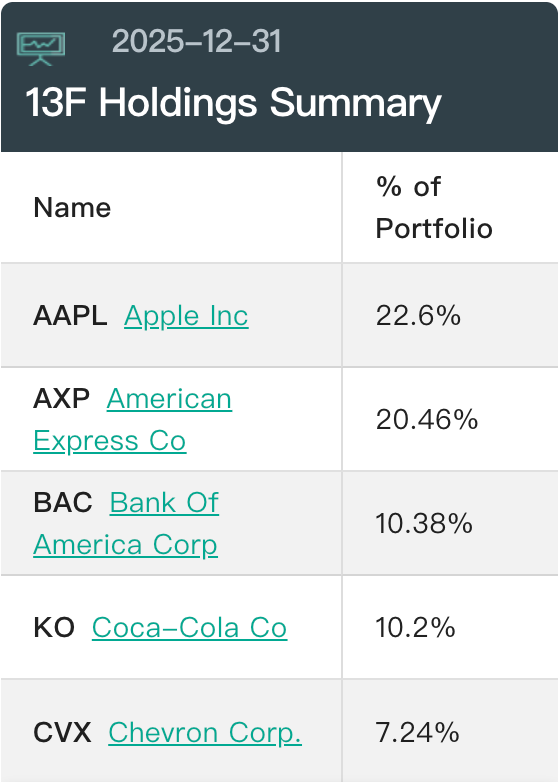
Core Viewpoint - Berkshire Hathaway disclosed its Q4 2025 U.S. stock holdings report, marking the last quarter under CEO Warren Buffett, showing significant reductions in key positions while also establishing a new position in The New York Times [1] Group 1: Holdings Summary - As of the end of Q4 2025, Berkshire's total holdings value was approximately $274.16 billion, up from $267.33 billion at the end of Q3 2025 [1] - The top five holdings included Apple, American Express, Bank of America, Coca-Cola, and Chevron, with Apple representing 22.6% of the portfolio [2][4] Group 2: Reductions in Holdings - In Q4 2025, Berkshire reduced its Apple shares by approximately 10.3 million, marking a 4.32% decrease, with total Apple shares held at 227.9 million, valued at about $61.96 billion [5] - The company also reduced its Bank of America shares by about 50.8 million, a decrease of 8.94%, leaving it with 517.3 million shares [5] - A significant reduction in Amazon shares was noted, with a decrease of 772.4 thousand shares, representing a 77% reduction [4][5] Group 3: New Investments - Berkshire initiated a new position in The New York Times, acquiring approximately 5.07 million shares valued at about $352 million, marking a re-entry into the media sector after selling its newspaper assets in 2020 [6] - The New York Times reported strong performance in Q4 2025, with total subscription users exceeding 12.78 million and a 10.2% increase in operating profit year-over-year [6]


What's weighing on gold and silver prices? eToro CEO talks retail investor adoption of AI
Youtube· 2026-02-17 23:20
Market Overview - Major indices closed flat after a volatile session, with the Dow gaining 32 points (approximately 0.07%), the Nasdaq Composite up 14 basis points, and the S&P 500 finishing up 0.1% [1][7] - Year-to-date performance shows the market has been close to positive but missed it by a small margin [2] Sector Performance - Financials led the day with an increase of over 1%, while real estate and industrials also performed well, with industrials reaching a record high [2][3] - Consumer staples, materials, and energy sectors saw declines, with consumer staples down nearly 1.5% [3] Notable Stocks - Walmart decreased by 3.76%, while Apple increased by 3.17% and Nvidia rose over 1% [3][4] - In the Dow Jones Industrial Average, Home Depot, IBM, and United Health saw declines, while JP Morgan, Goldman Sachs, and American Express were among the leaders, with American Express up 2% [5][6] AI and Investment Trends - The tone of the AI conversation among investors has shifted, with a focus on earnings and free cash flow rather than just revenue growth [8][11] - Investors are becoming more discerning, seeking companies that can demonstrate solid earnings and free cash flow to sustain long-term spending [12][15] Gold and Silver Market - Gold and silver are experiencing a pullback despite geopolitical tensions, with gold showing high correlations to tech trades and AI [24][22] - Central banks continue to buy gold, indicating a long-term trend away from the dollar into hard assets [27][29] E Toro Developments - E Toro reported strong fourth-quarter results, emphasizing accelerated product innovation and AI adoption [45] - The company is developing its products significantly faster and has opened its platform for pro investors to build and publish their own apps [46][52] - E Toro's app store is expected to enhance user experience, with various innovative apps already in development [48][50] Crypto Market Insights - Bitcoin has seen a decline of about 20% this year, attributed to a shift in investor focus towards precious metals [38] - Despite the downturn, there are expectations for Bitcoin to rise above $100,000 in the future, supported by ongoing trends in blockchain technology [39][40]




The roles copper and AI play for this metal miner, the 3 things the housing market needs right now
Youtube· 2026-02-17 22:29
Market Overview - Stocks showed a mixed performance with the Dow Jones Industrial Average up by about 18 basis points, NASDAQ Composite increasing by approximately 0.33%, and S&P 500 rising by 0.3% [2][4] - The Russell 2000 index also climbed into positive territory, reflecting a broader market recovery [3] - The bond market remained stable, with the 30-year T-bond yield down to 4.69% and the 10-year yield around 4.06% [3] Sector Performance - Financials led the large-cap sectors, with notable gains from JP Morgan (up 1.5%), Goldman Sachs, and American Express [4][8] - The technology sector saw mixed results, with Nvidia up nearly 2% and Apple rebounding by 3.76%, while Tesla and other mega-cap tech stocks faced declines [5][6] - Defensive sectors like staples, energy, and materials experienced losses of over 1% [4] Investment Sentiment - Investor sentiment is characterized as cautious, with a significant sector rotation observed from software to hardware and safer areas like materials and energy [10][11] - Small and mid-cap stocks are expected to show greater earnings growth compared to large caps, driven by AI infrastructure and other growth areas [18] BHP Financial Results - BHP reported a 22% increase in first-half profit, with copper now accounting for over 50% of its core earnings, indicating a strategic pivot towards copper production [33][34] - The company plans to increase copper production guidance for this year and next, capitalizing on strong copper prices [36] - BHP's operational performance remains robust, with record production and shipment in iron ore alongside copper growth [36][45] Copper Market Dynamics - The demand for copper is expected to grow significantly, driven by energy transition and digitization, with projections of a 70% increase over the next 25 years [38] - Supply challenges are anticipated due to lower grades and the complexity of new projects, enhancing the demand-supply dynamics for copper [39] Gold and Byproducts - BHP's copper deposits also yield significant byproducts, including gold, which contributed around $2 billion to earnings in the last half [41] - The company is actively seeking to unlock additional value from its portfolio, including a recent $4.3 billion silver stream agreement [42] Iron Ore Negotiations - BHP is engaged in tough negotiations with China's state-owned iron ore buyer but has managed to maintain strong production and price realization [45]


伯克希尔哈撒韦四季度建仓纽约时报,减持亚马逊、美国银行


Ge Long Hui A P P· 2026-02-17 22:25
Core Viewpoint - Berkshire Hathaway has made significant adjustments to its investment portfolio in the fourth quarter, including new positions and changes in existing holdings [1] Group 1: New Investments - Berkshire Hathaway has initiated a position in The New York Times [1] Group 2: Increased Holdings - The company has increased its stakes in Chubb, Chevron, Domino's Pizza, and Lamar [1] Group 3: Reduced Holdings - Berkshire Hathaway has reduced its investments in Amazon, Bank of America, DaVita, Pool Corp., and Aon Plc [1] Group 4: Major Holdings - The company continues to hold significant positions in Apple, American Express, US Bank, Coca-Cola, and Chevron [1]
The White House Is Threatening Card Issuers Again. Time to Buy Bank Stocks?
Yahoo Finance· 2026-02-17 10:35
Core Viewpoint - The Trump Administration is pressuring credit card issuers to lower high-interest rates, with a proposed cap of 10% on credit card interest rates, which would require Congressional action to implement [1][4]. Group 1: Government Pressure and Legislative Context - White House trade advisor Peter Navarro publicly criticized credit card companies for charging interest rates as high as 30%, echoing President Trump's earlier call for a 10% cap on rates [1][2]. - The proposal to cap credit card interest rates faces significant opposition from the financial industry, which has historically resisted similar legislative efforts [4]. Group 2: Market Reaction - Following Navarro's statements, share prices of major credit card issuers declined significantly, with Bank of America down 8%, JPMorgan Chase down 6.9%, and Citigroup down 9.9% over the week [5]. - The performance of major card payment networks also suffered, with Visa falling 3.6% and Mastercard down 4.7% during the same period [6]. Group 3: Interest Rate Outlook - Despite the pressure on credit card issuers, the outlook for bank and financial industry stocks remains positive due to anticipated interest rate cuts by the Federal Reserve, which could benefit these stocks in the long term [7].



American Express CFO Touts Strong Spending, Platinum Refresh Success and Resilient Credit at Conference
Yahoo Finance· 2026-02-16 21:11
Core Insights - American Express is experiencing strong and consistent spending trends across its customer base, particularly in premium products, travel, and entertainment, with a notable increase in credit performance [3][6] - The company reported a global spending increase of 7% to 8% for the year, with travel and luxury lodging seeing significant gains [2][6] - The Platinum Card refresh has driven higher-value growth, resulting in increased engagement and retention rates among card members [5][12] Financial Performance - American Express customers have a strong balance sheet characterized by low write-off and delinquency rates [1] - The company ended the year with a 9% increase in U.S. consumer spending during the holiday season, with Platinum Card members spending 12% more [1] - Operating expenses as a ratio of revenue improved from 26% to 22% over the last three years, attributed to operational efficiency and technology investments [4][18] Product Strategy - The company is prioritizing fee-paying accounts, especially the Platinum Card, leading to a significant rise in average fees per newly acquired account [10][11] - Travel bookings increased by 30% year-over-year in the fourth quarter, driven by the new Platinum value proposition [20] - The current Platinum refresh is reported to be more successful than previous refreshes, with strong acquisition and engagement metrics [12] International Growth - International expansion remains a key growth opportunity, with a focus on premium products and younger demographics, particularly Gen Z and millennials [14] - The company noted a 20% growth in Gen Z and millennial segments internationally, compared to 15% in the U.S. [14] - American Express is working towards increasing its acceptance coverage internationally, currently at about 6% across major markets [15] Technology and Efficiency - The company invests approximately $5 billion annually in technology, which has improved operating efficiency and customer engagement [4][18] - Digital servicing capabilities have led to a decline in customer service calls, with a significant portion of Gen Z interactions occurring online [19] - The company expects variable customer engagement expenses to be 44% of revenues in 2026, driven by premiumization and rewards costs [17] Capital Management - American Express plans to continue share buybacks and remains open to acquisitions, including the recent Center acquisition [21] - The company has achieved a return on equity of 36% and has guided for revenue growth of 9% to 10% for the coming year [20]
伯克希尔13F即将揭盅 巴菲特的最后一季会有哪些操作?
智通财经网· 2026-02-15 06:07
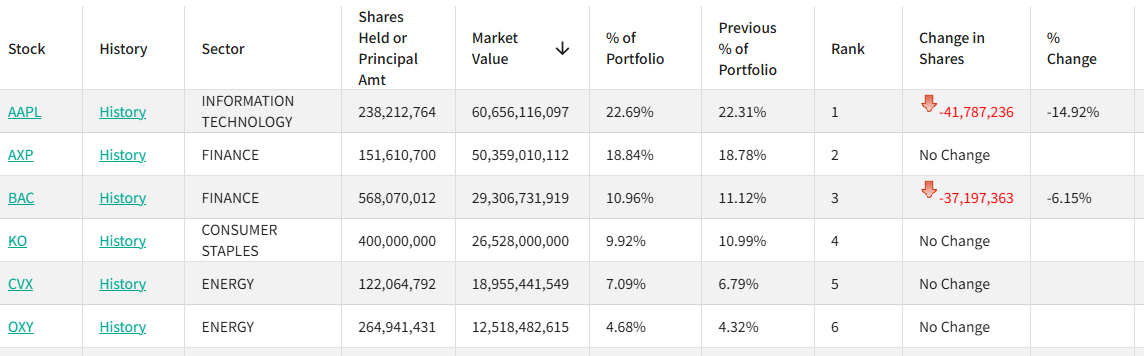
Core Viewpoint - The upcoming 13F quarterly filing deadline for Berkshire Hathaway is generating significant interest, particularly following Warren Buffett's resignation as CEO, with market participants eager to understand the investment decisions made during his final quarter in charge [1]. Group 1: Berkshire Hathaway's Holdings - Berkshire Hathaway's major holdings include Apple, American Express, Bank of America, Coca-Cola, Chevron, and Occidental Petroleum, which are believed to be primarily influenced by Buffett himself [2]. - As of the end of the third quarter, Berkshire's largest position is in Apple, valued at approximately $60.66 billion, representing 22.69% of the portfolio [2]. - The second-largest holding is American Express, valued at about $50.36 billion, making up 18.84% of the portfolio [2]. Group 2: Changes in Holdings - Significant reductions in holdings were observed for Apple and Bank of America, with Apple shares decreasing by nearly 42 million (approximately 15%) and Bank of America shares down by 37 million (over 6%) compared to the previous quarter [3]. - Apple's holdings have shrunk by about 75% from their peak, while Bank of America's holdings have nearly halved since the summer of 2024 [3]. - Berkshire's cash reserves have reached a new high, indicating a potential shift in investment strategy [3]. Group 3: Leadership Transition and Investment Strategy - Greg Abel has officially taken over as CEO of Berkshire Hathaway, following Buffett's departure, with Todd Combs previously seen as a strong candidate for the role [1]. - There is speculation regarding whether Berkshire will divest some positions established under Combs, particularly in companies like Amazon, Verizon, First Capital Credit, Visa, and Mastercard [3]. - Historical precedents suggest that when investment managers leave Berkshire, the company often sells off the majority of their managed holdings [3].
Almost 17% of Berkshire Hathaway's $328 Billion Portfolio Is Invested in 1 Top Stock That's Up 180% in 5 Years
Yahoo Finance· 2026-02-13 13:50
Core Insights - American Express (NYSE: AXP) has shown significant stock performance, with a price increase of 180% over the past five years, and a total return of 198% when including dividends [1] - Berkshire Hathaway holds a 22.1% stake in American Express, which has increased to represent 16.5% of its overall portfolio due to the company's stock buyback strategy [3] Company Performance - American Express has a strong brand presence in the credit card industry, offering premium cards that appeal to affluent customers, which contributes to its financial success [5] - The company has demonstrated pricing power, with an average fee per card increasing by 75% from 2020 to 2025, and it maintains lower delinquency and charge-off rates compared to industry averages [6] - Revenue (net of interest expense) has grown by 120% over the past decade, while diluted earnings per share have increased by 205%, with long-term growth targets set at 10% for revenue and mid-teens for earnings [7]