American Express(AXP)

Search documents
Amex, Deere, J&J Abandon Board Diversity Rule, Activist Says
Insurance Journal· 2026-02-25 06:12
Core Viewpoint - Major companies like American Express, Deere & Co., and Johnson & Johnson are retracting diversity criteria for selecting new board directors, influenced by conservative shareholder activism [1][4]. Group 1: Company Actions - American Express has removed language from its board member selection criteria that referenced "gender, race, ethnicity, age, sexual orientation and nationality" as part of an agreement with the National Legal and Policy Center (NLPC) [6]. - Deere & Co. has amended its bylaws to eliminate references to "race, ethnicity, gender, and other types of diversity" in the selection of new directors, following a shareholder proposal [7]. - Johnson & Johnson has already made similar changes to its board selection criteria, which were confirmed during discussions with the NLPC [9]. Group 2: Industry Trends - The trend of rolling back diversity commitments has been ongoing for several years, driven by conservative backlash and legal pressures against DEI initiatives [4]. - Goldman Sachs is contemplating similar changes to its board nomination criteria, potentially removing considerations of race, gender identity, and sexual orientation [8]. - A report indicated that while 58% of S&P 500 boards had policies similar to the NFL's Rooney Rule in 2025, the percentage of companies reporting their board's share of underrepresented minorities dropped from 99% in 2024 to 78% in 2025 [10].



《2028全球智能危机》:一篇雄文引发股市恐慌背后的十个逻辑
3 6 Ke· 2026-02-25 05:52
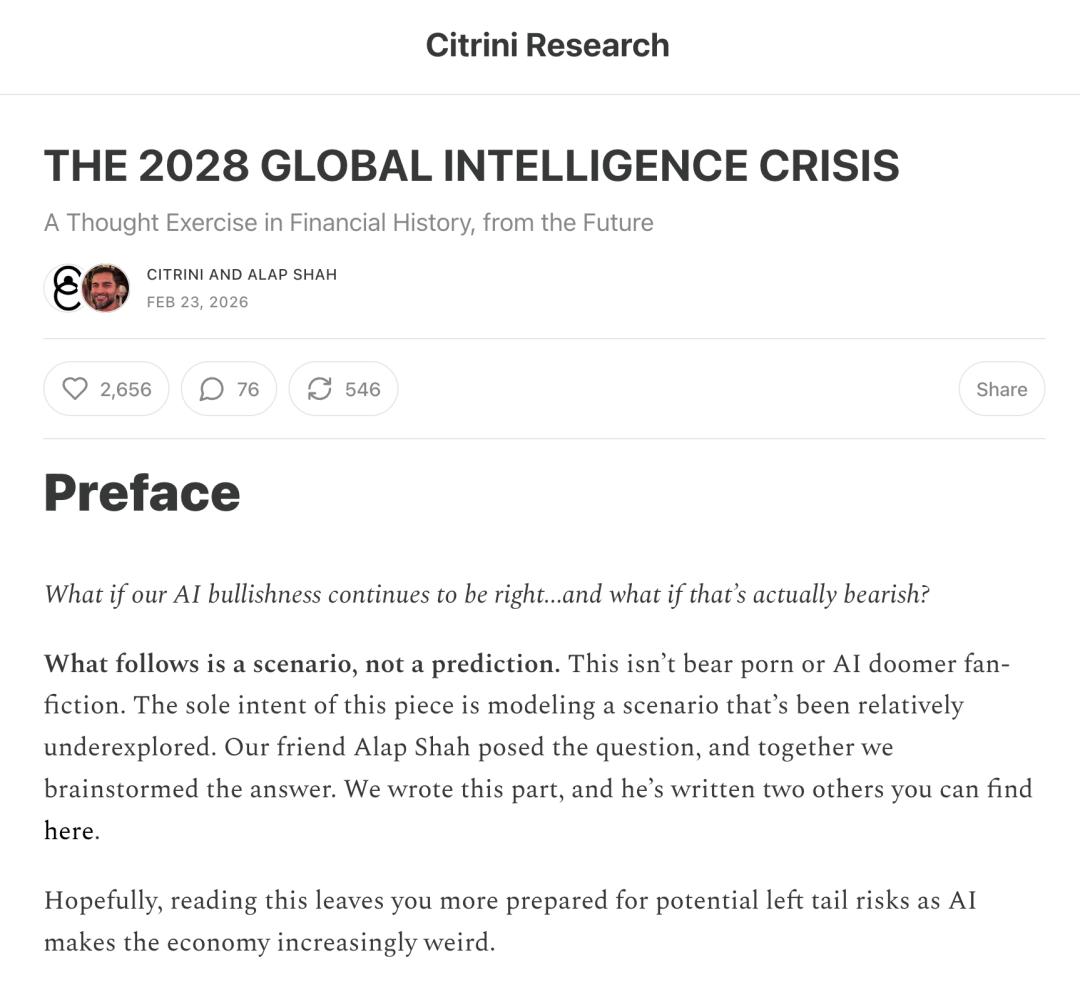
Core Viewpoint - The article discusses the potential risks associated with the rapid advancement of AI technology, suggesting that the optimism surrounding AI may signal a bear market rather than economic growth. It highlights the disconnect between GDP growth driven by AI and the actual economic benefits experienced by the general population [5][45]. Group 1: Market Reaction - On February 23, 2026, the U.S. stock market experienced a significant drop, with the Dow Jones falling over 800 points and only 27% of stocks rising [5]. - Major companies like DoorDash, MongoDB, ServiceNow, and Salesforce saw declines of 7%, 6%, and 4% respectively, while financial firms like American Express and KKR dropped over 8% [5]. Group 2: Economic Implications of AI - The article introduces the concept of "Ghost GDP," where economic output increases without benefiting the average person, as AI-driven productivity bypasses human consumption [7][25]. - A negative feedback loop is described, where AI advancements lead to layoffs, which in turn drive further investment in AI, perpetuating job losses without a self-correcting mechanism [9][10]. Group 3: Corporate Behavior - Companies threatened by AI, such as ServiceNow, are becoming aggressive adopters of AI technologies, often resulting in significant layoffs to fund these investments [12][19]. - The article notes that traditional companies are rapidly embracing AI due to the immediate threats they face, contrasting with past scenarios where new entrants disrupted established firms [19][20]. Group 4: Consumer Spending Dynamics - The article emphasizes that machines do not spend money, which poses a risk to the consumer-driven economy, as 70% of U.S. GDP is derived from human consumption [25]. - The impact of white-collar job losses on consumer spending is highlighted, noting that the affluent contribute significantly to overall consumption, and their job losses could lead to a substantial decline in spending [29][30]. Group 5: Financial Sector Risks - The growth of private credit in the U.S. has led to increased funding for software companies, which may face revenue declines as AI replaces traditional roles [30][31]. - The article warns that even high-quality mortgage loans may become problematic as borrowers lose jobs or face salary reductions due to AI advancements [33][34]. Group 6: Policy Limitations - Traditional monetary policy tools, such as interest rate cuts, may not effectively address the structural unemployment caused by AI advancements [36][38]. - The article argues that existing economic frameworks are based on the assumption of human labor scarcity, which is being challenged by AI's capabilities [40][41].


现金堆到3816亿美元却成净卖方?巴菲特“最后一季”持仓大揭秘
Jin Rong Jie· 2026-02-25 01:21
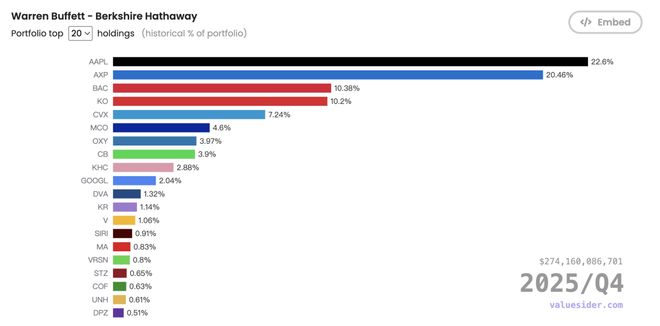
Core Insights - Berkshire Hathaway remains a net seller of stocks in Q4 2025, significantly reducing its positions in Apple, Bank of America, and nearly completely selling Amazon, while increasing holdings in Chevron and Chubb, and initiating a small position in The New York Times [1] Group 1: Portfolio Overview - The total market value of Berkshire's stock portfolio is approximately $274.16 billion [1] - The top five holdings are Apple Inc. (22.6%), American Express (20.46%), Bank of America (10.38%), The Coca-Cola Company (10.20%), and Chevron Corporation (7.24%) [3] - The financial sector dominates the portfolio with a 40.92% share, followed by technology at 24.64%, consumer staples at 14.87%, and energy at 11.21% [4] Group 2: Q4 Position Changes - Core sell-offs include: - Apple (AAPL) reduced by 4.3%, from 238.2 million shares to 227.9 million shares, decreasing in value by approximately $2.799 billion [5] - Bank of America (BAC) reduced by 8.9%, from 568.1 million shares to 517.3 million shares, with a value decrease of about $2.793 billion [5] - Amazon (AMZN) significantly reduced by 77.2%, from approximately 10 million shares to 2.28 million shares, resulting in a value decrease of about $1.783 billion [5][6] Group 3: Core Buys - Chevron (CVX) increased by 6.6%, from 122.1 million shares to 130.2 million shares, adding approximately $1.233 billion in value [7] - Chubb (CB) increased by 9.3%, from 31.33 million shares to 34.25 million shares, adding about $0.91 billion in value [7] Group 4: New Positions - A new position in The New York Times (NYT) was initiated with approximately 5.07 million shares, valued at about $0.352 billion, representing 0.13% of the total portfolio [8][9]


US Stock Market | Citrini founder shocked his AI prediction spurred stocks selloff
The Economic Times· 2026-02-25 00:09
Core Insights - The publication of a dystopian scenario regarding artificial intelligence by Citrini Research founder James van Geelen triggered a significant market reaction, leading to a drop in the S&P 500 Index by over 1% and a decline in specific stocks like ServiceNow Inc., DoorDash Inc., and American Express Co. [1][6][15] - The report highlighted concerns about potential economic disruptions caused by AI, which have made investors increasingly skittish, particularly following weeks of selloffs in various sectors including software and cybersecurity [6][15] Company Overview - Citrini Research, founded by van Geelen, focuses on thematic investing research and has gained a following of over 119,000 subscribers, making it a top seller among Substack's paid newsletters [9][15] - The firm does not manage outside money but is listed as a selling shareholder for RoboStrategy Inc., a fund focused on investments in robotics and AI [10][15] Market Reaction - Following the report's release, the stock market experienced a one-day panic, reflecting heightened anxiety among investors regarding AI's disruptive potential [7][15] - The broader market rebounded the day after the initial drop, indicating volatility and shifting sentiment around AI investments [7][15] Research and Analysis - The report was intended to spark discussions about the implications of AI on the economy, particularly concerning job losses and potential deflationary effects [13][15] - Van Geelen emphasized the importance of debating these issues to navigate the challenges posed by AI, suggesting that historical trends show that productive assets typically create jobs rather than eliminate them [14][15]

资讯早间报:隔夜夜盘市场走势-20260224
Guan Tong Qi Huo· 2026-02-24 03:04
Report Summary 1. Report's Industry Investment Rating No relevant information provided. 2. Core Viewpoints - Global financial markets are affected by multiple factors including geopolitical tensions, tariff policies, and corporate earnings, leading to significant fluctuations in various asset classes. For example, the US stock market declined due to Trump's tariff plan and EU's suspension of the trade - agreement approval, while the precious metals market rose due to increased risk - aversion [5][6]. - The energy market is influenced by the Iran - US nuclear negotiation, with expectations of increased Iranian oil supply putting downward pressure on oil prices [7]. 3. Summary by Directory Overnight Night - Market Trends - **Stock Markets**: US major indices (Dow, S&P 500, Nasdaq) fell, with IBM and American Express leading the decline. European indices (DAX, CAC40, FTSE 100) also closed lower. The reasons include Trump's tariff plan and EU's suspension of trade - agreement approval [5]. - **Precious Metals**: COMEX gold and silver futures rose due to increased risk - aversion from geopolitical tensions, tariff policy changes, and other factors [6]. - **Energy**: US crude oil and Brent oil futures fell as the Iran - US nuclear negotiation showed signs of progress, increasing the expectation of more Iranian oil supply [7]. - **Base Metals**: Most London base metals declined, except for LME tin which rose [7]. Important News Macro News - Shanghai Export Container Settlement Freight Index for European routes dropped 2.1%. The US will stop collecting certain illegal tariffs. There is still a risk of US military strikes against Iran. India postponed a trade delegation plan. China is assessing the impact of US tariff rulings and urges the US to cancel unilateral tariffs. The EU suspended the approval of a trade agreement with the US. The Trump administration is considering new "national security tariffs" [9][11]. Energy Futures - Saudi Aramco sold condensate oil. Methanol supply in Southeast Asia is restricted due to planned maintenance. Goldman Sachs and Morgan Stanley have different forecasts for oil prices, with Goldman Sachs raising price forecasts for Q4 2026 and 2027, and Morgan Stanley expecting a short - term increase followed by a decline [14][16][18]. Metal Futures - The US energy storage market is expected to grow 21%. Lebanon may sell part of its gold reserves. UBS is positive on gold, with a target price of $6200/ounce [20][21]. Black - Series Futures - China's iron ore arrivals decreased, but global iron ore shipments increased. Vietnam plans to build a large - scale steel plant. The blast furnace capacity utilization rate of Chinese pig - iron enterprises decreased, and inventory increased [23][25]. Agricultural Products Futures - Malaysian palm oil production and exports decreased in February. Argentina's soybean moisture conditions improved, and the production forecast remains unchanged [27][28]. Financial Markets Financial - 143 companies have submitted IPO applications in the Hong Kong stock market in 2026. Deloitte predicts a better performance in the Hong Kong IPO market this year [30]. Industry - Payment transactions on Chinese New Year's Eve increased. The real - estate market may show more stabilization signals. China's AI governance system is maturing [31]. Overseas - The US may adjust tariff application methods and continue steel - aluminum tariffs. The Fed has about 75 basis - points to reach the neutral rate. India plans to invest $200 billion in AI. The Australian central bank may tighten policy. UK unemployment reached a new high [32][34][35]. International Stock Markets - US and European stock markets rose, while the Japanese market fell. High - end companies made significant stock - position adjustments. The UK may adjust accounting rules to attract Chinese companies. Australia simplifies corporate governance rules. Some companies announced major transactions or reported good earnings [36][38][41]. Commodities - Precious metals, oil, and most base metals futures fell due to factors such as progress in the Iran - US nuclear negotiation and reduced risk - aversion [43]. Bonds - US Treasury yields had mixed changes. Japanese bonds rose, and the 2029 fiscal - year bond issuance may increase [45]. Foreign Exchange - The US dollar index rose slightly, and most non - US currencies fell [46]. Upcoming Economic Data and Events - **Economic Data**: Include Japan's trade balance, UK's inflation and housing - price index, US's new - home construction, and other data [48]. - **Events**: New Zealand's central - bank rate decision, European Central Bank officials' speeches, and the Fed's release of meeting minutes [50]. - **Market Closures**: Chinese, South Korean, and Vietnamese stock markets are closed due to the Spring Festival [52].






未知机构:CitriniResearch日前发布报告详细分析了人工智能AI可能给全-20260224
未知机构· 2026-02-24 02:25
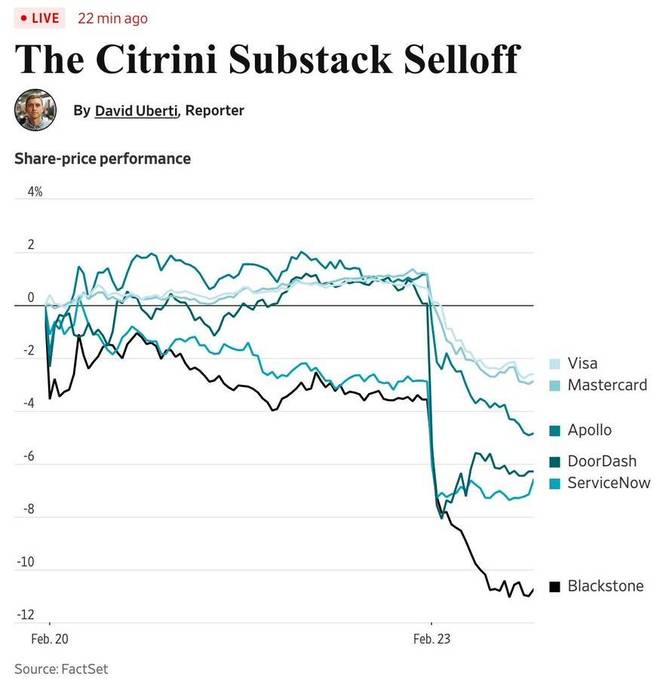
Summary of the Conference Call Industry Overview - The report by CitriniResearch analyzes the potential risks posed by artificial intelligence (AI) across various sectors of the global economy, leading to significant declines in stocks related to delivery, payment, and software industries [1][1]. - Companies specifically mentioned include DoorDash, American Express, KKR & Co Inc., and Blackstone, all of which saw stock prices drop over 8% on the day of the report [1][1]. Other affected companies include Uber, Mastercard, Visa, Capital One, and Apollo Global Management Inc., with stock declines of at least 3% [1][1]. Core Insights and Arguments - The report sets a hypothetical scenario for June 2028, where the disruptive impact of AI results in widespread white-collar unemployment, decreased consumer spending, and defaults on software-backed loans, leading to economic contraction [2][2]. - It emphasizes that the content is a scenario model rather than a prediction, aiming to prepare readers for potential tail risks associated with AI's influence on the economy [2][2]. - One scenario described involves the replacement of dominant food delivery apps like DoorDash and Uber Eats by alternatives based on "vibe-coded" programming [2][2]. - The report also suggests that AI agents could eliminate transaction fees charged by payment processors like Mastercard and Visa, potentially saving users money [3][3]. Additional Important Points - The report acknowledges that some scenarios presented are unlikely to occur [4][4]. - Investors are encouraged to assess how much of their portfolio is based on assumptions that may not hold in the next decade [5][5]. - The report has contributed to heightened anxiety in the stock market, which was already experiencing volatility due to AI disruption risks and geopolitical tensions [5][5]. - Thomas George from Grizzle Investment Management highlights that the report raises valid concerns about disruption risks, even if the worst-case scenarios may not materialize [6][6]. - The report has led to a loss of confidence among investors holding affected stocks [7][7]. - The market has seen a sell-off across various sectors, including software, wealth management, logistics, insurance brokerage, private credit, cybersecurity, and real estate services, due to investor anxiety over new AI tools [8][8]. - Some analysts warn that the market's reactions may be exaggerated, suggesting that risks associated with AI might be overestimated [8][8]. - Michael O'Rourke, Chief Market Strategist at Jones Trading, notes the surprising market response to the report, indicating that the market has shown resilience in the face of genuine negative news in the past [9][9]. - The report's fictional nature has led to an uncontrolled market decline, which is seen as an overreaction [10][10].


“2028AI末日预言”吓坏市场,投资者掀起抛售潮,美股多板块盘中集体重挫
Xin Lang Cai Jing· 2026-02-24 00:45
Group 1 - Citrini Research's report highlights potential risks of AI impacting various sectors, leading to significant stock declines in food delivery, payment, software, and IT services [1][7] - Specific stock declines include DoorDash (-7%), Uber (-4%), American Express (-8%), Visa (-5%), and Mastercard (-6%) among others, with several companies experiencing drops of at least 3% [1][6] - The report presents a hypothetical scenario for June 2028, suggesting AI could cause widespread white-collar job losses and a contraction in consumer spending [4] Group 2 - The report describes a future where AI could replace dominant food delivery apps like DoorDash and Uber Eats with alternative solutions [5] - AI could potentially eliminate transaction fees charged by payment processors like Mastercard and Visa, benefiting users financially [6] - The recent "AI panic" has led to sell-offs across multiple sectors, including software, wealth management, and logistics, as investors react to perceived risks [8]

Wall Street Slumps as Tariff Hikes and Trade Uncertainty Rattle Investors
Stock Market News· 2026-02-23 22:07
Market Overview - U.S. equity markets experienced significant selling pressure on February 23rd, 2026, due to escalating global trade tensions and a Supreme Court ruling that limited the executive branch's authority to impose tariffs [1] - The major indexes opened lower and maintained a downward trend throughout the session, reflecting a "risk-off" sentiment across nearly all sectors [1] Major Index Performance - The Dow Jones Industrial Average (DJI) fell by 814.40 points, or 1.7%, closing at 48,804, primarily impacted by losses in financial and industrial sectors [2] - The S&P 500 (SPX) decreased by 1.0%, ending at 6,837, while the Nasdaq Composite (IXIC) dropped 1.1% to close at 22,627 [2] - The CBOE Volatility Index (VIX) remained elevated, indicating heightened market fear amid geopolitical instability [2] Corporate News and Market Movers - International Business Machines (IBM) saw a significant decline of 13.1% due to concerns over AI disruption and trade-related challenges [3] - American Express (AXP) dropped 7.2%, while Visa (V), JPMorgan Chase (JPM), and Goldman Sachs (GS) all experienced declines exceeding 3% [3] - In the healthcare sector, Novo Nordisk (NVO) faced a 15.85% drop in its ADRs, attributed to increased competition in the metabolic drug market [4] - E-commerce giants Amazon (AMZN) and Tesla (TSLA) also suffered losses due to tariff-related concerns, while Nvidia (NVDA) gained 0.9% ahead of its earnings report [4] Retail Sector Highlights - Domino's Pizza (DPZ) reported fourth-quarter earnings of $5.35 per share, slightly missing estimates, but achieved a revenue of $1.535 billion and same-store sales growth of 3.7%, resulting in a 6% stock increase [5] Post-Market Earnings and Upcoming Events - Bed Bath & Beyond (BBBY) reported an adjusted loss of $0.16 per share, better than the expected loss of $0.23, with revenue at $273.43 million and a cautiously optimistic outlook for 2026 [6] - Other companies reporting included ONEOK (OKE), Diamondback Energy (FANG), and Keysight Technologies (KEYS), with investors monitoring the impact of new tariffs on capital expenditure and supply chain costs [6] Upcoming Market Events - The Conference Board is set to release the February Consumer Confidence Index, expected to rise to 87.5 [7] - President Trump will deliver the State of the Union address, likely providing further insights into trade policy [7] - Nvidia's earnings report is anticipated, with analysts expecting a 70% year-over-year revenue growth, which could influence market direction [7] - The January Producer Price Index (PPI) will be released, a key metric for the Federal Reserve regarding potential interest rate cuts [7]



Dow Jones sheds more than 800 points on Trump's latest tariff threat
Yahoo Finance· 2026-02-23 21:15
Group 1 - Global markets are facing uncertainty due to trade policy changes, key corporate earnings, and economic data, particularly following the US Supreme Court's decision on tariffs [1] - President Trump announced an increase in global tariffs to 15% under Section 122 of the Trade Act, which allows temporary tariffs without Congressional approval, raising questions about exemptions and the impact on deficit projections [2] - Deutsche Bank analysts indicated that the timing and structure of tariff refunds could influence medium-term economic and fiscal outcomes [3] Group 2 - The uncertainty surrounding tariffs has led to mixed market reactions, with no significant selloff despite confusion over Trump's latest tariff announcement [3] - The situation may favor European equities over US markets in the near term and could contribute to a continued decline in the dollar [4] - US stocks opened lower, with the Dow Jones leading the decline, down 0.9%, and notable falls in companies like Salesforce, Nike, and American Express [5]

Capital One收跌8.8%,美国运通下挫7.2%。
Xin Lang Cai Jing· 2026-02-23 21:11
Group 1 - Capital One shares fell by 8.8% [1] - American Express shares declined by 7.2% [1]