
BANK OF CHINA(BACHY)

Search documents
中国银行1月1日至12月31日开展指定信用卡分期财政贴息工作
Jin Tou Wang· 2026-01-21 03:14
中国银行将遵循市场化、法治化原则,针对2026年1月1日至2026年12月31日期间成功办理且符合政策规 定的信用卡消费分期、信用卡账单分期、信用卡自由分期(上述三项合并统称为"指定信用卡分期")开 展财政贴息工作。后续相关办理流程、操作步骤等详细规则,将通过中国银行官方网站等渠道发布,敬 请关注。 2026年1月20日,中国银行(601988)发布公告称,为深入贯彻落实中央经济工作会议精神,持续降低 居民个人消费信贷成本,充分激发消费潜力,中国银行将全力落实并严格执行《关于印发<个人消费贷 款财政贴息政策实施方案>的通知》(财金〔2025〕80号)、《关于优化实施个人消费贷款财政贴息政 策有关事项的通知》(财金〔2026〕1号),切实推动财政贴息政策红利触达广大消费者,以金融赋能 消费市场活力释放。 ...

个人消费贷贴息政策“延期扩围”,大行股份行快速跟进,新入围地方银行:客户流失担忧消除
Xin Lang Cai Jing· 2026-01-21 02:48
Core Viewpoint - The newly revised consumer loan interest subsidy policy is expected to stimulate domestic consumption recovery by encouraging banks to increase consumer loan issuance [1][7]. Group 1: Policy Implementation - Major state-owned banks and joint-stock banks, including Agricultural Bank of China, Bank of China, and Postal Savings Bank, have promptly responded to the new consumer loan interest subsidy policy [1][7]. - Postal Savings Bank announced that from September 1, 2025, to December 31, 2026, personal consumption loans used for actual consumption will be eligible for interest subsidies, with credit card bill installments also included in the subsidy scope [2][8]. - The policy removes the previous restriction on single transactions of 50,000 yuan or more for eligible consumption transactions [2][8]. Group 2: Operational Procedures - China Merchants Bank outlined that customers must follow specific procedures to apply for the consumer loan interest subsidy, including signing a supplementary agreement during or after the loan issuance [3][9]. - The bank will calculate the subsidy amount based on the agreed-upon subsidy ratio and cap, directly deducting the subsidy from the interest charged to customers [3][9]. Group 3: Inclusion of More Financial Institutions - The latest policy expansion includes city commercial banks, foreign banks, and consumer finance institutions, which were previously excluded from the interest subsidy program [4][10]. - This expansion aims to enhance fairness and inclusivity in the financial system, encouraging local banks to actively participate in consumer loan issuance [4][10]. - Industry insiders expressed optimism about the inclusion of more consumer finance companies, indicating readiness to implement the policy effectively [5][11].

中国银行:自股改上市以来累计分红超过9700亿元
Zheng Quan Ri Bao· 2026-01-20 11:21
Core Viewpoint - The company emphasizes its commitment to focusing on its core business, maintaining stable operations, and enhancing operational efficiency and value creation to provide long-term value returns to investors [1] Financial Performance - Since its reform and listing, the company has distributed over 970 billion yuan in dividends, with a high dividend payout ratio maintained in recent years [1]
中国银行:公司自2024年度起每年度实施中期和末期两次分红
Zheng Quan Ri Bao Zhi Sheng· 2026-01-20 11:18
Core Viewpoint - The company will implement mid-term and final dividends annually starting from the fiscal year 2024, with specific cash dividend distribution dates outlined for A-shares in 2025 [1] Dividend Distribution Plan - The mid-term cash dividend for A-shares will be distributed in January 2025, while the final cash dividend will be distributed in April 2025 [1] - For the fiscal year 2025, the company will continue with mid-term dividends, with the cash dividends for A-shares fully distributed by December 2025 [1] - The company will formulate the profit distribution plan for 2025 based on the annual performance and submit it for approval by the board and shareholders [1]
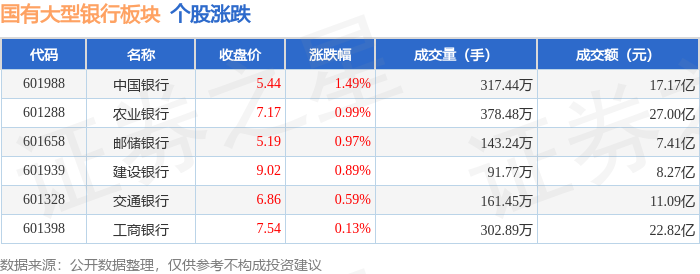
国有大型银行板块1月20日涨0.78%,中国银行领涨,主力资金净流入7.21亿元
Zheng Xing Xing Ye Ri Bao· 2026-01-20 08:56
Group 1 - The core viewpoint of the news is that the state-owned large bank sector experienced a rise of 0.78% on January 20, with China Bank leading the gains [1] - The Shanghai Composite Index closed at 4113.65, down 0.01%, while the Shenzhen Component Index closed at 14155.63, down 0.97% [1] - The trading performance of individual stocks in the state-owned large bank sector showed varied results, with China Bank closing at 5.44, up 1.49%, and Agricultural Bank at 7.17, up 0.99% [1] Group 2 - The net inflow of main funds into the state-owned large bank sector was 721 million yuan, while retail investors saw a net outflow of 177 million yuan [1] - The detailed fund flow for individual banks indicated that Agricultural Bank had a net inflow of 210 million yuan from main funds, while it experienced a net outflow of 140 million yuan from speculative funds [2] - Industrial and Commercial Bank had a net inflow of 181 million yuan from main funds, but a significant net outflow of 254 million yuan from speculative funds [2]



河南金融监管局核准杨凤仙中国银行济源分行行长助理任职资格
Jin Tou Wang· 2026-01-20 03:49
Core Viewpoint - The Henan Financial Regulatory Bureau has approved the appointment of Yang Fengxian as the Assistant President of the Jiyuan Branch of the Bank of China, emphasizing the importance of compliance with regulatory requirements and ongoing education in financial laws and regulations [1] Group 1 - The approval of Yang Fengxian's qualification as Assistant President is officially recognized by the Henan Financial Regulatory Bureau [1] - The Bank of China is required to ensure that the approved personnel comply with regulatory provisions and report their appointment status within three months [1] - Continuous learning and adherence to risk compliance awareness are mandated for the approved personnel to effectively fulfill their responsibilities [1]
聚力深耕江淮 服务“三地一区” ——中国银行安徽省分行交出“十四五”答卷
Zhong Guo Jin Rong Xin Xi Wang· 2026-01-19 10:37
Core Viewpoint - During the "14th Five-Year Plan" period, the Bank of China Anhui Branch has focused on political and people-oriented financial work, aligning closely with Anhui's strategic positioning and actively supporting major projects, industrial upgrades, rural revitalization, and opening up to the outside world [1] Group 1: Infrastructure Empowerment - The Bank of China Anhui Branch has injected financial momentum into major projects, such as the Changjing-Huang High-Speed Railway, which connects several famous tourist attractions across three provinces [2] - The bank has provided financial support for key transportation projects, including the G36 Ningluo Expressway and Wuyue Expressway, enhancing Anhui's geographical advantages for high-quality economic development [2] Group 2: Innovation in Science and Technology - The bank has supported over 15,000 manufacturing enterprises with more than 160 billion yuan in credit, focusing on strategic emerging industries and technology finance [3] - A notable case includes a private aerospace equipment company receiving 50 million yuan in equity investment and 100 million yuan in credit support through an innovative "small equity + large debt" financial service model [3] - The bank plans to launch an action plan to support the artificial intelligence industry chain and establish a direct investment pilot fund in Anhui [3] Group 3: Green Development - The Bank of China Anhui Branch has actively engaged in green finance, providing over 1.2 billion yuan in loans for ecological restoration projects in the Ma'anshan area [4] - The bank has integrated ecological governance with industrial development, promoting sustainable growth in the region [4] Group 4: Revitalizing Local Industries - The bank has tailored financial products to support local industries, such as the "Goose Industry Loan" in Huoqiu and the "Xuan Paper Loan" in Jingxian, facilitating the upgrade of local production chains [5] - These initiatives aim to enhance rural revitalization and promote regional economic strength [5] Group 5: Supporting International Trade - The bank has provided cross-border financial services to nearly 7,000 enterprises, with an external trade loan balance exceeding 65 billion yuan [6] - It has customized overseas loan solutions for companies expanding into international markets, such as a well-known automotive company entering Australia [6] - The bank emphasizes a tailored approach to meet the diverse needs of enterprises operating abroad [6]
中国银行 -我们对近期货币刺激的看法:财政刺激在路上,是时候重估了-China Banks Our take on recent monetary stimulus Fiscal stimulus on the way Time to revisit
2026-01-19 02:29
Summary of Conference Call on China Banks Industry Overview - The conference call focused on the Chinese banking sector, particularly the implications of recent monetary and fiscal stimulus measures announced by the People's Bank of China (PBoC) [1][2]. Key Points and Arguments Monetary Policy Changes - PBoC announced new supportive monetary policies on January 15, including: - Expansion of relending facilities with an additional quota of approximately RMB 1.1 trillion, targeting private enterprises and key industries such as agriculture, small businesses, technological innovation, carbon reduction, service consumption, and elderly care [1]. - A 25 basis points (bps) interest rate cut for relending facilities, reducing the rate from 1.5% to 1.25% [7]. - Potential for further cuts in the Reserve Requirement Ratio (RRR) and Loan Prime Rate (LPR) [1][2]. Impact on Banks' Net Interest Margin (NIM) - The relending facilities rate cut is expected to benefit banks' NIM by approximately 0.3 bps, as banks can borrow cheaper funds from PBoC [1]. - The balance of relending facilities reached around RMB 5 trillion by Q3 2025, representing about 1% of banks' total assets [1]. - The anticipated fiscal stimulus, including interest subsidies on consumer and micro loans, is expected to have a limited negative impact on banks' NIM [1]. Credit Growth and Loan Demand - The stimulus measures are designed to incentivize banks to direct credit towards policy-favored sectors, supporting loan growth at the beginning of 2026, coinciding with the start of the 15th five-year plan [1]. - There is an expectation of stronger-than-expected loan growth in early 2026 due to these targeted lending initiatives [1]. Treasury Bond Market Dynamics - Lower treasury bond yields are projected to widen the spread between banks' dividend yields and the 10-year China treasury bond yield, attracting yield-seeking investors [2][5]. - The PBoC may actively participate in treasury bond trading to rebalance supply and demand dynamics, potentially lowering treasury bond yields further [2]. Investment Outlook for China Banks - China banks' H-shares have underperformed the Hang Seng Index by 7 percentage points year-to-date in 2026, but there is optimism for recovery due to: - Expected growth in insurers' premiums, leading to increased inflows into high-yield bank stocks [6]. - The attractiveness of banks' dividend yields due to lower treasury bond yields [6]. - The positive impact of monetary and fiscal stimulus on loan growth with limited negative effects on NIM [6]. - Specific banks highlighted for potential investment include ICBC-H and BOC-H, which offer above-peer dividend yields and favorable valuations [6]. Insurer Investments in Banks - Notable changes in equity stakes by insurers in various banks were discussed, indicating a trend towards increased financial investments in the banking sector [12]. Additional Important Information - The conference call emphasized the importance of monitoring the evolving regulatory environment and market conditions that could impact the banking sector's performance [1][2][6]. - Analysts expressed caution regarding the potential for NIM compression in FY26, estimating a 6 bps decrease, but noted that RRR cuts and potential deposit rate cuts could provide some offset [2]. This summary encapsulates the key insights and projections regarding the Chinese banking sector as discussed in the conference call, highlighting the implications of recent monetary policies and the outlook for investment opportunities.
中国银行业:企业贷款强劲支撑贷款平稳增长,零售需求持续疲软-China Banks_ Strong corporate lending supports stable loan growth amid persistently weak retail demand
2026-01-16 02:56
Summary of Key Points from the Conference Call Industry Overview - **Industry**: Chinese Banking Sector - **Key Metrics**: Total Social Financing (TSF), Loans, Deposits Core Insights 1. **Total Social Financing (TSF) and Loan Growth**: - New TSF in December 2025 reached Rmb 2.2 trillion, a year-over-year decrease of Rmb 0.6 trillion, primarily due to a decrease in government bond issuance by Rmb 1.1 trillion [1] - Government bond issuance for the full year 2025 increased by Rmb 14 trillion (+23% year-over-year), contributing 39% of new TSF, up from 35% in 2024 [1] - Rmb loans to the real economy decreased by Rmb 16 trillion (-7% year-over-year), contributing 45% of new TSF, down from 53% in 2024, indicating weak demand from the real economy [1] 2. **Loan Composition**: - New loans totaled Rmb 0.9 trillion in December 2025, a year-over-year decrease of Rmb 0.1 trillion [1] - Retail credit saw a net decrease of Rmb 0.1 trillion, with short-term retail loans continuing a downward trend since October [1] - Corporate loans increased by Rmb 1.1 trillion (up Rmb 0.6 trillion year-over-year), attributed to a low base from December 2024 due to local government debt swaps [1] 3. **Credit Growth Dynamics**: - For the full year 2025, corporate loans contributed 95% of new credits, compared to 79% in 2024, with corporate loan growth at 9.1% versus 0.5% for retail loans [1] - Discussions with banks suggest that retail credit demand may improve in 2026 as retail risks are digested and consumption stimulus policies take effect [1] 4. **Deposit Trends**: - Deposits increased by Rmb 1.7 trillion, up Rmb 3.1 trillion year-over-year, primarily due to a smaller decline in non-bank financial institution deposits [5] - Household deposit growth remained robust, with a net increase of Rmb 2.6 trillion (up Rmb 0.4 trillion year-over-year) [5] - M2 growth rate was 8.5% year-over-year, rebounding from 8.0% in November, supported by fiscal spending [5] 5. **Market Conditions**: - M1 growth rate declined to 3.8% year-over-year from 4.9% in November, possibly due to a high base from large-scale corporate debt repayments in December 2024 [5] Additional Important Insights - The banking sector is experiencing a shift with corporate lending becoming the primary driver of credit growth, while retail lending remains subdued due to weak consumption and regulatory impacts [1][5] - The overall economic environment is characterized by a cautious outlook on retail credit demand, with expectations for gradual improvement in the coming year [1]
中国银行董事长葛海蛟会见加中贸易理事会董事会主席德马雷
Zheng Quan Shi Bao Wang· 2026-01-15 12:32
转自:证券时报 人民财讯1月15日电,1月15日,中国银行董事长葛海蛟在中国银行总行大厦会见加中贸易理事会董事会 主席奥利维耶·克雷蒂安·德马雷一行,围绕支持两国企业双向投资、深化中加经贸金融交流、推动绿色 金融合作、拓展人民币国际使用等话题深入交流。双方一致认为,中加经济互补性强、合作潜力巨大。 双方将以此次会见为契机,进一步加强多领域务实合作,持续服务两国企业交流,共享市场发展机遇, 为深化中加经贸关系注入新动力。 ...