CGS(CGXYY)

Search documents
中国银河证券:上游锗供给紧俏 光棒价格有望上行
智通财经网· 2026-03-05 05:55
Core Viewpoint - The tightening of export controls on germanium and the ongoing supply shortage of upstream materials are expected to support the steady rise in optical fiber prices, driven by increased demand from AI infrastructure development, which may enhance the overall industry outlook [1][4]. Group 1: Supply Constraints - The export control on germanium, a critical dopant for optical fiber preform, is leading to a tightening supply in the upstream market [2][3]. - The global proven reserves of germanium are approximately 8,600 tons, with the United States holding 45% and China 41% of these reserves [1][2]. - The production cycle for optical preforms is lengthy, typically taking 1.5 to 2 years to reach stable mass production, contributing to the ongoing supply gap [3]. Group 2: Price Trends - The optical preform constitutes about 70% of the cost of optical fibers, and the rising costs of upstream materials, including germanium, are expected to further support price increases [3]. - The inability of optical preform production capacity to quickly respond to demand is leading to a persistent supply gap, reinforcing the upward price trend [3]. Group 3: Demand Growth - The optical fiber industry is entering a growth phase, driven by surging demand from AI data centers and international markets, particularly for specialized optical fibers [4]. - According to CRU reports, global demand for optical fibers and cables is projected to grow by 4.1% year-on-year by 2025, with data center demand expected to increase by 75.9% [4]. - Chinese optical fiber manufacturers are expanding their international presence, securing contracts in regions such as the Middle East, Latin America, and Europe, which enhances their competitive position [4].



中国银河证券:家用电器行业追觅营销声势扩大 清洁电器份额提升
智通财经网· 2026-03-05 03:47
Core Viewpoint - The clean appliance industry is experiencing low penetration rates, but the global market is expected to grow rapidly, with intense competition among leading companies like Stone Technology, Ecovacs, and Dreame [1] Group 1: Market Dynamics - The market is currently dominated by three leading companies: Stone Technology, Ecovacs, and Dreame, with competition expected to ease as the gap between the first and second market shares widens [1] - Dreame has significantly increased its marketing efforts since 2026, including partnerships with major events like the Chinese Spring Festival and the Super Bowl, which have enhanced its brand visibility [1] - In the Chinese market, Dreame's market share for vacuum cleaners improved significantly, reaching 15.0% in the four weeks from February 16 to February 22, 2026, with a peak of 22.2% in the last week [1] Group 2: Pricing Trends - The average online retail price for vacuum cleaners was 3,391 yuan per unit in 2025, showing a year-on-year decrease of 2.5%, but it rebounded to 3,658 yuan by the eighth week of 2026, a 27.4% increase from the second week of 2026 [3] - The average retail price for floor washing machines has been declining, with a 2025 average of 2,053 yuan, down 3.0% year-on-year, and a new low of 1,820 yuan in January 2026, marking a significant drop [3] Group 3: Competitive Landscape - The competition among vacuum cleaner companies remains fierce, particularly in the Chinese market, where subsidies have been reinstated, leading to high marketing expenditures [2] - Stone Technology and Ecovacs have engaged in aggressive pricing strategies, which have intensified competition, although this has started to ease since 2026 [2]
中国银河证券:CBAM将显著增加中国高排放行业短期碳成本 转型快、已取得一定成果头部企业值得关注
智通财经网· 2026-03-05 02:40
Group 1 - The core viewpoint is that low-carbon technology and industries are essential for high-emission sectors to respond to the Carbon Border Adjustment Mechanism (CBAM) and achieve green transformation during the 14th Five-Year Plan period [1] - The three major high-emission industries—steel, aluminum, and cement—will focus on the circular economy, supported by both policy and corporate transformation needs, becoming a new engine for green low-carbon growth [1] - Leading companies in high-emission industries that have made significant progress in transformation possess technological and financial advantages, which may enhance their international competitiveness through low-carbon transformation [1] Group 2 - The CBAM will officially take effect on January 1, 2026, after a two-year transition period, initially covering six high-emission industries, including steel, aluminum, and cement [1] - Importers will need to pay for carbon emissions from the previous year, with the first CBAM certificate payments due in 2027, and the scope may expand to downstream industries by 2028 [1][2] - The CBAM is part of the EU carbon market reform, which will gradually increase the proportion of paid certificates while phasing out free allowances for relevant industries by 2035 [2] Group 3 - The CBAM is essentially a green trade barrier aimed at revitalizing the EU economy and addressing internal and external challenges, including the post-COVID recovery and energy crisis [3] - The EU is implementing a "Brussels effect" through the CBAM, encouraging other countries to adopt similar measures, thereby strengthening its position as a global regulator in green trade [3] Group 4 - The CBAM will significantly increase short-term carbon costs for China's high-emission industries, with cement facing the highest cost pressure, followed by steel and aluminum [4] - The carbon cost as a percentage of the value of corresponding export products is estimated to be 14.2%-15.9% for cement, 8.5%-9.5% for steel, and 2.9%-3.2% for aluminum [4] - Exporting companies in these sectors will also incur additional "hidden costs" related to carbon auditing and data management to comply with CBAM requirements [4] Group 5 - In response to the CBAM, China has made some preparations and achieved certain industry transformation results, but stricter carbon management and assessment will be enforced during the 14th Five-Year Plan [5] - High-emission industries will face dual carbon costs domestically and internationally, necessitating gradual low-carbon transformation through technological innovation [5] - The evolving trade landscape and supply chain restructuring present opportunities for accelerated transformation, with companies that adapt effectively likely to excel in innovation and operational performance [5]
中国银河证券:冲突升级油气双高 哪些化工板块值得重视
智通财经网· 2026-03-05 01:33
Core Viewpoint - The recent geopolitical conflicts, particularly involving Iran and the closure of the Strait of Hormuz, have led to significant price increases in the energy and chemical sectors, presenting various investment opportunities and risks [1][2][3][4][5][6][7]. Group 1: Oil and Gas Sector - The geopolitical tensions have caused a surge in oil prices, with Brent crude currently priced at $80 per barrel, reflecting expectations of supply losses from the Middle East [1]. - Iran's oil production is projected to be 3.37 million barrels per day by 2025, accounting for 4.3% of global production, with current production levels remaining stable despite the conflict [1]. - The closure of the Strait of Hormuz, which handles 26.6% of global seaborne oil trade, could lead to severe supply delays and increased transportation costs, further driving up global energy prices [1]. Group 2: Natural Gas Sector - Qatar Energy has announced a halt in LNG production due to military attacks, which could lead to substantial supply losses in the LNG market, where Qatar holds a 20% global market share [2]. - The combination of the Strait of Hormuz being blocked and major producers halting operations is expected to create a significant supply shortage in the LNG market, with prices likely to remain strong in the short term [2]. Group 3: Chemical Sector - The geopolitical situation is expected to impact methanol imports, with Iran accounting for 59.9% of the Middle East's methanol production capacity, leading to potential price increases due to supply disruptions [3]. - Iran's urea production capacity is approximately 9 million tons per year, and any disruptions could lead to increased prices in the international market, especially given the uncertainty surrounding its production and export [4][5]. - European chemical production, particularly for methionine and vitamins, faces significant uncertainty due to reliance on natural gas, which constitutes about 30% of direct raw materials [6]. Group 4: Bromine Market - The geopolitical tensions may lead to supply shortages in bromine, with Israel and Jordan being major producers, and increased shipping costs could further elevate bromine prices [7].
中国银河证券:A股市场震荡并非趋势性转向 配置机会上关注三大主线
智通财经网· 2026-03-05 00:46
Core Viewpoint - The recent volatility in the A-share market is not indicative of a trend reversal but rather a short-term emotional release under external pressures, with a medium to long-term positive trend remaining intact [1][2][3] Market Characteristics - The A-share market has experienced significant fluctuations driven by geopolitical risks, market structure differentiation, and capital dynamics, resulting in wide index oscillations and extreme sector divergence [2] - External geopolitical factors, particularly the ongoing Middle East tensions, have triggered short-term volatility, while domestic economic fundamentals and policy direction continue to dominate medium to long-term trends [2][3] Investment Opportunities - The market is expected to transition from emotion-driven movements to fundamentals-driven dynamics, characterized by "oscillation digestion, momentum enhancement, and structural focus" [3] - Key investment themes include: - **Theme One**: Short-term certainty in price increases and risk aversion, particularly in sectors like oil and gas, petrochemicals, coal, non-ferrous metals, and shipping ports, which are benefiting from rising energy prices and inflation expectations [3][4] - **Theme Two**: Improvement in supply-demand dynamics and industry profit recovery, with a focus on sectors such as basic chemicals, steel, construction materials, and financials, especially banks [4] - **Theme Three**: New productive forces in the domestic economy, including storage, computing power, consumer electronics, communication equipment, communication services, semiconductors, and military industries, as well as consumer sectors with strong domestic and external demand expectations [4]
中国银河证券:料三月布伦特原油区间75-90美元/桶 短期关注高分红油气标的
智通财经网· 2026-03-04 08:59
Core Viewpoint - China Galaxy Securities forecasts that Brent crude oil prices will range between $75 and $90 per barrel by March 2026, with short-term price volatility expected due to geopolitical uncertainties [1] Group 1: Oil Price Trends - In February, the average prices for Brent and WTI crude oil were $69.4 and $64.5 per barrel, reflecting increases of 7.2% and 7.1% respectively [1] - The recent trends in international oil prices are closely linked to geopolitical situations in the Middle East, particularly concerning Iran's oil production and its control over the Strait of Hormuz [1] - As of January 2026, Iran's oil production and export levels were reported at 3.3 million and 1.53 million barrels per day respectively [1] Group 2: Geopolitical Impact on Oil Supply - Even if oil cannot pass through the Strait of Hormuz temporarily, it will lead to significant supply delays and increased transportation costs, thereby raising global energy prices [2] - By early March, Brent crude oil prices exceeded $80 per barrel, reflecting market expectations of potential losses in Middle Eastern oil supply [2] - Future price movements will depend on the evolution of geopolitical situations; if U.S.-Iran negotiations progress and the Strait of Hormuz reopens, prices may fall to the $60-$70 per barrel range [2] Group 3: Domestic Oil Demand and Supply in China - In 2025, China's apparent crude oil demand is expected to improve, with a year-on-year growth of 3.3% [3] - China's crude oil production is projected to reach 216 million tons in 2025, marking a 1.5% increase, while crude oil imports are expected to be 578 million tons, up 4.4% [3] - The apparent consumption of crude oil in China is forecasted to be 789 million tons in 2025, with a dependency on foreign oil remaining high at 73.2% [3] Group 4: Natural Gas and Refined Oil Demand - China's apparent natural gas consumption is expected to increase by 2.4% in 2025, reaching 4,322 billion cubic meters [4] - Natural gas production is projected to be 2,619 billion cubic meters, a 6.3% increase, while imports are expected to decline by 2.7% [4] - In contrast, China's apparent demand for refined oil is anticipated to decrease by 1.5% in 2025, with production and consumption also showing declines [5]
超研股份跌2.17%创新低 去年初上市中国银河保荐
Zhong Guo Jing Ji Wang· 2026-03-04 08:23
Group 1 - The core point of the article highlights that Chao Yan Co., Ltd. (301602.SZ) has reached a new low in its stock price since its listing, with a closing price of 20.30 yuan, reflecting a decline of 2.17% and a total market capitalization of 8.695 billion yuan [1][1][1] Group 2 - Chao Yan Co., Ltd. was listed on the Shenzhen Stock Exchange's Growth Enterprise Market on January 22, 2025, with a total public offering of 64.249 million shares at an issuance price of 6.70 yuan per share [1][1][1] - The total amount of funds raised from the initial public offering was 430.4713 million yuan, with a net amount of 384.3632 million yuan after deducting issuance costs, exceeding the original plan by 72.9057 million yuan [1][1][1] - The company plans to use the raised funds for various projects, including medical imaging product research and industrial non-destructive testing system development, among others, with a total planned fundraising of 311.4575 million yuan [1][1][1]
中国银河策略:A股市场波动的“正负手”及投资展望
Xin Lang Cai Jing· 2026-03-04 08:10
炒股就看金麒麟分析师研报,权威,专业,及时,全面,助您挖掘潜力主题机会! 来源:中国银河策略 A股市场投资机会展望:A股剧烈波动并非趋势性转向,而是外围压力叠加下的短期情绪集中释放,中 长期市场向好趋势未变,后续将逐步从"情绪驱动"回归"基本面驱动",呈现"震荡消化、动能提升、结 构聚焦"的运行格局。一是政策面持续发力,两会期间政策红利将集中释放,为市场提供明确的主线方 向;二是国内经济复苏基础逐步夯实,企业盈利有望持续改善,为市场提供基本面支撑;三是当前A股 估值仍处于合理水平,长线资金逐步入场,市场中长期向好趋势明确。配置机会上,建议重点关注:主 线一,短期确定性,涨价与避险。若地缘冲突短期内难以平息,全球实物资产正经历价值重估过程。霍 尔木兹海峡的紧张局势直接驱动能源及替代性需求走强。油气、石油化工(直接受益于油价上涨)、煤 炭(替代逻辑);有色金属(铜、铝、黄金,受益于通胀预期和避险需求);航运港口(运价飙升及航 线重构)。主线二,供需格局改善与行业盈利修复逻辑,以及估值具备安全边际的红利资产,建议关注 基础化工(业绩边际改善预期加强,如化学制品、化学原料、农化制品等)、钢铁、建筑材料、金融 (尤其是 ...

中国银河证券:冲突升级油气双高 建议关注高分红油气标的等投资主线
Zhi Tong Cai Jing· 2026-03-04 07:47
Core Viewpoint - The geopolitical tensions in the Middle East have led to significant fluctuations in the global energy and chemical markets, with rising prices for key products in the energy and chemical sectors. The report suggests focusing on high-dividend oil and gas stocks, improving profitability in coal-to-olefins, coal-to-methanol, urea, and bromine, and the potential competitive advantage for domestic companies in Europe due to the impact on natural gas chemicals [1]. Group 1: Oil Market Dynamics - The situation in the Strait of Hormuz has caused a spike in oil prices, with Iran's oil production expected to be 3.37 million barrels per day by 2025, accounting for 4.3% of global production. Current production remains stable, with January 2026 figures showing 3.3 million barrels per day [1]. - The Strait of Hormuz is crucial for oil transport, with 20.1 million barrels per day passing through, representing 26.6% of global maritime oil trade. Any disruption could lead to significant supply delays and increased transportation costs, pushing global energy prices higher [1]. - Current oil prices around $80 per barrel reflect some expectations of Middle Eastern supply losses, with future prices dependent on geopolitical developments. If negotiations progress, prices may drop to the $60-$70 range; if the Strait remains blocked, prices could rise to $90-$100 [1]. Group 2: Natural Gas Market Impact - Qatar Energy announced a halt in LNG production due to military attacks, impacting about 20% of global LNG supply. This, combined with low European gas inventories and increased demand from China, is expected to keep natural gas prices strong in the short term [2]. - The geopolitical situation has led to a significant reduction in LNG supply, with Qatar being a major player in the market. The combination of supply disruptions and seasonal demand is likely to maintain upward pressure on prices [2]. Group 3: Methanol and Urea Market Trends - Iran's methanol production capacity is significant, with 1,739 million tons per year, and the country accounts for 59.9% of the Middle East's methanol capacity. The expected import volume for China in 2025 is 14.41 million tons, with 69.4% coming from the Middle East [3]. - The geopolitical tensions may lead to a decrease in methanol shipments from the Middle East, potentially resulting in higher prices due to supply constraints and demand recovery [3]. - Iran is a major urea producer, with a capacity of nearly 9 million tons per year. Recent geopolitical changes have caused uncertainty in urea production and exports, which could lead to a temporary supply gap in the international market, pushing prices higher [4]. Group 4: Chemical Industry Challenges - The European chemical industry faces uncertainty due to rising natural gas prices, which account for about 30% of direct raw materials. The impact of the ongoing geopolitical situation could mirror past energy crises, affecting production capacities for key chemicals like methionine and vitamins [5][6]. - The rising costs of shipping and extended delivery times due to geopolitical tensions may lead to increased bromine prices, as Israel and Jordan are major suppliers, and any disruptions could create supply shortages [7].
【中国银河宏观】PMI季节性回落,一季度力争开门稳——2026年2月PMI分析
Xin Lang Cai Jing· 2026-03-04 06:33
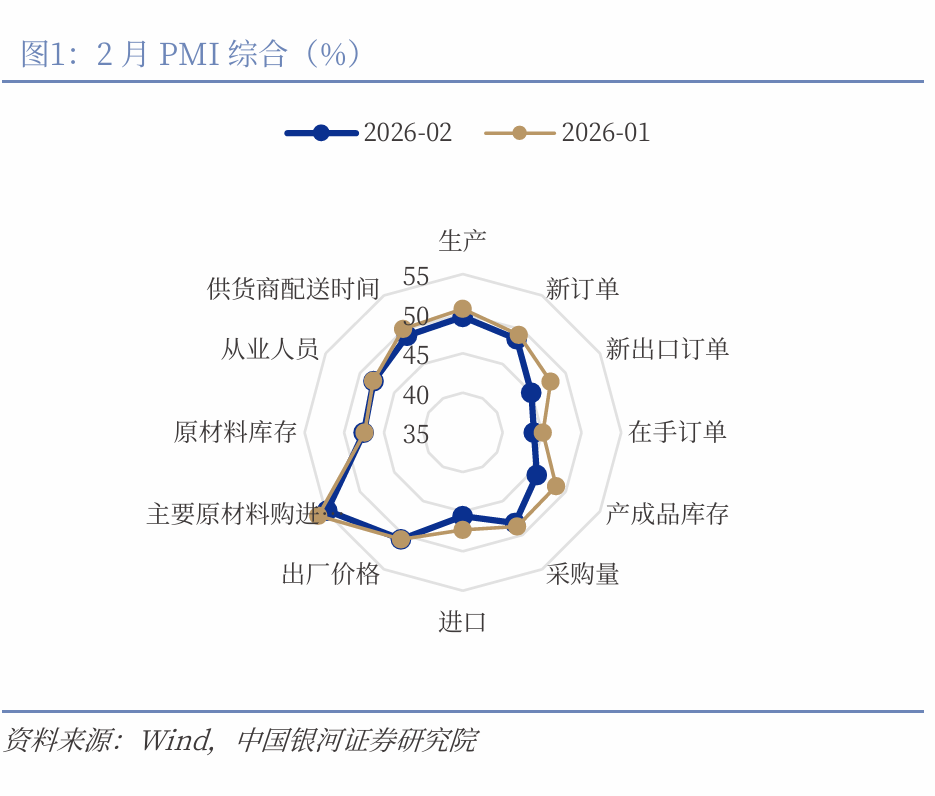
Core Viewpoint - The overall decline in February PMI is primarily influenced by seasonal factors such as the Spring Festival holiday, with both supply and demand experiencing a temporary slowdown. Production activities and order indicators have declined in tandem, but the extent of the decline is consistent with historical seasonal patterns. [2] Group 1: PMI and Economic Activity - The manufacturing PMI for February is reported at 49.0%, a decrease of 0.3 percentage points from the previous month. The construction business activity index is at 48.2% (previously 48.8%), and the service business activity index is at 49.7% (previously 49.5%) [1] - The production index for February is at 49.6% (previously 50.6%), and the new orders index is at 48.6% (previously 49.2%), indicating a decline in both supply and demand [3] - The operating rate has decreased due to the holiday impact, with the high-frequency data showing a drop in the rebar operating rate by 3.49 percentage points to 39.51%, and the electric furnace capacity utilization rate declining by 17.41 percentage points to 36.34% [3] Group 2: Price and Cost Dynamics - The factory price index remains unchanged at 50.6%, while the raw material purchase price has decreased by 1.3 percentage points to 54.8%, indicating a reduction in upstream cost pressures [4] - The gap between purchase prices and factory prices is currently 4.2 percentage points, suggesting that corporate profits are still under some cost pressure, although this gap has shown signs of narrowing [4] Group 3: Inventory Trends - The finished goods inventory index has decreased by 2.8 percentage points to 45.8%, while the raw material inventory has increased slightly by 0.1 percentage points to 47.5%. The purchasing index has declined by 0.5 percentage points to 48.2% [4] - Companies are adopting a cautious "production based on sales" strategy, leading to a relatively tight balance in overall inventory levels [4] Group 4: Future Outlook - As the effects of the Spring Festival gradually dissipate, manufacturing production activities are expected to recover in March, with both the production index and new orders index anticipated to rise [2] - External demand remains resilient, as indicated by the OECD composite leading indicators pointing towards a mild upward trend in exports year-on-year until June [2]