CGS(CGXYY)

Search documents
中国银河(601881) - 中国银河:关于行使21银河Y2发行人赎回选择权的第三次提示性公告
2026-03-17 09:15
中国银河证券股份有限公司(以下简称"公司"或"发行人")于 2026 年 3 月 10 日披露了《中国银河证券股份有限公司公开发行 2021 年永续次级债券 (第二期)发行人不行使续期选择权暨行使赎回权并全额兑付的公告》(公告编 号:2026-023),本公告为上述事项的提示性公告。 公司于 2021 年 4 月 21 日完成中国银河证券股份有限公司公开发行 2021 年永续次级债券(第二期)(以下简称"21 银河 Y2")的发行工作。根据《中 国银河证券股份有限公司公开发行 2021 年永续次级债券(第二期)募集说明书》, 21 银河 Y2 设发行人赎回权,于 21 银河 Y2 第五个和其后每个付息日,发行人 有权按面值加应付利息(包括所有递延支付的利息及其孳息)赎回 21 银河 Y2。 公司决定行使 21 银河 Y2 发行人赎回权,即全部赎回 21 银河 Y2。 公司将根据相关业务规则,做好 21 银河 Y2 后续信息披露及还本付息工作。 特此公告。 证券代码:601881 证券简称:中国银河 公告编号:2026-027 中国银河证券股份有限公司 关于行使"21 银河 Y2"发行人赎回选择权的 第三次提示 ...
中国银河(06881) - 海外监管公告
2026-03-17 08:42
香港交易及結算所有限公司及香港聯合交易所有限公司對本公告之內容概不負責,對其準確性 或完整性亦不發表任何聲明,並明確表示,概不對因本公告全部或任何部分內容而產生或因依 賴該等內容而引致之任何損失承擔任何責任。 (在中華人民共和國註冊成立之股份有限公司) (股份代號:06881) 海外監管公告 本公告乃由中國銀河證券股份有限公司(「本公司」)根據香港聯合交易所有限公司 證券上市規則第13.10B條作出。 茲載列本公司於上海證券交易所網站發佈之《中國銀河證券股份有限公司關於行 使「21銀河Y2」發行人贖回選擇權的第三次提示性公告》,僅供參閱。 承董事會命 中國銀河證券股份有限公司 王晟 董事長及執行董事 中國北京 2026年3月17日 公司于 2021 年 4 月 21 日完成中国银河证券股份有限公司公开发行 2021 年永续次级债券(第二期)(以下简称"21 银河 Y2")的发行工作。根据《中 国银河证券股份有限公司公开发行 2021 年永续次级债券(第二期)募集说明 书》,21 银河 Y2 设发行人赎回权,于 21 银河 Y2 第五个和其后每个付息日, 发行人有权按面值加应付利息(包括所有递延支付的利息及其孳 ...
中国银河:将行使“21银河Y2”发行人赎回权并全额兑付
Xin Lang Cai Jing· 2026-03-17 08:28
Core Viewpoint - China Galaxy announced the completion of the issuance of "21 Galaxy Y2" bonds on April 21, 2021, and has decided to exercise its redemption right for the entire amount of the bonds [1] Group 1 - The bond issuance was conducted according to the prospectus, which included the issuer's redemption rights [1] - The company will ensure proper follow-up on information disclosure and the repayment of principal and interest [1]
中国银河证券:企业融资边际回暖 资金活化程度继续提升
Zhi Tong Cai Jing· 2026-03-17 01:52
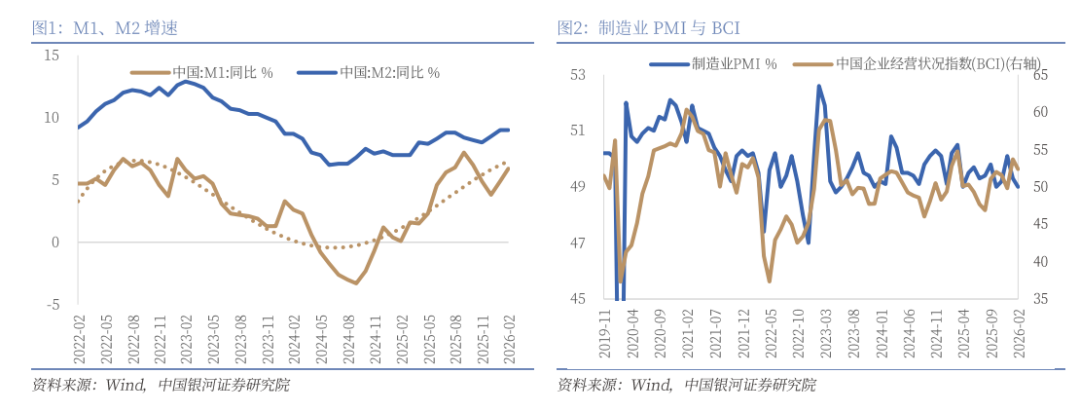
Core Viewpoint - The report from China Galaxy Securities indicates that the social financing (社融) in February 2026 reached 9.6 trillion yuan, showing a year-on-year increase of 146.1 billion yuan, with a stock growth rate of 8.2%, remaining stable compared to the previous month. The credit structure continues to optimize, driven mainly by an increase in corporate loans, while household loans remain weak [1]. Group 1: Social Financing and Loan Growth - In February, social financing increased by 9.6 trillion yuan, with a year-on-year increase of 146.1 billion yuan; as of the end of February, the stock of social financing grew by 8.2% year-on-year, consistent with the previous month [1]. - The increase in corporate loans contributed significantly to the year-on-year growth of RMB loans, while government bonds showed a year-on-year decrease due to a high base effect from the previous year [2]. Group 2: Loan Structure and Performance - By the end of February, the balance of RMB loans from financial institutions increased by 6% year-on-year, with a monthly increase of 900 billion yuan, although household loans continued to drag down overall performance [3]. - Corporate loans increased by 1.49 trillion yuan, showing a year-on-year increase of 450 billion yuan, while household loans decreased by 650.7 billion yuan, primarily due to concentrated repayments after the holiday and weak demand [3]. Group 3: Money Supply and Deposit Trends - The M1 and M2 money supply grew by 5.9% and 9% year-on-year, respectively, with the M1-M2 gap narrowing to -3.1%, indicating an increase in the liquidity of funds [4]. - In February, financial institutions' RMB deposits increased by 1.17 trillion yuan, with household deposits rising by 3.11 trillion yuan, while corporate deposits decreased by 2.65 trillion yuan, attributed to the transfer of funds from enterprises to households [4].
中国银河证券:OpenClaw兴起 算力板块有望迎来景气共振
智通财经网· 2026-03-16 01:52
Core Insights - The rise of OpenClaw signifies a shift in the AI industry value from model capability to task completion capability, indicating a transition from "can chat" to "can do" [2] - OpenClaw has consistently ranked as the top application on OpenRouter, with its token consumption significantly surpassing that of other applications, leading to structural changes in computing infrastructure [1][2] Group 1: Market Dynamics - In the first week of March 2026, OpenClaw's platform processed 14.8 trillion tokens, doubling the volume compared to the beginning of the year, with agent-driven workflows accounting for over half of the total output [2] - The demand for AI agents is expected to exert pressure on computing infrastructure, benefiting AIDC data centers, computing power leasing, and CDN services in the short term [3] - High-end GPU rental prices have increased by 15%-30% as of February 2026, with major cloud service providers announcing price hikes of 20%-30% in March [4] Group 2: Infrastructure Implications - The surge in token consumption is driving a structural transformation in network architecture, with increased request frequency and a shift towards a "central + edge" computing collaboration [2] - AIDC data centers are experiencing growth due to increased load density and value, with a shortage of high-performance data centers prompting cloud providers to invest in greenfield projects [3] - Mid-term growth is anticipated in optical modules, optical fibers, switching devices, and liquid cooling systems, driven by the need for high throughput and continuous operation in data centers [3] Group 3: Investment Opportunities - The AI agent boom is creating systemic investment opportunities in infrastructure, with the entire telecommunications sector experiencing a wave of prosperity [4] - Companies like Zhiyuan AI are raising subscription prices by 30%-60% due to increased user scale and call volume, indicating a broader trend of price adjustments across the industry [4]
中国银河证券:AI推升VC和金刚石散热需求 国产替代仍具备广阔市场空间
Zhi Tong Cai Jing· 2026-03-16 01:52
Core Insights - The domestic thermal materials industry in China has formed a clustering effect in fields such as TIM, ceramic substrates, and liquid cooling materials, with significant potential for domestic substitution [1] Group 1: Industry Overview - The thermal materials industry chain consists of upstream raw materials, midstream device manufacturing, and downstream applications, characterized by high barriers in upstream, high value in midstream, and strong demand in downstream [1] - Upstream raw materials include high-purity ceramic powders (AlN/BN/SiC/diamond), carbon-based materials (graphene/CNT/graphite), metal materials (copper/aluminum/copper alloys/tantalum), and liquid cooling working fluids (fluorinated liquids/synthetic esters/water-based liquids) [1] - Major players in the first tier of thermal materials are concentrated in Europe, America, and Japan, while the second tier includes domestic companies like Zhongshi Technology, Feirongda, Zhongci Electronics, Sanhuan Group, and Tianyue Advanced, focusing on TIM, ceramic substrates, and liquid cooling materials [1] Group 2: Key Technologies - VC vapor chamber and graphite film have become the preferred cooling solutions for AI smartphones, with VC vapor chambers offering a heat transfer efficiency that significantly increases the heat dissipation area by 5 to 8 times compared to traditional solid thermal methods [2] - The thermal conductivity of VC vapor chambers ranges from 0.2 to 50 KW/m*K, while that of heat pipes is approximately 10 to 100 KW/m*K, and liquid cooling plates range from 1 to 5 KW/m*K [2] Group 3: Emerging Materials - Diamond alloy materials are expected to be promoted in high-power AI chip cooling, with diamond being an excellent heat sink material when thermal conductivity requirements exceed 500 W/m·K [3] - CVD polycrystalline diamond is highlighted as an ideal cooling solution for the high computing power era, with a thermal conductivity of 2000-2200 W/(m·K) compared to copper's 380-400 W/(m·K) [3] - The global diamond cooling market is projected to reach 17.2 to 48.3 billion yuan by 2028, benefiting related enterprises [3] Group 4: Advanced Cooling Solutions - Thermoelectric cooling offers precise temperature control with no moving parts and rapid response, penetrating applications in AI optical modules, medical devices, lasers, and automotive sectors [4] - Liquid metal cooling, utilizing gallium-based, indium-based, and bismuth-based alloys, provides a thermal conductivity of 15-73 W/(m·K), significantly improving upon traditional silicone grease by 5-10 times, making it crucial for high-power density cooling in AI servers and high-end consumer electronics [4]


【中国银河社服】如何理解“十五五”期间服务消费的发展思路——“十五五”规划纲要点评
Sou Hu Cai Jing· 2026-03-15 05:01
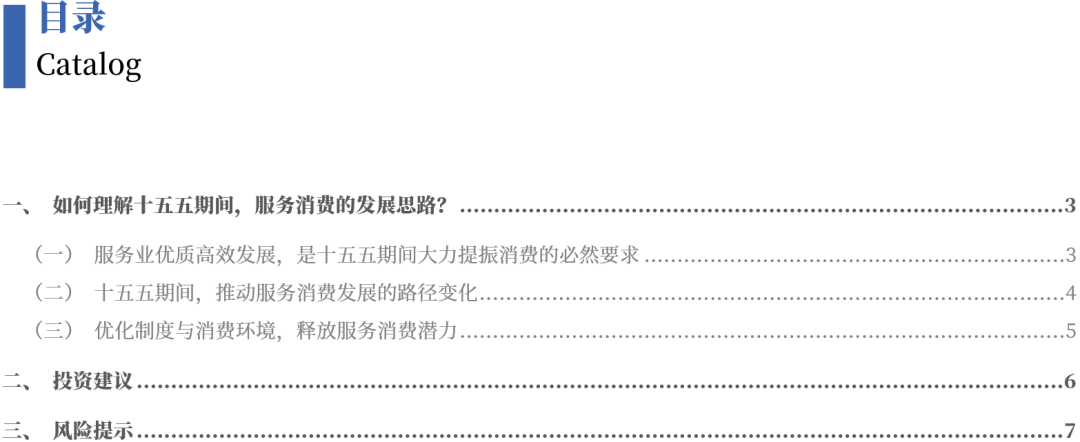
Core Viewpoint - The "15th Five-Year Plan" emphasizes the high-quality and efficient development of the service industry, aiming to expand service consumption to meet public needs and drive employment growth [1][3]. Group 1: Service Industry Development Goals - The "15th Five-Year Plan" aims for high-quality and efficient service industry development, focusing on better supporting industrial upgrades and meeting public needs [3]. - The plan highlights the importance of expanding service consumption as a key driver for employment, with service sector employment projected to reach 359 million by the end of 2024, accounting for 48.8% of total employment [3]. - The contribution rate of the service industry to national economic growth is expected to reach 60.2% by mid-2025, an increase of 5.8 percentage points from the previous year [3]. Group 2: Key Areas of Focus - The plan prioritizes the development of high-quality, diverse, and convenient life services, addressing gaps in areas such as elderly care, childcare, and health services [4]. - Encouragement of quality development in wholesale, retail, and accommodation sectors, promoting new business models and online-offline collaboration [4]. - The plan aims to enhance the quality of services in sectors like housekeeping, property management, and delivery services, while fostering new growth points in health, smart elderly care, cultural tourism, and home services [4]. Group 3: Policy and Environmental Optimization - Optimizing the regulatory framework and consumer environment is deemed essential for unleashing service consumption potential [2][4]. - The plan emphasizes the need to relax entry restrictions and promote business model integration to expand service consumption and cultivate new growth points [4]. - Specific sectors such as sports events and performances are expected to benefit from improved approval management, which will help stimulate service consumption [4].

【中国银河消费】消费温和复苏,“十五五”延续大力提振消费——“十五五”规划纲要解读
Sou Hu Cai Jing· 2026-03-15 03:50
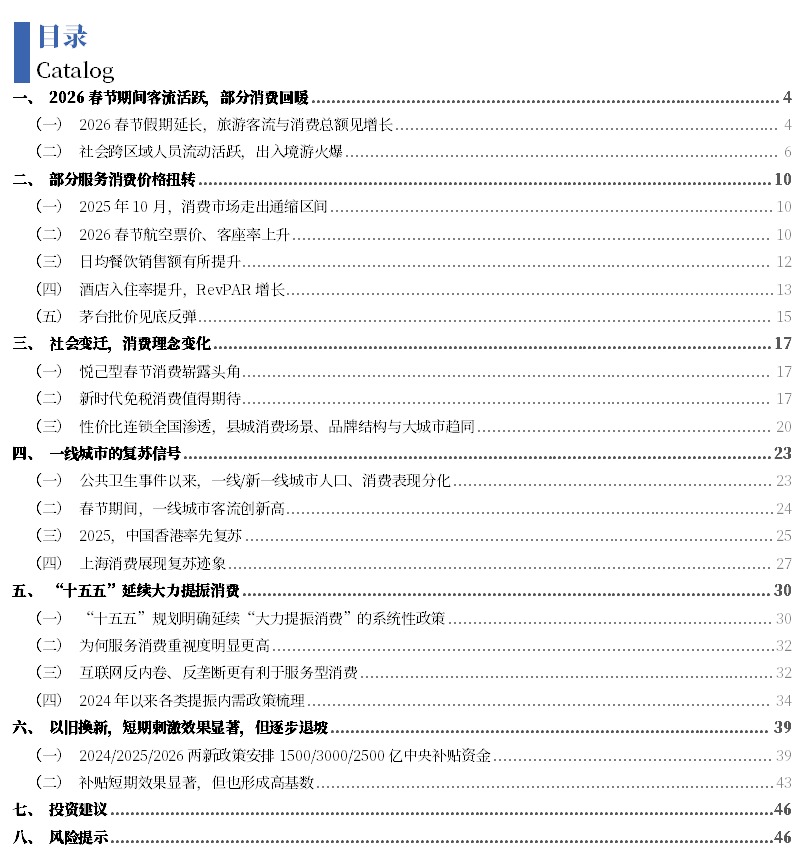
Group 1 - The "14th Five-Year Plan" continues to emphasize boosting consumption through systematic arrangements rather than short-term subsidies, aiming to enhance consumer capacity and improve consumption willingness [4] - From July 2024, consumption policies will significantly strengthen, with a notable initiative involving 150 billion yuan in special bonds to support consumption upgrades, which began to show effects in September [4] - The government has launched systematic consumption promotion measures during the Spring Festival, including a "New Spring Shopping" campaign, resulting in approximately 30,000 cultural and tourism events and over 360 million yuan in consumption vouchers [5] Group 2 - Since 2021, consumer demand has been weak, with a notable decline in average prices due to insufficient purchasing power, as seen in the wholesale price of premium products like Feitian Moutai [6] - The 2026 Spring Festival saw a reversal in some consumption signals, with increased total passenger flow and consumption, despite a decrease in average daily spending [7] - The rise in consumer spending during the Spring Festival is attributed to an extended holiday period, leading to increased airline ticket prices and hotel occupancy rates [7] Group 3 - The four first-tier cities experienced a temporary net outflow of residents due to public health events, but their population began to recover in 2023, with retail sales growth projected to improve [8] - Retail sales in first-tier cities showed a compound annual growth rate (CAGR) of 0.8% from 2019 to 2025, with significant fluctuations in growth rates across different cities [9] - Hong Kong's retail sector has shown signs of recovery since May 2025, which may present investment opportunities, while first-tier cities in mainland China are also witnessing signs of consumption recovery [10] Group 4 - The "14th Five-Year Plan" clearly outlines a systematic policy to boost consumption, with a particular focus on service consumption and regulatory measures against monopolistic practices in the internet sector [4][5] - The government has implemented various policies to stimulate domestic demand since 2024, including substantial central subsidies for consumption upgrades [12] - The short-term effects of these subsidies are significant, but they may lead to high baselines in subsequent years, necessitating a comprehensive approach to sustain consumer spending [12]
科莱瑞迪过会:今年IPO过关第34家 中国银河过首单
Zhong Guo Jing Ji Wang· 2026-03-14 07:27
Core Viewpoint - Guangzhou Kolarity Medical Equipment Co., Ltd. has been approved for IPO on the Beijing Stock Exchange, marking it as the 34th company to pass the review in 2026, with a focus on radiation therapy and rehabilitation medical devices [1][2]. Company Overview - Kolarity specializes in providing medical device solutions for radiation therapy and rehabilitation, focusing on the development, production, and sales of radiation positioning devices and rehabilitation aids [1]. - The company is primarily controlled by Lijin Technology, which holds 43.13% of the shares, and the actual controllers are Zhan Derun and his spouse Li Li, who collectively control 64.93% of the voting rights [1]. IPO Details - Kolarity plans to publicly issue up to 14.8 million shares, with a potential over-allotment option of up to 2.22 million shares, bringing the total issuance to a maximum of 17.02 million shares [2]. - The company aims to raise approximately 259.13 million yuan for projects related to radiation positioning and rehabilitation product headquarters, composite material production line upgrades, and research center construction [2]. Review and Inquiry - The review committee raised inquiries regarding the authenticity and reasonableness of Kolarity's collaboration with the American company Klarity, including the sustainability of using the "Klarity" trademark and the company's reliance on Klarity for sales channels [4]. - Questions were also posed about the sustainability of Kolarity's operating performance, particularly in light of healthcare cost control policies and market competition, as well as the company's competitive advantages in technology, funding, and scale [4].
【中国银河宏观】 企业贷款显著改善会成为重要宏观线索吗? ——2026年2月金融数据解读
Xin Lang Cai Jing· 2026-03-13 15:25
Core Viewpoint - The central theme of the report is the analysis of China's financial data for February 2026, highlighting the trends in money supply, social financing, and loan growth, which indicate a mixed economic outlook with improvements in corporate loans but declines in household loans [1][9]. Group 1: Money Supply - M1 growth increased to 5.9% year-on-year, up from 4.9% previously, while M2 growth remained stable at 9.0% [1][9]. - The rise in M1 is attributed to a significant increase in M0 growth to 14.1%, influenced by seasonal factors such as the Spring Festival [12]. - M2 growth is supported by increased foreign exchange reserves and faster fiscal spending, despite a decrease in loan growth impacting credit-derived money supply [14]. Group 2: Social Financing - New social financing in February reached 2.4 trillion yuan, an increase of 146.1 billion yuan year-on-year, with a social financing growth rate of 8.2% [6][16]. - The components of social financing showed mixed results, with increases in RMB and foreign currency loans, while government and corporate bond financing saw declines [16]. - Effective social financing growth, which includes medium to long-term loans and direct financing, rose to 5.47% [16]. Group 3: Loan Growth - Financial institutions issued 900 billion yuan in new RMB loans in February, a decrease of 110 billion yuan year-on-year, with a loan growth rate of 6.0% [1][21]. - Household loans saw a significant decline, with a year-on-year decrease of 2.6 trillion yuan, while corporate loans improved, particularly in medium to long-term loans, which increased by 3.5 trillion yuan [21]. - The overall loan growth trend indicates a need for further data to assess the sustainability of the improvements in corporate loans [10]. Group 4: Policy Outlook - A reserve requirement ratio (RRR) cut of 50 basis points is anticipated in the first quarter, which could release approximately 1 trillion yuan in liquidity [26]. - Comprehensive interest rate cuts are expected to be delayed, with the focus on stabilizing expectations and employment amid external and internal economic pressures [26]. - The potential for a single interest rate cut of 10-20 basis points throughout the year is projected, which may influence loan and deposit rates [26].