Costco(COST)

Search documents
X @Bloomberg
Bloomberg· 2025-08-14 12:10
A coalition of faith-based activists had pressured Costco to not offer the abortion pill mifepristone in its pharmacy locations. The group now turns its focus to CVS and Walgreens https://t.co/onQcBjz7pU ...


Costco: Not Cheap, But Not Stretched
Seeking Alpha· 2025-08-14 11:31
Group 1 - Despite an expected surge in interest in defensive stocks like Costco Wholesale Corporation, valuations have not significantly exceeded historical averages, unlike Walmart [1] - Costco's business model is price-conscious, which contributes to a strong customer loyalty base [1] Group 2 - The article emphasizes the importance of macroeconomic trends, corporate earnings, and financial statement analysis in identifying investment opportunities [1]

Costco: Don't Just Look At The P/E And Miss The Story
Seeking Alpha· 2025-08-14 07:35
Group 1 - Successful growth companies are characterized not only by their earnings and revenues but also by the narratives they present, which play a crucial role in how the market perceives these investments [1] - The underlying story of a business is often as important as the financial metrics in justifying current and future valuations [1] Group 2 - The article emphasizes the importance of storytelling in the context of investment, suggesting that a compelling narrative can enhance investor interest and market perception [1] - It highlights that while numbers are essential, the narrative can significantly influence the overall investment appeal of a company [1]
美股异动 | 部分美国知名零售商股价下挫 克罗格(KR.US)跌近5%
智通财经网· 2025-08-13 14:52
Core Viewpoint - The announcement by Amazon regarding same-day delivery of fresh groceries has negatively impacted the stock prices of several major U.S. retailers, indicating increased competition in the grocery sector [1] Group 1: Stock Price Movements - Kroger's stock (KR.US) fell nearly 5% [1] - Walmart's stock (WMT.US) declined over 2% [1] - Costco's stock (COST.US) and Target's stock (TGT.US) both dropped over 1% [1] Group 2: Amazon's Service Expansion - Amazon has launched a same-day delivery service for fresh groceries, covering over 1,000 cities [1] - The company plans to expand this service to over 2,300 cities in the U.S. by the end of the year [1] - Customers can order a variety of fresh products, including produce, dairy, meat, seafood, baked goods, and frozen foods, alongside other items available for same-day delivery [1]


Is Costco Stock Worth Buying Now or Too Pricey to Touch?
ZACKS· 2025-08-13 13:46
Core Insights - Costco Wholesale Corporation (COST) is trading at a forward 12-month price-to-earnings (P/E) multiple of 50, which is above the industry average of 33.02 and the S&P 500's 22.62, indicating a premium valuation [1][2] - Despite this premium, Costco's stock has increased by 8.2% year-to-date, outperforming the industry average rise of 6.9% [5][6] - Membership renewal rates are strong at 92.7% in the U.S. and Canada, contributing to Costco's robust business model [8][9] Valuation and Performance - Costco's current P/E is slightly below its 12-month median of 50.74, suggesting it is relatively cheaper than its recent historical average [1] - Compared to peers, Ross Stores trades at a P/E of 22.72, Dollar General at 18.92, and Target at 13.50, highlighting Costco's premium positioning [2] - E-commerce sales grew by 14.8% in Q3, supported by improved logistics and a new Buy Now Pay Later option [8][11] Membership and Revenue Growth - The company has 79.6 million paid household members, a 6.8% increase year-over-year, with executive memberships growing by 9% [10] - Membership fee income rose by 10.4%, aided by a recent fee hike, contributing approximately 4.6% growth in the quarter [10] - Costco's private-label brand, Kirkland Signature, saw sales growth outpacing overall company growth, with penetration increasing by 50 basis points year-over-year [12] Competitive Landscape - Costco faces increasing competition from rivals like Ross Stores, Dollar General, and Target, which are enhancing their capabilities [13] - Margins are a critical area to monitor, with potential concerns related to selling, general, and administrative expenses, as well as foreign exchange volatility [14] Consensus Estimates - The Zacks Consensus Estimate for the current fiscal year remains stable at $17.97, while the next fiscal year's estimate has decreased slightly to $19.92 [15][17] - Expected year-over-year growth rates are 11.6% for the current fiscal year and 10.9% for the next [17] Investment Outlook - Costco's strong fundamentals and market leadership support its long-term investment case, but its premium valuation suggests a cautious approach [18] - The recommendation is to hold existing positions rather than pursue new investments at current high valuations [18]

Costco: Kirkland Penetration Growth Continues
Seeking Alpha· 2025-08-13 13:17
Core Insights - The article expresses a positive outlook on the stock performance of Costco (COST), highlighting a beneficial long position held by the analyst [1]. Group 1 - The analyst emphasizes that past performance does not guarantee future results, indicating a cautious approach to investment predictions [2]. - The article does not provide specific recommendations or advice regarding investment suitability for individual investors [2]. - The views expressed in the article may not represent the overall opinions of Seeking Alpha, suggesting a diversity of perspectives among analysts [2].
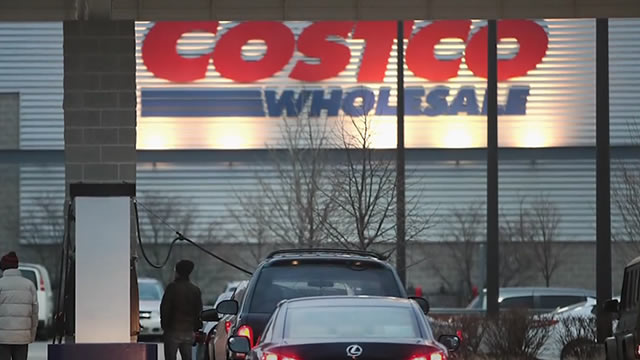
Costco is a clear beneficiary of value-based behavior changes, says Accuvest's Eric Clark
CNBC Television· 2025-08-12 19:26
Consumer Behavior & Inflation - Consumers are actively seeking value due to perceived inflation across various categories, influencing their purchasing decisions [1][2] - Costco benefits from this trend as consumers prioritize value and positive experiences [2] - The trend of consumers seeking value and in-demand items/services is a key theme [4] Company Performance & Strategy - Costco's parking lots are consistently packed, indicating strong customer traffic [3] - Costco continues to attract customers by adding new offerings [4] - Uber is expanding its services within its "super app" to enhance value and increase user engagement, aiming for recurring revenue [5][6] Competitive Landscape - TJX (TJ Maxx) is positioned as a destination for branded apparel at a value, potentially benefiting from the downfall of other retailers or during economic downturns [6] - TJX is becoming a go-to place for consumers looking to save money, especially with rising prices [7] - Uber's pricing is becoming expensive compared to competitors like DoorDash [6]
Costco (COST) Is Considered a Good Investment by Brokers: Is That True?
ZACKS· 2025-08-12 14:31
Core Viewpoint - The article discusses the reliability of brokerage recommendations, particularly focusing on Costco (COST), and suggests that while the average brokerage recommendation (ABR) indicates a favorable outlook, investors should exercise caution and consider additional analysis tools like the Zacks Rank for better investment decisions [1][5][10]. Brokerage Recommendations - Costco has an average brokerage recommendation (ABR) of 1.95, which is between Strong Buy and Buy, based on recommendations from 33 brokerage firms [2]. - Out of the 33 recommendations, 15 are Strong Buy (45.5%) and 4 are Buy (12.1%) [2]. Limitations of Brokerage Recommendations - Studies indicate that brokerage recommendations have limited success in guiding investors towards stocks with the best price increase potential [5]. - Brokerage firms often exhibit a strong positive bias in their ratings due to vested interests, leading to a disproportionate number of Strong Buy recommendations compared to Strong Sell [6][10]. Zacks Rank as an Alternative - The Zacks Rank categorizes stocks into five groups based on earnings estimate revisions, which have shown a strong correlation with near-term stock price movements [8][11]. - The Zacks Rank is distinct from the ABR, as it is a quantitative model based on earnings estimates rather than solely on brokerage recommendations [9]. Current Earnings Estimates for Costco - The Zacks Consensus Estimate for Costco's earnings for the current year remains unchanged at $17.97, indicating steady analyst views on the company's earnings prospects [13]. - The recent consensus estimate change, along with other factors, has resulted in a Zacks Rank of 3 (Hold) for Costco, suggesting a cautious approach despite the favorable ABR [14].
Inflation Is Ticking Upwards. Should Costco Wholesale Investors Be Worried?
The Motley Fool· 2025-08-12 08:22
Group 1: Inflation Impact on Retail - Inflation has been a significant issue for consumers in recent years, with rates hitting 2.7% as of June [3][5] - Historical data shows that the S&P 500 performs best when inflation is between 2% and 3%, with higher inflation potentially leading to increased interest rates that can negatively impact stock valuations [2] - Costco Wholesale, a leading big-box retailer, has seen its stock return over 200% in the past five years, outperforming the broader market [3][6] Group 2: Costco's Business Model - Costco operates on razor-thin margins, primarily generating profits from membership fees rather than product sales [4] - As one of the largest retailers, Costco can source goods at lower costs, allowing it to maintain competitive pricing even during inflationary periods [5] - The company attracts consumers looking for deals, but excessive inflation could still negatively affect sales, particularly of discretionary items [5][6] Group 3: Financial Performance and Valuation - Costco's sales for July 2025 reached $20.89 billion, reflecting an 8.5% increase from the previous year [6] - The company's price-to-earnings (P/E) ratio has increased from about 40 five years ago to 55 today, indicating a significant rise in valuation [8] - Analysts project Costco's earnings will grow at an annualized rate of 9% over the next three to five years, resulting in a PEG ratio of approximately 6.0, suggesting the stock may be overvalued relative to its growth potential [10] Group 4: Future Outlook - The stock's current valuation may lead to a reversion towards long-term norms, especially if inflation continues to rise and discretionary spending is squeezed [12] - Despite concerns about short-term prospects, Costco is expected to remain a strong business in the long term [13]

The retail trade earnings setup. JPMorgan's Chris Horvers breaks it down
CNBC Television· 2025-08-11 18:00
Recurring theme from retailers that have reported thus far. Some have raised prices because of it, including ELF last week. The National Retail Federation warning last week that the direct result of tariffs will be higher prices and fewer capital expenditures.But my next guest is staying positive into earnings. Joining me now is Chris Horver, retail analyst at JP Morgan. Chris, it's great to have you on the show.And let's start right there. What what is sparking the positivity. Well, it's a little bit of wh ...