Cisco Systems(CSCO)

Search documents
Cisco Hits 52-Week High: Can AI Focus Further Drive the Stock?
ZACKS· 2025-06-25 16:31
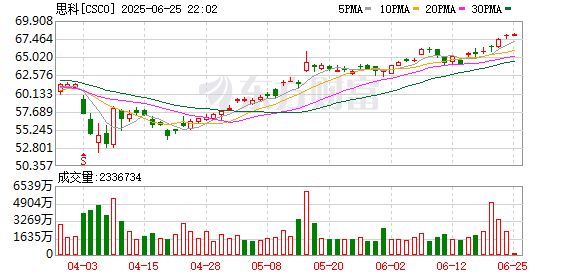
Core Insights - Cisco Systems (CSCO) reached a 52-week high of $67.49, with a year-over-year stock increase of 14.7%, reflecting strong investor confidence in the company's prospects [1][9] - The company's growth is driven by solid earnings, margin expansion, and a positive outlook, particularly due to its focus on AI and innovative product rollouts [1][2] AI and Infrastructure - Cisco's involvement in AI-focused infrastructure is a major catalyst, with AI-related infrastructure orders surpassing $600 million in Q3 fiscal 2025, bringing the year-to-date total over $1 billion [2] - Major clients, including Meta, are contributing to the growing demand for AI-optimized networks [2] Product Demand and Innovation - There is robust demand across Cisco's broader product portfolio, with networking product orders growing in double digits, driven by web-scale infrastructure and industrial IoT products [3] - The company is accelerating its innovation pipeline, integrating security features into its networking products [3] Security Strategy - Security is a key pillar of Cisco's strategy, highlighted by the $28 billion acquisition of Splunk, which has already resulted in significant deals with major financial institutions [4] - New products like Secure Access, XDR, and Hypershield have gained traction, adding over 370 new customers in Q3 fiscal 2025 [4] Competitive Landscape - Cisco faces intensified competition from Juniper Networks and Arista Networks, which are leveraging AI-driven innovations to challenge Cisco's dominance in enterprise and cloud networking [5][6][7] - Juniper focuses on high-performance routing and integrated security, while Arista leads in AI and cloud networking, projecting over $750 million in backend AI networking revenues for 2025 [6][7] Financial Performance and Valuation - Cisco's shares have gained 14.7% year-to-date, outperforming the Zacks Computer – Networking industry's return of 13.5% [8] - The company is trading at a forward price-to-sales ratio of 4.56, which is higher than the industry's 4.32X, indicating a potentially overvalued position [10] - The Zacks Consensus Estimate for Cisco's fiscal 2025 and 2026 earnings is $3.79 and $4 per share, reflecting year-over-year growth of 1.61% and 5.63%, respectively [11]


思科全球副总裁:企业对AI依赖程度加大 也更易遭网络攻击
Nan Fang Du Shi Bao· 2025-06-25 14:01
Core Viewpoint - The integration of artificial intelligence (AI) into business operations is increasing, leading to a broader range of potential cyber threats that require a balance between AI innovation and cybersecurity measures [2][5][6]. Group 1: AI and Cybersecurity - The current reliance on AI in business operations has expanded the scope of potential cyberattacks, making them more targeted and pervasive across countries [6][5]. - The 2025 Cybersecurity Readiness Index by Cisco indicates that only 5% of Chinese enterprises have reached a "mature" readiness stage, reflecting a slow progress in cybersecurity maturity globally [5][6]. - Companies are advised to balance their investments in AI and cybersecurity, as the rise of AI brings heightened cybersecurity risks [5][6]. Group 2: AI Innovations and Security - AI innovation must prioritize security; new AI applications should consider security implications from the outset [7][6]. - Cisco has developed a large language model (LLM) for cybersecurity, which has been downloaded over 20,000 times globally, showcasing the industry's shift towards AI-driven security solutions [6][5]. Group 3: Entrepreneurial Spirit and Global Challenges - The theme of the recent Summer Davos Forum emphasizes the need for a new entrepreneurial spirit to address global economic challenges, highlighting the importance of sustained focus and investment in technology breakthroughs [8]. - Companies must navigate changing international conditions while maintaining long-term plans, as external uncertainties pose significant challenges to innovation and development [8][11]. Group 4: Market Dynamics and Localization - Cisco has extensive experience in localization and supports Chinese enterprises in their international expansion, reflecting the rapid growth of Chinese companies in global markets [9][12]. - The company emphasizes the importance of healthy competition and innovation to maintain its market position amidst increasing domestic competition and localization policies [11][12].
钱伯斯“偷偷”去了华为食堂,说了这样一句话
Xin Lang Cai Jing· 2025-06-24 11:26
Core Viewpoint - The article discusses the historical relationship and rivalry between Huawei and Cisco, highlighting key events that shaped their interactions and the competitive landscape in the telecommunications industry. Group 1: Historical Context - The first contact between Huawei and Cisco occurred in 1997, but it was missed due to Cisco's CEO, Chambers, being on a business trip [4][5]. - After the missed meeting, Huawei learned from IBM, which significantly improved its research and development capabilities [7]. Group 2: Competitive Dynamics - In 2002, Huawei showcased its products at a telecom equipment exhibition in Atlanta, offering prices 20% to 50% lower than Cisco's comparable products [9]. - Following this, Chambers visited Huawei's booth, leading to the establishment of a task force at Cisco to counter Huawei's growing presence [14]. Group 3: Legal Battles and Resolutions - Cisco filed a lawsuit against Huawei in 2003, claiming infringement of intellectual property rights, which lasted over a year before both companies reached a settlement [16][14]. Group 4: Evolving Relationship - After the lawsuit settlement, Chambers visited Huawei in 2005, where he expressed admiration for Huawei's competitiveness [19]. - Over the years, both leaders acknowledged each other as worthy opponents, with Chambers inviting Ren Zhengfei to visit the U.S. and Ren humorously declining, citing a preference for Europe [25]. Group 5: Learning from Competitors - In 2020, Ren emphasized the importance of learning from great competitors like Chambers, despite Huawei facing significant challenges from U.S. pressures [27].

Better Tech Stock: Arista Networks vs. Cisco Systems
The Motley Fool· 2025-06-24 07:45
Core Insights - Arista Networks and Cisco Systems represent two distinct investment opportunities in the networking infrastructure and software market, with Arista focusing on high-growth data centers and cloud-scale networks, while Cisco serves a broader range of sectors as a diversified market leader [1][2] Company Performance - Over the past five years, Arista's stock increased nearly 540%, while Cisco's stock advanced about 50%, compared to a 90% rise in the S&P 500 [2] - From fiscal 2019 to fiscal 2024, Cisco's revenue grew at a compound annual growth rate (CAGR) of less than 1%, while its adjusted EPS rose at a CAGR of nearly 4% [9][12] - In contrast, Arista's revenue rose at a CAGR of 24% and adjusted net income increased at a CAGR of 30% during the same period [12][13] Competitive Landscape - Cisco is the largest networking hardware company, known for its proprietary chips and software, creating a "sticky" ecosystem with integrated security and network observability services [4][8] - Arista utilizes Broadcom's chips and open-source software, providing flexibility that appeals to customers seeking alternatives to Cisco's ecosystem [5][6] - Cisco remains a leader in end-to-end deployments, while Arista primarily focuses on cloud and data center markets [7][8] Growth Prospects - Analysts expect Cisco's revenue and EPS to grow at a CAGR of 5% and 9%, respectively, from fiscal 2024 to fiscal 2027, driven by subscription expansion and AI tailwinds [15] - Arista's revenue and EPS are projected to increase at a CAGR of 19% and 15%, respectively, benefiting from cloud and AI market growth and expansion into enterprise markets [16] Investment Valuation - Cisco trades at 17 times forward adjusted earnings with a forward dividend yield of 2.5% [15] - Arista's stock is priced at 33 times its forward adjusted earnings and has never paid a dividend [16]


以太网和InfiniBand外,第三种选择
半导体行业观察· 2025-06-24 01:24
Core Viewpoint - The article discusses the evolution of networking technologies, particularly focusing on Cornelis Networks' CN500 architecture, which enhances AI performance by coordinating up to 500,000 computers without increasing latency, outperforming existing technologies like InfiniBand and Ethernet in terms of message throughput and latency reduction [1][2][3]. Group 1: Networking Technology Evolution - Ethernet has long been synonymous with local area networks (LAN), but the rise of data centers necessitated new networking solutions to handle diverse systems and resource sharing [2]. - Cornelis Networks' Omni-Path architecture, developed for high-performance computing (HPC), maximizes throughput and eliminates packet loss, addressing the need for efficient data exchange in AI model training [3][4]. Group 2: Challenges in Data Coordination - Coordinating processors for AI model training requires high bandwidth and low latency, with congestion management being a significant challenge [4][5]. - Cornelis' dynamic adaptive routing algorithm mitigates congestion by rerouting traffic and employing credit-based flow control to prevent delays caused by insufficient memory at endpoints [5][6]. Group 3: Market Dynamics and Trends - The CN5000 product, built on custom chips, targets organizations looking to upgrade for AI or faster HPC simulations, with partnerships with original equipment manufacturers (OEMs) to facilitate sales [7]. - The Ethernet switch market is diversifying, with IDC reporting significant growth in data center Ethernet switch sales, driven by AI cluster needs, while non-data center markets also show growth [8][21]. Group 4: Competitive Landscape - Nvidia has surpassed Cisco and Arista in data center Ethernet sales, with a remarkable growth rate of 760.3% year-over-year, indicating its strong position in the market [17][23]. - Arista Networks remains a key player, with a 26.4% increase in sales, while Cisco's growth is more modest at 4.7% [23][22].


Cisco TAC’s GenAI Transformation: Building Enterprise Support Agents with LangSmith and LangGraph
LangChain· 2025-06-23 15:30
AI Customer Support Challenges & Solutions - Cisco faced challenges in scaling support for mass scale issues, with potentially tens of thousands of customers opening cases simultaneously [2] - Monitoring AI agent performance and driving improvements proved difficult [2] - Integrating multiple AI agents (up to six) using different tools was unreliable and time-consuming [8][9] Langchain & Langsmith Implementation - Langchain facilitated rapid prototyping by enabling easy model swapping [3] - Langsmith provided full visibility into AI applications, replacing custom observability solutions [4] - Langsmith connected subject matter experts (SMEs) with developers, enabling direct feedback on RAG retrieval [4][5] - Langraph allowed breaking down code into modular nodes, providing greater control over flows [10] - Langraph platform and Langchain Agent Protocol standardized agent communication, simplifying integration and improving scalability [11] Business Impact - Cisco enhanced customer experience through improved observability and faster development cycles [12] - Langsmith accelerated development and prototyping, identifying what was working well and what wasn't [9] - The firewall assistant was the first application, leveraging domain expertise to improve in-product assistance [6][7]

INE Releases Top Five Takeaways from Cisco Live 2025
GlobeNewswire News Room· 2025-06-18 13:51
Core Insights - The rise of AI is prompting significant changes in data center operations, with organizations focusing on how to adopt AI quickly while maintaining security and performance standards [2] Group 1: Key Themes from Cisco Live 2025 - "Agentic AI" is emerging as a new industry buzzword, indicating a shift towards autonomous AI agents capable of completing workflows without human intervention [2][3] - Security-first architecture is becoming essential, with embedded security features like Hybrid Mesh Firewall and Universal Zero Trust Network Access (ZTNA) being prioritized from the outset [4][5] - The performance demands of AI workloads are challenging existing network designs, necessitating new hardware solutions like the 8000-series routers to ensure low-latency connectivity [6][8] Group 2: Management and Skills Development - There is a growing frustration among IT professionals regarding the complexity of managing multiple dashboards, leading to a demand for unified platforms like Cisco Cloud Control [9][10] - A significant skills gap is evident, with organizations struggling to find talent proficient in AI infrastructure, driving interest in comprehensive certification programs [11][12]

Cisco Systems, Inc. (CSCO) Presents at Cisco Innovation Tech Talk Transcript
Seeking Alpha· 2025-06-16 23:17
Group 1 - Cisco Systems, Inc. hosted an Innovation Tech Talk on June 16, 2025, featuring key executives including Jeetendra I. Patel, DJ Sampath, and Sami Badri [1][3] - The conference call was organized for JPMorgan clients only, with restrictions on participation from other members of JPMorgan Investment and Corporate Banking [2] Group 2 - The event aimed to discuss technology questions and insights following Cisco Live, indicating a focus on recent developments and innovations within the company [3]

Cisco Systems (CSCO) Update / Briefing Transcript
2025-06-16 19:02
Cisco Systems (CSCO) Conference Call Summary Industry and Company Overview - **Company**: Cisco Systems (CSCO) - **Industry**: Networking and Cybersecurity - **Event**: Cisco Innovation Tech Talk, June 16, 2025 Key Points and Arguments Major Announcements from Cisco Live - Cisco Live hosted approximately **22,000 customers** in San Diego, marking a significant event for the company [7] - The company emphasized a transition from basic AI applications (like chatbots) to more advanced AI agents capable of performing tasks autonomously [7][8] - Cisco introduced its largest product refresh in **20 to 30 years**, aiming to simplify its messaging and unify its various business units under a "One Cisco" approach [9][10] Three Key Problems Addressed 1. **AI Ready Data Centers**: Cisco aims to provide critical infrastructure for building AI-ready data centers globally, addressing issues like data sovereignty and power scarcity [11][12] 2. **Future-Proof Workplace**: The company is focused on enhancing workplace connectivity and security across various environments, including campuses and remote offices [13][14] 3. **Digital Resilience**: Cisco is working on solutions to ensure organizations can quickly identify and respond to outages, leveraging its acquisition of Splunk for better data correlation [14][15] Differentiation and Competitive Advantage - Cisco's strategy includes a **platform advantage** that reduces costs and enhances value for customers by integrating new technologies seamlessly [15] - The company builds its own silicon, which allows for a cohesive stack from hardware to software, enhancing performance and security [16][17] - Cisco is committed to being **AI-first**, ensuring that AI capabilities are integrated from the ground up in its products [17] Product Innovations - Cisco announced **24 new products** across its portfolio, focusing on operational simplicity and advanced security features [18] - The new **Catalyst 9K** smart switches are designed to support high-performance AI applications, offering up to **51.2 terabits per second** throughput with latency below **five microseconds** [29] - The **LiveProtect** feature allows switches to implement compensating controls for vulnerabilities within minutes, significantly reducing the risk window [31] Market Opportunities and Partnerships - Cisco is actively pursuing partnerships in the Middle East, including projects with the **Kingdom of Saudi Arabia** and **G42 in Abu Dhabi**, to build out data center infrastructure [79][82] - The company anticipates a global demand for updated infrastructure due to the increasing need for AI capabilities and secure networking [76][78] Security Strategy - Cisco has redefined its security approach with a **hybrid mesh firewall** strategy, integrating security across all devices and environments [88][90] - The company has attracted talent from major tech firms to enhance its security offerings, aiming to leverage its extensive telemetry for better breach detection [87][88] Additional Important Insights - Cisco's focus on **silicon diversity** is crucial for attracting hyperscaler clients, as it allows for programmability and flexibility in their offerings [55] - The integration of **optics capabilities** is essential for AI training use cases, highlighting the importance of a comprehensive technology solution [56] - Cisco's competitive positioning is strengthened by its ability to offer a full stack solution, combining networking, security, and observability [66][69] This summary encapsulates the key points discussed during the conference call, highlighting Cisco's strategic direction, product innovations, and market opportunities.
Cisco's Strong Portfolio Aids Product Revenues: A Sign of More Upside?
ZACKS· 2025-06-16 17:16
Core Insights - Cisco Systems is enhancing its position in network security and intelligent infrastructure with a strong product portfolio, reporting a 15% year-over-year increase in product revenues to $10.37 billion in Q3 fiscal 2025, with Security products leading the growth at 54% [2][10] - The company's product Annual Recurring Revenue (ARR) increased by 8%, indicating a successful transition to software-based offerings and a more predictable revenue model [3][10] - Cisco's AI Canvas innovation is designed to unify AI-powered IT operations, improving operational efficiency and problem-solving across various domains [4] Financial Performance - Cisco's product revenues rose 15% to $10.37 billion, driven by significant growth in Security and Observability segments [10] - The product ARR climbed 8%, reflecting the shift towards software-based offerings and recurring revenue streams [10] - The Zacks Consensus Estimate for Cisco's fiscal 2025 revenues is $56.59 billion, suggesting a 5.18% year-over-year growth, with earnings estimated at $3.79 per share, indicating a 1.61% increase from fiscal 2024 [12] Strategic Developments - Cisco has secured over $1 billion in AI infrastructure orders in fiscal 2025, ahead of schedule, bolstered by its partnership with NVIDIA and the launch of AI Canvas [5][10] - The collaboration with NVIDIA is aimed at strengthening Cisco's presence in the AI infrastructure market [5] Competitive Landscape - Fortinet and Juniper are emerging as significant competitors to Cisco in the AI and cybersecurity domains, with Fortinet focusing on next-gen firewalls and AI-driven SecOps tools, while Juniper excels in AI-powered networking and automation [6][7][8] Valuation Metrics - Cisco's stock is currently trading at a forward 12-month price-to-sales ratio of 4.31, which is higher than the industry's ratio of 4.11, indicating that the stock may be overvalued [11]