
Ford Motor(F)

Search documents
Ford Likely To Report Lower Q3 Earnings; These Most Accurate Analysts Revise Forecasts Ahead Of Earnings Call - Ford Motor (NYSE:F)
Benzinga· 2025-10-23 04:04
Ford Motor Company (NYSE:F) will release earnings results for the third quarter, after the closing bell on Thursday, Oct. 23.Analysts expect the Dearborn, Michigan-based company to report quarterly earnings at 36 cents per share, down from 49 cents per share in the year-ago period. The consensus estimate for Ford's quarterly revenue is $42.87 billion, compared to $43.07 billion a year earlier, according to data from Benzinga Pro.The company has beaten analyst estimates for revenue in two straight quarters. ...


Ford Likely To Report Lower Q3 Earnings; These Most Accurate Analysts Revise Forecasts Ahead Of Earnings Call
Benzinga· 2025-10-23 04:04
Core Viewpoint - Ford Motor Company is expected to report a decline in quarterly earnings and revenue for the third quarter compared to the previous year [1][2] Earnings Expectations - Analysts anticipate Ford's earnings to be 36 cents per share, down from 49 cents per share in the same quarter last year [1] - The consensus estimate for Ford's quarterly revenue is $42.87 billion, a slight decrease from $43.07 billion a year earlier [1] Recent Performance - Ford has surpassed analyst revenue estimates in the last two consecutive quarters and in seven of the last ten quarters overall [2] - The company's stock price fell by 1% to close at $12.43 on Wednesday [2] Analyst Ratings and Price Targets - Jefferies analyst upgraded Ford from Underperform to Hold, raising the price target from $9 to $12 [4] - Goldman Sachs maintained a Neutral rating and increased the price target from $11 to $12 [4] - RBC Capital maintained a Sector Perform rating and raised the price target from $10 to $11 [4] - Piper Sandler maintained a Neutral rating with a price target increase from $9 to $9.5 [4] - Citigroup maintained a Neutral rating and raised the price target from $10 to $11 [4]
Earnings live: Tesla stock falls after earnings miss, IBM sinks
Yahoo Finance· 2025-10-22 20:35
Earnings season is ramping up as Tesla (TSLA), Netflix (NFLX), General Motors (GM), and Ford Motor Company (F), among others, report results this week. As of Oct. 17, 12% of S&P 500 companies have reported results, according to FactSet data, and analysts are expecting an 8.5% jump in earnings per share during the third quarter. If that figure holds, it would mark the ninth straight quarter of positive earnings growth but a deceleration from the 12% earnings growth reported in Q2 of this year. Expectation ...


Trump boasts General Motors and Ford executives thanked him for truck tariffs — ‘Their stock has gone through the roof’
MINT· 2025-10-22 17:58
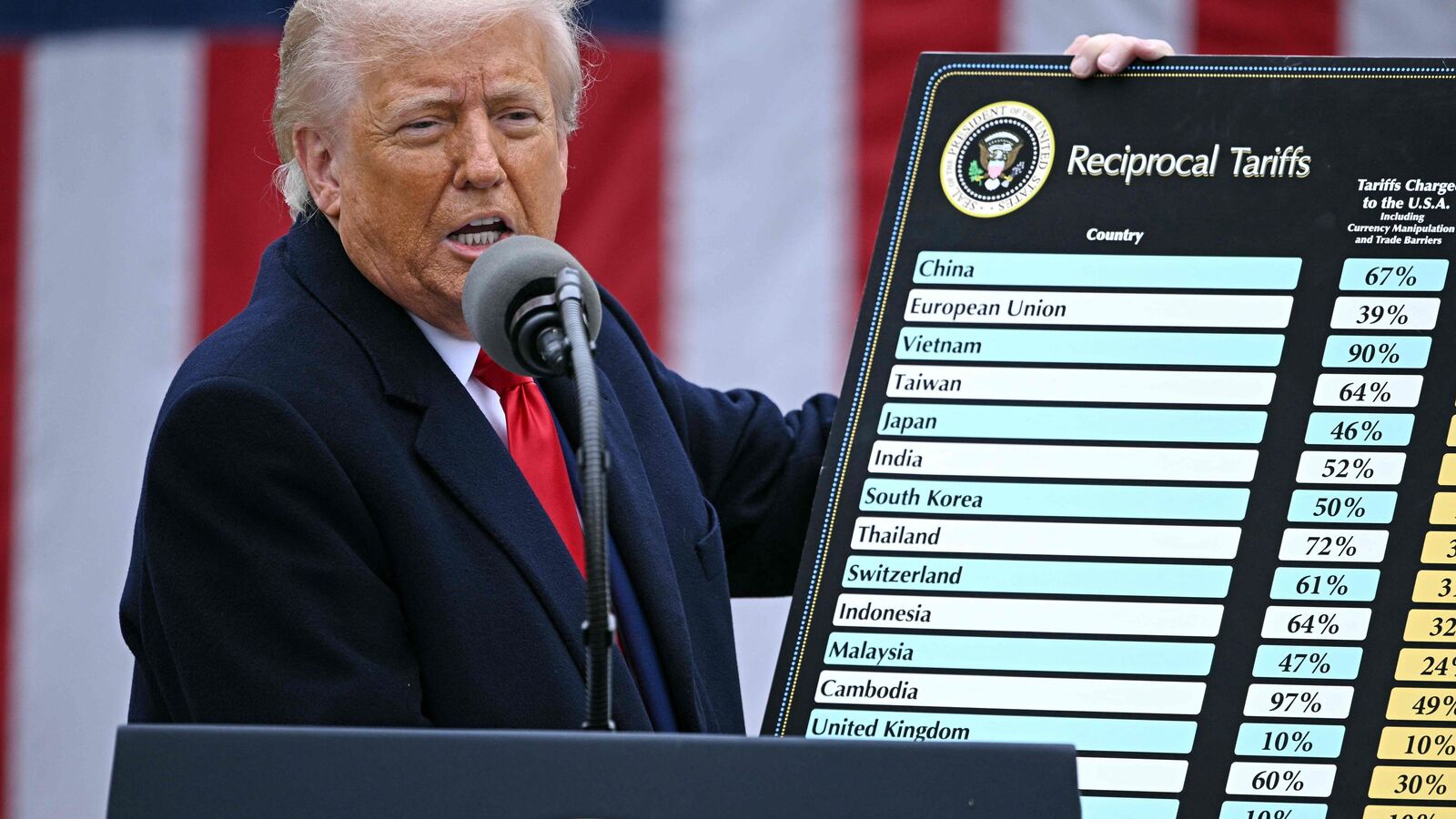
Group 1 - Executives from General Motors and Ford expressed gratitude to President Trump for the tariffs on medium- and heavy-duty trucks, indicating a positive impact on their stock prices [1] - The tariffs are positioned as a national security measure, with Trump asserting that they strengthen the US economy [2] - The tariffs will impact various vehicle types, including delivery trucks, garbage trucks, public utility trucks, transit buses, school buses, and semi-trucks [2] Group 2 - Prior to the new tariffs, the US had a 15% tariff on light-duty vehicles as part of trade agreements with Japan and the EU [3] - In April, a 25% tariff was imposed on all automobile imports, which was later extended to auto parts in May [3] - Producers are permitted to deduct the value of US components from tariffs on light-duty vehicles assembled in Canada and Mexico [3]
Trump says GM, Ford execs thanked him for tariffs, soaring stocks
Reuters· 2025-10-22 17:10
President Donald Trump said the chief executives of General Motors Co and Ford Motor Co called to thank him on Wednesday for putting tariffs on mid- and large-sized trucks, saying their companies stock has soared. ...
Can Ford Be More Like GM?
247Wallst· 2025-10-22 13:20
General Motors Co. (NYSE: GM) releases quarterly earnings before Ford Motor Co. ...
Ford To Recall Over 1.4 Million US Cars Over Rearview Camera Defect - Ford Motor (NYSE:F)
Benzinga· 2025-10-22 10:56
Recall Information - Ford Motor Company is recalling over 1.4 million vehicles in the U.S. due to a rearview camera malfunction that may cause distorted, intermittent, or blank images when reversing [1][2] - The recall affects 1,448,655 vehicles, including models from 2015 to 2020 such as the Flex, Explorer, Lincoln MKT, Lincoln MKZ, C-Max, Escape, Taurus, Fusion, Fiesta, and Mustang [2] Recent Setbacks - The recent recall is part of a series of setbacks for Ford in 2025, including a previous recall of over 680,000 vehicles due to various issues, including steering defects in F-250, F-350, and F-450 pickup trucks [3] - In September, Ford recalled 115,000 F-250, F-350, and F-450 trucks due to potential steering column detachment [4] - A fire at a key Ford supplier in September is expected to disrupt production operations for several months [4] Sales Performance - Despite the recalls, Ford achieved a record third quarter in electric vehicle (EV) sales, with a 19.8% increase to 85,789 units [5] - The Mustang Mach-E experienced a significant sales surge of 50.7%, marking its best quarter to date [5] - The F-Series trucks surpassed 600,000 units sold year-to-date, maintaining its position as America's best-selling truck for the 49th consecutive year [5] - Ford has a growth score of 52.96% and a momentum rating of 68.23% according to Benzinga Edge Stock Rankings [5]
奔驰实施30000人裁员计划,离职人员最高可获50万欧元补偿;长城汽车公布新款坦克400预售价:30.98万起丨汽车交通日报
创业邦· 2025-10-22 10:18
Group 1 - Great Wall Motors announced the pre-sale of the new Tank 400, starting at 309,800 yuan [2] - From January to September 2025, the top ten automotive companies sold a total of 20.431 million vehicles, accounting for 83.9% of total automotive sales [4] - Mercedes-Benz is implementing a major layoff plan affecting 30,000 employees, with severance packages up to 500,000 euros for senior management [3][5] Group 2 - Ford is recalling over 1.448 million vehicles in the U.S. due to rearview camera malfunctions [4]

全球超13万汽车人将失业
第一财经· 2025-10-22 09:21
2025.10. 22 本文字数:1265,阅读时长大约3分钟 作者 | 第一财经 葛慧 美国福特汽车公司9月16日宣布,由于欧洲电动汽车市场需求疲软,该公司德国科隆工厂将于2026 年初裁员1000人。这意味着该公司在德国的裁员规模将进一步扩大,并首次涉及整车生产部门。去 年11月,福特公布了一项大规模削减成本方案,计划到2027年底在欧洲裁员4000人。 随着全球汽车市场的需求疲软,国际汽车巨头在今年来陆续开启了裁员计划。 据第一财经不完全统计,近一年来,奔驰、奥迪、大众、福特、日产等公司先后宣布了大规模的裁员 计划,其中整车厂的裁员计划人数就超过10万人。头部的供应商巨头近期也开始祭出裁员计划,采 埃孚和博世两大巨头裁员计划总数达到3万人规模。 | 公司 | 裁员人 型 | | --- | --- | | 手机 | 30000 | | 興山 | 7500 | | 大东大 | 3000 | | 電诺 | 3000 | | 1 | 35000 | | 福特 | 5000 | | H P | 20000 | | 采埃宇 | 7600 | | 博世 | 22000 | | 总计 | 133100 | 10月22 ...

Jim Cramer on Ford: “The Stock Could Slip Below 11”
Yahoo Finance· 2025-10-22 09:20
Ford Motor Company (NYSE:F) is one of the stocks in Jim Cramer’s recent game plan. With the company set to report this week, Cramer mentioned it and remarked: “After the close, Ford reports. I want, look, we gotta find out how much damage this gigantic fire at a key aluminum plant will do to their numbers. If the numbers do come down, by the way, I think the stock could slip below 11.” Image by Marcin Machalski from Pixabay Ford Motor Company (NYSE:F) manufactures, and sells Ford and Lincoln vehicles, ...