
J&J(JNJ)

Search documents
强生多款创新医疗器械进博会“首秀”
Bei Ke Cai Jing· 2025-11-06 13:41
Core Insights - Johnson & Johnson Medical Technology launched the ETHICON 4000, the first 3D stapler for laparoscopic surgery in Asia, aimed at enhancing patient outcomes by improving tissue integrity during surgical procedures [1] - The CEREGLIDE 71 distal access catheter made its Asian debut, designed for neurovascular systems, which can reach critical areas in the brain, thus providing timely intervention for stroke patients [2] - The strong and flexible blood flow-directed mesh stent, developed in collaboration with a domestic medical innovation company, was also introduced, showcasing advancements in neurointerventional devices [2] Group 1 - The ETHICON 4000 laparoscopic stapler represents a significant technological advancement, transitioning from 2D to 3D stapling, which enhances the integrity of tissue connections and reduces the risk of complications such as blood leakage [1] - The innovative pre-set chip technology in the ETHICON 4000 allows for dynamic adjustment during the stapling process, potentially decreasing postoperative complications and improving patient recovery [1] Group 2 - The CEREGLIDE 71 distal access catheter is capable of reaching the M1-M2 segments of the brain, facilitating rapid access for stroke treatment, which is critical for patient outcomes [2] - The introduction of a complete thrombectomy product line, including the EMBOTRAP III and EMBOVAC devices, highlights Johnson & Johnson's commitment to advancing neurointerventional solutions [2] - The collaboration with a domestic company to develop the blood flow-directed stent emphasizes the trend of partnerships in the medical technology sector to enhance product offerings and address specific clinical needs [2]


US FDA expands use of J&J's Caplyta as add-on depression drug
Reuters· 2025-11-06 12:34
Core Insights - The U.S. Food and Drug Administration has approved the expanded use of Johnson & Johnson's drug Caplyta for adults with major depressive disorder as an add-on treatment [1] Company Summary - Johnson & Johnson's Caplyta has received FDA approval for an expanded indication, which may enhance its market potential and revenue opportunities in the mental health treatment sector [1]


FDA approval of CAPLYTA® (lumateperone) has the potential to reset treatment expectations, offering hope for remission in adults with major depressive disorder
Prnewswire· 2025-11-06 12:30
Core Insights - Johnson & Johnson announced the FDA approval of CAPLYTA (lumateperone) as an adjunctive therapy for major depressive disorder (MDD) in adults, marking a significant addition to treatment options for patients experiencing residual symptoms despite current antidepressant therapies [1][2][8] Summary by Sections Approval and Indications - CAPLYTA is now approved for use alongside antidepressants for MDD, as well as for bipolar I and II depression and schizophrenia, making it the first FDA-approved treatment for bipolar depression in adults [1][15] - This approval follows Johnson & Johnson's acquisition of Intra-Cellular Therapies, Inc., and represents the fourth indication for CAPLYTA [1][8] Clinical Efficacy - The approval is based on positive results from two Phase 3 trials (Study 501 and 502), which demonstrated significant improvements in depression symptoms compared to placebo [2][12] - In Study 501, the mean change in Montgomery-Asberg Depression Rating Scale (MADRS) score was -4.9 points (effect size 0.61), while Study 502 showed a -4.5 points change (effect size 0.56) at six weeks [3][12] - Early separation from placebo was observed as soon as one week in Study 501 and two weeks in Study 502 [3] Safety and Tolerability - CAPLYTA's safety profile was consistent with previous studies, showing no new safety concerns, and weight gain and metabolic changes were similar to placebo [4][6] - The most common side effects included sleepiness, dizziness, nausea, dry mouth, fatigue, and diarrhea [4][22] - In a 26-week open-label extension study (Study 503), 80% of patients responded to treatment, and 65% achieved remission, defined as a MADRS total score of 10 or less [6][13] Mechanism of Action - While the exact mechanism of action is not fully understood, CAPLYTA is characterized by high serotonin 5-HT2A receptor occupancy and moderate dopamine D2 receptor occupancy at therapeutic doses [7][16] Market Context - MDD affects approximately 22 million adults in the U.S., with 2 in 3 patients experiencing residual symptoms despite treatment, highlighting the need for effective adjunctive therapies [1][11] - The introduction of CAPLYTA is expected to reset treatment expectations and provide hope for patients seeking remission from depression [5][8]

细胞与基因治疗“变天了”
Ge Long Hui· 2025-11-06 12:03
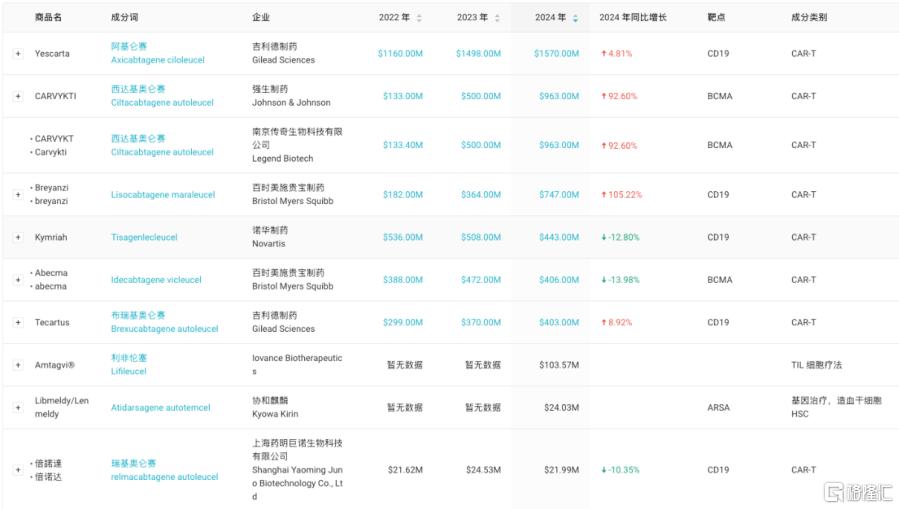
Core Insights - The cell and gene therapy (CGT) sector is experiencing a dichotomy, with major pharmaceutical companies entering the CAR-T therapy space while others are exiting, indicating a complex market landscape [1][2][10]. Group 1: Market Dynamics - The CGT market has seen rapid growth, with 46 CGT products approved by the FDA and approximately 3,600 active INDs [2]. - Despite the approval of over 10 CAR-T therapies globally, only a few have achieved blockbuster status, with Gilead's Yescarta showing a sales growth of only 4.81% in 2024 [3][4]. - The commercial performance of most CAR-T therapies has been disappointing, with high costs and market access issues limiting their success [6][9]. Group 2: Economic Challenges - The CGT sector faces significant economic challenges, including high R&D costs (estimated at $1.7 to $2.3 billion for CGT drugs compared to $1.25 to $1.48 billion for traditional drugs) and high production costs due to the personalized nature of treatments [11][12]. - The pricing of CAR-T therapies is exorbitant, with Carvykti priced over $500,000 in the U.S. and similar high costs in China, which restricts market accessibility [8][13]. Group 3: Industry Exits - Major multinational corporations (MNCs) like Takeda and Novo Nordisk have announced exits from the CGT space, indicating a shift in focus from technology-driven enthusiasm to financial viability [10][11]. - The industry's narrative has shifted from a focus on unique treatment mechanisms to a more pragmatic assessment of economic returns, highlighting the unsustainable nature of current CGT investments [11]. Group 4: Path to Recovery - The CGT industry is exploring various strategies to overcome its challenges, including the development of off-the-shelf CAR-T therapies to reduce costs and improve accessibility [14]. - Expanding the indications for CGT drugs to target larger patient populations is seen as a potential avenue for growth, similar to how Novartis expanded the application of siRNA therapies [17]. - The shift towards in vivo CAR-T therapies aims to simplify processes and reduce costs significantly, with predictions suggesting treatment costs could drop by an order of magnitude [18]. Group 5: Future Directions - The future of the CGT sector hinges on technological advancements that enhance accessibility, with a focus on universal CAR-T, in vivo therapies, and next-generation delivery technologies [19]. - The strategic movements of MNCs signal a paradigm shift in the industry, emphasizing the need to convert cutting-edge technology into sustainable business models for long-term success [19].


Samsung Bioepis Reaches Settlement Agreement for PYZCHIVA® (ustekinumab) in Europe
Businesswire· 2025-11-06 07:00
Core Insights - Samsung Bioepis has entered into a settlement and license agreement with Johnson & Johnson for the commercialization of PYZCHIVA® in Europe [1] Company Summary - The agreement allows Samsung Bioepis to commercialize PYZCHIVA®, which is a biosimilar product, in the European market [1]

药械高管热议进博:与中国同行,持续推动医疗健康行业高质量发展
2 1 Shi Ji Jing Ji Bao Dao· 2025-11-06 01:27
Core Viewpoint - China's ongoing deepening of open practices has transformed into tangible opportunities, enhancing the local medical innovation ecosystem and attracting global expertise while promoting Chinese innovation on a global scale [1] Group 1: Government Initiatives and Market Opportunities - Premier Li Qiang emphasized that the China International Import Expo (CIIE) serves as a vital bridge connecting the Chinese economy with the world, showcasing the vitality of China's vast market [1] - The number of participating companies at this year's CIIE reached a historical high, reflecting the robust dynamism of China's super-large market [1] - China is committed to high-level opening-up, providing clearer policy directions and stable expectations for foreign enterprises operating in China [1] Group 2: Corporate Responses and Investments - Executives from various pharmaceutical and medical device companies expressed encouragement from the Premier's speech, viewing CIIE as a crucial platform for foreign enterprises to connect deeply with the Chinese market [2] - AstraZeneca announced a $2.5 billion investment in Beijing, establishing a new global strategic R&D center to enhance drug discovery and clinical development [2] - Boehringer Ingelheim highlighted its commitment to innovation in China, marking its 30th anniversary in the market and emphasizing the supportive policies for biopharmaceutical innovation [3] Group 3: Long-term Commitment to China - Sanofi views China as a key strategic market and is optimistic about the future of the healthcare sector, having recently launched a new insulin raw material project in Beijing [4] - GE Healthcare has introduced over 50 precision medical innovations from the expo to clinical settings, indicating a strong commitment to the Chinese market [8] - Johnson & Johnson Medical Technology has been a witness and participant in China's healthcare modernization, aligning its strategies with China's support for industrial innovation [7]




Johnson & Johnson to Participate in the Citi's 2025 Global Healthcare Conference
Businesswire· 2025-11-05 21:50
Core Insights - Johnson & Johnson will participate in the Citi's 2025 Global Healthcare Conference on December 3, 2025, with management engaging in a Fireside Chat at 11:15 a.m. Eastern Time [1] - A live audio webcast of the presentation will be available on Johnson & Johnson's Investor Relations website, with an archived edition accessible later that day [2] - The company also announced its participation in the 7th Annual Wolfe Research Healthcare Conference on November 17, 2025, with a Fireside Chat scheduled for 10:40 a.m. Eastern Time [3] Company Developments - Johnson & Johnson announced its intent to separate its Orthopaedics business to enhance strategic and operational focus, aiming to drive value for stakeholders and strengthen its position in Innovative Medicine and MedTech [6]
The Multi-Billion-Dollar Battle For Metsera
Forbes· 2025-11-05 18:00
Core Insights - The competition between Novo Nordisk and Pfizer for Metsera has intensified, with Novo making an unsolicited bid of up to $9 billion, surpassing Pfizer's previous bid of $7.3 billion [2] - A legal battle has emerged, with Pfizer suing to block the deal and alleging anticompetitive behavior from Novo, which has since increased its bid to $10 billion while Pfizer raised its offer to $8.1 billion [3] - Metsera's stock has surged by 40% since the bidding war began, reflecting the high stakes in the weight loss drug market, where Pfizer lacks any current offerings [4] Company Developments - Metsera, although not yet having any drugs on the market, has a promising pipeline with its lead candidate in phase 2 trials and seven additional drugs, potentially generating over $5 billion in peak sales [5] - Investors Arch Venture Partners and Population Health Partners, who founded Metsera, stand to gain significantly from the ongoing bidding war, holding a combined 37.7% stake in the company [6] Industry Trends - The weight loss drug market is becoming increasingly competitive, with major pharmaceutical companies vying for control as consumer demand rises [4] - Kimberly-Clark's acquisition of Kenvue for over $40 billion highlights the trend of consolidation in the consumer health sector, despite ongoing litigation risks associated with Kenvue's products [12][13] - Kenvue's stock has dropped approximately 35% since its spin-off from Johnson & Johnson, indicating market concerns over its litigation exposure and overall performance [14]

Halozyme Beats on Q3 Earnings & Revenues, Raises 2025 View
ZACKS· 2025-11-04 16:36
Core Insights - Halozyme Therapeutics (HALO) reported Q3 2025 adjusted earnings of $1.72 per share, exceeding the Zacks Consensus Estimate of $1.63, with a year-over-year increase of 35.4% [1][7] - Total revenues for Q3 2025 reached $354.3 million, a 22% increase year-over-year, surpassing the Zacks Consensus Estimate of $337 million [1][7] Revenue Breakdown - The growth in total revenues was primarily driven by increased product sales and higher royalty payments [2] - Royalty revenues amounted to $236 million in Q3, reflecting a 52% increase from the previous year, driven by strong demand for Phesgo, subcutaneous Darzalex, and Vyvgart Hytrulo [6] - Product sales were reported at $94.2 million, an 8.7% increase year-over-year, exceeding the model estimate of $83.8 million [8] - Revenues from collaborative agreements decreased by 50.4% year-over-year to $24 million [8] Financial Performance - Adjusted EBITDA for Q3 was $248.2 million, representing a 35% increase from the prior year [8] - As of September 30, 2025, the company had cash, cash equivalents, and marketable securities totaling $702 million, up from $548.2 million as of June 30, 2025 [9] Guidance Update - Halozyme raised its 2025 revenue guidance to a range of $1.30 billion to $1.38 billion, up from the previous range of $1.28 billion to $1.36 billion [10] - Royalty revenue expectations were adjusted to $850-$880 million, compared to the earlier forecast of $825-$860 million [11] - Adjusted EBITDA guidance was increased to $885-$935 million, up from $865-$915 million [11] - Adjusted earnings per share guidance was raised to a range of $6.10-$6.50, compared to the previous range of $6.00-$6.40 [11] Recent Developments - Halozyme announced a definitive agreement to acquire Elektrofi, a biopharmaceutical company specializing in ultra-high concentration microparticle technology for biologics [12] - The acquisition involves an upfront payment of $750 million, with potential milestone payments of $50 million each, contingent on regulatory approvals for three products [13]



Top 20 biopharma companies Q3 2025 market cap up 4% despite headwinds
Yahoo Finance· 2025-11-04 16:28
Core Insights - The top 20 global biopharmaceutical companies saw a 4% increase in combined market capitalisation from $3.7 trillion on June 30, 2025, to $3.8 trillion on September 30, 2025, despite challenges from tariffs and drug pricing pressures [1] Company Performances - UCB experienced the largest market capitalisation growth of 40.9%, reaching $59.8 billion in Q3 2025, driven by the competitive positioning of its drug Bimzelx in hidradenitis suppurativa [2] - Alnylam Pharmaceuticals recorded a 40.6% increase in market capitalisation, attributed to strong sales of its RNAi therapeutic Amvuttra, which saw a 59% quarter-on-quarter increase in global sales to $492 million in Q2 2025 [3] - AbbVie reported a 24.7% rise in market capitalisation, bolstered by its $2.1 billion acquisition of Capstan Therapeutics and plans to invest $195 million in a new manufacturing facility in North Chicago [4] - Johnson & Johnson's market capitalisation grew by 21.5%, supported by a 5.8% sales growth in Q2 and FDA approval of its monoclonal antibody Tremfya for paediatric patients [5]

