Lilly(LLY)

Search documents
Why Novo Nordisk Stock Tumbled on Tuesday
The Motley Fool· 2025-08-26 22:23
Core Insights - A competitor, Eli Lilly, reported successful late-stage clinical trial results for a weight-loss drug, orforglipron, which poses a significant threat to Novo Nordisk's leading products, Wegovy and Ozempic [1][3] - Investors reacted negatively to the news, resulting in a nearly 2% decline in Novo Nordisk's stock price, despite a general market increase in the S&P 500 index [2] Company Developments - Eli Lilly's orforglipron achieved all primary and key secondary endpoints, leading to an average weight loss of 10.5% among participants, compared to just over 2% for the placebo group [5] - The drug also effectively lowered blood sugar levels, which is beneficial for diabetic patients [5] - A key advantage of orforglipron is its pill form delivery, contrasting with the injection method required for Wegovy and Zepbound, making it a more convenient option for patients [6] Industry Context - The competition in the obesity treatment market is intensifying, with a high demand for weight-loss medications in the U.S. [7] - Novo Nordisk must adapt to these competitive pressures to maintain its position in the weight-loss market [7]


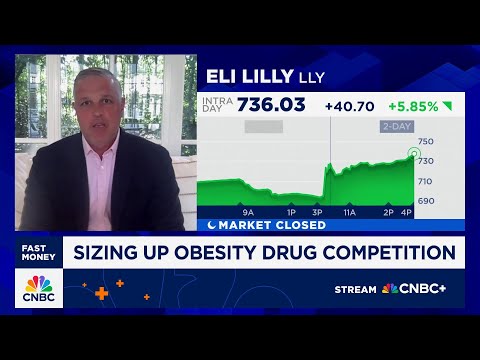
Citi's Geoff Meacham on Eli Lilly's stock climbing as weight loss pill clears latest trial
CNBC Television· 2025-08-26 22:21
Switching gears, Eli Lily surging almost 6%. It led the S&P 500 today. Their obesity pill cleared yet another late stage trial.Patients with type 2 diabetes and obesity losing an average 10 a.5% of their body weight after 72 weeks is on the highest dose. For more on what may come next, city research managing director Jeff Meechum joining us now. Jeff, great to have you on the show.What did these results mean for Lily. >> Awesome. Thanks for having me, Brian.Um, yes. So, the results here are derisking from t ...
美股三大指数均小幅收涨,礼来涨近6%
Xin Lang Cai Jing· 2025-08-26 22:19
Core Viewpoint - US stock market opened lower but closed higher, with all three major indices showing slight gains, indicating a positive market sentiment despite initial declines [1] Group 1: Major Indices Performance - Nasdaq increased by 0.44%, S&P 500 rose by 0.41%, and Dow Jones gained 0.3% [1] - Large-cap tech stocks mostly saw gains, with Tesla and Nvidia rising over 1%, while Apple, Netflix, Amazon, and Meta experienced slight increases [1] - Google, Microsoft, and Intel saw minor declines [1] Group 2: Notable Company Movements - Eli Lilly's stock surged nearly 6% following the successful results of its Phase 3 clinical trial for the oral GLP-1 receptor agonist orforglipron for obesity combined with type 2 diabetes [1] - Popular Chinese concept stocks mostly rose, with the Nasdaq Golden Dragon China Index up by 0.72% [1] - Hesai Technologies surged over 14%, NIO increased by 10%, XPeng Motors rose over 5%, and Li Auto gained nearly 3% [1]
Eli Lilly Stock Jumps On Weight-Loss Pill Trial
Benzinga· 2025-08-26 17:26
Core Viewpoint - Eli Lilly and Co. has experienced significant stock volatility due to developments in its weight-loss drug portfolio, with recent positive trial results boosting investor confidence [1][5]. Company Summary - Eli Lilly's stock reached highs near $960 in August 2024 but subsequently dropped over 20% due to disappointing drug trial results and concerns regarding insurance coverage and competition [2]. - The company's oral obesity drug previously failed to meet expectations compared to rival products, prompting investors to reassess growth prospects [3]. - Increased competition in the obesity drug market has led to price wars, creating further uncertainty for Eli Lilly [4]. Market Reaction - Following the announcement of positive Phase 3 trial results, Eli Lilly's stock surged more than 4%, indicating renewed investor confidence in the drug's regulatory and commercial potential [5]. - At the time of publication, Eli Lilly shares were reported at $724.66, reflecting a 4.22% increase [5].

X @Investopedia
Investopedia· 2025-08-26 16:30
Eli Lilly shares gained Tuesday as results from a new study moved the drugmaker closer to applying for approval of its experimental weight-loss pill. https://t.co/57DKN32qpC ...
Immuneering Stock Rises 21.7% on Supply Agreement With LLY
ZACKS· 2025-08-26 16:21
Core Insights - Immuneering Corporation (IMRX) has entered into a clinical supply agreement with Eli Lilly (LLY) for the KRAS G12C inhibitor, olomorasib (LY3537982) [1] - The agreement supports a planned phase II study evaluating Immuneering's atebimetinib (IMM-1-104) in combination with olomorasib for treating advanced KRAS G12C-mutant non-small cell lung cancer (NSCLC) [2] - Immuneering's shares rose by 21.7% following the announcement, and the stock has increased by 170.5% year-to-date compared to the industry's 4.1% rise [2][3] Agreement Details - The combination of atebimetinib and olomorasib is expected to provide a vertical blockade of the RAS-MAPK pathway, with preclinical data showing enhanced tumor regression and prolonged survival compared to monotherapy [5] - This is Immuneering's second collaboration announcement in 2025, following a similar agreement with Regeneron Pharmaceuticals to evaluate atebimetinib with Libtayo for advanced NSCLC [6][7] - In both agreements, Immuneering retains full worldwide development and commercialization rights to atebimetinib [8] Ongoing Studies - Immuneering is advancing atebimetinib in other cancer studies, including a phase IIa study in combination with modified gemcitabine/nab-paclitaxel for first-line pancreatic cancer [9] - Preliminary data from this study indicated a 94% overall survival and 72% progression-free survival at six months, with updated data expected later in Q3 2025 [10] - The company plans to initiate a pivotal study for atebimetinib in combination with modified gemcitabine/nab-paclitaxel in 2026, pending regulatory feedback [11]


Eli Lilly's Obesity Pill Moves Closer to Approval
Bloomberg Television· 2025-08-26 16:06
Clinical Trial Results & FDA Approval - Lilly's oral pill data for obesity and Type 2 diabetes initially caused significant market disappointment [1][2] - The recent data is viewed as the final step before submitting plans to the FDA for approval of the pill [2] - FDA approval is anticipated no earlier than 2026 [4] Market Expectations & Potential - Long-term expectations for the pill have decreased due to weight loss percentage and gastrointestinal side effects [3] - Despite lowered expectations, the pill is still projected to become a multi-billion dollar product in the US market [3] Side Effects & Advantages - The pill's side effects include diarrhea, nausea, and gastrointestinal issues, comparable to other medications like Wegovy [5] - The primary advantage of the pill is its convenience as a once-daily oral medication compared to weekly injections [6]

Guggenheim Partner's Seamus Fernandez: Oral weight loss pill 'meaningful step up' for Eli Lilly
CNBC Television· 2025-08-26 15:35
Eli Lilly's Obesity Drug Data & Regulatory Outlook - Eli Lilly's obesity pill data shows patients with obesity and diabetes lost approximately 105% of their body weight [1] - The new data positions Eli Lilly to seek regulatory approval for its obesity treatment [1] - Guggenheim analyst has a buy rating on Eli Lilly with a price target of $875 [1] Orphoglyon Analysis - Orphoglyon's weight loss results are similar to Wegovy's in diabetic patients [3] - Orphoglyon is viewed as a well-behaved GLP-1 that can be taken orally [3] - The scalability of producing an oral pill is a significant advantage [3] - Eli Lilly's pricing strategy for Orphoglyon is a key unknown factor [4] - Orphoglyon is likely to hit the market in the middle of next year [5] Competitive Landscape - Eli Lilly has a robust pipeline of injectable assets in addition to Orphoglyon [5] - Novo faces challenges in launching new products at the same pace as Eli Lilly [6] - Novo is the number two player in the US GLP-1 market and the number one player globally [6] - The scalability of Novo's oral pill and intellectual property challenges related to compounding are hurdles [7]
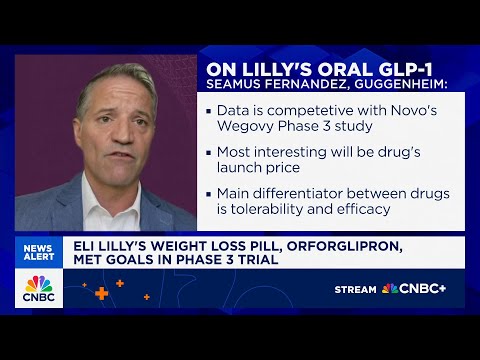
Eli Lilly advances weight loss pill towards regulatory submissions after successful trial
Proactiveinvestors NA· 2025-08-26 15:01
Group 1 - Proactive provides fast, accessible, informative, and actionable business and finance news content to a global investment audience [2] - The company focuses on medium and small-cap markets while also covering blue-chip companies, commodities, and broader investment stories [3] - Proactive's news team delivers insights across various sectors including biotech, pharma, mining, natural resources, battery metals, oil and gas, crypto, and emerging technologies [3] Group 2 - Proactive is committed to adopting technology to enhance workflows and improve content production [4] - The company utilizes automation and software tools, including generative AI, while ensuring all content is edited and authored by humans [5]

Eli Lilly Stock Climbs on Weight-Loss Drug Trial Results
Schaeffers Investment Research· 2025-08-26 14:52
Core Insights - Eli Lilly's shares have increased by 3.7% to $720.07 following positive results from a late-stage trial of its weight-loss pill, orforglipron, which helped type 2 diabetes patients lose 10.5% of their body weight over 72 weeks, paving the way for global approval [1] Group 1 - The stock has been on an upward trend since hitting a 52-week low of $623.78 on August 8, achieving its 10th gain in the last 12 sessions [2] - Despite the recent gains, the shares are still down 24.9% year over year and 7.5% year to date [2] - There has been significant options activity, with 50,000 calls exchanged, which is double the intraday average volume, compared to 20,000 puts [2] Group 2 - The popularity of calls has increased over the last 10 weeks, with a 50-day call/put volume ratio of 1.67, ranking higher than 90% of readings from the past year [3]