Lilly(LLY)

Search documents
Lilly's oral GLP-1, orforglipron, is successful in third Phase 3 trial, triggering global regulatory submissions this year for the treatment of obesity
Prnewswire· 2025-08-26 10:45
Core Insights - Eli Lilly announced positive topline results from the Phase 3 ATTAIN-2 trial for orforglipron, an investigational oral GLP-1 receptor agonist, showing significant weight loss and A1C reductions in adults with obesity or overweight and type 2 diabetes [1][2][4] Efficacy Results - Orforglipron 36 mg led to an average weight loss of 22.9 lbs (10.5%) and a reduction in A1C by 1.8% after 72 weeks, compared to 5.1 lbs (2.2%) weight loss and 0.1% A1C reduction in the placebo group [1][2] - In the trial, 75% of participants on the highest dose achieved an A1C ≤6.5%, meeting the American Diabetes Association's definition of diabetes [2][4] - The trial demonstrated that orforglipron met all primary and key secondary endpoints, including significant improvements in cardiometabolic risk factors [1][4] Safety Profile - The safety profile of orforglipron was consistent with established GLP-1 receptor agonists, with the most common adverse events being gastrointestinal-related, such as nausea (20.1% to 36.4%), vomiting (12.8% to 23.1%), and diarrhea (21.3% to 27.4%) across different doses [4][8] - Treatment discontinuation rates due to adverse events were 6.1% for 6 mg, 10.6% for 12 mg, and 10.6% for 36 mg, compared to 4.6% for placebo, indicating a balanced overall treatment discontinuation rate [4][8] Regulatory Pathway - With the completion of the ATTAIN-2 trial, Eli Lilly is prepared to initiate global regulatory submissions for orforglipron, aiming to provide a convenient, once-daily oral treatment option for obesity and type 2 diabetes [1][4][6] Clinical Trial Details - The ATTAIN-2 trial was a 72-week, randomized, double-blind, placebo-controlled study involving over 1,600 participants across multiple countries, focusing on the efficacy and safety of orforglipron [7][8]


特朗普急了,罢免美联储理事库克!库克:不会辞职
Sou Hu Cai Jing· 2025-08-26 05:47
Group 1 - Trump announced a significant reduction in drug prices, claiming a potential decrease of 1400% to 1500%, and plans to impose higher tariffs on imported drugs, indicating a strong stance on pharmaceutical pricing [1] - Major pharmaceutical companies, including Eli Lilly, Novo Nordisk, and Pfizer, received letters from Trump urging them to lower drug prices within 60 days, with threats of using all means to protect American families from drug pricing abuses [1] - The proposed tariffs on imported drugs could reach as high as 250%, marking the most severe plan to date, aimed at encouraging pharmaceutical manufacturers to bring production back to the U.S. [1] Group 2 - Industry experts expressed concerns that the proposed tariffs could increase costs, disrupt the drug supply chain, and pose risks to patients, with the Pharmaceutical Research and Manufacturers of America (PhRMA) stating that drugs have historically been exempt from tariffs due to cost implications [2] - Trump's dismissal of Federal Reserve Governor Lisa Cook is seen as an escalation of his attacks on the central bank, with implications for future monetary policy and potential shifts towards more dovish members [3][4] - Powell's recent remarks at the Jackson Hole conference suggested a potential for interest rate cuts in September, indicating a shift in monetary policy that could be influenced by the ongoing power struggle within the Federal Reserve [4]


“药王”更替加速 今年上半年司美格鲁肽登顶
Xin Jing Bao· 2025-08-26 05:26
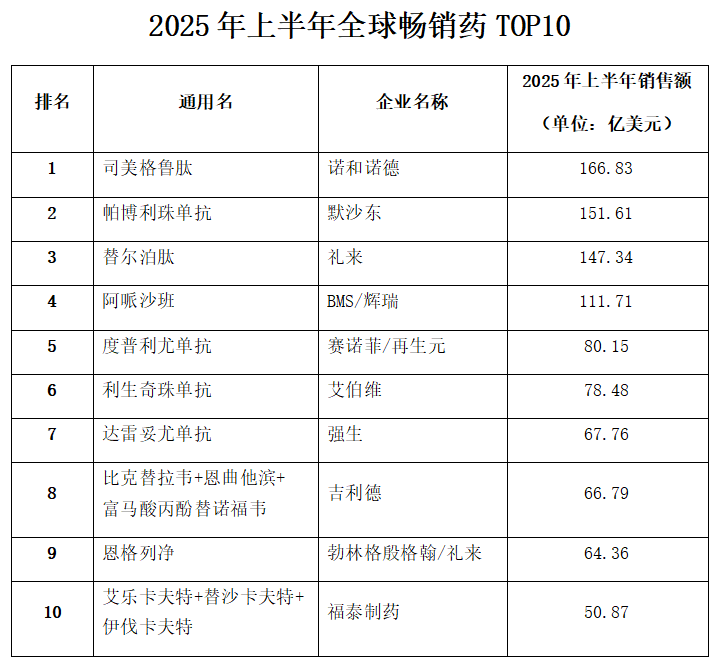
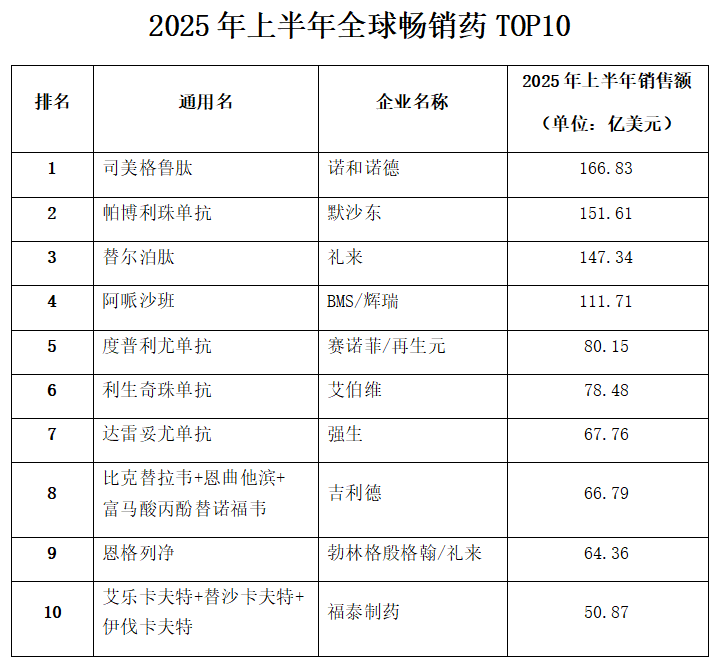
Core Insights - The global top-selling drugs for the first half of 2025 have been released, with Novo Nordisk's semaglutide leading the sales at 166.83 billion USD, followed by Merck's pembrolizumab and Eli Lilly's tirzepatide [1][3][4] Group 1: Top-Selling Drugs - Semaglutide from Novo Nordisk achieved sales of 166.83 billion USD, maintaining its position as the "king of drugs" [1][3] - Pembrolizumab from Merck recorded sales of 151.61 billion USD, ranking second [3] - Tirzepatide from Eli Lilly reached sales of 147.34 billion USD, securing the third position [3] Group 2: Sales Growth and Market Dynamics - Semaglutide's sales growth is driven by its three products: Ozempic (95.46 billion USD), Rybelsus (16.79 billion USD), and Wegovy (54.58 billion USD), with Wegovy showing a remarkable growth of 78% [5][6] - Tirzepatide has rapidly gained market share, with Mounjaro's sales skyrocketing from 4.83 billion USD in 2022 to an expected 115.4 billion USD in 2024 [7] - The competition between semaglutide and tirzepatide is intensifying, with both drugs exceeding 140 billion USD in sales for the first half of 2025 [7] Group 3: Market Challenges - The entry of biosimilars has impacted the sales of established drugs, with Janssen's ustekinumab dropping out of the top 10 due to a significant decline in sales [8] - Ustekinumab's sales fell by 38.6% in the first half of 2025, reaching only 32.78 billion USD [8] - Despite challenges, Johnson & Johnson's daratumumab saw a 21.7% increase in sales, reaching 67.76 billion USD, indicating strong demand in the multiple myeloma market [9][10]


Lilly to participate in Morgan Stanley 23rd Annual Global Healthcare Conference
Prnewswire· 2025-08-25 13:00
Core Insights - Eli Lilly and Company will participate in the Morgan Stanley 23rd Annual Global Healthcare Conference on September 8, 2025, featuring key executives in a fireside chat [1] - A live audio webcast of the event will be available on Lilly's investor website, with a replay accessible for approximately 90 days [2] - Lilly has a long history of nearly 150 years in pioneering medical discoveries, focusing on significant health challenges such as diabetes, obesity, Alzheimer's disease, immune system disorders, and difficult-to-treat cancers [3]

“药王”更替加速,今年上半年司美格鲁肽登顶
Xin Jing Bao· 2025-08-25 10:11
Core Insights - The global top-selling drugs for the first half of 2025 have been released, with Novo Nordisk's semaglutide leading the sales at 166.83 billion USD, followed by Merck's pembrolizumab and Eli Lilly's tirzepatide [1][3][4] Sales Performance - Semaglutide achieved sales of 166.83 billion USD, maintaining its position as the top-selling drug [1][3] - Pembrolizumab (K drug) recorded sales of 151.61 billion USD, while tirzepatide reached 147.34 billion USD [3] - Other notable drugs include apixaban at 111.71 billion USD and dupilumab at 80.15 billion USD [3] Market Dynamics - The competition for the title of "King of Drugs" is intensifying, with new entrants like tirzepatide rapidly gaining market share [1][5] - Semaglutide's sales are bolstered by its three product variants, with the weight loss version, Wegovy, showing a remarkable growth of 78% [5][6] - Tirzepatide has been recognized for its rapid market uptake, with sales skyrocketing from 4.83 billion USD in 2022 to an expected 115.4 billion USD in 2024 [7] Product Innovations - Wegovy has recently gained approval for treating metabolic-associated fatty liver disease, which is expected to further enhance its sales [6] - Tirzepatide is the first and only dual-target GLP-1 receptor agonist approved for type 2 diabetes, positioning it as a strong competitor to semaglutide [7] Market Challenges - The entry of biosimilars has impacted the sales of established drugs, with Johnson & Johnson's ustekinumab dropping out of the top 10 due to a significant sales decline [8] - Ustekinumab's sales fell by 38.6% in the first half of 2025, reflecting the challenges faced by original drugs as patents expire [8] Future Outlook - Daratumumab from Johnson & Johnson has shown a 21.7% increase in sales, indicating strong market potential in the multiple myeloma segment [9][10] - The overall trend suggests a shift in market leadership as newer drugs gain traction and established drugs face competitive pressures [1][5][8]
Eli Lilly's obesity pill remains a viable rival to Novo's oral Wegovy despite data that underwhelmed investors
CNBC· 2025-08-24 12:00
Core Viewpoint - Eli Lilly's obesity pill, orforglipron, has shown disappointing trial results compared to expectations, leading to a significant drop in stock price, although it has since recovered somewhat [2][3]. Drug Efficacy and Comparison - In a late-stage trial, orforglipron resulted in less weight loss (12.4% at the highest dose) and higher side effects than anticipated, while Novo Nordisk's oral semaglutide showed greater efficacy (up to 16.6% weight loss) [13][14]. - Analysts believe that orforglipron could still be a viable competitor in the weight loss market, especially due to its easier absorption and manufacturing advantages over Novo Nordisk's peptide-based drug [5][6]. Market Potential and Projections - Goldman Sachs analysts project that daily oral weight loss pills could capture 24% of the $95 billion global weight loss drug market by 2030, with Eli Lilly's orforglipron expected to hold a 60% share of the daily oral segment, translating to approximately $13.6 billion [7][8]. Manufacturing and Pricing Considerations - Eli Lilly's orforglipron is a small-molecule drug, making it easier and potentially cheaper to manufacture compared to Novo Nordisk's oral semaglutide, which is a peptide medication [5][22]. - Pricing strategies for both drugs remain uncertain, but analysts suggest that orforglipron could be priced lower than Novo Nordisk's offering, which may provide a competitive edge in a market where many health plans do not cover obesity treatments [6][23]. Side Effects and Tolerability - The side effects of orforglipron, primarily gastrointestinal, led to a 10.3% discontinuation rate at the highest dose, which is higher than the placebo group [17][19]. - Comparatively, Novo Nordisk's oral semaglutide had a higher incidence of gastrointestinal side effects, with 30.9% reporting vomiting and 46.6% reporting nausea [19]. Competitive Landscape - The obesity drug market is competitive, with other companies like Pfizer and Viking Therapeutics also developing oral medications, but Eli Lilly and Novo Nordisk are currently leading the race [9][27]. - Viking Therapeutics recently reported disappointing trial results, indicating that its drug may not be as effective as Eli Lilly's orforglipron [27][28].
美股市场速览:回调后再度发动,中小盘明显占优
Guoxin Securities· 2025-08-24 09:03
Investment Rating - The report maintains a "Weaker than Market" rating for the U.S. stock market [1] Core Insights - After a pullback, the U.S. stock market has shown significant recovery, with small-cap stocks outperforming [3] - The S&P 500 index increased by 0.3%, while the Nasdaq decreased by 0.6% [3] - Among 18 sectors, 12 experienced gains, with notable increases in banking (+3.2%), automotive (+2.9%), and energy (+2.8%) sectors [3] Price Trends - Small-cap value stocks (Russell 2000 Value) rose by 4.1%, outperforming small-cap growth (Russell 2000 Growth +2.6%) and large-cap value (Russell 1000 Value +1.7%) [3] - The report highlights that 18 sectors saw price increases, while 6 sectors faced declines, with the largest declines in food and staples retailing (-2.0%) and software and services (-1.9%) [3] Fund Flows - The estimated fund flow for S&P 500 constituents was +1.7 billion USD this week, a significant decrease from +75.8 billion USD the previous week [4] - Notable inflows were observed in automotive (+11.0 million USD), diversified financials (+4.6 million USD), and banking (+3.8 million USD) sectors [4] - Conversely, significant outflows were recorded in software and services (-29.9 million USD) and semiconductor products and equipment (-7.7 million USD) [4] Earnings Forecast - The report indicates a 0.3% upward revision in the 12-month forward EPS expectations for S&P 500 constituents, following a 0.2% increase the previous week [5] - 21 sectors saw upward revisions in earnings expectations, with the semiconductor sector leading with a +1.2% increase [5]




Eli Lilly Vs. Novo Nordisk: One Stock Is Massively Undervalued, The Other Overvalued
Seeking Alpha· 2025-08-24 00:55
Core Insights - The emergence of GLP-1 and weight loss medications has significantly impacted Eli Lilly and Novo Nordisk, placing them in the spotlight recently [1] - Both companies' stocks have experienced notable declines, indicating potential market volatility and investor concern [1] Company Analysis - Eli Lilly (NYSE: LLY) and Novo Nordisk (NVO) are key players in the GLP-1 medication market, which is gaining attention for its weight loss benefits [1] - The recent performance of both stocks suggests a need for careful evaluation by investors, as they may be perceived as a buy-hold-check opportunity [1]
礼来(LLY.US)、诺和诺德(NVO.US)迎来好消息!研究显示:GLP-1药物可降低患癌风险
智通财经网· 2025-08-23 03:56
Core Findings - The study published in the Journal of the American Medical Association Oncology indicates that GLP-1 receptor agonists, such as Eli Lilly's Mounjaro and Novo Nordisk's Ozempic, can reduce cancer risk [1] - The research analyzed electronic health records of over 80,000 obese patients without prior cancer history, revealing a statistically significant decrease in overall cancer risk among users of GLP-1 medications compared to non-users [1] Study Details - The study utilized data from the OneFlorida+ health research network, covering 43,315 non-users and 43,317 users of GLP-1 medications from 2014 to 2024 [1] - Among patients using GLP-1 medications, the incidence rate of 14 types of cancers (including 13 obesity-related cancers) was 13.6 cases per 1,000 individuals per year, compared to 16.4 cases per 1,000 for non-users [1] Additional Insights - The study also noted a slight but not statistically significant increase in the risk of kidney cancer associated with GLP-1 medications [1] - Researchers emphasize the need for long-term follow-up studies to assess the clinical significance and underlying reasons for the findings due to the retrospective nature of the study [2]
Is Orforglipron Pill Setback End of the Road for LLY's Obesity Plans?
ZACKS· 2025-08-22 13:50
Core Insights - Eli Lilly and Company (LLY) is a significant player in the diabetes and obesity drug market, primarily due to the success of its GLP-1 therapies, Mounjaro and Zepbound, which are facing competition from Novo Nordisk's semaglutide medicines [1][2] - The obesity market is projected to grow to $100 billion by 2030, leading to intense competition among key players [2] - Lilly is actively investing in obesity treatments, with several new molecules in clinical development, including orforglipron and retatrutide [3][9] Company Developments - Lilly has reported positive data from two phase III studies on orforglipron, showing significant reductions in A1C and weight among participants [4] - Despite the promising data, the weight loss results from orforglipron fell short of investor expectations, leading to concerns about its market potential [5][6] - Lilly plans to file regulatory applications for orforglipron in obesity by Q4 2025 and for type II diabetes in H1 2026 [7] Competitive Landscape - Other companies, such as Amgen and Viking Therapeutics, are also developing GLP-1-based candidates, intensifying competition in the obesity treatment space [12][16] - Novo Nordisk is advancing its pipeline with an oral version of Wegovy and other next-generation candidates [16] Financial Performance - Lilly's stock has declined by 7.6% this year, contrasting with a 0.2% increase in the industry [17] - The company's stock is currently trading at a price/earnings ratio of 25.29, higher than the industry average of 14.64, but below its 5-year mean of 34.54 [19] Earnings Estimates - Earnings estimates for Lilly have increased for 2025 and 2026, indicating positive market sentiment despite recent setbacks [21]