LVMH(LVMUY)

Search documents
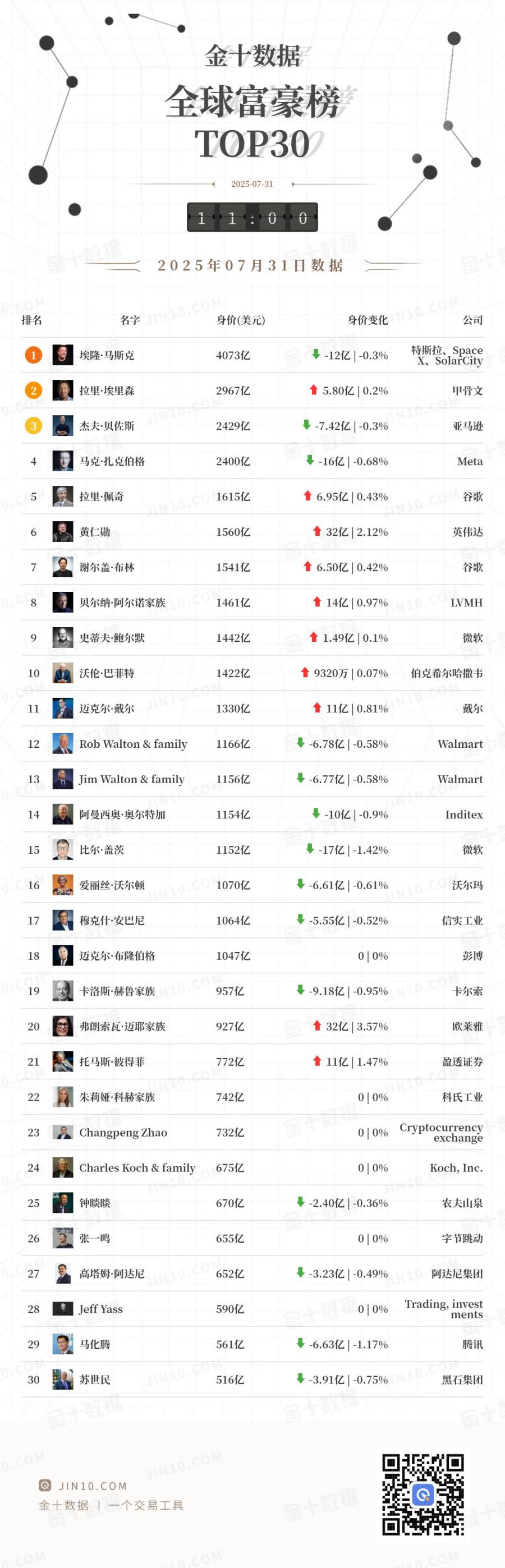
金十图示:2025年07月31日(周四)全球富豪榜





news flash· 2025-07-31 03:04
Group 1 - Elon Musk remains the richest person with a net worth of $407.3 billion, experiencing a decrease of $1.2 billion or 0.3% [1] - Larry Ellison ranks second with a net worth of $296.7 billion, increasing by $1.58 billion or 0.2% [1] - Jeff Bezos is third with a net worth of $242.9 billion, down by $7.42 billion or 0.3% [1] - Mark Zuckerberg's net worth is $240 billion, decreasing by $1.6 billion or 0.68% [1] - Larry Page has a net worth of $161.5 billion, increasing by $6.95 billion or 0.43% [1] Group 2 - Nvidia's CEO Jensen Huang has a net worth of $156 billion, increasing by $3.2 billion or 2.12% [1] - Sergey Brin, co-founder of Google, has a net worth of $154.1 billion, increasing by $650 million or 0.42% [1] - Bernard Arnault's family has a net worth of $146.1 billion, increasing by $1.4 billion or 0.97% [1] - Steve Ballmer, former CEO of Microsoft, has a net worth of $144.2 billion, increasing by $149 million or 0.1% [1] - Warren Buffett's net worth is $142.2 billion, increasing by $9.32 million or 0.07% [1] Group 3 - Michael Dell has a net worth of $133 billion, increasing by $1.1 billion or 0.81% [1] - Rob Walton and family have a net worth of $116.6 billion, decreasing by $6.78 billion or 0.58% [3] - Jim Walton and family have a net worth of $115.6 billion, decreasing by $6.77 billion or 0.58% [3] - Amancio Ortega has a net worth of $115.4 billion, decreasing by $1 billion or 0.9% [3] - Bill Gates has a net worth of $115.2 billion, decreasing by $1.7 billion or 1.42% [3]

X @The Economist
The Economist· 2025-07-30 19:40
Market Value & Leadership - LVMH's market value has decreased by over 25% in the past year [1] - The question is whether Bernard Arnault, the founder, can reverse this trend [1]

Is The Luxury Industry Facing An Identity Crisis?
Forbes· 2025-07-30 15:55
Core Insights - The luxury industry is experiencing a significant downturn, with LVMH's profits dropping 15% in the first half of 2025 and organic growth down 3% [3] - Kering's revenue has decreased by 18% in Q2, with Gucci's sales falling by 25% and overall sales in Asia and Japan down by 29% in the first half of the year [3] - The current challenges are attributed to a need for a reset in the luxury sector, moving away from hyper-scaling growth strategies that have led to overexposure and loss of brand essence [4][5] Company Performance - LVMH's shares have declined by 15% since the start of 2025, indicating investor concerns about the company's performance [2] - Hermès, in contrast, reported a 9% revenue increase to 3.9 billion in Q2, demonstrating strong brand equity and customer loyalty [5][6] - Gucci's decline in sales and consumer loyalty highlights the risks of overexposure and trend-chasing strategies [7] Market Trends - Luxury consumers are becoming more selective, valuing emotional connections and long-term worth over short-lived trends [8][10] - The industry is witnessing a shift towards authenticity, craftsmanship, and storytelling as key drivers of desirability [9] - Brands are encouraged to return to their roots, focusing on intention and intimacy rather than mass visibility [9]

X @Forbes
Forbes· 2025-07-28 23:40
Financial Performance - LVMH's fashion and leather goods segment experienced a 4% decrease (or 5% organically) in the first quarter [1] - The segment further declined by 12% in the second quarter [1] - Resulting in an 8% drop for the first half of the year, amounting to $224 billion [1]
Why LVMH Stock Was Sliding Today
The Motley Fool· 2025-07-28 19:05
Core Viewpoint - Investors are disappointed with the new trade deal between the E.U. and the U.S., which has negatively impacted LVMH's stock performance and reflects broader concerns in the luxury sector [1][2]. Group 1: Trade Deal Impact - The E.U. and the U.S. agreed to a 15% tariff on European goods, which has been criticized by France as a "submission" [3]. - The tariff agreement avoids a trade war but increases costs for luxury goods, which are already facing challenges [3]. - The trade war is expected to affect LVMH's fashion and leather goods segment, as well as wines and spirits, with trade-related pressures in China further hurting demand [5]. Group 2: Financial Performance - LVMH reported a 4% decline in revenue for the first half of the year, with operating profit falling 15% to €9 billion, primarily due to weakness in Asia [4]. - Organic revenue in fashion and leather goods, which constitute nearly half of LVMH's sales, declined by 7% [4][5]. Group 3: Future Outlook - Investors are looking for a potential trade deal with China, which could benefit LVMH, as China accounts for about a quarter of the global luxury market [6]. - There is disappointment that luxury goods were not excluded from the U.S. trade deal, but a strong economy and stock market may mitigate the impact of import taxes [6]. - LVMH possesses a strong portfolio of brands that should provide long-term stability, although short-term volatility is expected [7].

X @The Economist
The Economist· 2025-07-28 17:40
LVMH’s market value has fallen by more than a quarter over the past year. By contrast, Hermès, which has remained focused on selling fashion to the exceedingly wealthy, has continued growing handsomely https://t.co/uHhP8R1kHL ...
X @Forbes
Forbes· 2025-07-28 13:58
Financial Performance - LVMH's fashion and leather goods segment experienced a 4% decrease (or 5% organically) in the first quarter [1] - The segment further declined by 12% in the second quarter [1] - Resulting in an 8% drop for the first half, reaching $224 billion [1]
Louis Vuitton: Positioned For Recovery As Market Prices Stabilize
Seeking Alpha· 2025-07-28 10:25
Core Insights - The article emphasizes the importance of identifying strong businesses at reasonable prices for long-term investment success [1] - It highlights a focus on technology companies while also considering opportunities in the cryptocurrency sector [1] - The investment approach is global, seeking value beyond the U.S. market [1] Company Focus - The analyst has a beneficial long position in LVMHF, indicating confidence in the company's future performance [1] - The article reflects personal opinions and insights rather than being influenced by external compensation or relationships [1] Industry Perspective - The analysis includes a trend-following strategy, suggesting a dynamic approach to investment that adapts to market changes [1] - There is a noted bias towards technology, which may indicate a trend in investor preferences within the industry [1]
LVMH如何在“奢侈寒冬”续写口红经济?
FBeauty未来迹· 2025-07-26 05:47
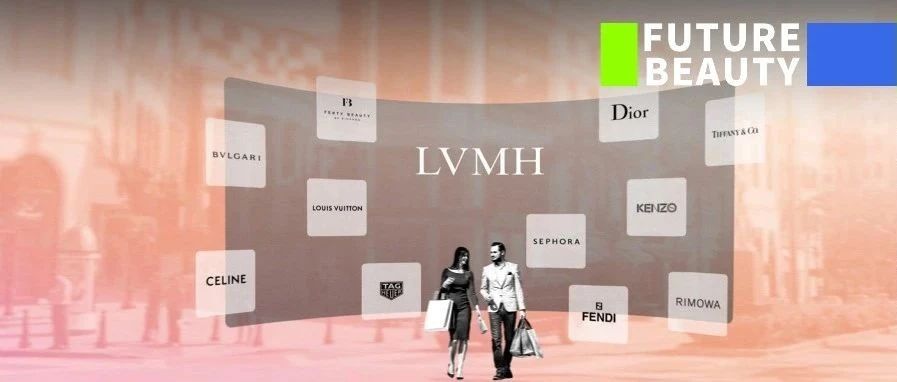
Core Viewpoint - LVMH is experiencing significant challenges in the luxury goods market, with a notable decline in overall revenue and profits, yet its high-end beauty segment shows resilience and potential for growth amidst these difficulties [2][4][20]. Financial Performance - Total revenue for the first half of 2025 was €398.1 billion (approximately RMB 3,351.2 billion), a year-on-year decline of 4% [4][7]. - Operating profit decreased by 15% to €90.1 billion (approximately RMB 758.4 billion), with the operating margin dropping to 22.6%, down 2.5 percentage points year-on-year [4][7]. - The Asian market (excluding Japan) saw its share shrink by 2 percentage points to 28% [4][17]. Market Trends - The "Veblen Effect," which traditionally drove luxury consumption, appears to be weakening, particularly among younger consumers who are reassessing the value of luxury goods [6][7]. - Bain & Company warns of significant challenges ahead for the luxury sector, predicting it may face its largest setback in 15 years [7]. Beauty Segment Performance - The Perfumes and Cosmetics division reported stable revenue of €40.8 billion (approximately RMB 343.4 billion), with organic growth remaining flat [20]. - Sephora, as part of the selective retailing segment, achieved revenue of €8.63 billion (approximately RMB 726.7 billion), with a 2% organic growth, marking it as the only department with positive growth in the first half of 2025 [21][22]. Regional Insights - The Asian market's contribution to LVMH's sales has declined, with organic revenue in Japan dropping by 15% due to currency fluctuations affecting tourist spending [17][18]. - In China, LVMH's beauty brands are facing challenges, with classic brands experiencing brand aging and declining transaction volumes despite some increases in transaction value [23][24]. Strategic Initiatives - LVMH is focusing on high-end beauty as a key growth area, with significant investments in brand innovation and market entry strategies targeting younger consumers [20][27]. - The introduction of new beauty products under the Louis Vuitton brand and the expansion of Fenty Beauty in China are part of LVMH's strategy to capture the Z generation market [27][28]. Organizational Changes - Sephora's operations in China are being prioritized, with the global CEO directly overseeing the market to enhance competitiveness [30][33]. - LVMH is restructuring its DFS business and reducing workforce in its wine and spirits division to control costs amid declining luxury demand [34].
LVMH Seeks $1 Billion Sale of Fashion Brand Marc Jacobs
PYMNTS.com· 2025-07-26 00:04
Group 1 - LVMH is reportedly looking to sell the fashion brand Marc Jacobs for approximately $1 billion [1] - The company is in discussions with multiple parties and could finalize a deal soon, as reported by the Wall Street Journal [2] - LVMH has a history of both acquiring and selling assets, having acquired Tiffany in 2021 and sold Donna Karan and DKNY in 2016 [2] Group 2 - LVMH's overall business performance declined in the first half of the year, with earnings down 22% compared to the same period in 2024 [3] - The company cited macroeconomic factors such as currency fluctuations, decreased tourist traffic, and comparisons to stronger year-ago performance as reasons for the decline [4] - The luxury market is experiencing mixed results, with high-income consumers becoming more price-conscious and seeking greater value in their luxury purchases [4] Group 3 - LVMH CEO Bernard Arnault described the luxury industry as being in "highly turbulent times" [5] - Tariffs have become a significant issue for the industry, and LVMH is prepared to increase prices and implement other strategies if tariff negotiations are unproductive [5][6] - The company may pass along the costs of tariffs to consumers as part of its mitigation strategy [6]