Pfizer(PFE)

Search documents
Moderna shares hit a low after report suggests the FDA plans to tie COVID shots to child deaths
Fastcompany· 2025-09-15 13:11
Core Viewpoint - The pharmaceutical sector, particularly companies involved in COVID-19 vaccines, is facing significant stock declines following reports linking vaccines to the deaths of 25 minors, which has raised concerns about vaccine safety and regulatory scrutiny [2][3][5]. Group 1: Stock Performance - Moderna shares dropped 7.4% to their lowest level since March 2020, marking a year-to-date decline of over 44% [3]. - Pfizer's shares fell by 3.9%, while BioNTech and Novavax experienced declines of 7.3% and 3.6%, respectively [3]. - This downturn in pharmaceutical stocks contrasts with the broader market, where the S&P 500 has risen more than 12% this year [4]. Group 2: Regulatory Developments - The FDA is expected to present data regarding the vaccine-related deaths at an upcoming advisory panel meeting, which influences vaccine schedules and insurance coverage [5][6]. - The Vaccine Adverse Event Reporting System (VAERS) data, which is self-reported and unverified, is the basis for the FDA's concerns, although it does not establish causation between the vaccine and deaths [6]. Group 3: Changes in Vaccine Policy - The new administration has made significant changes to the vaccine advisory panel, with Secretary Robert F. Kennedy Jr. replacing all members with individuals who have previously criticized vaccines [9]. - The Advisory Committee on Immunization Practices (ACIP) is scheduled to meet on September 18 and 19 to discuss COVID-19 vaccines and other immunizations [10]. Group 4: Company Responses - Moderna's CEO criticized the recent changes in U.S. vaccine policy as a "step backward," emphasizing the rigorous safety monitoring of their vaccine [11]. - Pfizer highlighted extensive data supporting the safety and effectiveness of its vaccine, noting its administration to over one billion individuals [12].



疫苗安全性争议重燃致美股生物科技股下挫 花旗发布谨慎展望
Zhi Tong Cai Jing· 2025-09-15 08:01
Core Viewpoint - The Trump administration's health officials plan to present claims linking COVID-19 vaccines to 25 child deaths to a key vaccine advisory committee, impacting biotech stocks negatively [1] Group 1: Impact on Biotech Stocks - Following the news, U.S. biotech stocks experienced significant declines, with BioNTech down 7.26%, Pfizer down 3.98%, Moderna down 7.40%, and Novavax down 3.62% [1] - Citigroup highlighted the volatility risk for biotech companies due to the news, emphasizing the robust research supporting COVID-19 vaccines and billions of doses administered [1] Group 2: Company Ratings by Citigroup - **BioNTech**: Rated "Buy" with a target price of $140, but considered "high risk" due to typical volatility in biotech stocks and uncertainties in clinical trials [3] - **Moderna**: Rated "Neutral" with a target price of $30, also deemed "high risk" with potential down risks related to market stability and product effectiveness [4] - **Novavax**: Rated "Sell" with a target price of $6, facing risks but with potential upside if the COVID-19 vaccine market recovers unexpectedly [5] - **Pfizer**: Target price set at $26, with both upside and downside risks related to new drug sales and competitive pressures [6]


Blue Chip Stocks With Fat Dividends: Smart Buy Or Value Trap? - Altria Group (NYSE:MO), LyondellBasell Industries (NYSE:LYB)
Benzinga· 2025-09-14 19:32
Group 1 - High dividend yields in blue-chip stocks do not guarantee safe income streams, as some may be value traps rather than genuine investment opportunities [1][5] - LyondellBasell has seen a 40% decline over the past year, with a double-digit dividend yield that appears risky due to missed earnings expectations and negative free cash flow [2] - Pfizer's stock is down 18% over the past year, with its attractive yield driven by significant declines in key income lines, resulting in a payout ratio of about 97% of free cash flow [3] Group 2 - Altria's large dividend payout is sustainable only while business remains stable, but faces risks from regulation, litigation, and declining cigarette volumes [4] - Companies in sectors like infrastructure, chemicals, and telecom may experience margin pressure and regulatory risks, impacting their ability to maintain high dividend payouts [4] - Evaluating high-yield stocks should include analysis of cash flow statements, dividend growth history, and the sustainability of the high yield [6] Group 3 - The top high-yield large-cap U.S. stocks include LyondellBasell (9.88%), United Parcel Service (7.75%), Pfizer (6.92%), Altria (6.39%), and Verizon (6.25%) [7]




Why I Sold Pfizer To Buy Novo Nordisk (NYSE:PFE)
Seeking Alpha· 2025-09-14 07:57
Core Insights - The decision has been made to sell shares in Pfizer and use the proceeds to invest in Novo Nordisk, indicating a strategic shift in investment focus [1]. Group 1: Investment Strategy - The objective is to identify reasonably priced companies with steady long-term growth prospects and uncover small- and mid-cap companies with potential for exponential growth through fundamental analysis [1]. Group 2: Professional Background - The individual has a background as a corporate lawyer with an MBA and has spent 7 years practicing at prestigious law firms, now operating a boutique law firm focused on investment transactions and dispute resolution for the past 10 years [1].


1 Reason Every Investor Should Know About Pfizer (PFE) Stock
The Motley Fool· 2025-09-13 08:00
Core Insights - Pfizer offers a high dividend yield of approximately 7%, significantly higher than the S&P 500's average yield of around 1.2% [1][3] - The company has a long history of dividend payments, having paid dividends for 347 consecutive quarters and increased payouts for 15 consecutive years [3] Financial Performance - Pfizer's recent forward-looking price-to-earnings (P/E) ratio is 8, below its five-year average of 10, indicating potential undervaluation [4] - In the second quarter, Pfizer reported a 10% year-over-year revenue increase and a 30% jump in earnings per share [4] - The company raised its full-year 2025 adjusted diluted EPS guidance, reflecting confidence in its strategic execution and shareholder returns [4] Growth Potential - Pfizer has a robust pipeline with over 50 programs and 80+ clinical trials globally, dedicating 40% of its R&D budget to oncology [4]
传特朗普政府计划指控新冠疫苗导致25名儿童死亡 辉瑞(PFE.US)、Moderna(MRNA.US)股价大跌
智通财经网· 2025-09-12 23:10
Group 1 - Pfizer (PFE.US) and Moderna (MRNA.US) stocks fell sharply following reports that Trump administration health officials plan to present claims linking COVID-19 vaccines to 25 child deaths to a key vaccine advisory committee next week [1][2] - The Advisory Committee on Immunization Practices (ACIP) is responsible for reviewing vaccination data and making recommendations that significantly influence vaccine policy [1][2] - Following the news, Pfizer's stock dropped by 3.98%, Moderna's stock fell by 7.4%, and Novavax (NVAX.US) also saw a decline of 3.62% [1] Group 2 - The U.S. Department of Health and Human Services (HHS) stated that the FDA and CDC regularly analyze vaccine safety data and share results through established ACIP processes, emphasizing that any unverified claims should be considered speculation [1][2] - Moderna highlighted that the safety of its vaccine is being closely monitored by the company, FDA, and regulatory agencies in over 90 countries, with no new safety concerns reported in systems monitoring across various regions [2] - Research indicates that mRNA vaccines produced by Pfizer and Moderna are safe and effective, with severe adverse reactions being extremely rare, although there is a slight increase in myocarditis risk among young males [2][3] Group 3 - FDA Director Marty Makary acknowledged that there have been self-reported cases of child deaths following COVID-19 vaccination, but did not provide specific data, stating that a report will be released in the coming weeks [3] - The claims made by the Trump administration appear to be based on data from the Vaccine Adverse Event Reporting System (VAERS), which collects self-reported data that requires thorough investigation to determine causality [2]
Stocks Settle Mixed as Bond Yields Climb
Nasdaq· 2025-09-12 23:00
Market Overview - The S&P 500 Index closed down -0.05%, the Dow Jones Industrials Index down -0.59%, while the Nasdaq 100 Index closed up +0.42% [1] - Stock indexes settled mixed as higher bond yields led to long liquidation in equities, with the 10-year T-note yield rising +5 basis points to 4.06% [2] - The University of Michigan US September consumer sentiment index fell -2.8 to a 4-month low of 55.4, which weighed on stock prices [5] Economic Indicators - The US consumer sentiment report for September was weaker than expected, contributing to a Fed-friendly outlook for interest rate cuts [3][9] - Markets are pricing in a 100% chance of a -25 basis point rate cut at the upcoming FOMC meeting, with an overall expectation of -70 basis points by year-end [6][9] Company Movements - Warner Bros Discovery (WBD) surged over +16% following reports of a potential acquisition bid from Paramount Skydance [13] - Tesla (TSLA) rose more than +7% after receiving approval for testing autonomous vehicles in Nevada [13] - Micron Technology (MU) increased over +4% on speculation of accelerated growth due to strong demand for AI chips [14] - Oracle (ORCL) fell more than -5% amid reports of insider backing for a competing acquisition bid [17] Sector Performance - Covid vaccine makers, including Moderna (MRNA) and BioNTech SE (BNTX), retreated over -7% following reports linking child deaths to Covid shots [16] - Home builders and suppliers faced declines due to rising T-note yields, with Builders FirstSource (BLDR) and Toll Brothers (TOL) down more than -2% [16]






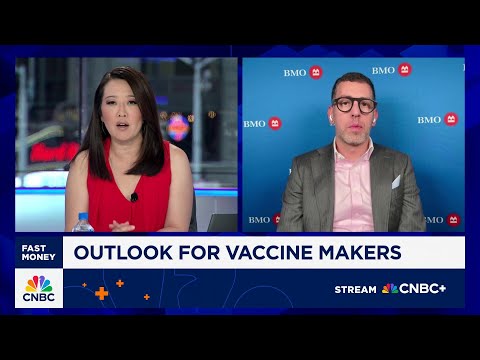
Anti-vaccination rhetoric from Washington has cascading effect for vaccine makers: BMO's Seigerman
CNBC Television· 2025-09-12 22:16
For more, let's bring in Beimo head of healthc care research, Evan David Seagerman. Evan, great to have you with us. How do you think about this in terms of the impact on on other vaccines as Angelica had pointed out.Well, I think this general antivaccine rhetoric is not great for public health. Um, you know, as Angelica said, the COVID vaccine for kids is such a small portion of the current sales. I don't even model it out in my Fiser and Biontech models for what it's worth.um really the bulk of my sales a ...
Pfizer, Moderna shares plunge on report that Trump officials plan to link 25 child deaths to COVID vaccine
New York Post· 2025-09-12 20:46
Core Viewpoint - Shares of Pfizer and Moderna experienced declines of 3.9% and 7.4%, respectively, following reports that the Trump administration intends to link the deaths of 25 children to COVID vaccines, which may influence vaccine access and costs [1][8]. Group 1: Impact on Vaccine Companies - The planned presentation by Trump health officials could affect the perception and market performance of Pfizer and Moderna, as it may lead to changes in vaccine recommendations and insurance coverage [1][8]. - The report indicates that the deaths were sourced from the Vaccine Adverse Event Reporting System (VAERS), which is known for containing unverified reports of vaccine side effects [2][3]. Group 2: Regulatory and Advisory Context - The upcoming meeting of the vaccine advisory panel is critical, as it will determine whether insurers are required to cover the vaccines and the willingness of pharmacies and doctors to administer them [8]. - Health and Human Services Secretary Robert F. Kennedy Jr. has made significant changes to the vaccine panel, replacing its members with his own selections, which may influence future vaccine policy [8][13]. Group 3: Public Health Recommendations - The American Academy of Pediatrics continues to recommend annual COVID vaccinations for children aged 6 to 23 months and asserts that the vaccines are safe and effective [14]. - In contrast, Kennedy has directed health officials to cease recommending vaccinations for healthy children, suggesting that only high-risk individuals or those over 65 should receive them [9][13].

Pfizer, Moderna shares fall on report that Trump officials will link child deaths to Covid shots
CNBC· 2025-09-12 16:21
Core Viewpoint - Shares of Pfizer and Moderna declined following a report linking COVID-19 vaccines to the deaths of 25 children, which is set to be presented to a key vaccine advisory panel [1][2][3] Group 1: Stock Performance - Pfizer's stock fell more than 3% and Moderna's shares dropped over 7% after the report [3] - Novavax, another company involved in COVID-19 vaccine development, saw its stock slide more than 4% [3] Group 2: Regulatory Context - The report is part of a presentation to a vaccine panel that advises the Centers for Disease Control and Prevention (CDC), which plays a crucial role in vaccine access and recommendations [2] - Health and Human Services Secretary Robert F. Kennedy Jr. is moving to change U.S. vaccine policy, including dropping recommendations for healthy children and pregnant women [4] Group 3: Safety Monitoring - Moderna stated that the safety of its vaccine is rigorously monitored by the company, the FDA, and regulators in over 90 countries, with no new safety concerns identified in children or pregnant women [5] - The claim linking vaccines to deaths is based on unverified reports submitted to the federal Vaccine Adverse Event Reporting System [6] Group 4: Scientific Perspective - The CDC emphasizes that only thorough investigations by scientists and public health officials can determine if a vaccine caused or contributed to reported side effects [7] - During a recent Senate hearing, Kennedy supported claims that mRNA vaccines pose a dangerous risk [7]