
Palantir Technologies(PLTR)

Search documents
Palantir Earnings: Good or Bad?
ZACKS· 2025-11-05 17:16
Core Insights - Palantir (PLTR) reported strong Q3 results, attracting significant attention due to recent short positions and market uncertainty [1] Financial Performance - Quarterly sales reached $1.2 billion, marking a 63% increase year-over-year [2] - US commercial revenue surged by 121% YoY, while US government revenue increased by 52% [2] Deal Activity - The company closed over 200 deals worth at least $1 million, including 91 deals worth at least $5 million and 53 deals worth at least $10 million [3] - Total Contract Value (TCV) reached a record $2.8 billion, up 340% from the same period last year [3] Customer Growth - Customer count grew by 45% YoY, indicating strong momentum and a rapidly expanding customer base [4] Future Outlook - Palantir provided its highest sequential quarterly revenue growth guidance in history for Q4, expecting 61% growth [8] - The company also raised its sales, adjusted operating income, and adjusted free cash flow guidance for the current year [8] Market Reaction - Despite robust results, the share reaction was muted, likely due to significant year-to-date gains of 140% in 2025 [10][12] - The company remains a strong candidate for investors seeking exposure to the software and AI sectors, supported by high growth rates and demand forecasts [12]



Here's Why Palantir Technologies Inc. (PLTR) is a Strong Momentum Stock
ZACKS· 2025-11-05 15:51
Core Viewpoint - Zacks Premium provides tools and resources to help investors make informed decisions and invest confidently in the stock market [1]. Zacks Style Scores - Zacks Style Scores rate stocks based on value, growth, and momentum characteristics, serving as complementary indicators to the Zacks Rank [2]. - Stocks are rated from A to F, with A indicating the highest potential for outperforming the market [3]. Value Score - The Value Style Score focuses on identifying undervalued stocks using financial ratios such as P/E, PEG, and Price/Sales [3]. Growth Score - The Growth Style Score assesses a company's financial strength and future outlook based on projected and historical earnings, sales, and cash flow [4]. Momentum Score - The Momentum Style Score evaluates trends in stock prices and earnings estimates to identify favorable investment opportunities [5]. VGM Score - The VGM Score combines all three Style Scores, providing a comprehensive indicator for selecting stocks with attractive value, growth potential, and momentum [6]. Zacks Rank - The Zacks Rank is a proprietary model that uses earnings estimate revisions to simplify portfolio building [7]. - Stocks rated 1 (Strong Buy) have historically produced an average annual return of +23.93% since 1988, significantly outperforming the S&P 500 [8]. Stock Selection Strategy - Investors should prioritize stocks with a Zacks Rank of 1 or 2 and Style Scores of A or B to maximize potential success [9]. - Stocks with lower ranks, even if they have good Style Scores, may still face declining earnings forecasts, increasing the risk of price drops [10]. Company Spotlight: Palantir Technologies Inc. - Palantir Technologies, founded in 2003, specializes in software platforms for the intelligence community [11]. - The company holds a Zacks Rank of 2 (Buy) and a VGM Score of B, indicating strong potential [11]. - Palantir's shares have increased by 4.7% over the past four weeks, and it has a Momentum Style Score of A [12]. - Recent earnings estimates for fiscal 2025 have been revised upward, with the Zacks Consensus Estimate increasing by $0.01 to $0.67 per share, alongside an average earnings surprise of +16.3% [12].

Palantir因估值担忧下跌
Xin Lang Cai Jing· 2025-11-05 15:47
Core Viewpoint - Despite exceeding quarterly performance expectations and raising guidance, Palantir (PLTR) saw a decline of approximately 2.3% in early trading due to analysts citing high valuation multiples and a sentiment of "good news already priced in" in the market [1] Group 1 - Palantir's quarterly performance surpassed expectations [1] - The company raised its guidance following the strong quarterly results [1] - Analyst concerns regarding high valuation multiples contributed to the stock's decline [1] Group 2 - Market sentiment indicated that positive news may have already been factored into the stock price [1] - Notably, prominent short-seller Michael Burry disclosed his bearish position on the company [1] - Palantir's CEO, Alex Karp, criticized Burry following the revelation of his short position [1]
Palantir Stock Just Crossed Below Its 20-Day Moving Average. Options Data Tells Us It Could Be Headed Here Next.
Yahoo Finance· 2025-11-05 15:32
Palantir (PLTR) shares are inching further down in morning trading on Wednesday, Nov. 5 as valuation concerns continue to weigh on sentiment despite a blockbuster third-quarter release. Trading at a forward price-earnings (P/E) multiple of nearly 465x, PLTR is currently one of the most expensive software names in the benchmark S&P 500 Index ($SPX). More News from Barchart Despite the post-earnings dip, Palantir stock remains up roughly 145% versus the start of this year. www.barchart.com Where Options ...
Should You Buy the Dip in Palantir Stock Today?
Yahoo Finance· 2025-11-05 15:22
Palantir (PLTR) shares closed sharply lower on Tuesday, Nov. 4, even though the AI-enabled data analytics company posted another strong quarter and raised its guidance for the full year. Shares are down another 3.6% in Wednesday morning trading. Investors bailed on PLTR primarily because of valuations concerns. At a forward price-earnings (P/E) multiple of nearly 465x, it’s among the most expensive S&P 500 Index ($SPX) names heading into 2026. More News from Barchart Despite the post-earnings decline, P ...
‘Big Short’ Investor Michael Burry Is Betting Big Against the AI Revolution
Yahoo Finance· 2025-11-05 15:17
Core Insights - Michael Burry, known for predicting the 2008 housing crash, has recently taken a bearish stance on the AI sector by acquiring substantial put options on Palantir Technologies and Nvidia, indicating skepticism towards the ongoing AI hype [1][2] Investment Strategy - Scion Asset Management allocated approximately 80% of its $1.1 billion notional portfolio value to put options on Palantir and Nvidia, with Palantir being the largest position at around $912 million and Nvidia at approximately $186 million [5][7] - The put options allow Scion to profit if the stock prices of these companies decline, reflecting Burry's doubts about their valuations amidst the AI boom [2][6] Historical Context - Burry gained fame for his successful shorting of mortgage-backed securities before the 2008 financial crisis, showcasing a history of bold investment calls [3] - His track record has been mixed since then, with some successful predictions and others that did not materialize, such as warnings about overvalued tech stocks during bullish market phases [4] Market Sentiment - Burry's recent actions and social media posts suggest a contrarian view on the AI market, echoing his previous critiques of market exuberance and inflated valuations in tech stocks [4][6]

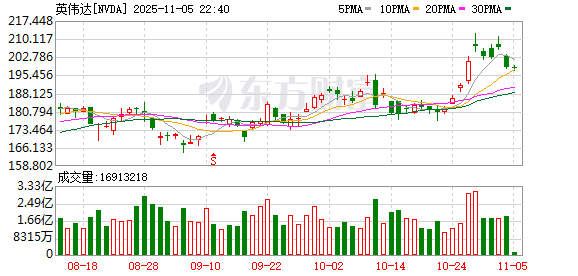
押注逾10亿美元!美国知名“空头”做空英伟达
2 1 Shi Ji Jing Ji Bao Dao· 2025-11-05 14:40
Core Viewpoint - Michael Burry, a well-known short seller, has bet over $1 billion against technology companies, including Nvidia and Palantir, by purchasing put options that profit from stock price declines [2] Summary by Category Investment Actions - Burry has invested approximately $1.1 billion in put options for Nvidia and Palantir, indicating a strong bearish outlook on these companies [2] Market Implications - The purchase of put options suggests that Burry anticipates a significant decline in the stock prices of Nvidia and Palantir, reflecting broader concerns about the technology sector [2]
Here Are Wednesday’s Top Wall Street Analyst Research Calls: Amgen, Cloudflare, Shopify, Super Micro Computer, Wingstop and More
Yahoo Finance· 2025-11-05 14:20
Market Overview - Futures are trading modestly higher after a risk-off day, with the NASDAQ leading the sell-off, closing over 2% lower due to a significant drop in Palantir despite better-than-expected results [2] - The S&P 500 and Dow Jones Industrial Average managed to recover some losses, closing at 6771 and 47,085 respectively, while the NASDAQ closed at 23,348 [2] - Concerns about AI valuation and warnings from top Wall Street bankers about an overbought market contributed to the selling pressure [2][5] Treasury Bonds - Yields across the Treasury curve fell as investors sought the safety of U.S. government debt, with the 10-year bond closing at 4.0% and the 30-year bond at 4.67% [3] - Shrinking job openings to the lowest level since 2021 may support expectations for a December rate cut, as Fed Governors suggest current rates are too restrictive [3] Oil and Gas - Brent Crude and West Texas Intermediate prices declined due to the equity market sell-off and speculation that Russian sanctions may not be as severe as anticipated [4] - Natural Gas prices increased by 1.15% to $4.31, with expectations that the energy trade for 2025 and 2026 may focus on Natural Gas due to rising power demands from AI cloud computing [4] Technology Sector - The technology, AI, and Data Center sectors experienced significant selling pressure, leading to concerns among "Buy the Dip" investors [5] - The focus is shifting towards economic data as the third-quarter earnings season concludes, with investors questioning the potential for a December rate cut [5]
综述丨美国科技股遭抛售冲击全球股市
Xin Hua She· 2025-11-05 14:16
截至4日当天收盘,道琼斯工业平均指数比前一交易日下跌251.44点,跌幅为0.53%;标准普尔500种股 票指数下跌80.42点,跌幅为1.17%;纳斯达克综合指数下跌486.089点,跌幅为2.04%。科技类股票中的 帕兰蒂尔股价下跌7.94%,英伟达股价下跌3.96%。 新华社北京11月5日电 综述丨美国科技股遭抛售冲击全球股市 新华社记者闫亮 由于市场对美国科技类股票估值过高的担忧加剧,以及美国华尔街一些高管警告当前市场回调风险,美 国纽约股市三大股指4日收盘显著下跌。受此影响,全球多数股市5日呈现下跌态势。 此外,资本的"有意为之"或成为近日美股大跌的推手。美国机构3日发布的相关文件显示,美国知名"空 头"迈克尔·伯里已斥资约11亿美元,买入对英伟达和软件企业帕兰蒂尔公司的看跌期权。这种期权能从 股价下跌中获利。 受纳斯达克股指大跌影响,东京股市两大股指5日大幅下挫。日经225种股票平均价格指数收盘下跌 2.5%;东京证券交易所股票价格指数下跌1.26%。今年以来涨幅显著的软银集团一度下跌超过13%。 此前,韩国综合股价指数因投资者对人工智能类股票的追捧,成为今年表现最佳的股指之一。5日,该 股票指数 ...
大空头出手致美股大跌,全球科技股力竭?华尔街这么看
Di Yi Cai Jing· 2025-11-05 14:07
Group 1 - The article discusses the recent stock market pullback driven by various catalysts, particularly focusing on the AI sector, which has seen significant volatility due to short-selling activities by prominent investors like Michael Burry [1][3][6] - Michael Burry has shorted major AI stocks such as Nvidia and Palantir, leading to a notable decline in Palantir's stock price despite strong earnings reports, indicating a disconnect between market sentiment and company performance [1][4][5] - Palantir's stock has a high static P/E ratio of nearly 1000, but expectations for future earnings growth suggest a forward P/E ratio could drop to around 200 by 2026, highlighting the market's speculative nature regarding AI valuations [4] Group 2 - The article notes that the recent sell-off in the stock market is largely driven by emotional factors, with many investors locking in profits as the year-end approaches, despite strong overall performance in the market [2][7] - Asian markets, particularly South Korea and Japan, have also experienced declines in tech stocks, reflecting the global impact of the U.S. tech stock pullback, with significant drops in companies like Samsung and SK Hynix [3][6] - The article highlights that institutional investors are still optimistic about the AI sector's long-term prospects, viewing the current market adjustment as a healthy correction rather than a sign of a bear market [7][11] Group 3 - The ongoing U.S. government shutdown is contributing to market uncertainty, with liquidity tightening and potential economic pressures mounting, which could influence investor sentiment and market dynamics [9][10] - Despite the current pullback, historical trends suggest that November is typically a strong month for U.S. stocks, and there is still hope for a "Santa Rally" as liquidity risks may ease if the government reopens [10][11] - Companies like Amazon, Google, and Microsoft are expected to continue funding their capital expenditures through free cash flow, while others like Meta and Oracle are increasing leverage, indicating varied strategies among tech giants in response to market conditions [8][11]