
Qualcomm(QCOM)

Search documents
挑战英伟达?高通股价一度狂拉20%
第一财经· 2025-10-27 15:58
2025.10. 27 本文字数:966,阅读时长大约2分钟 作者 | 第一财经 李娜 10月27日晚间,高通宣布推出人工智能芯片AI200和AI250,正式进军数据中心市场,上述芯片预 计将分别于2026年和2027年投入商业使用。 微信编辑 | 雨林 第 一 财 经 持 续 追 踪 财 经 热 点 。 若 您 掌 握 公 司 动 态 、 行 业 趋 势 、 金 融 事 件 等 有 价 值 的 线 索 , 欢 迎 提 供 。 专 用 邮 箱 : bianjibu@yicai.com (注:我们会对线索进行核实。您的隐私将严格保密。) 高通在官网公布的细节中,AI200和AI250是基于芯片加速卡和机架的解决方案,均采用其神经处理 单元(NPU)技术。每卡配备768 GB的LPPDR内存,以提供更高的内存容量和更低的成本。其 中,AI200芯片可作为独立组件、可插入现有设备的扩展卡,或作为由高通提供的整机机架服务器的 一部分。该产品的首位客户是沙特阿拉伯的人工智能初创公司Humain,该公司计划从2026年开始 基于这款新芯片部署200兆瓦的算力。 "借助高通AI200和AI250,我们正在重新定义机架级AI ...



Qualcomm stock pops 20% as it warms up to rival Nvidia
Invezz· 2025-10-27 15:50
Core Insights - Qualcomm Inc (NASDAQ: QCOM) experienced a significant increase of approximately 20% on Monday, reaching a new 52-week high following the announcement of two new artificial intelligence (AI) chips designed for enterprise data centers [1] Company Summary - The newly announced AI chips are named AI200 and AI250, indicating Qualcomm's strategic focus on enhancing its product offerings in the AI sector [1]

挑战英伟达?高通入局AI芯片市场,股价一度狂拉20%
Di Yi Cai Jing· 2025-10-27 15:34
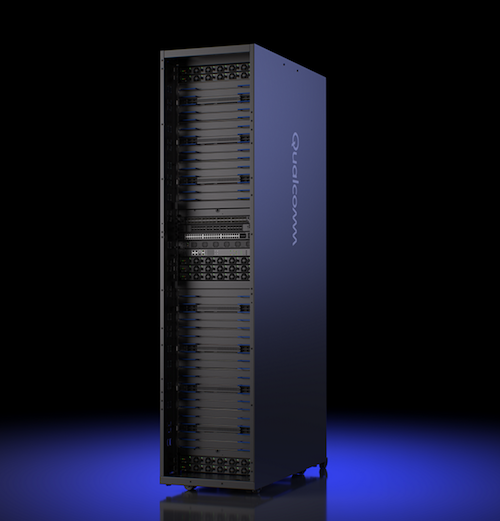
高通在官网公布的细节中,AI200和AI250是基于芯片加速卡和机架的解决方案,均采用其神经处理单 元(NPU)技术。每卡配备768 GB的LPPDR内存,以提供更高的内存容量和更低的成本。其中,AI200 芯片可作为独立组件、可插入现有设备的扩展卡,或作为由高通提供的整机机架服务器的一部分。该产 品的首位客户是沙特阿拉伯的人工智能初创公司Humain,该公司计划从2026年开始基于这款新芯片部 署200兆瓦的算力。 高通称,两款AI芯片预计将分别于2026年和2027年投入商业使用。 10月27日晚间,高通宣布推出人工智能芯片AI200和AI250,正式进军数据中心市场,上述芯片预计将 分别于2026年和2027年投入商业使用。 这一举动也意味着这家在移动领域驻守的芯片巨头开始向外扩延,并正式向英伟达所在AI计算领域发 起挑战。 截至发稿前,高通的股价为193.48美元每股,较前一交易日上涨24.54美元,涨幅为14.53%。在消息公 布后,该公司涨幅一度扩大至超20%,创2019年以来最大日内涨幅。 有观点认为,此次高通的入场,正在改变AI芯片市场的竞争格局。此前,英伟达凭借其全面的软件和 硬件生态系统, ...
中国资产爆发,高通一度涨超20%,黄金跳水跌破4000美元
2 1 Shi Ji Jing Ji Bao Dao· 2025-10-27 15:25
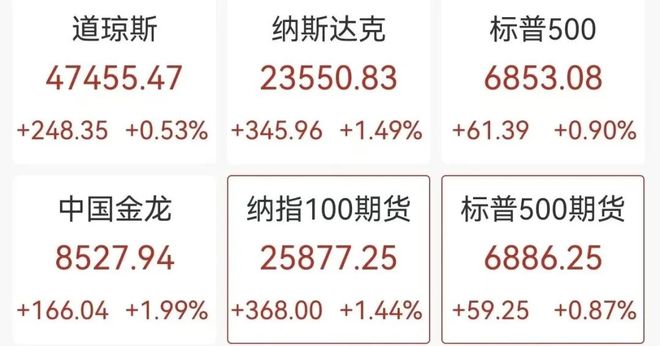
Market Performance - The three major U.S. stock indices opened higher, reaching new historical highs, with the Nasdaq index up nearly 1.5%, and both the Dow Jones and S&P 500 indices rising over 0.5% [1] - The Dow Jones index closed at 47,455.47, up 248.35 points (+0.53%), while the Nasdaq and S&P 500 indices closed at 23,550.83 (+345.96, +1.49%) and 6,853.08 (+61.39, +0.90%) respectively [2] Technology Sector - Qualcomm led the tech sector with a significant increase, rising over 20%, marking its largest intraday gain since 2019, following the announcement of its AI chips aimed at competing with Nvidia in the data center market [2] - Intel's stock rose over 5%, pushing its market capitalization above $190 billion, while Nvidia, Google, Amazon, and Microsoft also saw gains of over 2% [2] Chinese Stocks - Chinese assets surged, with the Nasdaq Golden Dragon Index and the Wind Chinese Concept Stock Index both increasing by approximately 2%, driven by notable gains in Baidu (+5%), JD.com (+3%), and Alibaba (+2%) [2] Gold Market - Gold prices fell below $4,000 per ounce for the first time since October 10, with a daily decline exceeding 3%, while silver prices also dropped around 5% [5] - Analysts noted that the recent decline in gold prices was due to profit-taking after a significant rise, with Citigroup downgrading its overweight recommendation on gold due to concerns over high positions [7] Cryptocurrency Market - The cryptocurrency market experienced mixed performance, with over 12,500 traders liquidated, resulting in over $400 million in liquidation amounts [9] - Bitcoin's trading volume surged by 78.21%, with its price at $114,793, while Ethereum and other cryptocurrencies also saw significant trading volume increases [10] Regulatory Environment - The Governor of the People's Bank of China emphasized the need to combat domestic virtual currency operations and speculation, highlighting the risks associated with stablecoins and their regulatory challenges [12]




Qualcomm stock surges on AI chips launch
Proactiveinvestors NA· 2025-10-27 15:22
Group 1 - Proactive provides fast, accessible, informative, and actionable business and finance news content to a global investment audience [2][3] - The news team covers key finance and investing hubs including London, New York, Toronto, Vancouver, Sydney, and Perth [2] - Proactive focuses on medium and small-cap markets while also covering blue-chip companies, commodities, and broader investment stories [2][3] Group 2 - The team delivers news and insights across various sectors including biotech, pharma, mining, natural resources, battery metals, oil and gas, crypto, and emerging technologies [3] - Proactive adopts technology to enhance workflows and improve content production [4][5] - All content published by Proactive is edited and authored by humans, ensuring adherence to best practices in content production and search engine optimization [5]
中国资产爆发,高通一度涨超20%,黄金跳水跌破4000美元
21世纪经济报道· 2025-10-27 15:21
Market Performance - The U.S. stock market opened with all three major indices rising, reaching new historical highs, with the Nasdaq index up nearly 1.5% and both the Dow Jones and S&P 500 indices up over 0.5% [1][2] - The Nasdaq Golden Dragon Index and the Wind China Concept Stock Index both increased by approximately 2%, with notable gains in Chinese stocks such as Baidu (up over 5%), JD.com (up nearly 3%), and Alibaba (up nearly 2%) [3][4] Technology Sector - Qualcomm led the tech sector with a significant increase, rising over 20%, marking its largest intraday gain since 2019, driven by the launch of AI chips to compete with Nvidia [3] - Other tech giants like Intel, Nvidia, Google, Amazon, and Microsoft also saw substantial gains, with Intel's market cap exceeding $190 billion [3] Currency and Commodities - The offshore RMB appreciated against the USD, rising over 200 basis points, while the A50 index increased by about 1.2% [4] - Gold prices fell below $4000 per ounce for the first time since October 10, with a daily decline exceeding 3%, and silver prices also dropped significantly [4][5] Cryptocurrency Market - The cryptocurrency market experienced a significant increase in trading volume, with Bitcoin's trading volume rising by 78.21% and Ethereum's by over 50%, despite over 125,000 traders facing liquidation, amounting to over $400 million [6][7] - The People's Bank of China emphasized the need to combat virtual currency trading and speculation, highlighting the risks associated with stablecoins and their regulatory challenges [8]

Bernstein’s Stacy Rasgon breaks down why he likes Qualcomm
CNBC Television· 2025-10-27 14:54
Joining us this morning, Stacy Rasgen Bernstein, senior analyst. Stacy's got an outperform on Qualcomm target of 185. Stacy, what a great time to have you on.I mean, what do you make of this reaction and and the overall move. >> Yeah, you bet. So, today's probably a good day to announce something like this.Now, people actually forget Qualcomm has actually sold AI accelerators for for quite a while. They've had the AI 100. The these look like next generation parts.Um, so we'll see if they can compete or not. ...

Bernstein's Stacy Rasgon breaks down why he likes Qualcomm
Youtube· 2025-10-27 14:54
Core Viewpoint - Qualcomm is positioned to benefit from the growing AI market, with significant potential in AI accelerators and CPUs for AI servers, despite current market models not reflecting this opportunity [1][2][3] Qualcomm's AI Strategy - Qualcomm has been selling AI accelerators for years, and the introduction of next-generation parts could enhance its competitive position in the AI space [1][3] - The company has substantial option value in AI, which is not currently reflected in market models [2][3] Market Dynamics and Competition - The inference market is expected to be more fragmented compared to the trading market, which is dominated by Nvidia [5][6] - There is potential for Qualcomm to gain market share in inference, as the total addressable market (TAM) is large enough to accommodate multiple players [6][7] Nvidia's Position - Nvidia is expected to maintain a strong position in the inference market, but increased competition could impact its market dominance [7][8] - The key question for Nvidia is not pricing but the ability to continue improving performance, which has historically allowed them to maintain margins despite rising costs [10][12] Future Outlook - The overall opportunity in the AI market remains significant, and as long as the market continues to grow, there is room for various companies to benefit [9][10] - Nvidia's strategy focuses on enhancing GPU performance, which is crucial for sustaining margins in a competitive landscape [12][13]

Qualcomm Stock Surges on AI Chip Launch
WSJ· 2025-10-27 14:52
Core Insights - Shares in the semiconductor maker increased by 20% following the launch of a new AI chip aimed at competing with Nvidia [1] Company Summary - The semiconductor maker has introduced an AI chip designed to enhance its competitive position in the market against Nvidia [1] Industry Summary - The launch of the AI chip signifies a strategic move within the semiconductor industry to capture market share in the rapidly growing AI sector [1]

美股异动 | 推出人工智能芯片 高通(QCOM.US)直线拉升大涨超18%
智通财经网· 2025-10-27 14:38
Core Viewpoint - Qualcomm (QCOM.US) experienced a significant stock price increase of over 18%, marking its largest intraday gain since 2019, closing at $199, following the announcement of two AI chips aimed at the data center market [1] Group 1: Product Development - Qualcomm has introduced two AI chips, named AI200 and AI250, targeting the data center sector [1] - The new chips are designed to enhance memory capacity and optimize the performance of AI applications [1] - Commercial supply of these chips is planned to begin next year, with the AI200 and AI250 expected to be launched in 2026 and 2027, respectively [1] Group 2: Strategic Direction - This product launch represents a crucial step for Qualcomm in diversifying its business and moving beyond the limitations of the smartphone market [1] - The company aims to expand into the rapidly growing AI infrastructure sector [1]