
Qualcomm(QCOM)

Search documents
Will QCOM's Utility Market Expansion With Anterix Deal Boost Shares?
ZACKS· 2026-02-27 15:55
Core Insights - Qualcomm is expanding its presence in the utility and critical infrastructure market through a partnership with Anterix, aiming to accelerate the adoption of next-generation private wireless networks for utilities across the U.S. [1][8] Group 1: Partnership and Technology - Qualcomm will provide industrial-grade IoT chipsets, including the Snapdragon SDX35-3 and SDX32-3 modems, designed for large-scale utility deployments, enhancing mission-critical connectivity [2][8] - The Snapdragon X62 modem offers high-speed 5G connectivity with power-efficient performance, suitable for large-scale utility and industrial applications [3] - Qualcomm's 9205S modem supports cellular and satellite connectivity with low-power operation, aiding utilities in maintaining reliable coverage for smart meters and grid monitoring [3] Group 2: Market Trends - The private wireless and industrial IoT markets are rapidly growing as utilities transition to secure, low-latency LTE and 5G networks, with companies like Easymetering utilizing Qualcomm's SDX35-3 modem for advanced metering solutions [4] Group 3: Competitive Landscape - Qualcomm faces competition from Intel and Broadcom, with Intel promoting AI-enabled edge computing and rugged processors for smart grids, and Broadcom providing networking and custom chip solutions for industrial communications [5][6] Group 4: Financial Performance - Qualcomm shares have decreased by 5.7% over the past year, contrasting with the industry's growth of 59.7% [7] - The company's shares currently trade at a price/earnings ratio of 12.83, lower than the industry's 31.67 [10] - Earnings estimates for fiscal 2026 have declined by 7.5% to $11.18, while estimates for fiscal 2027 have decreased by 8.8% to $11.41 [11]


Why Qualcomm Stock Could Be Heading For A Correction?
Forbes· 2026-02-27 14:40
Core Viewpoint - Qualcomm is facing significant challenges, including margin compression, declining handset revenue, and escalating competition in the premium Android market, which could impact its financial performance and stock value [3][4][5][6]. Financial Performance - In Q1 2026, Qualcomm's net income decreased by 6% year-over-year despite a 5% increase in revenue, indicating potential ongoing financial strain [10]. - Revenue guidance for Q2 2026 is projected between $10.2 billion and $11.0 billion, which falls short of consensus expectations, suggesting adverse effects on near-term revenue and earnings growth [10]. - Qualcomm's gross margin fell to 55% from 56% a year prior, and operating margin narrowed by approximately 300 basis points year-over-year [10]. Risks Identified - **Margin Compression**: This is attributed to an unfavorable product mix and increasing costs, which could further pressure profitability [4]. - **Handset Revenue Decline**: Supply chain disruptions are causing a decline in handset revenue, with management noting industry-wide memory supply constraints affecting demand [10]. - **Escalating Competition**: There is increasing competition in the premium tier Android market, with key players like Samsung and MediaTek impacting Qualcomm's market share and pricing power [10]. Historical Context - Qualcomm's stock has shown vulnerability to significant downturns in the past, including a nearly 79% drop during the Dot-Com crash and a 48% decline amid the Global Financial Crisis [7].
庄思民:高通以AI原生6G加速下一代无线技术落地
Huan Qiu Wang· 2026-02-27 10:30
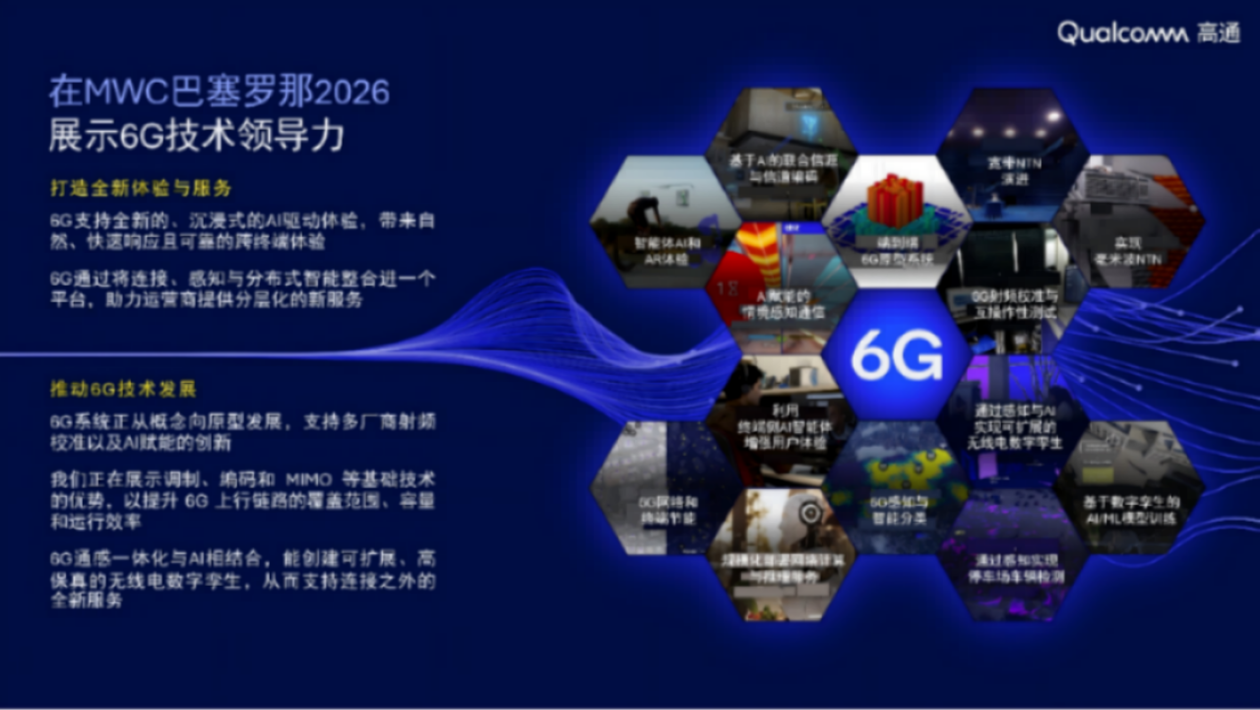
Core Viewpoint - Qualcomm is set to showcase its advancements in 6G technology at the upcoming MWC 2026, focusing on intelligent and efficient engineering practices, with three core themes: evolution of 6G foundational technologies, AI-native design for new experiences, and a digital twin platform empowered by perception [1][7]. Group 1: 6G Foundational Technology Evolution - The development of 6G begins with scalable system design choices, emphasizing efficient use of bandwidth, improved spectrum efficiency, and advancing air interface technologies towards greater intelligence [3]. - Qualcomm will present an end-to-end 6G prototype system that integrates technologies such as massive MIMO, probabilistic shaping, and full-duplex subband, enhancing spectrum efficiency and increasing throughput for data-intensive applications [3]. - Collaborations with leading infrastructure suppliers for 6G RF calibration and interoperability testing are underway to validate key RF front-end performance targets, advancing the early ecosystem of 6G [3]. Group 2: AI-Native Experience and Services - The core challenge for wireless communication systems has shifted from mere bit transmission to ensuring a consistent experience across all scenarios, with distributed computing, collaborative communication, and context-aware adaptability becoming key research areas for 6G [4]. - Four core technological achievements will be showcased: AI and AR experiences leveraging distributed computing, AI-enabled context-aware communication, scalable network computing and inference services, and enhanced cellular experiences through AI agents [4]. Group 3: Integrated Sensing and Communication (ISAC) - ISAC extends wireless communication beyond mere connectivity into the realm of perception, creating new service opportunities and pathways for efficient wireless system operation [5]. - Key demonstrations will include real-time target detection and tracking capabilities, scalable radio digital twins, AI/ML model training based on synthetic data, and energy-efficient 6G networks [5]. Group 4: Non-Terrestrial Networks (NTN) - The evolution of non-terrestrial networks is crucial for achieving comprehensive broadband coverage in 6G, with advancements in millimeter-wave NTN technologies being explored [6]. - Next-generation broadband access terminals will utilize millimeter-wave spectrum to provide robust, high-speed satellite connections across wider areas, including direct satellite connections to various devices [6]. Group 5: Future Development of 6G Technology - The wave of 6G is fully underway, with Qualcomm actively participating in 3GPP's research on new capabilities and architectures for 6G [7]. - The company aims to continue its focus on AI-native experiences, perception-enabled infrastructure, and radio digital twins, leveraging its extensive experience in mobile communication technology evolution [7].
Smartphone market set to shrink 13% due to memory chip crisis
BusinessLine· 2026-02-27 09:19
Core Insights - The global smartphone market is projected to contract by 12.9% in 2026 due to an unprecedented memory chip shortage, marking a significant crisis for the industry [1][2] - The forecast has been dramatically revised down from earlier estimates, with expected mobile shipments dropping to approximately 1.1 billion in 2026 from 1.26 billion the previous year, reversing years of gradual growth [2] - The ongoing memory crunch is affecting all sectors of the electronics industry, particularly impacting smartphone manufacturers who are adjusting by reducing specifications and focusing on premium devices [2][5] Industry Impact - IDC predicts a seismic shift in the smartphone market in terms of size, average selling prices, and competitive landscape, with expectations that the situation will not improve until at least mid-2027 [3] - Counterpoint Research also forecasts a decline of 12.4% in smartphone sales for the current year, attributing this to a full-scale supply shock related to memory chips [3] - The cost of memory chips, including DRAM and NAND, is squeezing profit margins for many Android device brands, particularly affecting entry-level models which are more sensitive to rising material costs [5] Market Dynamics - Premium handsets, such as Apple's iPhone lineup, are expected to fare better during the crisis, while companies like Xiaomi and Lenovo have indicated that consumer prices may need to increase [6] - The memory shortage is anticipated to extend into 2027, and even after supply is restored, it is unlikely that prices will revert to 2025 levels [6][7] - The segment of smartphones priced below $100, which saw around 170 million units shipped last year, is now considered uneconomical to maintain due to the rising costs of memory [7]


世界首次五百强断崖:日本149家,美国151家,中国3家,现在呢
Sou Hu Cai Jing· 2026-02-27 09:13
前言 很多人看世界五百强榜单,只觉得是一堆企业的排名,比谁更有钱、规模更大,但其实这张榜单,更像 是一面照妖镜,把全球经济的起起落落、各国实力的此消彼长,看得明明白白。 回望1995年《财富》首次发布世界500强排行榜时的格局,如今很多人都难以想象,榜单几乎被美国和 日本包揽,当时的中国企业不仅数量稀少,在全球榜单中也几乎没有话语权。 从149到40 如果把时间往回推三十年,在欧洲的斯特拉斯堡,或者美国纽约那些金融写字楼里,假如有人当众说一 句:未来几十年,中国会把日本从全球产业竞争的中心位置挤出去,很多人可能只会当作笑话听。 当时的世界格局完全不是现在这样,日本在经济舞台上的地位几乎无人能撼动,1995年发生了一件很有 象征意义的事。 《财富》杂志在那一年第一次把服务业公司纳入统计,正式形成了我们今天熟悉的"世界500强"榜单体 系。 从那份榜单的结构来看,当时全球商业力量几乎被两个国家垄断:美国有151家公司上榜,日本紧跟其 后,149家。换句话说,这两个国家加起来几乎占据了榜单的六成席位。 当时的日本正处在一种极度自信甚至有点飘的阶段。全球前十强企业里,日本公司竟然占了六个席位, 而且前三名几乎都被日本 ...




Can Snapdragon 8 Elite Gen 5 for Galaxy Launch Boost QCOM Shares?
ZACKS· 2026-02-26 16:32
Core Insights - Qualcomm has launched its advanced mobile chip, Snapdragon 8 Elite Gen 5 for Galaxy, enhancing its partnership with Samsung Electronics [1] - The new processor is optimized for the Samsung Galaxy series, specifically powering the Galaxy S26 Ultra globally [1] Chip Features and Performance - The Snapdragon 8 Elite Gen 5 includes the custom 3rd Gen Qualcomm Oryon CPU, next-generation Qualcomm Adreno GPU, and advanced Qualcomm Hexagon NPU, improving performance, graphics, and on-device AI [2] - The platform supports faster workflows, enhanced camera capabilities, and personalized AI experiences [2] - Qualcomm is collaborating with Samsung to optimize the chip for Galaxy AI features, ensuring efficient background tasks and low power consumption [3] - The chip features Qualcomm Smart Transmit technology for improved connectivity across 5G, Wi-Fi, Bluetooth, and satellite links [3] - The Qualcomm FastConnect 7900 mobile connectivity system is included, enhancing responsiveness for interactions on Galaxy devices [3] Competitive Landscape - Qualcomm faces competition from Apple and Broadcom in the mobile chip market [4] - Apple is upgrading its A-series chips and has introduced its first in-house 5G modem, aiming to enhance performance and reduce reliance on external suppliers [4] - Broadcom is developing advanced Wi-Fi and wireless combo chips, including Wi-Fi 7 and 8 solutions, to improve mobile device connectivity [5] Financial Performance and Valuation - Qualcomm shares have decreased by 5.6% over the past year, contrasting with the industry's growth of 65% [6] - The company's shares currently trade at a price/earnings ratio of 12.85, significantly lower than the industry average of 32.86 [8] - Earnings estimates for fiscal 2026 have declined by 7.5% to $11.18, while estimates for fiscal 2027 have decreased by 8.8% to $11.41 [9]

Anterix Deepens Collaboration with Qualcomm to Accelerate Utility Grid Connectivity
Globenewswire· 2026-02-26 12:31
Core Insights - Anterix has expanded its collaboration with Qualcomm to enhance the adoption of next-generation connectivity for utilities and critical infrastructure operators across the nation [1][2] - The partnership aims to provide a comprehensive private wireless connectivity platform that supports safer operations, greater resilience, and long-term grid modernization for the utility sector [2][3] Collaboration Details - The collaboration focuses on developing new industrial-grade IoT chipsets specifically optimized for utility use cases, including Qualcomm's Snapdragon SDX35-3 and SDX32-3 IoT Modems, which will enable 4G and 5G connectivity on Anterix's 900 MHz broadband platform [3][4] - Eight utilities have already chosen Anterix-enabled private wireless as the foundation for their next-generation grid connectivity [3] Strategic Importance - The partnership provides utilities with a scalable roadmap to 5G, delivering immediate operational value while supporting long-term network evolution [4] - The collaboration is positioned to future-proof the adoption of private wireless networks, enhancing operational efficiency and resilience in the energy sector [4]


MWC 2026剧透:高通以6G+AI双引擎,打造通信新范式
Huan Qiu Wang· 2026-02-26 08:37
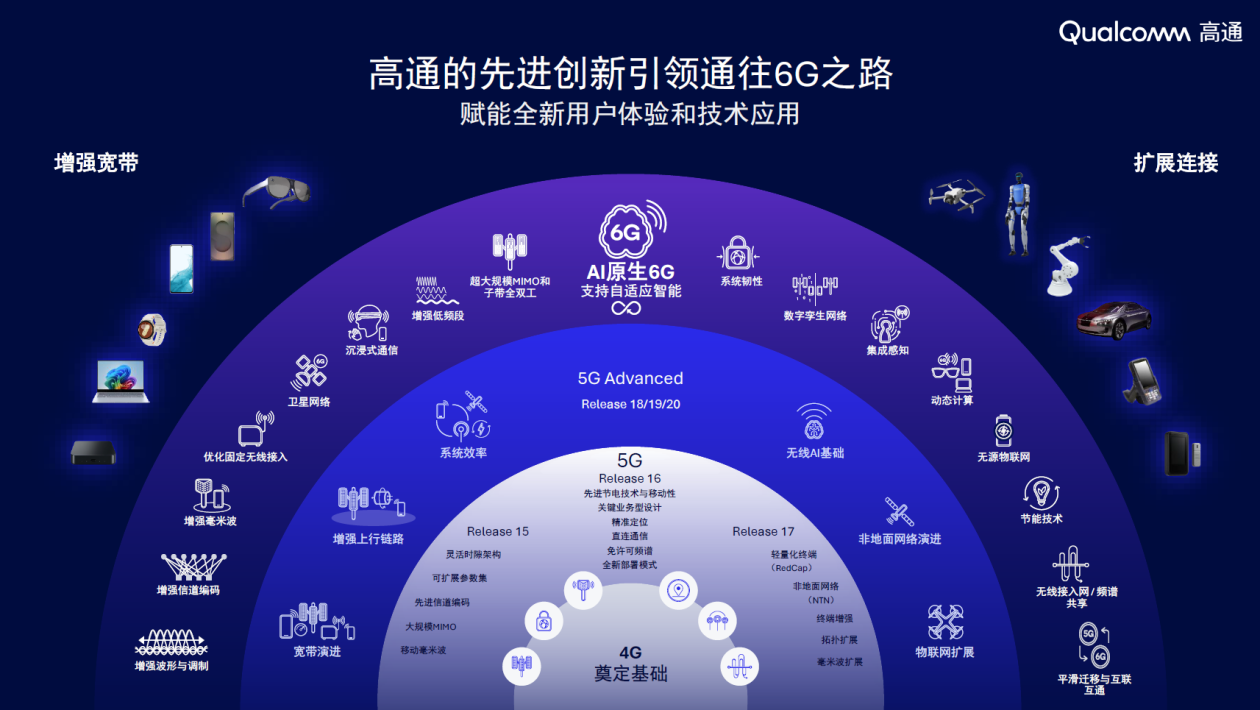
Core Insights - The year 2025 is recognized as the "standardization year for 6G," with a consensus in the industry that 6G will not only enhance communication capabilities but also serve as a collaborative technology innovation platform deeply integrated with AI [1][3] - The transition of communication networks from "data pipelines" to "intelligent foundations" is crucial for supporting personal intelligence, embodied intelligence, and the digital upgrade of various industries, making it an essential infrastructure in the AI era [1] Group 1: Technological Advancements - Qualcomm has initiated systematic investments and explorations in multiple cutting-edge technology areas, leading industry research and promoting standardization for 6G, aiming to create an end-to-end system that encompasses terminal devices, networks, and computing infrastructure [3][6] - In foundational technology, Qualcomm is testing ultra-large-scale MIMO to support new wide-area capacity, providing feasible paths for operators to reduce costs and accelerate commercialization [3] - Qualcomm has achieved interoperability verification of wireless AI with Nokia Bell Labs, enabling AI training and collaborative operation between terminals and the cloud based on shared data or models [3] Group 2: Industry Evolution - Qualcomm's continuous investment and technological accumulation across multiple generational nodes have positioned it as a key player in the evolution of 6G, building on its historical contributions from 2G to 5G [5] - The integration of AI, expansion of spectrum resources, and enhancement of performance and perception capabilities in 6G are seen as new missions for communication technology, connecting the physical world with digital intelligence [5] - The upcoming MWC 2026 will showcase Qualcomm's vision for 6G, emphasizing its engineering and systematic approach to make 6G an innovative platform that transcends mere connectivity [6][8] Group 3: Future Applications - Qualcomm plans to demonstrate the natural, rapid, and reliable cross-terminal experience brought by the integration of 6G and AI during the MWC, focusing on the new layered services that operators can provide [8] - The transition from concept to prototype for 6G systems will be highlighted, showcasing innovations in multi-vendor RF calibration and AI-enabled advancements, as well as the latest developments in millimeter-wave NTN and scalable, high-fidelity wireless digital twins [8] - The industry is expected to recognize that 6G is not just an isolated generational upgrade but a systematic reconstruction centered around an AI-native communication system [8]
Vusion and Qualcomm Unveil their AI-Native Store™ Vision
Prnewswire· 2026-02-25 18:56
Core Insights - Vusion and Qualcomm have introduced "The AI-Native Store™: The New Operating System for Physical Commerce," a white paper outlining how BLE-native infrastructure and on-device AI will transform retail operations and customer engagement [1] Group 1: AI-Native Store Concept - The AI-Native Store™ leverages Bluetooth Low Energy (BLE) and intelligent shelf-edge systems to enhance store interactions, enabling real-time support for shoppers with BLE-native devices [1] - Retailers lacking BLE and EdgeSense capabilities will struggle to engage consumers effectively, leading to a competitive disadvantage as the industry shifts towards AI-native retail [1] Group 2: Benefits for Retailers - AI-native stores can provide up to 1.5–2 percentage points of operating margin improvement [1] - The implementation of AI-native technology can save associates 60–90 minutes of time per shift and improve picking accuracy for local e-commerce [1] - Enhanced on-shelf availability and significant improvements in shelf condition are expected outcomes of adopting AI-native systems [1] Group 3: Company Profiles - Vusion is a leader in AI-powered digitalization solutions for physical commerce, serving over 350 major retail groups globally [1] - Qualcomm Technologies emphasizes the transformative potential of AI at the edge, particularly in the retail sector, to create more responsive and interactive shopping environments [1] - Both companies are committed to building a scalable and open retail infrastructure that integrates AI and BLE technology for improved customer experiences [1]

Loop Capital Upgrades Qualcomm (QCOM) to Buy, Sees Stock Nearing Turning Point
Yahoo Finance· 2026-02-25 15:46
QUALCOMM Incorporated (NASDAQ:QCOM) is included among the Goldman Sachs Dividend Stocks: Top 14 Stock Picks. Loop Capital Upgrades Qualcomm (QCOM) to Buy, Sees Stock Nearing Turning Point Photo by Vitaly Taranov on Unsplash A February 24 report by CNBC said Loop Capital sees QUALCOMM Incorporated (NASDAQ:QCOM) nearing a turning point. The firm believes some of the pressures that weighed on the stock are starting to ease, while new growth opportunities are beginning to take shape. Analyst Gary Mobley upg ...