
Sanofi(SNY)

Search documents
SNY Down Despite Eczema Candidate Meeting Goal in Phase III Study
ZACKS· 2025-09-04 15:51
Core Insights - Sanofi announced positive results from the phase III COAST 1 study for amlitelimab, an anti-OX40L monoclonal antibody, aimed at treating moderate-to-severe atopic dermatitis in patients aged 12 and above [1][7] - The study achieved all primary and key secondary endpoints, demonstrating significant skin clearance and improvement in disease severity compared to placebo [2][7] Study Results - Amlitelimab, administered every four weeks or every 12 weeks, showed statistically significant and clinically meaningful efficacy in skin clearance and disease severity at week 24 [2] - The treatment was generally safe and well-tolerated, with no new safety concerns reported [2] Market Reaction - Despite the positive data, Sanofi's shares fell by 8.8% in pre-market trading on September 4, as the results did not meet investor expectations [3] - Analysts expressed concerns that amlitelimab may be less effective than Sanofi's existing drug Dupixent, which is a leading treatment for various inflammatory diseases [3] Dupixent Performance - In the first half of 2025, Dupixent generated sales of €7.31 billion, marking a 20.7% year-over-year increase [4] - Dupixent holds the top new-to-brand prescription market share across all its approved indications in the U.S., with ongoing efforts to expand its label [4] Stock Performance - Year-to-date, Sanofi's shares have increased by 3.5%, contrasting with a 0.1% decline in the industry [5] Future Developments - Amlitelimab is part of the OCEANA clinical development program, which includes four other phase III studies, with data expected through 2026 [9][10] - Positive results from these studies could support global regulatory filings for amlitelimab for atopic dermatitis [9] Additional Indications - Besides atopic dermatitis, Sanofi is also exploring amlitelimab for celiac disease, alopecia areata, asthma, and systemic sclerosis in mid-stage studies [10]


Sanofi Hit With Shock As Flagship Drug Successor Disappoints Investors
Benzinga· 2025-09-04 13:21
Core Viewpoint - Sanofi's stock experienced a significant decline following the disappointing late-stage trial results for amlitelimab, which raised concerns about the company's ability to maintain its dermatology portfolio after the expiration of patent protections for Dupixent [1][5]. Group 1: Trial Results - The global COAST 1 phase 3 study demonstrated that amlitelimab met all primary and key secondary endpoints, showing statistically significant and clinically meaningful improvements in skin clearance and disease severity compared to placebo at Week 24 for patients aged 12 years and older with moderate-to-severe atopic dermatitis [2]. - Amlitelimab was well-tolerated, with no new safety concerns identified during the study [2]. - The EASI-75 results indicated that 35.9% and 46% of patients achieved a 75% or greater improvement in the eczema area and severity index total score at Q4W, compared to 19.1% on placebo, and 39.1% and 50.3% at Q12W versus 27.6% [3]. Group 2: Comparative Analysis - The validated investigator global assessment scale for atopic dermatitis (vIGA-AD) showed results of 21.1% and 22.5% for amlitelimab compared to 9.2% and 26.5% for placebo, depending on patient inclusion [4]. - Analysts noted that the Phase 3 results were weaker than those of Sanofi's existing drug Dupixent and rival biologic drugs, although the safety profile and convenient 12-week dosing of amlitelimab could still support its use [6]. Group 3: Market Reaction - Following the trial results, Sanofi's stock price fell by 8.52%, trading at $45.64 during the premarket session [6]. - Investors had previously viewed amlitelimab as a key pipeline asset and potential successor to Dupixent, which is set to lose patent protection in 2031 [5].

赛诺菲创新药特瑞可 在华获批 用于延缓1型糖尿病进展
Jing Ji Guan Cha Wang· 2025-09-04 09:36
Core Viewpoint - Sanofi's Tzield (teplizumab) has received approval from the National Medical Products Administration (NMPA) in China for use in children aged 8 and above and adults with stage 2 type 1 diabetes, aiming to delay progression to stage 3 diabetes [1] Group 1 - Teplizumab is a CD3-targeting monoclonal antibody that protects endogenous pancreatic function, allowing patients to delay the progression from stage 2 to stage 3 type 1 diabetes by nearly 3 years [1] - This approval marks a significant milestone for the product, following its status as the first prescription approved in Asia earlier in June [1] - The approval represents a breakthrough in the treatment of type 1 diabetes in China, shifting the approach from "passive treatment" to "active intervention" [1]
赛诺菲(SNY.US)盘前跌近9% 特应性皮炎药物后期试验疗效不及预期
Zhi Tong Cai Jing· 2025-09-04 09:23
Core Viewpoint - Sanofi's experimental drug for atopic dermatitis, amlitelimab, has underperformed in late-stage trials, disappointing investors and leading to a pre-market stock drop of up to 9.3% [1]. Group 1: Drug Performance and Market Impact - Amlitelimab showed improvement in skin clearance and disease severity compared to placebo, but the efficacy was still lower than Sanofi's best-selling drug, Dupixent [1]. - The stock has declined by 18% over the past 12 months, reflecting investor concerns about the drug's potential [1]. - Analysts believe the results of the amlitelimab trial are crucial for Sanofi, especially given the uncertain future of another key drug, itepekimab [1]. Group 2: Future Prospects and Comparisons - Sanofi is seeking alternatives to Dupixent, which is projected to generate over €21 billion annually at peak sales [3]. - Amlitelimab is expected to generate approximately €1.5 billion (around $1.75 billion) in annual revenue by 2031 [3]. - Amlitelimab has a dosing advantage, requiring administration only once every three months compared to Dupixent's more frequent dosing schedule [3]. Group 3: Other Drug Developments - The efficacy results of itepekimab have been mixed in recent late-stage trials, as it is being tested for chronic obstructive pulmonary disease in former smokers [4].


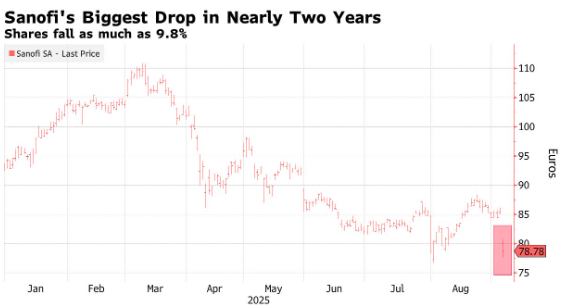
美股异动 | 赛诺菲(SNY.US)盘前跌近9% 特应性皮炎药物后期试验疗效不及预期
智通财经网· 2025-09-04 09:23
Core Viewpoint - Sanofi's experimental drug for atopic dermatitis, amlitelimab, has underperformed in late-stage trials, disappointing investors and leading to a pre-market stock drop of up to 9.3% [1]. Group 1: Drug Performance and Market Impact - Amlitelimab showed improvement in skin clearance and disease severity compared to placebo after 24 weeks of treatment, but the efficacy was still lower than Sanofi's best-selling drug, Dupixent [1]. - The stock has declined by 18% over the past 12 months, reflecting investor concerns about the drug's potential [1]. - Analysts believe the results of the amlitelimab trial are critical for Sanofi, especially given the uncertain future of another key drug, itepekimab [1]. Group 2: Future Projections and Comparisons - Dupixent is projected to generate over €21 billion (approximately $25 billion) annually at its peak, and Sanofi is actively seeking alternatives to replace it [3]. - Amlitelimab is expected to generate around €1.5 billion (approximately $1.75 billion) in annual revenue by 2031 [3]. - Amlitelimab has a dosing advantage, requiring administration every three months compared to Dupixent's more frequent dosing schedule [3]. Group 3: Additional Drug Development - The efficacy results of itepekimab, developed in collaboration with Regeneron, have shown contrasting outcomes in late-stage trials [4].
美股异动丨赛诺菲盘前大跌超9%,OX40L数据不及预期
Ge Long Hui· 2025-09-04 09:07
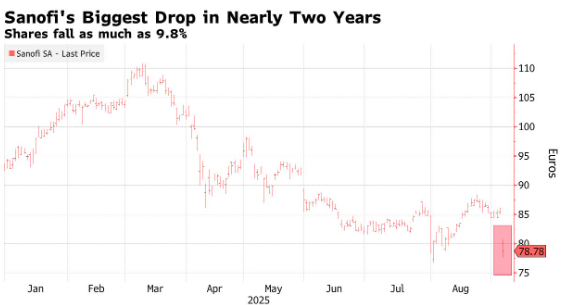
Core Viewpoint - Sanofi (SNY.US) experienced a pre-market drop of over 9%, trading at $45.35, following the announcement that the Phase III COAST 1 study of Amlitelimab for atopic dermatitis met all primary and secondary endpoints, but the results fell short of market expectations [1] Group 1: Company Overview - Amlitelimab is a fully human non-T cell depleting monoclonal antibody targeting OX40L (OX40 ligand), developed by Sanofi [1] - The drug functions by blocking the interaction between the key immune regulatory factor OX40L and its receptor OX40, maintaining the balance between pro-inflammatory T cells and regulatory T cells [1] - Amlitelimab is currently the only OX40L antibody in Phase III development [1] Group 2: Market Reaction - The market reacted negatively to the study results, leading to a significant decline in Sanofi's stock price [1] - The results of the COAST 1 study did not meet the expectations set by market analysts, contributing to the stock's drop [1]
赛诺菲实验性抗炎药物临床试验结果不佳,股价暴跌超9%
Xin Lang Cai Jing· 2025-09-04 08:59
Core Viewpoint - Sanofi's experimental drug amlitelimab for treating atopic dermatitis failed to meet Wall Street expectations in late-stage clinical trials, resulting in a stock price drop of over 9% [1]. Group 1: Drug Development and Clinical Trials - Sanofi is developing amlitelimab to treat atopic dermatitis, a severe form of eczema, aiming for it to complement or potentially replace its blockbuster drug Dupixent, which has patent protection until 2031 [1]. - Analysts from Jefferies noted that while amlitelimab has good safety data and a convenient dosing schedule of once every 12 weeks, its efficacy in the Phase III trial was inferior to previous trial data and less effective compared to competing biologics [1]. - JPMorgan analysts indicated that the data shows amlitelimab's efficacy is not as strong as Dupixent [1]. Group 2: Market Impact - Sanofi's stock fell by 8.9%, making it the largest decliner among the constituents of the STOXX 600 index [2].
X @Bloomberg
Bloomberg· 2025-09-04 07:20
Stock Performance - Sanofi shares experienced a decline following disappointing results from a late-stage trial of its experimental dermatitis drug [1] Pharmaceutical Development - The experimental drug for dermatitis failed to meet investor expectations in a late-stage trial [1]
赛诺菲股票开盘跌7%
Mei Ri Jing Ji Xin Wen· 2025-09-04 07:20
Group 1 - Sanofi's stock opened down by 7% on September 4 [2]

Press Release: Sanofi's amlitelimab met all primary and key secondary endpoints in the COAST 1 phase 3 study in adults and adolescents with atopic dermatitis
GlobeNewswire News Room· 2025-09-04 05:01
Core Insights - Amlitelimab, a monoclonal antibody targeting OX40-ligand, met all primary and key secondary endpoints in the COAST 1 phase 3 study for atopic dermatitis, showing significant skin clearance and reduced disease severity compared to placebo at Week 24 [1][2][6] - The study demonstrated that amlitelimab can be administered every four weeks or every twelve weeks, with a potential for only four doses per year, indicating a significant advancement in treatment options for atopic dermatitis [2][6] - Amlitelimab was well-tolerated, with no new safety concerns identified, and the most common treatment-emergent adverse events were more prevalent in the placebo group [7] Study Details - The COAST 1 study was a randomized, double-blind, placebo-controlled trial involving 601 participants aged 12 years and older with moderate-to-severe atopic dermatitis, conducted across 15 countries [9] - Key endpoints included the proportion of patients achieving a validated investigator global assessment scale for AD (vIGA-AD) of 0 or 1 and a reduction from baseline score of ≥2 points, as well as a 75% or greater improvement in the eczema area and severity index total score (EASI-75) [2][3][9] - Results showed that 21.1% and 22.5% of patients on Q4W and Q12W dosing achieved vIGA-AD 0/1, respectively, compared to 9.2% in the placebo group, with p-values indicating statistical significance [3] Efficacy and Safety - Amlitelimab demonstrated progressively increasing efficacy throughout the treatment period, with significant improvements in both skin clearance and disease severity compared to placebo [6][8] - The study's key secondary endpoints were also achieved, including a reduction in peak pruritus and achieving vIGA-AD 0/1 with minimal erythema [5][6] - The safety profile was favorable, with similar rates of treatment-emergent adverse events between amlitelimab and placebo groups, and mild injection site reactions were the most common adverse events [7] Future Outlook - Additional phase 3 data from the OCEANA clinical development program, which includes COAST 1 and four other studies, is expected to provide further insights into amlitelimab's efficacy and safety [8] - The results from these studies will form the basis for potential global regulatory submissions, with ongoing investigations into the long-term maintenance treatment and off-treatment efficacy [8][10]
