T-Mobile(TMUS)

Search documents
Iridium Awarded U.S. Department of Transportation Contract for Complementary Positioning, Navigation, and Timing Services Deployment and Testing
Prnewswire· 2025-10-21 11:01
Core Insights - Iridium Communications Inc. has been selected by the U.S. Department of Transportation for a contract to support the deployment of Iridium's Positioning, Navigation, and Timing (PNT) services across the United States in collaboration with T-Mobile [1][2] - The partnership aims to enhance the resilience of 5G networks by providing complementary timing synchronization, which is crucial for maintaining service reliability and data integrity [2][3] Group 1 - The U.S. Department of Transportation's CPNT Action Plan focuses on evaluating commercially available PNT technologies to improve the resilience of critical infrastructure, including 5G networks [2] - T-Mobile will expand its installation of Iridium PNT receivers to 90 additional live 5G network sites, which will help protect against GPS disruptions [2][4] - Iridium's PNT signals offer sub-100-nanosecond accuracy and are significantly stronger than traditional GNSS systems, providing reliable service even indoors [4] Group 2 - The collaboration with T-Mobile highlights the effectiveness of Iridium's PNT solutions and positions them as a gold standard for timing synchronization services [3] - T-Mobile will conduct user equipment exercises at its testing range to evaluate the performance of the PNT services [3] - Iridium's low-Earth orbit satellite constellation ensures global connectivity and weather resilience for its PNT services [4][5]


Getac Achieves T-Mobile T-Priority Certification, Delivering Rugged Laptops, Body-Worn Cameras, and In-Car Video Solutions
Prnewswire· 2025-10-20 15:29
Core Insights - Getac Technology Corporation has expanded its partnership with T-Mobile, introducing a comprehensive ruggedized portfolio certified on the T-Mobile Network and T-Priority, a 5G solution aimed at first responders [1][2]. Group 1: Product Offerings - The certified portfolio includes rugged laptops, tablets, body cameras, and in-car video DVRs, providing a reliable performance ecosystem for customers [2][5]. - Specific products in the certified lineup are the B360 Fully Rugged Laptop, V120 Fully Rugged Laptop, S510 Rugged Laptop, UX10 Fully Rugged Tablet, F120 Rugged Tablet, BC-04 4K UHD Rugged Body Camera, and VR-X20 Edge Intelligence System [7]. Group 2: Market Focus - Getac's rugged computing solutions target vertical markets where connectivity, safety, and durability are essential, such as public safety, utilities, transportation, and field services [3][4]. - The devices are designed to support critical communications in high-pressure scenarios, ensuring that first response teams and utility crews can operate effectively during emergencies [3][4]. Group 3: Strategic Vision - Getac aims to empower teams working in extreme environments by providing robust hardware that meets the growing demands for 5G connectivity and AI-driven analytics [4]. - The collaboration with T-Mobile is positioned as a foundation for digital transformation, enabling faster and more informed decision-making in field operations [4]. Group 4: Company Background - Getac is recognized as a global leader in AI-capable rugged mobile technology and serves customers in over 100 countries across various sectors, including defense, public safety, and logistics [6]. - The company has been acknowledged as one of Newsweek's "World's Most Trustworthy Companies" for 2024, highlighting its reputation in the industry [6].

T-Mobile to discontinue convenient customer perk after 10 years
Yahoo Finance· 2025-10-18 18:03
Core Insights - T-Mobile is undergoing significant leadership changes, with CEO Mike Sievert stepping down and COO Srini Gopalan taking over, aiming to enhance the company's digital-first strategy [1][2] Leadership Transition - Mike Sievert will transition to the role of vice chair after five years as CEO, effective November 1 [1] - Srini Gopalan, the current COO, is expected to lead T-Mobile towards becoming a more disruptive force in the industry [2] Customer Policy Changes - T-Mobile plans to increase late fees from $7 to $10 starting November 1, or 5% of the past due balance, whichever is higher [3] - The JUMP! On Demand leasing program will be discontinued on December 1, 2025, affecting customers' ability to upgrade phones every 30 days [4][5] - Customers with leasing agreements ending after December 2 can keep their devices, and remaining lease payments will be forgiven [5] Strategic Focus - The decision to end the JUMP! On Demand program allows T-Mobile to concentrate on its Purchase Option Installment Plan, which offers nine-month payment options for leased phones [7] - T-Mobile aims to make customers reliant on its T-Life app for managing upgrades and account activations by January 2026 [8] Customer Behavior and Market Dynamics - T-Mobile reported gaining 830,000 new postpaid phone customers in Q2 2025, but experienced a 10 basis point increase in postpaid phone churn year-over-year [9] - The company has faced customer loss following price hikes on older phone plans, amid a competitive environment with aggressive promotions from rivals [10] - A survey indicated that 58% of customers from major carriers are considering switching due to rising costs, with a potential loss of 230 million customers across the industry [11] Competitive Position - Despite recent customer losses, T-Mobile is viewed as strategically ahead of competitors like Verizon and AT&T in terms of wireless network performance and value offerings [11]
TMUS Set to Report Q3 Results: Will Higher Revenue Drive Earnings?
ZACKS· 2025-10-17 17:15
Core Insights - T-Mobile, US, Inc. (TMUS) is expected to report third-quarter 2025 results on October 23, with a history of earnings surprises, including a 9.86% surprise over the last four quarters and a 5.58% surprise in the last quarter [1][2] Revenue Expectations - The company is anticipated to experience year-over-year revenue growth, driven by strong postpaid service traction and increasing demand for its 5G offerings [2][11] - Total service revenues are estimated at $17.6 billion, reflecting a 5.3% year-over-year increase, while equipment revenues are projected at $3.55 billion, indicating a 10.9% rise [7] - The Zacks Consensus Estimate for total revenues stands at $21.73 billion, up from $20.16 billion reported in the same quarter last year [8][11] Earnings Projections - The consensus estimate for adjusted earnings per share (EPS) is $2.42, down from $2.61 reported a year ago [8][11] - T-Mobile's Earnings ESP is -1.29%, suggesting that the model does not predict an earnings beat this time [9][10] Competitive Positioning - T-Mobile maintains a leadership position in the 5G market, enhancing its network infrastructure for improved connectivity and coverage [3] - The company completed a $2 billion network expansion in Florida, enhancing 5G speeds and coverage for 22 million residents [4] - Recent agreements with Charter and Comcast to utilize T-Mobile's 5G network, along with partnerships with Southwest Airlines for in-flight WiFi, are expected to positively impact third-quarter results [5][11] Market Challenges - Despite growth opportunities, T-Mobile faces challenges from intense competition in the saturated U.S. wireless market, particularly from major players like AT&T and Verizon [6]
T-Mobile's Fundamentals Trump Political Static: The Bullish Case
MarketBeat· 2025-10-17 12:24
Core Viewpoint - T-Mobile US demonstrates strong operational performance and resilience in the face of industry challenges, positioning itself as a market leader in the telecom sector [1][2][9]. Subscriber Growth - T-Mobile added 1.7 million postpaid net customers in Q2 2025, including 830,000 postpaid phone subscribers, significantly outperforming competitors like AT&T and Verizon [3][4]. - The company also leads in the home internet market, adding 454,000 5G broadband customers, marking its 14th consecutive quarter of leadership in this area [3]. Financial Performance - T-Mobile's postpaid Average Revenue Per Account (ARPA) increased by 5% to $149.87, indicating successful cross-selling and enhanced customer value [4]. - The company generated $4.6 billion in adjusted free cash flow in Q2, raising its full-year guidance for this metric to between $17.6 billion and $18.0 billion [8]. Balance Sheet and Debt Management - T-Mobile's credit rating was upgraded to Baa1 by Moody's, reflecting a stronger financial profile and reduced investment risk [6]. - The company announced the redemption of $1.5 billion in high-cost Sprint notes while issuing $2.8 billion in new senior notes at better rates, saving millions in interest payments [7]. Investment Outlook - Analysts have set a 12-month price target for T-Mobile at $266.17, indicating a potential upside of 17.54% from the current price [6]. - T-Mobile's technological advancements, such as its superior 5G network and innovations like T-Satellite, provide a competitive edge [9][14]. - The company is recognized for its financial discipline, rewarding shareholders with a 16% increase in its quarterly dividend to $1.02 per share [8][14].
富国银行:T-Mobile(TMUS.US)用户增长领跑同行 上调评级至“增持”
智通财经网· 2025-10-17 03:59
Group 1 - T-Mobile is expected to continue leading the industry in user growth and revenue due to its extensive 5G coverage and strong mid-band spectrum [1][2] - Wells Fargo upgraded T-Mobile's stock rating from "hold" to "overweight," citing its strategic advantage in wireless network performance compared to competitors [1] - The valuation premium of T-Mobile compared to AT&T and Verizon has narrowed, indicating stronger potential for T-Mobile to outperform its rivals [1] Group 2 - Verizon's stock is expected to remain in a certain range until the new CEO Dan Schulman clarifies the strategic direction [1] - Verizon faces ongoing challenges, including a net loss of consumer mobile subscribers in Q3, and EBITDA estimates may decline due to increased promotional efforts in Q4 [1] - T-Mobile is projected to maintain its lead in postpaid user growth over the next few years, surpassing its three main competitors [2]
Wall Street Analysts are Bullish on NVDA, MU, NFLX, TMUS
Yahoo Finance· 2025-10-16 15:43
Market Overview - Investors are currently dismissing concerns over the trade war and the ongoing U.S. government shutdown, which has entered its third week [1][2] - Despite threats from President Trump regarding tariffs and bans on Chinese goods, market sentiment remains resilient [2] Company Ratings and Performance - Bank of America has reiterated a buy rating on Nvidia (NASDAQ: NVDA), highlighting its strong positioning in healthcare and artificial intelligence sectors [3][7] - Morgan Stanley maintains a bullish outlook on Nvidia, expecting the stock to continue rising despite market optimism [4] - UBS has also reiterated a buy rating on Micron (NASDAQ: MU), citing robust demand and worsening DRAM supply shortages, with an increase in price target from $225 to $245 [5] - Wells Fargo has upgraded T-Mobile (NASDAQ: TMUS) to an overweight rating, raising the price target from $250 to $260, and expects TMUS to maintain its leadership in postpaid subscriber growth [6][8]


T-Mobile Stock Catches an Upgrade. The Shares Could Gain 15%.
Barrons· 2025-10-16 15:26
Core Insights - The company is strategically positioned ahead of competitors Verizon and AT&T, boasting the broadest 5G coverage according to Wells Fargo analysts [1] Group 1 - The company has the most extensive 5G network compared to its peers [1] - Analysts from Wells Fargo highlight the company's competitive advantage in the telecommunications sector [1] - The strategic positioning may lead to potential growth opportunities for the company [1]

Lululemon downgraded, T-Mobile upgraded: Wall Street's top analyst calls
Yahoo Finance· 2025-10-16 13:33
Core Insights - The article compiles significant research calls from Wall Street, highlighting upgrades and downgrades of various companies that investors should be aware of [1] Upgrades - BofA upgraded Sea Limited (SE) to Buy from Neutral with a price target of $215, increased from $206, citing strong momentum across its businesses [2] - JPMorgan upgraded Las Vegas Sands (LVS) to Overweight from Neutral with a price target of $60, up from $56, due to a recent pullback in shares and a positive outlook for Singapore [2] - JPMorgan also upgraded PPG (PPG) to Overweight from Neutral, maintaining a price target of $112, believing that PPG's market value has decreased more than its business fundamentals [3] - Seaport Research upgraded TKO Group (TKO) to Buy from Neutral with a price target of $214, becoming more constructive after recent share pullbacks [3] - Wells Fargo upgraded T-Mobile (TMUS) to Overweight from Equal Weight with a price target of $260, up from $250, due to higher expected free cash flow growth and network leadership [4] Downgrades - Bernstein downgraded Lululemon (LULU) to Market Perform from Outperform with a price target of $190, down from $220, citing worsening underlying U.S. trends despite a near-term boost from promotions [5] - TD Cowen downgraded Molina Healthcare (MOH) to Hold from Buy, maintaining a price target of $203, due to potential medical loss ratio pressure from state budget deficits [5] - Deutsche Bank downgraded Fiserv (FI) to Hold from Buy with a price target of $122, down from $175, anticipating a lower 2025 outlook amid deteriorating fundamentals [5] - Rothschild & Co Redburn downgraded Verisk Analytics (VRSK) to Sell from Neutral with a price target of $220, indicating that downside risks are not reflected in the shares [5] - Goldman Sachs downgraded Cricut (CRCT) to Sell from Neutral with a price target of $4.75, down from $5.50, due to limited visibility into sustainable revenue growth beyond 2026 [5]


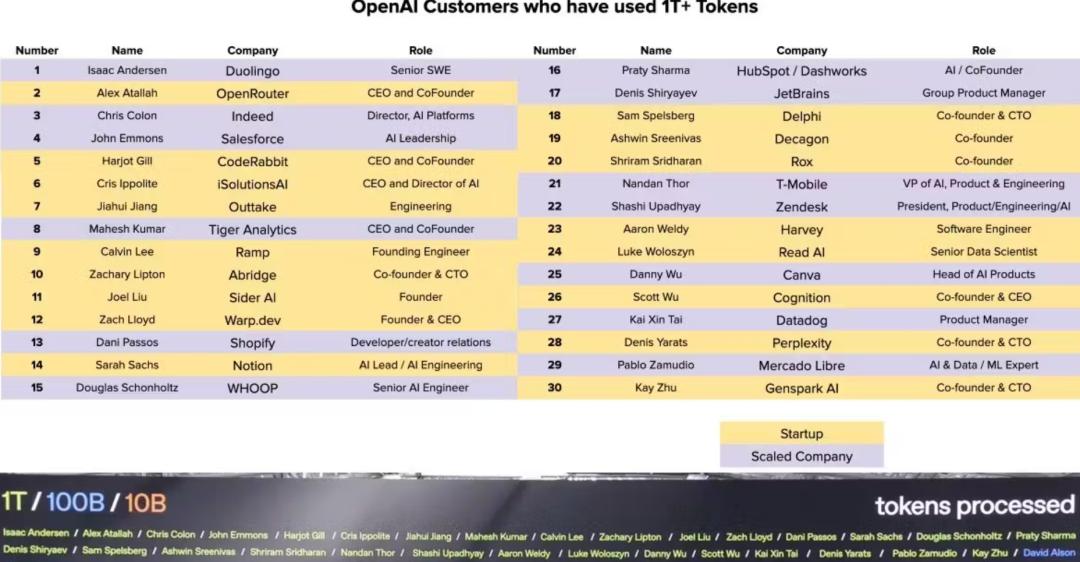
OpenAI“隐秘客户榜”曝光:谁在烧掉上万亿Token?
3 6 Ke· 2025-10-16 00:33
Core Insights - OpenAI's annual revenue has surpassed $12 billion, increasing more than threefold compared to the previous year [1] - A "mysterious list" of OpenAI's top 30 clients has emerged, with each company consuming over 1 trillion tokens annually, translating to approximately $56.25 million or nearly 400 million RMB per company [3][4] - The list includes well-known companies such as Duolingo, Salesforce, Shopify, and T-Mobile, indicating a diverse range of industries utilizing AI [3][7] Client Consumption and Token Usage - The top 30 clients are categorized into two-thirds established companies and one-third startups, showcasing the widespread adoption of AI across different business stages [7][9] - The primary sectors driving high token consumption include: 1. Software development lifecycle with companies like JetBrains and CodeRabbit integrating GPT into their tools [9][19] 2. Enterprise workflow automation with Salesforce and Zendesk generating responses and reports, leading to high token usage proportional to employee numbers [9][17] 3. Content and design generation with platforms like Canva and Notion requiring extensive token usage for multi-modal requests [10][15] 4. Specialized vertical applications in healthcare and legal sectors, where single interactions can consume thousands of tokens [11][18] Notable Companies and Their AI Applications - **Duolingo**: The leading language learning app utilizes AI for personalized learning experiences, resulting in over 1 trillion tokens consumed [8][15] - **Salesforce**: The CRM giant employs AI to generate personalized emails and sales actions, significantly increasing token usage [16][17] - **Shopify**: Integrates AI for e-commerce solutions, leading to substantial token consumption through automated customer interactions [15][19] - **Abridge**: Focuses on medical documentation, using AI to summarize conversations, which results in high token usage among healthcare professionals [18] - **Canva**: A visual collaboration platform that leverages AI for content generation, contributing to its extensive token consumption [21] Industry Trends and Future Outlook - The data indicates that AI is evolving from a mere efficiency tool to becoming integral to product development and operational processes [13][14] - The decreasing cost of model calls suggests that more industries will likely adopt AI solutions, creating further opportunities for token consumption [14] - Companies are encouraged to focus on B2B and developer-centric applications, as these areas show the highest potential for token usage and growth [14]