Uber(UBER)

Search documents
下周重磅日程:美非农、欧英央行决议、日本大选、伊朗局势、谷歌亚马逊AMD财报
Hua Er Jie Jian Wen· 2026-02-01 03:53
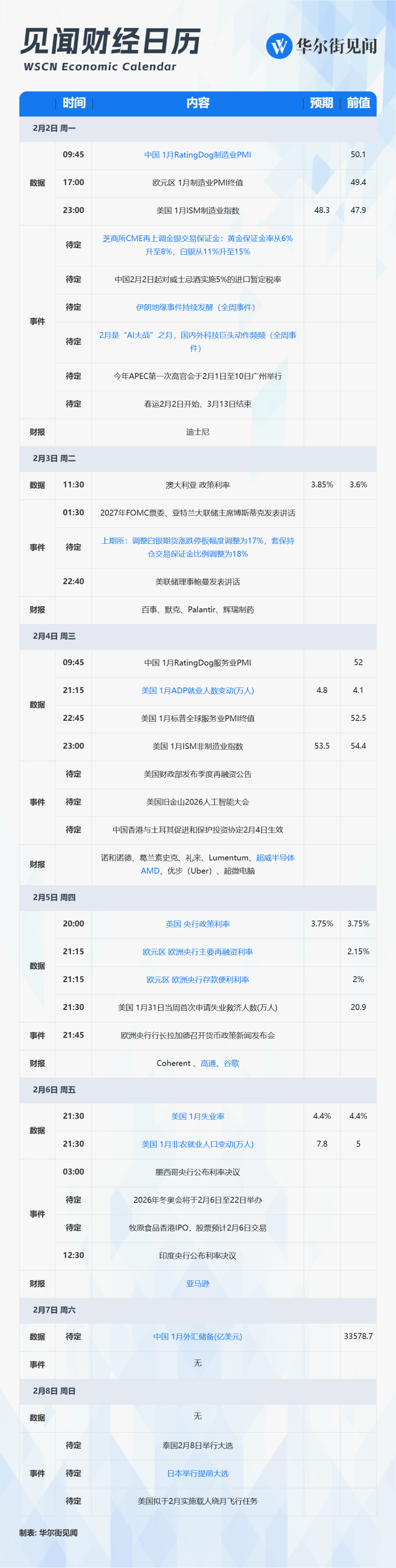
Economic Data - China's January Manufacturing PMI is expected to be 50.1, indicating a slight recovery in manufacturing activity [3] - Eurozone's January Manufacturing PMI final value is reported at 49.4, showing continued contraction [3] - The US ISM Manufacturing Index for January is anticipated to rise to 48.3 from 47.9, suggesting a potential stabilization in manufacturing [3] Central Bank Decisions - The Reserve Bank of Australia is expected to raise its policy rate to 3.85% from 3.6% [4] - The European Central Bank and the Bank of England are both expected to maintain their current interest rates during their upcoming meetings [9] Major Corporate Earnings - Key earnings reports are expected from major companies including Disney, Pepsi, Merck, and Pfizer, with a focus on their performance in the current economic climate [4][26] - Tech giants like Google and Amazon will report on their cloud business growth, which is critical for assessing AI monetization capabilities [6][26] Geopolitical Events - Ongoing tensions in Iran are highlighted, with the US increasing military presence in the region, which may impact global markets [12] - Japan and Thailand are set to hold significant elections on February 8, which could influence regional political stability [15][17] IPOs and Market Movements - Muyuan Foods is set to launch its IPO in Hong Kong, potentially raising up to 14 billion HKD (approximately 1.8 billion USD) [28] - The Shanghai Futures Exchange has adjusted the trading limits and margin requirements for silver futures, reflecting a tightening in trading conditions [11] Commodity Market Changes - CME has raised the margin requirements for gold from 6% to 8% and for silver from 11% to 15%, indicating a move to reduce leverage in the precious metals market [10] - The Chinese government has implemented a temporary 5% import tax on whiskey starting February 2 [19]



X @TechCrunch
TechCrunch· 2026-01-31 16:34
Years ago, Uber walked away from its own autonomous vehicles, and now, it finds itself in a strange and interesting place surrounded by robotaxi rivals. https://t.co/ZPl9xKyhPu ...
A million job losses: Brace for Britain’s driverless car revolution
Yahoo Finance· 2026-01-31 08:00
Core Viewpoint - The rise of self-driving cars is expected to lead to significant job displacement in the driving sector, while also creating new economic opportunities in other areas such as productivity and logistics. Job Displacement - Approximately 1 million people in Britain are employed as drivers, representing around 3% of the workforce, with significant job losses anticipated due to the introduction of driverless vehicles [2][6] - Uber's CEO, Dara Khosrowshahi, acknowledges that job displacement will occur, particularly affecting driving instructors and various driving professions [1][4] Economic Impact - Self-driving cars could enhance productivity by allowing commuters to use travel time for work or leisure activities, potentially benefiting sectors like streaming services and online shopping [7][8] - The logistics sector may see a transformation, with automated heavy goods vehicles (HGVs) projected to create a market worth £3.5 billion annually by 2040 [13] Changes in Property Demand - The shift to driverless cars may alter property demand, moving it away from traditional rail station locations to more evenly distributed areas across commuter belts [9] - Historical trends during the pandemic indicate that remote working can lead to increased demand for larger homes further from city centers, which may be replicated with the rise of autonomous vehicles [10] Public Transport and Congestion - The introduction of driverless cars could lead to a decline in public transport usage, as seen during the pandemic when rail journeys dropped significantly [11] - While driverless vehicles may reduce the need for parking in urban areas, they could also exacerbate road congestion if not managed properly [12] Logistics and Efficiency - Self-driving lorries are expected to operate in convoys, improving fuel efficiency by up to 20% and reducing logistics costs significantly [14][15] - The potential for small delivery robots to replace traditional delivery methods could disrupt the current delivery industry, which has seen rapid job growth [16] Skepticism and Challenges - Concerns exist regarding the economic viability of autonomous vehicle programs, with some industry experts likening them to a "dotcom bubble" due to high operational losses [18] - Despite the potential benefits, practical challenges remain, such as the need for vehicle maintenance and the complexities of urban driving environments [19]
Uber Q4 Earnings: Potential Risks And Robotaxis Stepping Stones
Seeking Alpha· 2026-01-30 18:11
Core Insights - The article discusses the expertise of Vladimir Dimitrov, CFA, who has a background in strategy consulting focused on brand and intangible asset valuation, particularly in technology, telecom, and banking sectors [1]. Group 1 - Vladimir Dimitrov has worked with some of the largest global brands in various sectors, indicating a strong professional background [1]. - He graduated from the London School of Economics, which adds credibility to his expertise in investment analysis [1]. - The focus is on identifying reasonably priced businesses that possess sustainable long-term competitive advantages, highlighting a strategic investment approach [1].
Uber Eats Ordered to Pay $3.5 Million Over NYC Delivery Worker Pay
WSJ· 2026-01-30 18:04
Core Insights - The food-delivery business has agreed to pay a total of $3.15 million in restitution to 48,000 workers across the city [1] - Additionally, the company will incur $350,000 in civil penalties and fees [1] Financial Implications - The restitution payment of $3.15 million translates to an average of approximately $65.63 per worker for the 48,000 affected [1] - The civil penalties and fees amounting to $350,000 represent an additional financial burden on the company [1]
Uber puts another chip on the self-driving roulette table
TechCrunch· 2026-01-30 16:37
Core Insights - Waabi, a self-driving truck startup, has raised a total of $1 billion, which includes $750 million upfront and an additional $250 million from Uber based on deployment milestones [2] Group 1: Company Developments - The funding marks a significant expansion for Waabi into the robotaxi sector, indicating a strategic shift beyond just trucks [2] - Waabi aims to deploy over 25,000 robotaxis, raising questions about the effectiveness of Uber's broad autonomous vehicle partnership strategy [2] Group 2: Industry Context - Uber has over 20 autonomous vehicle partners globally, highlighting the competitive landscape in the autonomous vehicle market [2] - The discussion around Waabi's "simulation-first" approach suggests a potential differentiation in its strategy compared to other players in the industry [3]
Mercedes, NVIDIA and Uber Team Up to Build S-Class Robotaxis
ZACKS· 2026-01-30 16:06
Core Insights - Mercedes-Benz Group AG, NVIDIA Corporation, and Uber Technologies are collaborating to launch robotaxi services in major cities, utilizing the Mercedes S-Class sedan as the foundation for their global autonomous-driving platform [1][7] Group 1: Technology and Integration - The next-generation S-Class will feature Mercedes-Benz's MB.OS, integrating NVIDIA DRIVE Hyperion hardware and full-stack NVIDIA DRIVE AV Level 4 software, focusing on safety-first autonomy through NVIDIA's Halos system [2] - NVIDIA DRIVE AV equips the S-Class with a comprehensive automated-driving system capable of handling rare and complex driving scenarios within a safety-centric architecture, validated through high-fidelity simulations [4] - The technology is built on NVIDIA's AI foundation, enabling real-time analysis of complex environments and the selection of the safest driving actions [5] Group 2: Market Strategy and Collaboration - The S-Class aims to provide a premium, chauffeur-style autonomous experience, with plans to offer these vehicles through Uber's mobility network, showcasing collaboration between established automakers and AI leaders [3] - The companies have not disclosed a timeline for the robotaxi service launch, although Mercedes-Benz has previously partnered with Bosch and Momenta on autonomous-driving initiatives [6]


Countdown to Uber (UBER) Q4 Earnings: A Look at Estimates Beyond Revenue and EPS
ZACKS· 2026-01-30 15:20
Core Viewpoint - Analysts forecast that Uber Technologies (UBER) will report quarterly earnings of $0.79 per share, reflecting a year-over-year decline of 75.4%, while revenues are expected to reach $14.28 billion, an increase of 19.4% compared to the previous year [1]. Earnings Projections - The consensus EPS estimate has been revised downward by 4.9% over the past 30 days, indicating a collective reassessment by analysts [2]. - Revisions to earnings projections are crucial for predicting investor behavior and are strongly linked to short-term stock price performance [3]. Revenue Estimates - Analysts estimate 'Revenue- Mobility' will reach $8.27 billion, a year-over-year increase of 19.6% [5]. - 'Revenue- Freight' is projected at $1.28 billion, indicating a slight increase of 0.2% year-over-year [5]. - 'Revenue- Delivery' is expected to be $4.72 billion, reflecting a 25% increase compared to the previous year [5]. Geographic Revenue Breakdown - 'Geographic Revenue- Latin America' is estimated at $883.37 million, a 21.5% increase year-over-year [6]. - 'Geographic Revenue- United States and Canada' is projected to be $7.21 billion, showing a 14.2% increase [6]. - 'Geographic Revenue- Europe, Middle East and Africa' is expected to reach $4.23 billion, a 17.9% increase [7]. - 'Geographic Revenue- Asia Pacific' is estimated at $1.58 billion, reflecting an 18.7% increase [7]. Key Metrics - Analysts predict 'Gross Bookings - Total' will be $53.08 billion, compared to $44.20 billion in the previous year [7]. - 'Monthly Active Platform Consumers (MAPCs)' are expected to reach 198, up from 171 year-over-year [8]. - 'Trips' are projected to total 3,704, an increase from 3,068 in the same quarter last year [8]. - 'Gross Bookings - Delivery' is estimated at $24.76 billion, compared to $20.13 billion in the previous year [8]. - 'Gross Bookings - Mobility' is expected to reach $27.07 billion, up from $22.80 billion in the same quarter last year [9]. Market Performance - Uber shares have remained unchanged over the past month, while the Zacks S&P 500 composite has increased by 0.9% [9].
Uber Technologies: This Ride Has Exceeded My Expectations (NYSE:UBER)
Seeking Alpha· 2026-01-30 13:52
Group 1 - The core focus of Crude Value Insights is on cash flow and companies that generate it, highlighting value and growth prospects in the oil and natural gas sector [1] - Subscribers benefit from a model account featuring over 50 stocks, in-depth cash flow analyses of exploration and production (E&P) firms, and live discussions about the sector [1] Group 2 - A two-week free trial is available for new subscribers, promoting engagement with the oil and gas investment community [2]
Uber's new plan to deploy 25,000 robotaxis will come from an autonomous trucking company — led by an Uber alum
Business Insider· 2026-01-30 11:23
Core Insights - Uber has announced a partnership with Waabi, a Canadian self-driving trucking startup, to deploy 25,000 robotaxis, with a $250 million investment contingent on Waabi meeting certain milestones [1] - Waabi's leadership includes former Uber executives, highlighting a connection between the two companies [2] - Waabi is developing a generalizable AI system that can be applied across different vehicle platforms, which is crucial for scaling autonomous vehicle technology [5] Group 1: Partnership and Investment - Uber's partnership with Waabi includes a significant investment of $250 million, although specific milestones for the investment have not been disclosed [1] - The collaboration aims to leverage Waabi's expertise in autonomous trucking to support Uber's robotaxi initiative [1] Group 2: Leadership and Expertise - Raquel Urtasun, Waabi's founder, previously served as the chief scientist at Uber's self-driving division, indicating a strong background in autonomous vehicle technology [2] - Lior Ron, Waabi's COO, is also an Uber alum who previously led Uber Freight, showcasing a blend of experience in both ride-hailing and trucking sectors [2] Group 3: Technology and Development - Waabi is focused on creating a sophisticated AI "brain" that can adapt to various vehicle types without needing extensive redevelopment [5] - The company has developed a mixed reality testing simulator that allows for extensive scenario training, which is essential for preparing AI drivers for real-world challenges [6][7] - This simulation technology enables testing of numerous traffic scenarios that would be difficult or dangerous to replicate in real life, enhancing the safety and reliability of autonomous systems [6][7]