
风格切换

Search documents
估值逻辑的断裂:从流动性狂欢到现金流为王
美股研究社· 2026-03-22 12:36
Core Viewpoint - The rise of the US 10-year Treasury yield to 4.37% signifies the end of the era of cheap capital, fundamentally altering the investment landscape and asset pricing dynamics [1][3][14]. Group 1: Impact of Rising Yields - The bond market serves as a reliable indicator of macroeconomic conditions, reflecting true pricing of inflation expectations and capital supply and demand [3][4]. - The increase in the risk-free rate has reset the valuation framework for all assets, leading to a systematic re-evaluation of risk premiums [6][10]. - High-leverage industries, such as real estate and technology, are particularly vulnerable as rising financing costs threaten their operational viability [9][10]. Group 2: Shifts in Investment Behavior - Investors are now compelled to reassess whether the risks they are taking are justified, leading to a preference for safer, cash-generating assets [7][12]. - There is a noticeable shift in asset allocation, with institutional investors increasing bond holdings while reducing equity risk exposure [7][11]. - Cash flow-generating assets, such as those in the energy and financial sectors, are becoming more attractive in a high-interest environment [11][12]. Group 3: Market Dynamics and Valuation - The market is transitioning from a focus on growth narratives to an emphasis on current cash flows and profitability, marking a return to traditional valuation metrics [12][16]. - The disparity in market expectations is evident, with some investors betting on a return to lower rates while others prepare for prolonged high rates, increasing market volatility [13][14]. - The strong dollar and rising US Treasury yields are drawing capital back to the US, creating pressure on emerging markets and potentially leading to sovereign debt crises [13][14]. Group 4: Long-term Implications - The end of the cheap capital era necessitates a focus on asset quality and cash flow generation, as only those assets with real earning potential will thrive in the new environment [14][16]. - The current market conditions highlight the risks of relying on outdated investment strategies, emphasizing the need for adaptability and a return to fundamental analysis [16].


中信证券:中东局势从短期激烈冲突转向持续的小规模混乱,涨价为矛,增加低估值敞口,高估值板块情绪降温
Xin Lang Cai Jing· 2026-03-08 09:34
Group 1 - The core viewpoint is that the market sentiment for high valuation sectors may continue to cool, while the relative advantage of low valuation factors will gradually manifest [1][3][4] - The ongoing situation in the Middle East is shifting from short-term intense conflict to sustained small-scale chaos, which may impact global energy prices and economic concerns [2][15] - The policy design aimed at enhancing corporate quality and efficiency is expected to be the main theme for the next five years, reflecting a shift from traditional production scale expansion to improving profitability [9][22] Group 2 - The emotional sentiment in high valuation sectors has shown signs of decline, with significant fluctuations in investor sentiment indices observed during the spring market [3][16] - There is a potential shift in market styles between large and small caps, as well as between high and low valuation stocks, which may be accelerated by the Middle East conflict [4][17] - The revaluation space for Chinese resources and traditional manufacturing industries remains substantial, especially if return on equity (ROE) returns to reasonable levels [6][19] Group 3 - The current market configuration suggests a focus on sectors with competitive advantages and high barriers to overseas capacity reset, such as chemicals, non-ferrous metals, and renewable energy [11][22] - The report emphasizes the importance of profit margin recovery in various industries, as many sectors are still below historical profit margin levels [8][21] - The recommendation includes increasing exposure to low valuation factors, particularly in industries like insurance and brokerage, which are currently rare [11][22]

光大期货:2月27日金融日报
Xin Lang Cai Jing· 2026-02-27 01:40
Market Overview - The A-share market experienced mixed fluctuations, with Wind All A index rising by 0.21% and a trading volume of 2.56 billion [9] - The geopolitical risks remain a concern, particularly with the ongoing U.S. military buildup in the Middle East and the potential for renewed U.S.-Iran conflict [9] - The market has largely priced in expectations regarding the U.S.-Iran conflict, suggesting limited impact on equity markets from localized conflicts [9] Economic Indicators - The U.S. Supreme Court ruled that Trump's tariffs under IEEPA were illegal, requiring cessation and refunds, but this does not affect his ability to impose tariffs through other domestic laws [9] - Trump announced a global tariff increase from 10% to 15%, which may have a short-term impact on global equity markets, though the overall effect is expected to be limited [9] Sector Performance - The technology sector is anticipated to remain a strong investment theme in the first half of the year, with consumer and cyclical sectors likely to stabilize after inflation data shows improvement [9] - Historical trends indicate that style shifts often occur around the Chinese New Year, which is a point of interest for market participants [9] Bond Market - The bond futures market saw declines across various maturities, with the 30-year contract down by 0.53% and the 10-year contract down by 0.10% [10] - The People's Bank of China conducted a 7-day reverse repurchase operation of 320.5 billion yuan at a rate of 1.4%, maintaining the same rate as the previous operation [10] - The bond market is currently driven by a loose liquidity environment and a weak economic recovery, with long-term bonds showing greater yield declines compared to shorter maturities [10][11] Precious Metals - Gold prices showed a strong upward trend, while silver and platinum experienced weaker fluctuations, with the gold-silver ratio around 58 [11] - Geopolitical tensions, particularly regarding U.S.-Iran negotiations, are influencing gold market dynamics, with expectations of high volatility around the $5000 per ounce mark [11] - Zimbabwe's ban on raw and refined mineral exports has impacted platinum and palladium markets, although the actual effect is expected to be limited due to previous export adjustments [11]

光大期货:2月26日金融日报
Xin Lang Cai Jing· 2026-02-26 01:19
Market Overview - The A-share market saw most stocks rise, with Wind All A increasing by 1.05% and a trading volume of 2.48 billion [10] - The geopolitical risks remain present but have not escalated significantly during the holiday period, with the U.S. continuing to gather military forces in the Middle East [10] - The market anticipates limited impact from localized conflicts on equity markets, as the pricing has been adequately adjusted over time [10] Economic Indicators - The U.S. Supreme Court ruled that Trump's tariff policy under IEEPA was illegal, requiring a halt and refund of tariffs, but this does not affect his ability to impose tariffs through other domestic laws [10] - Trump announced an increase in global tariffs from 10% to 15%, which may have a short-term impact on global equity markets, although the overall effect is expected to be limited [10] Sector Performance - The technology sector is expected to remain a strong theme in the first half of the year, with consumer and cyclical sectors likely to stabilize after inflation data shows significant improvement [10] - The bond market is experiencing a recovery due to ample liquidity and a weak economic recovery, with the 10-year government bond yield dropping below 1.8% [11][12] Bond Market Dynamics - The 30-year, 10-year, 5-year, and 2-year government bond futures all saw declines, indicating a bearish sentiment in the bond market [11] - The People's Bank of China conducted a 4.095 billion yuan reverse repurchase operation, maintaining a stable liquidity environment [11] Precious Metals - Gold and silver prices fluctuated, with the gold-silver ratio dropping to around 58 and the platinum-palladium spread rising to approximately $511 per ounce [12] - Geopolitical tensions, particularly regarding U.S.-Iran negotiations, are expected to keep gold prices volatile, with a recommendation for a long-term holding strategy [12]
光大期货:2月25日金融日报
Xin Lang Cai Jing· 2026-02-25 01:15
Market Overview - The A-share market saw most stocks rise, with Wind All A increasing by 1.06% and a trading volume of 2.22 billion [3] - The geopolitical risks remain in the background, particularly with the potential for conflict between the US and Iran, which could impact market sentiment [3] - The US Supreme Court ruled that Trump's tariff policy under the IEEPA was illegal, but this does not affect his ability to impose tariffs through other domestic laws [3] Bond Market - The bond futures closed with the 30-year main contract up by 0.35%, and the 10-year main contract up by 0.08% [10] - The People's Bank of China conducted a 7-day reverse repurchase operation of 526 billion yuan at a rate of 1.4%, maintaining liquidity in the banking system [10] - The bond market is driven by a loose funding environment and a weak economic recovery, with long-term bond yields declining more than short-term yields [10][5] Precious Metals - Gold and silver prices showed weak fluctuations, while platinum and palladium experienced stronger movements [11] - The uncertainty surrounding US tariffs has increased global economic uncertainty, impacting precious metal prices [11] - Gold is expected to trade in a wide range around $5,000 per ounce post-holiday, with a focus on geopolitical developments and potential interest rate cuts [11]
落袋为安?60亿,“跑了”
Xin Lang Cai Jing· 2026-02-13 05:45
Core Viewpoint - The stock ETF market in China experienced a significant net outflow of approximately 62 billion yuan on February 12, with a total outflow of nearly 200 billion yuan over four consecutive trading days, indicating a trend of capital withdrawal ahead of the upcoming holiday [1][2][3]. Market Overview - On February 12, the total market ETF net outflow reached 56.3 billion yuan, with broad-based ETFs seeing the largest outflows, totaling 60.13 billion yuan [3][12]. - The stock ETF market saw a reduction of 44.33 million shares, reflecting a cautious sentiment among investors as they reposition ahead of the holiday [3][12]. Sector Performance - The ETFs tracking the ChiNext, A500, Sci-Tech 50, and CSI 300 indices, as well as thematic ETFs in green power, securities insurance, and non-ferrous metals, experienced significant net outflows [1][6][10]. - Conversely, ETFs tracking the CSI 500, CSI 1000, and sectors like Hang Seng Technology and internet themes saw notable net inflows, with the CSI 500 ETF, Hang Seng Technology ETF, and CSI 1000 ETF leading the inflows [1][3][12]. Fund Flows - A total of 27 stock ETFs recorded net inflows exceeding 1 billion yuan, with the top three being the CSI 500 ETF (11.24 billion yuan), Hang Seng Technology ETF (8.77 billion yuan), and CSI 1000 ETF (8.19 billion yuan) [5][14]. - The top inflow sectors included the Hang Seng Technology Index (23.8 billion yuan), CSI 1000 Index (15.7 billion yuan), and CSI 500 Index (14.4 billion yuan) [3][12]. Fund Management Insights - E Fund reported a total ETF size of 662.75 billion yuan, with significant inflows into its internet and technology ETFs, indicating strong investor interest in these sectors [8][16]. - Huaxia Fund noted that its Hang Seng Technology Index ETF and CSI 1000 ETF also saw substantial inflows, reflecting a trend towards high-quality assets [8][16]. Market Sentiment - Fund managers suggest that the market may stabilize after recent fluctuations, with a focus on sectors that could benefit from a post-holiday recovery and potential style rotation [9][17]. - The emphasis on domestic demand and the regulatory support for capital markets are seen as positive factors for future market performance [9][17].
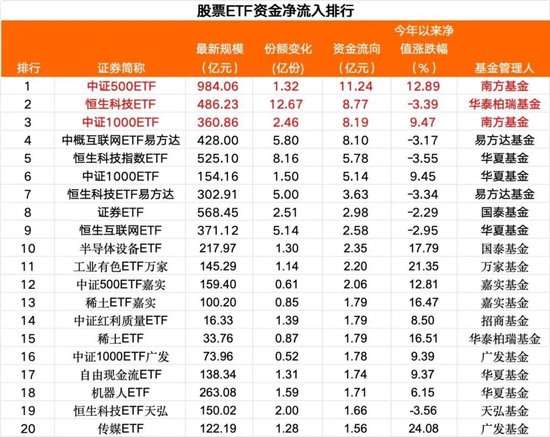
加仓!资金“盯上”这些方向
Zhong Guo Zheng Quan Bao· 2026-02-11 12:17
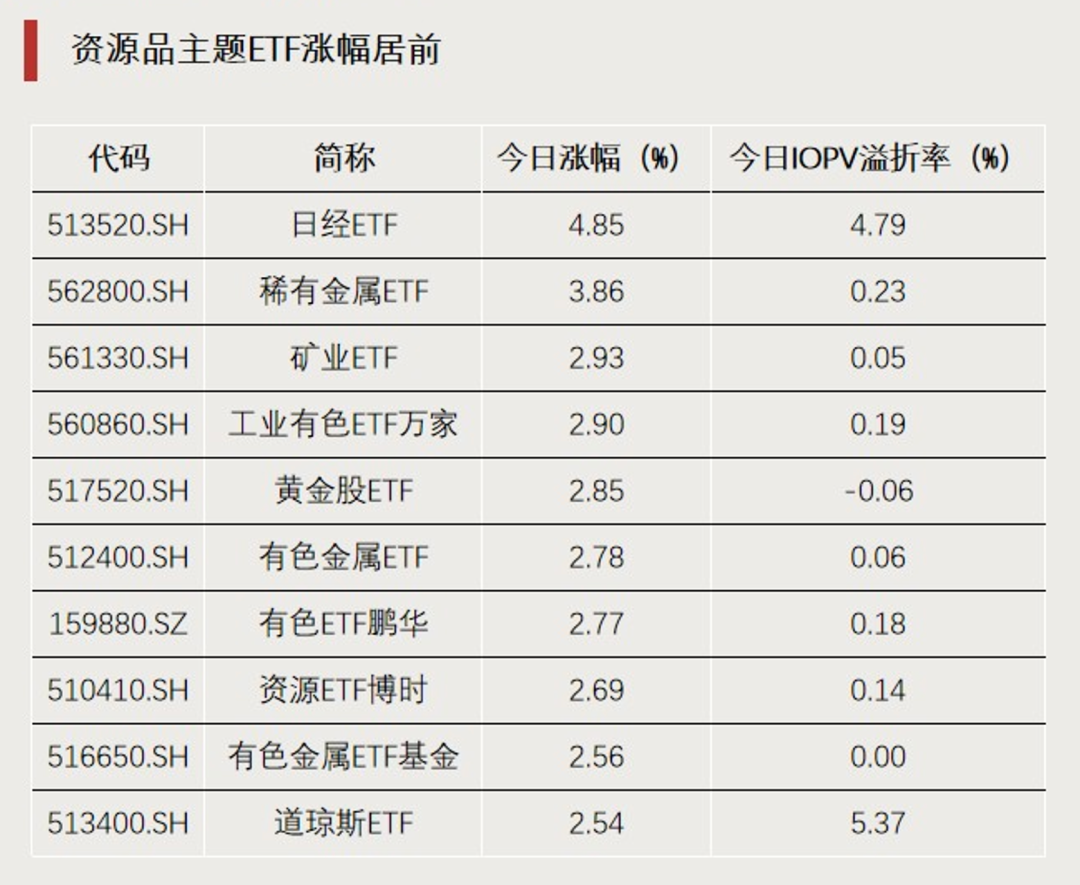
Group 1 - The resource sector, represented by non-ferrous metals, showed strong performance with multiple rare metal ETFs rising over 3% and mining, non-ferrous, gold, rare earth, and chemical ETFs generally increasing over 2% [1][2] - The Nikkei 225 theme ETF rose by 4.85%, with a premium rate increasing to 4.79%, while the Dow Jones ETF also saw a premium rate rise above 5% as the Dow Jones Industrial Average reached a new high [2][3] - Bond ETFs experienced significant trading activity, with total transaction volume increasing by over 90 billion yuan compared to the previous day, and the short-term bond ETF Hai Futong reached a historical high transaction volume of over 63 billion yuan [5][6] Group 2 - Recent market trends indicate a shift of funds from broad-based ETFs to industry-specific theme ETFs, with significant net outflows from the CSI 300 and CSI A500 theme ETFs, while the tourism ETF maintained a net inflow for 17 consecutive trading days, reaching a historical high in scale [7][8] - The film and media ETFs, which benefited from AI applications, experienced a collective pullback, with the film ETF dropping nearly 6% and the media ETF declining over 2% [3][4] - Fund managers are focusing on three key areas for investment: AI hardware driven by overseas trends, high-end manufacturing in new energy and innovative pharmaceuticals, and domestic price increase chains in chemicals, building materials, and steel [9]
202602保险客户资产配置月报:A股关注中盘蓝筹,中债阶段性对冲配置
Orient Securities· 2026-02-10 07:20
Asset Allocation Insights - A-shares are focusing on mid-cap blue chips, with a neutral stance on bonds and US stocks, and a cautious outlook on gold in the short term[2] - The risk appetite in A-shares is shifting, with structural opportunities being the main focus amid overall market fluctuations[2] - Bond performance in February is expected to follow risk appetite trends, serving as a hedge against risk assets[2] Market Sentiment and Risk Assessment - Regulatory measures in January have led to a more balanced risk preference, with high-risk investors showing decreased appetite while low-risk investors gain confidence[9] - Trading sentiment across large, mid, and small-cap stocks has cooled, but medium-term uncertainty remains relatively stable[9] Industry and Sector Recommendations - Current price increases in cyclical goods are key indicators for asset allocation, with a positive outlook on sectors like chemicals, agriculture, and non-ferrous metals[30] - The report highlights two main drivers for price increases: industrialization in emerging economies and geopolitical tensions affecting import prices[30] Model and Strategy Suggestions - The recommendation includes increasing positions in mid-term bonds and focusing on sectors such as non-ferrous metals, chemicals, and military technology for February[5] - The multi-asset allocation strategy suggests a combination of passive and active enhancements, with a focus on risk parity models for stock and bond allocations[48] Performance Metrics - The low-volatility strategy has achieved an annualized return of 11.8%, while the high-volatility strategy has reached 18.1% since 2025[9] - The industry rotation strategy has outperformed benchmarks with an annualized return of 44.8% since 2025[9]
202602保险客户资产配置月报:A股关注中盘蓝筹,中债阶段性对冲配置-20260210
Orient Securities· 2026-02-10 06:52
Market Outlook - A-shares are focusing on mid-cap blue chips, with a neutral stance on bonds and US stocks, and a cautious outlook on gold in the short term[2] - Risk appetite in A-shares is shifting, with structural opportunities being the main focus amid overall market fluctuations[2] - The bond market is expected to continue following risk appetite trends, serving as a hedge against risk assets[2] Investment Strategy - The report recommends increasing allocations to mid-cap blue chips and sectors such as non-ferrous metals, chemicals, new energy, military, communication, and electronics[5] - A dual strategy of passive and active enhancement is suggested for stock-bond allocation, with a focus on increasing positions in mid-term bonds[48] Industry Insights - Price increases in cyclical goods are highlighted as key investment clues, particularly in the chemical, agricultural, and non-ferrous sectors[30] - Geopolitical tensions are raising global economic risk assessments, which is a fundamental driver for commodity price increases[30] Performance Metrics - The low-volatility strategy has achieved an annualized return of 11.8%, while the high-volatility strategy has reached 18.1% since 2025[9] - The industry rotation strategy has outperformed benchmarks with an annualized return of 44.8% since 2025[9] Risk Considerations - Extreme risk events could disrupt market expectations, and there is a risk of quantitative models failing to predict future trends[6]
廖市无双:马年春节,持币还是持股?
2026-02-10 03:24
Summary of Conference Call Notes Company/Industry Involved - The conference call primarily discusses the Chinese stock market and investment strategies, with a focus on various sectors including consumer goods, technology, and financial services. Core Points and Arguments 1. **Market Sentiment and Predictions** - The market is expected to experience a "small red envelope" rally before the Spring Festival, indicating a bullish sentiment for holding stocks [3][4][5] - The Shanghai Composite Index has shown signs of weakness, breaking below the 20-day and 5-week moving averages, suggesting a potential end to the previous upward trend [4][5][10] 2. **Market Structure and Adjustments** - The market is undergoing a significant adjustment phase, with a possible three-part correction structure (A-B-C) anticipated [5][9][14] - The recent market volatility has led to a shift in investment style, favoring large-cap stocks over small-cap growth stocks [6][7][21] 3. **Sector Performance** - Consumer sectors, particularly food and beverage, have shown strong performance, while resource and technology sectors have underperformed [11][12][28] - The financial sector, particularly brokerage firms, is expected to enter a bullish phase starting February 4, 2024, although immediate large gains are not anticipated [8][24] 4. **Investment Strategy Recommendations** - Investors are advised to maintain positions but reduce exposure to high-volatility sectors, focusing instead on sectors with lower risk and higher potential for recovery [21][22][23] - Specific sectors to watch include securities, consumer services, and building materials, which are expected to perform well in the current market environment [23][24][28] 5. **Market Dynamics and Future Outlook** - The market is likely to remain in a volatile but upward-trending phase leading up to the Spring Festival, with potential for a rebound after the holiday if no significant negative events occur [15][16][20] - The overall market sentiment remains cautiously optimistic, with expectations of continued sector rotation and a focus on value-oriented investments [19][21][28] Other Important but Possibly Overlooked Content 1. **Historical Context** - The market has experienced significant growth over the past two years, with a rise of over 2500 points, leading to concerns about sustainability and potential corrections [25][26] 2. **Sector Rotation and Investment Behavior** - There is a clear trend of funds reallocating from previously high-performing sectors (like technology and resources) to more stable sectors as investors seek to mitigate risk [22][28] 3. **Technical Analysis Insights** - The analysis indicates that the current market structure is not conducive to a straightforward upward trend, suggesting that investors should be prepared for fluctuations and adjust their strategies accordingly [10][12][25] 4. **Emerging Themes and Indices** - New themes in the market include traditional industries and sectors like electric equipment and consumer services, which are gaining traction as investors seek stability [28][30][31] 5. **Investor Sentiment and Behavior** - There is a noted disconnect between past market performance and current investor expectations, with many still expecting continuous growth despite recent volatility [25][26]