
信贷风险

Search documents
AI+信贷风险重挫银行板块 KBW银行指数ETF(KBE.US)创去年关税风波以来最大单日跌幅
Zhi Tong Cai Jing· 2026-02-27 23:38
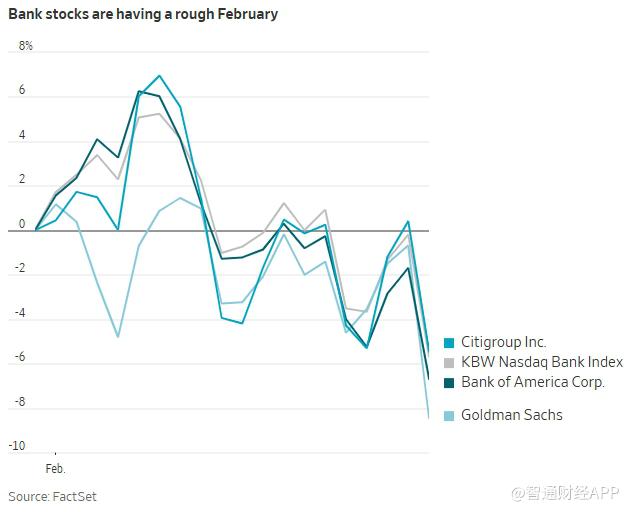
Group 1: Banking Sector Performance - The U.S. banking sector experienced a significant decline, with major banks and investment firms seeing substantial drops in stock prices, reflecting rising investor concerns about the economic outlook [1] - Bank of America (BAC.US) fell over 4%, Citigroup (C.US) and Wells Fargo (WFC.US) both dropped more than 5%, Morgan Stanley (MS.US) declined over 6%, Goldman Sachs (GS.US) fell more than 7%, and JPMorgan Chase (JPM.US) decreased by 1.9% [1] - The KBW Bank Index ETF (KBE.US) dropped 4.95%, marking the largest single-day decline since the tariff turmoil in April of the previous year, indicating that large banks are viewed as economic barometers [1] Group 2: Impact of AI and Credit Risks - Negative expectations surrounding artificial intelligence (AI) have continued to disrupt the market, with payment company Block (XYZ.US) announcing a 40% workforce reduction due to AI efficiency improvements, heightening fears of large-scale job losses [3] - The rise in credit risk has further impacted financial stocks, particularly consumer finance institutions like American Express (AXP.US), First Capital Credit (COF.US), and Synchrony Financial (SYF.US), which were among the biggest decliners [3] - Turmoil in the private credit sector has also caused investor unease, with redemption requests for related investment tools increasing after notable loan losses last year [3] Group 3: Market Sentiment and Future Outlook - Analysts suggest that the weakness in tech stocks and tightening credit conditions may undermine previously optimistic expectations for a recovery in the M&A and IPO markets [4] - Investor sentiment has shifted from optimism at the beginning of the year to facing previously unaccounted risk factors, leading to a spread of panic in the market [4]


坏账压顶,Apollo私募信贷基金被迫下调估值
Hua Er Jie Jian Wen· 2026-02-27 13:14
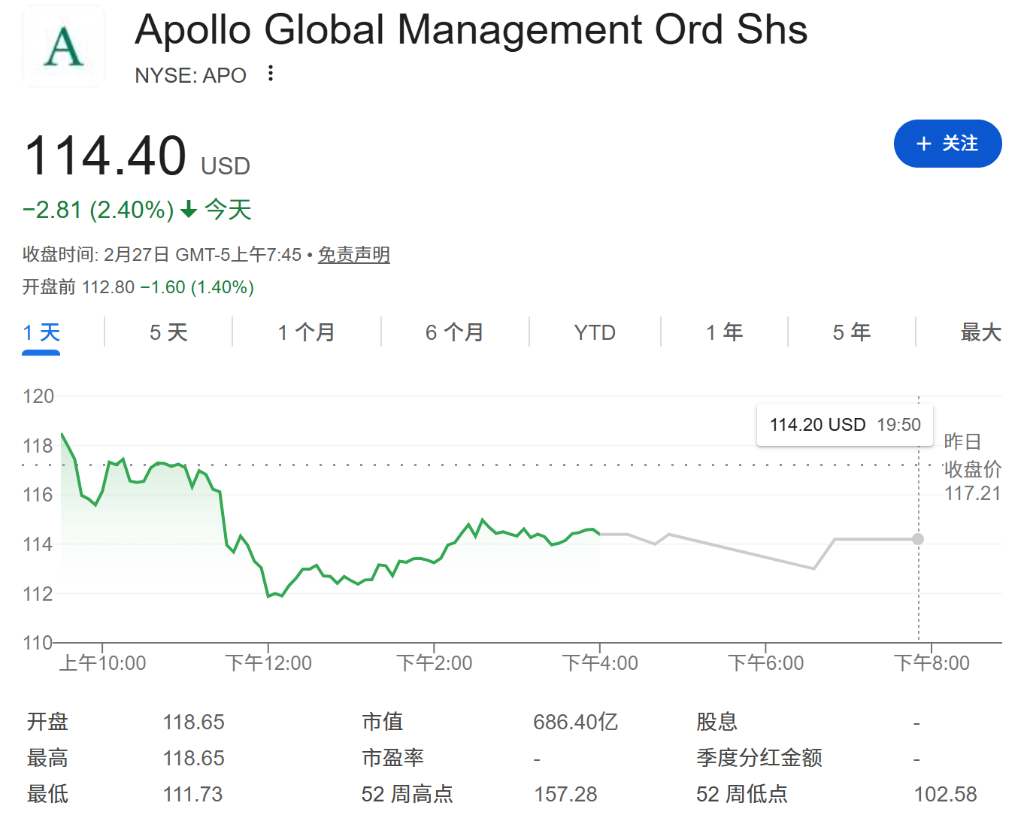
Core Viewpoint - The credit market is experiencing rising default risks, highlighted by the recent collapse of the UK non-bank financial institution Market Financial Solutions (MFS), which has led to significant valuation adjustments and dividend cuts by private credit firms like Apollo Global Management [1][10]. Group 1: Market Reactions - The collapse of MFS has triggered a chain reaction in the capital markets, causing stock prices of related financial institutions to plummet, with Jefferies Financial Group down nearly 9.8% and Apollo's stock declining by 4.7% [1]. - Barclays and Santander also saw their stock prices drop by 3.8% and 1.7%, respectively, following the news of MFS's bankruptcy [1]. Group 2: Details of MFS Collapse - MFS, established in 2006, specialized in complex, real estate-backed loans and had a peak loan volume of £2.4 billion [11]. - The company is facing serious allegations of fraud, including double pledging of assets and misappropriation of funds, which led to its rapid decline [12]. - Barclays has approximately £600 million linked to MFS, while Apollo's risk exposure is around £400 million, and Jefferies' exposure is about £100 million [11]. Group 3: Broader Implications - The MFS incident is not isolated, as it mirrors issues faced by other companies like Tricolor Holdings and First Brands Group, raising concerns about asset write-downs among major banks [13]. - Financial leaders, including JPMorgan's CEO Jamie Dimon, have expressed concerns about similarities between the current market conditions and those preceding the 2008 financial crisis [13]. - The private credit sector is also feeling the strain, with firms like Blue Owl Capital halting redemptions in retail funds, leading to sell-offs in asset management stocks [14].
英国贷款机构MFS破产 巴克莱(BCS.US)等华尔街银行受波及
Zhi Tong Cai Jing· 2026-02-27 02:33
Group 1 - Market Financial Solutions (MFS) has initiated bankruptcy proceedings in the UK following allegations of fraud and financial misconduct, impacting several Wall Street banks [1] - Barclays Bank, Santander Bank, and Wells Fargo have exposure to MFS, with Barclays reportedly facing a risk exposure of approximately £600 million [1] - Atlas SP Partners, part of Apollo Global Management, confirmed its role as a senior creditor, seeking to recover £400 million through legal means [1] Group 2 - Jefferies has a risk exposure of about £100 million to MFS, while Castlelake has arranged a loan with an outstanding amount of approximately £400 million, although they claim no direct unsecured exposure [2] - This incident raises concerns about lax credit underwriting standards in the market, reminiscent of the period leading up to the 2008 financial crisis, as noted by JPMorgan CEO Jamie Dimon [2] - The recent bankruptcies of First Brands Group and Tricolor Holdings have heightened Wall Street's awareness of credit risks [2]

香港金管局最新发声
Zhong Guo Ji Jin Bao· 2026-02-12 15:59
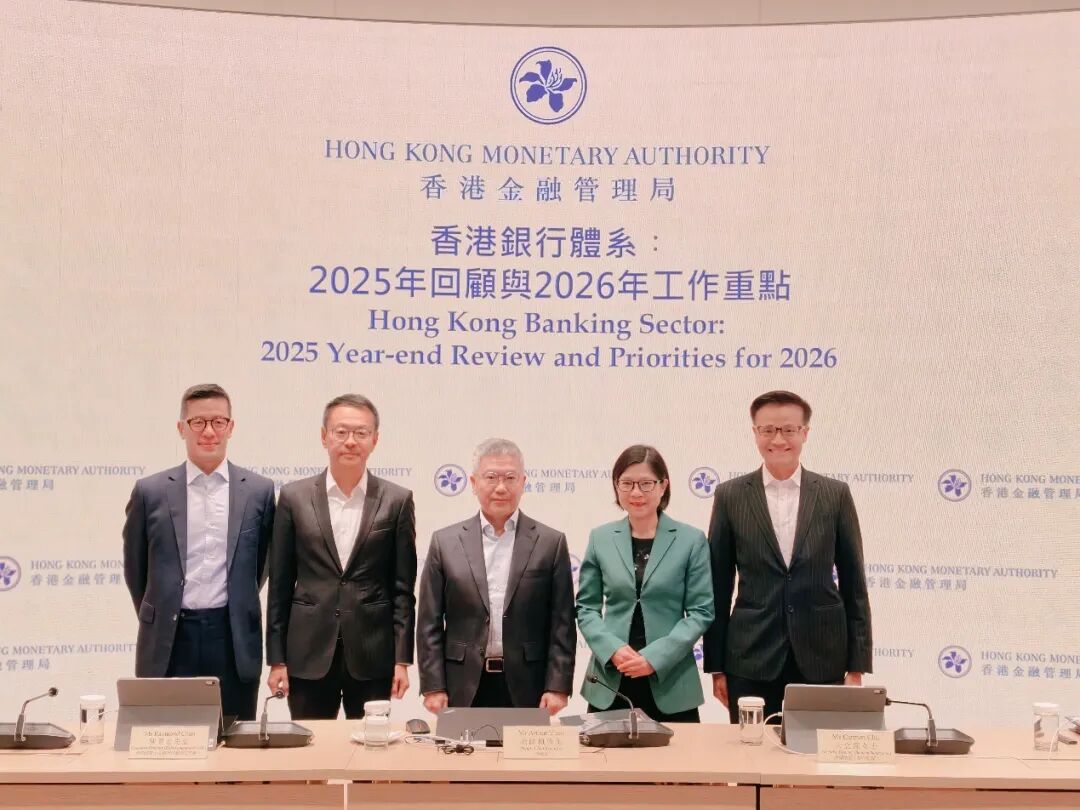
Group 1 - The core focus of the Hong Kong Monetary Authority (HKMA) for 2026 is managing credit risk and credit fund flows, emphasizing the need for vigilance in monitoring asset quality and proactively addressing potential risks [3][5] - HKMA plans to implement measures to support the real economy, particularly small and medium-sized enterprises (SMEs), by facilitating access to bank loans, supporting business transformation, and promoting intellectual property financing [5] - The pressure on asset quality primarily stems from the commercial real estate sector, with outstanding loans in this sector accounting for 14% of the total, and HKMA will continue to monitor loan quality and liquidity indicators [5] Group 2 - In a declining interest rate environment expected in the second half of 2025, banks are anticipated to see increased customer interest in investment products, with transaction volume through banks rising from HKD 819 billion in 2022 to HKD 2.3 trillion [6] - HKMA will focus on high-yield and complex products, including those related to private credit, and will support the sustainable and responsible development of the digital asset industry, with investment transactions in digital assets increasing from HKD 17.2 billion in 2024 to HKD 74.2 billion in 2025 [6] - HKMA will also pay attention to higher-risk insurance products and review banks' insurance referral businesses [7] Group 3 - A key initiative for HKMA in 2026 is combating fraud, highlighted by the release of an anti-fraud song and music video to raise public awareness [8] - HKMA has supported the smooth operation of the cross-border wealth management connect business, enhancing banks' sales services to mainland customers and increasing the client limit for non-local registered banks [9] - Continuous monitoring of banks' asset quality and credit risk management effectiveness is essential to ensure the stability of the banking system while supporting the real economy [10]
数十年来最低溢价或藏暴雷风险!汇丰重磅警告:警惕“AI亢奋”反噬信贷市场
智通财经网· 2026-02-03 07:05
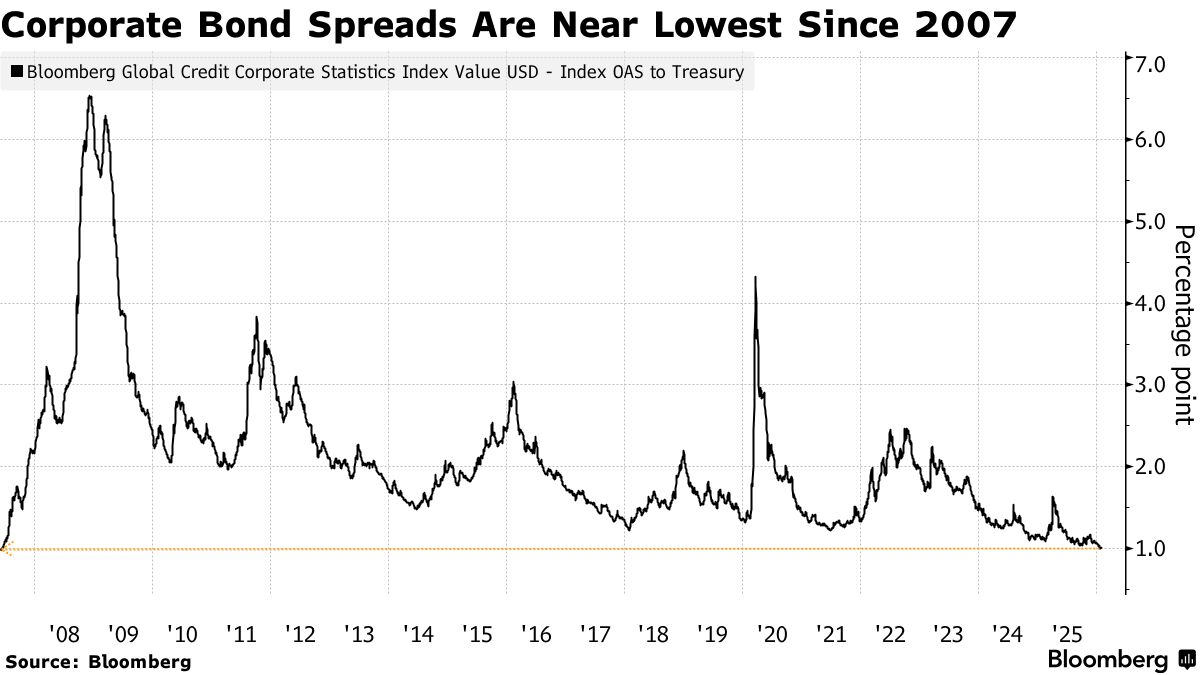
Core Viewpoint - HSBC strategists warn credit investors to be cautious of potential downside risks associated with the "AI euphoria" as yield premiums drop to their lowest levels in decades due to optimism surrounding artificial intelligence [1] Group 1: Economic Impact - A significant portion of recent GDP growth in the U.S. is linked to AI, either through direct investment spending or the wealth effect from AI-related stocks [1] - Any disappointing developments could reverberate through the credit markets via multiple channels [1] Group 2: Credit Market Analysis - Corporate bond spreads are nearing their narrowest levels since the pre-global financial crisis of 2007, despite a strong macroeconomic backdrop [1] - The current pricing reflects a moderate outlook for this asset class, supported by generally healthy fundamentals of developed market corporate borrowers [1] - However, the changes in yield premiums do not account for the narrow foundation upon which current optimism relies [1] Group 3: Investment Strategy Recommendations - HSBC advises investors to consider diversification strategies and maintain distance from U.S. tech company bonds, noting that some sectors in Eurozone credit have less exposure to the AI cycle [4] - The report suggests that most gains from further economic growth and AI advancements will benefit equity holders rather than creditors [4] - Even if AI experiences unexpected growth, private credit in the U.S. still has significant exposure to high-yield software companies, which may face challenges [4] - Asian investment-grade credit may provide some protection amid volatility triggered by weakening risk sentiment and fiscal factors [4] Group 4: Broader Market Sentiment - The view on credit risk is not unique to HSBC, as Goldman Sachs' asset allocation research head indicates that credit is the weakest link, with potential "spread arbitrage pullback risks" related to the U.S. dollar and Japanese yen [4] - He currently holds an underweight position on credit but favors equities based on profit outlook [4]

Landmark Bancorp(LARK) - 2025 Q4 - Earnings Call Transcript
2026-01-29 17:00
Financial Data and Key Metrics Changes - Landmark Bancorp reported a net income of $4.7 million for Q4 2025, a significant increase from $3.3 million in Q4 2024, with diluted earnings per share rising to $0.77 [4][9] - For the full year 2025, net income reached $18.8 million or $3.07 per share, marking a 43% increase over 2024 earnings per share [5] - The tangible book value increased to $20.79 per share, up $0.83 from the previous quarter and $4.09 or 24% from year-end 2024 [4][5] - The efficiency ratio improved to 62.7% in 2025 from 69.1% in 2024, indicating better expense management [5] Business Line Data and Key Metrics Changes - Net interest income for Q4 2025 totaled $14.8 million, an increase of $695,000 from Q3 2025, driven by higher asset yields and lower funding costs [9] - Commercial loan production was strong, particularly in commercial real estate, with mortgage originations increasing by 11% year-over-year [6][19] - Non-interest income for Q4 2025 was $3.9 million, a decrease of $169,000 from the prior quarter, primarily due to a loss on the sale of investment securities [12] Market Data and Key Metrics Changes - Deposits totaled $1.4 billion at December 31, 2025, increasing by $63.4 million in Q4, with interest checking and money market deposits rising significantly [15][16] - Non-interest-bearing deposits accounted for 26.3% of total deposits at year-end [16] - The Kansas economy remains healthy, with an unemployment rate of 3.8% as of November 30, 2025 [21] Company Strategy and Development Direction - The company plans to continue investing in its associates and make strategic investments to enhance customer service and capitalize on growth opportunities in its markets [23] - Management emphasized the importance of maintaining a strong and resilient balance sheet while proactively monitoring credit quality to minimize future losses [19] Management's Comments on Operating Environment and Future Outlook - Management expressed confidence in building on the foundation set in 2025 and highlighted the dedication of associates in serving customers and strengthening communities [23] - The company remains focused on addressing non-performing loans and improving the overall quality of its loan portfolio [20] Other Important Information - The board of directors declared a cash dividend of $0.21 per share, marking the 98th consecutive quarterly cash dividend since the company's formation [8] - The allowance for credit losses stood at $12.5 million, representing 1.12% of gross loans, indicating a strong position in managing credit risk [20] Q&A Session Summary - No specific questions or answers were documented in the provided content, indicating that the call may have concluded without a formal Q&A segment [24]

BankUnited(BKU) - 2025 Q4 - Earnings Call Transcript
2026-01-21 15:02
Financial Data and Key Metrics Changes - The company reported earnings of $69.3 million, or $0.90 per share, for the fourth quarter, with an adjusted EPS of $0.94 after accounting for one-time software write-downs [7][25] - The annualized return on assets (ROA) was 78 basis points, adjusted for the software write-down, it was approximately 81 basis points [8] - Net interest margin (NIM) expanded to 3.06%, up from 3% in the previous quarter and 22 basis points year-over-year [7][26] - Total deposits increased by $735 million during the quarter and $1.5 billion for the year [19] Business Line Data and Key Metrics Changes - Core loans grew by $769 million in the fourth quarter, with commercial real estate (CRE) loans up by $276 million and commercial and industrial (C&I) loans up by $474 million [20] - Non-interest income increased by $30 million quarter-over-quarter and year-over-year, despite a decline in leasing income [28] - The company experienced a decline in criticized and classified loans, with non-performing loans (NPLs) down slightly [11][28] Market Data and Key Metrics Changes - The company noted that the cost of deposits decreased by 21 basis points to 2.10% at year-end, down 53 basis points from December of the previous year [10] - The loan-to-deposit ratio finished the quarter at 82.7% [20] - The commercial real estate portfolio grew by 9%, with a total exposure of $6.8 billion, representing 28% of total loans [22] Company Strategy and Development Direction - The company aims to maintain a balanced growth strategy across various asset classes, with a focus on avoiding excessive concentration in any single area [63] - The management expressed confidence in achieving double-digit NIDDA growth and targeting a mix of 33% for non-interest-bearing deposits to total deposits [73] - The company plans to continue investing in existing markets, particularly in Atlanta, Texas, and North Carolina, while expanding its physical footprint [76][78] Management's Comments on Operating Environment and Future Outlook - The management remains optimistic about the economic environment, despite geopolitical risks, and expects continued growth in business operations [33][34] - The company anticipates two Fed rate cuts, which have been factored into their financial projections, but they are prepared for various scenarios regarding interest rates [34][45] - The management highlighted that they are not seeing broad systemic risks in their credit portfolio, with improvements noted in the office sector [69] Other Important Information - The board authorized an additional $200 million share buyback, bringing the total available for buybacks to approximately $250 million [12][13] - The company increased its dividend by $0.02, consistent with its historical practice [13] Q&A Session Summary Question: What drove the non-interest-bearing deposit growth in Q4? - Management reported that all business lines contributed to deposit growth, with no outliers, and emphasized the importance of average NIDDA over period-end figures [40][41] Question: What are the beta assumptions for deposits and loans? - The company expects an 80% beta for deposits and noted that the beta for loans varies by business line, with floating rate loans being predominant [44][45] Question: How does the company plan to balance buybacks with capital levels? - Management indicated they would remain opportunistic with buybacks, adjusting based on market conditions and stock price volatility [49] Question: What is the outlook for commercial real estate (CRE) growth? - The company has room to grow in CRE, focusing on asset classes other than office and hospitality, and expects mid-single-digit growth in 2026 [62][63] Question: Can you provide details on the fraud incident mentioned? - The fraud involved a contractor in New York, resulting in a complete write-off of a $10 million loan due to lack of collateral [67]

信贷管理漏洞频现,泉州农商行因多项违规被罚270万元!
Shen Zhen Shang Bao· 2026-01-21 11:38
Core Viewpoint - Quanzhou Rural Commercial Bank has been fined 2.7 million yuan due to serious violations in credit management and internal controls, indicating increasing regulatory pressure on regional banks [1][2] Group 1: Regulatory Actions - The bank was penalized for five major violations, including inadequate internal control in credit business and insufficient loan management [1] - Multiple responsible individuals received warnings or fines, highlighting accountability within the institution [1] - The bank has faced numerous fines in recent years for various compliance issues, particularly in credit management and account compliance [2] Group 2: Historical Context - Quanzhou Rural Commercial Bank was established in March 2011 with a registered capital of 1.664 billion yuan, focusing on local economic service [1] - The bank's penalties have increased over time, with a notable rise in the severity of fines, reflecting growing concerns about internal control risks [2] - Comparatively, the bank's recent fine of 2.7 million yuan is considered moderate to high within the regional context, indicating a trend of stricter regulatory enforcement [2]
特朗普风险“大到无法忽视”!丹麦养老基金宣布清仓美债
Jin Shi Shu Ju· 2026-01-20 14:46
Core Viewpoint - AkademikerPension, a Danish pension fund, plans to exit the U.S. Treasury market by the end of the month due to concerns over credit risks associated with U.S. President Trump's policies [1] Group 1: Company Actions - AkademikerPension manages approximately $25 billion in savings for teachers and scholars and currently holds about $100 million in U.S. Treasuries, which it plans to divest [1] - The fund's Chief Investment Officer, Anders Schelde, indicated that the decision to withdraw is based on the belief that alternatives can be found for risk and liquidity management [1] - Other Danish pension funds, such as Laerernes Pension and PFA, have also reduced their U.S. Treasury holdings due to concerns over U.S. debt sustainability and the independence of the Federal Reserve [2] Group 2: Market Context - The withdrawal from U.S. Treasuries by AkademikerPension is seen as a significant symbolic step, reflecting a broader reassessment among institutional investors regarding what constitutes a safe-haven asset [1] - The ongoing political climate, particularly Trump's threats regarding Greenland, has heightened fears among European allies, prompting a reevaluation of investment strategies [2] - The discussion around U.S. Treasury sales is expected to be a key topic during Trump's visit to Davos, with his Treasury Secretary attempting to downplay concerns about European divestment from U.S. debt [2]
首尔房价“降温难” 韩国央行敲响金融脆弱性警钟
Sou Hu Cai Jing· 2025-12-23 02:49
Core Viewpoint - The Bank of Korea's semi-annual financial system report indicates that while the overall financial system remains resilient amid economic recovery, rising housing prices and a weakening currency are increasing financial vulnerabilities [1] Group 1: Financial System Resilience - The report highlights that domestic financial institutions maintain robust capital buffers and external payment capabilities [1] - Despite this resilience, recent asset price volatility, including stock market declines and a continuously weakening won, keeps financial and foreign exchange market volatility high [1] Group 2: Housing Market Concerns - The report warns that despite government measures to cool the market, housing prices in the Seoul metropolitan area continue to rise strongly, raising concerns about worsening financial imbalances [1] - The central bank's concerns over rising capital housing prices influenced its decision to maintain interest rates last month, avoiding further easing due to fears that cheaper borrowing costs could fuel speculative activities [1] Group 3: Credit Risk in Vulnerable Sectors - The report notes that credit risks in vulnerable sectors remain high [1] - The Bank of Korea stated that it will actively seek appropriate measures to ensure the stability of the financial system, including policy coordination with the government and collaboration with financial institutions if necessary [1]