
Walmart(WMT)

Search documents
Walmart Inc. (WMT) Presents At Goldman Sachs Communacopia + Technology Conference 2025 Transcript
Seeking Alpha· 2025-09-09 20:44
PresentationKatharine McShaneMD & Retail Analyst Hello, everyone. My name is Kate McShane. I'm the retail hardline, broadline analyst at Goldman Sachs. And we're very happy to have David Guggina, Executive Vice President and Chief E-commerce Officer of Walmart U.S. David serves as the Executive Vice President and Chief E-commerce Officer for Walmart U.S. and leads the company's work to grow its online business by delivering exceptional customer and seller experiences across all online platforms and services ...



Walmart (NYSE:WMT) 2025 Conference Transcript
2025-09-09 19:32
Financial Data and Key Metrics Changes - Walmart reported a 26% growth in its US e-commerce business for Q2, with a two-year stack growth of approximately 48% [9] - Fast delivery options have seen significant uptake, with 25% of fast deliveries now completed in 30 minutes or less [12] Business Line Data and Key Metrics Changes - The e-commerce segment now accounts for about 20% of Walmart's total sales, reflecting rapid growth and transformation in this area [8] - Walmart Fulfillment Services (WFS) has seen a penetration increase of nearly 600 basis points over the past year, indicating strong growth in fulfillment capabilities [30] Market Data and Key Metrics Changes - Walmart can deliver to 94% of U.S. households in three hours or less, with plans to expand this to 95% by year-end [11] - Customers utilizing fast delivery options spend two times more than the average digital customer, with those using it four or more times spending three times more [16] Company Strategy and Development Direction - The company is focusing on enhancing its e-commerce capabilities, particularly through fast delivery and expanding its marketplace offerings [41] - Walmart is investing in automation technology within its supply chain, with about half of its inventory moving through automated systems [39] Management's Comments on Operating Environment and Future Outlook - Management expressed excitement about the potential for faster delivery options and the growth of the marketplace, emphasizing the importance of artificial intelligence in reshaping customer experiences [42] - The company is optimistic about the continued integration of e-commerce with higher-margin businesses like advertising and data ventures, which are expected to improve profitability [31][32] Other Important Information - Walmart's e-commerce strategy includes a focus on connecting its physical stores with online offerings to enhance customer experience [10] - The company is leveraging artificial intelligence to improve operational efficiency and customer engagement through tools like Sparky, a shopping assistant [36] Q&A Session Summary Question: Can you discuss the current role and responsibilities at Walmart? - The Chief E-commerce Officer outlined responsibilities in leading the US e-commerce strategy and execution, leveraging extensive experience in supply chain and fulfillment [6] Question: What are the key milestones in Walmart's e-commerce transformation? - Key milestones include the expansion of online pickup and delivery, fast delivery options, and the development of Walmart Fulfillment Services [9][10] Question: How does Walmart's store footprint provide a competitive advantage? - Walmart's extensive network of 4,700 assets allows for rapid delivery capabilities, with a focus on local inventory tailored to geographic locations [11] Question: What is the impact of fast delivery on customer behavior? - Fast delivery has led to increased purchase frequency and larger basket sizes, with customers spending significantly more when utilizing these options [15][16] Question: How is Walmart building relationships with brands and distributors? - The company engages with sellers through both outbound and inbound contacts, utilizing software tools to facilitate onboarding and assess seller performance [26][27] Question: What is the current status of Walmart's automation journey? - Walmart is in the early stages of its automation journey, with significant progress in fulfillment centers and plans for further deployment across its distribution network [39]
Walmart's Options: A Look at What the Big Money is Thinking - Walmart (NYSE:WMT)
Benzinga· 2025-09-09 18:01
Whales with a lot of money to spend have taken a noticeably bearish stance on Walmart.Looking at options history for Walmart WMT we detected 14 trades.If we consider the specifics of each trade, it is accurate to state that 42% of the investors opened trades with bullish expectations and 50% with bearish.From the overall spotted trades, 10 are puts, for a total amount of $431,425 and 4, calls, for a total amount of $248,496.Predicted Price RangeBased on the trading activity, it appears that the significant ...

Walmart plans to bring its namesake stores to South Africa this year (WMT:NYSE)
Seeking Alpha· 2025-09-09 16:19
Core Insights - Walmart plans to open its first branded stores in South Africa later this year, highlighting its commitment to making affordable merchandise accessible to more customers [2] Group 1 - The strategic move into South Africa is part of Walmart's broader commitment to expanding its market presence [2] - The initiative aims to enhance customer access to affordable products in the region [2] - This expansion reflects Walmart's ongoing strategy to penetrate new markets and increase its global footprint [2]
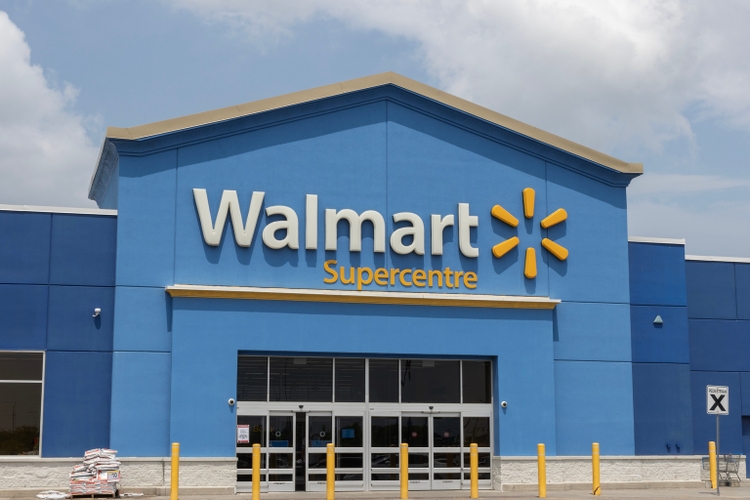
Walmart opens perishable distribution center in South Carolina
Yahoo Finance· 2025-09-09 14:41
Group 1 - Walmart has opened a 725,000-square-foot perishable distribution center in Wellford, South Carolina, as part of its strategy to enhance its grocery supply chain [3][8] - The Wellford facility is the third of five new perishable distribution centers being established nationwide, with additional locations in California, Texas, Illinois, and New Jersey [3][8] - The new facilities can process over double the volume of traditional distribution centers by utilizing automation and artificial intelligence [4][6] Group 2 - The Wellford center will handle fresh produce, eggs, dairy, meat, and frozen goods for distribution to 180 Walmart stores, employing over 600 full-time workers [8] - Walmart is actively hiring for roles such as automation equipment operators to support the operations of the new facility [8] - The implementation of AI technology in the distribution process ensures accuracy and freshness, facilitating faster unloading at stores and allowing associates to focus more on customer service [6][8]
Walmart to launch first stores in Africa by year-end
Reuters· 2025-09-09 12:52
U.S. retailer Walmart will launch its first branded stores in South Africa this year, it said on Tuesday. ...
Better Stock to Buy Now: Walmart or Dollar Tree?
The Motley Fool· 2025-09-09 07:52
Both retailers are executing well lately, but one stock looks better than the other for the long term.Walmart (WMT 1.72%) and Dollar Tree (DLTR -1.70%) shares have both surged over the past year, standing out in a choppy economy with their value-focused retail models. Each company has delivered solid results for shareholders recently, but their investment cases rely on very different strengths. Walmart, the scaled and tech-driven retailer with supercenters, Sam's Club, and a fast-growing e-commerce platform ...

“拥挤”的扬州只是序幕,会员店进入狂飙年代
Hu Xiu· 2025-09-07 08:56
Core Viewpoint - The retail landscape in Yangzhou is undergoing a significant transformation with the rapid rise of membership warehouse stores, creating intense competition among various retail formats in this second-tier city [1][3][8]. Group 1: Market Dynamics - Yangzhou has recently seen the opening of multiple membership stores, including the M Membership Store and the upcoming Sam's Club, indicating a shift towards a more competitive retail environment [2][5][6]. - The city is strategically located at the intersection of the Nanjing and Shanghai metropolitan areas, enhancing its appeal for consumer spending from larger cities [4]. - In 2023, Yangzhou welcomed 39 new stores, including the M Membership Store, which has quickly become a local consumer hotspot due to its large size and innovative shopping model [5][6]. Group 2: Competitive Landscape - The entry of Sam's Club is expected to significantly impact existing players like M Membership Store and Metro, as it offers a strong brand presence and efficient delivery services [10][17]. - Sam's Club has demonstrated impressive single-store performance, with projections indicating that some locations could achieve annual sales exceeding RMB 3.67 billion [9][20]. - The competition is not only about foot traffic but also about changing consumer purchasing habits, as Sam's Club promotes bulk buying and high-quality products [17][23]. Group 3: Challenges for Local Retailers - Local retailers, including M Membership Store, face challenges in maintaining customer loyalty and addressing service quality issues, as evidenced by consumer complaints shortly after its opening [13][14]. - The rapid expansion of membership stores in Yangzhou is creating a "sandwich effect" for traditional retailers, who must adapt to the new market dynamics [17][18]. - The pressure on local retailers is compounded by the need to differentiate themselves in a crowded market, as they compete against both established brands and emerging retail formats [19][26]. Group 4: Broader Industry Trends - The membership warehouse store model is experiencing rapid growth across China, with Sam's Club planning to open additional locations in various cities, reflecting a broader trend of expansion into lower-tier markets [22][24]. - Despite the growth potential, challenges such as supply chain management and consumer acceptance of membership models in smaller cities remain significant hurdles [23][25]. - The ultimate success in this competitive landscape will depend on retailers' ability to understand consumer needs and provide differentiated value propositions [26].
Best Stock to Buy Right Now: Walmart vs. Kohl's
The Motley Fool· 2025-09-07 08:05
Core Viewpoint - Investing in the retail sector presents challenges, but it may also create buying opportunities for long-term successful retailers that maintain a competitive edge [1] Group 1: Walmart - Walmart has a strong identity and has focused on low prices since its inception over six decades ago, which provides a competitive advantage [4] - The company has invested in technology to compete with e-commerce giants like Amazon, including omnichannel capabilities and a subscription program, Walmart+ [5] - Walmart U.S. division reported a 4.6% increase in same-store sales for the fiscal second quarter, with higher traffic contributing 1.5 percentage points [6] - Management raised the companywide sales growth outlook for the year from 3.5% to 4.25%, excluding foreign-currency exchange translations [7] - Walmart's stock appreciated 26.7% over the past year, outperforming the S&P 500's 13.6%, with a P/E ratio contracting from 40 to 36 [8] Group 2: Kohl's - Kohl's offers a wide range of products at moderate prices but has struggled with traffic and sales, despite initiatives like Amazon returns at its stores [9] - The company's fiscal second-quarter same-store sales fell 4.2%, leading to a decrease in operating income from $165 million to $161 million [10] - Management projects a further decline in same-store sales by 4% to 5% for the year [10] - Kohl's has faced leadership instability, with a recent CEO dismissal, contributing to a 16.8% decline in share price over the past year [11] - The stock trades at a P/E ratio of 9, significantly lower than the S&P 500's P/E [11][12] Group 3: Investment Considerations - Kohl's may appear as a value stock due to its low P/E ratio, but declining sales and lack of a clear turnaround plan suggest caution [12] - Walmart is favored for its consistent customer attraction and future investments, even with a higher valuation, as it typically performs well in challenging economic conditions [13]

理肤泉百元喷雾被质疑成分只有水|消费舆警指数
2 1 Shi Ji Jing Ji Bao Dao· 2025-09-06 13:01
Group 1: Consumer Trust and Brand Management - The trust and affection of consumers are invaluable market resources for consumer-facing companies, reflecting their brand building and emergency strategies [1] - The increasing integration of consumer brands with operational processes highlights the importance of effective management in response to public events and shifts in public opinion [1] - A quantitative scoring mechanism has been developed to evaluate companies' responses to public sentiment, focusing on management, response, event handling, and brand impact [1] Group 2: Incident Analysis - La Roche-Posay - La Roche-Posay's thermal water spray was criticized on social media for being perceived as overpriced, with claims that its only ingredient is water [2][3] - The company responded by clarifying that the water is not ordinary but sourced from a natural thermal spring in France, processed to retain minerals, and that the pricing reflects production costs [3] - The controversy reflects a broader trend of consumers valuing ingredient transparency and rationality in the cosmetics market, with La Roche-Posay's pricing being significantly higher than competitors [3][4] Group 3: Incident Analysis - Sam's Club - A product sold at Sam's Club faced scrutiny for inconsistent packaging labels, leading to a formal investigation by local market regulators [6][7] - Walmart, the parent company, emphasized its commitment to compliance and stated that the product's labeling had passed local regulatory checks [7] - The incident highlights a failure in management practices and a disregard for consumer rights, potentially damaging the brand's image and trust [8]
