可孚医疗

Search documents
股票行情快报:可孚医疗(301087)1月12日主力资金净买入8017.46万元
Sou Hu Cai Jing· 2026-01-12 14:18
Group 1 - The core viewpoint of the news is that Kefu Medical (301087) has shown a positive performance in both stock price and financial results, indicating potential growth in the home medical device sector [1][2]. - As of January 12, 2026, Kefu Medical's stock closed at 59.3 yuan, up 6.69%, with a turnover rate of 6.39% and a trading volume of 124,100 hands, resulting in a transaction amount of 720 million yuan [1]. - The net inflow of main funds on January 12 was 80.17 million yuan, accounting for 11.13% of the total transaction amount, while retail investors experienced a net outflow of 54.67 million yuan, representing 7.59% of the total transaction amount [1]. Group 2 - For the first three quarters of 2025, Kefu Medical reported a main revenue of 2.398 billion yuan, a year-on-year increase of 6.63%, and a net profit attributable to shareholders of 260 million yuan, up 3.3% year-on-year [2]. - In Q3 2025, the company achieved a single-quarter main revenue of 902 million yuan, reflecting a significant year-on-year increase of 30.72%, and a net profit of approximately 92.83 million yuan, which is a 38.68% increase year-on-year [2]. - The company has a debt ratio of 27.37%, with investment income of 18.18 million yuan and a gross profit margin of 53.35% [2].


脑机接口概念股走强,爱朋医疗涨超9%
Ge Long Hui· 2026-01-12 06:37
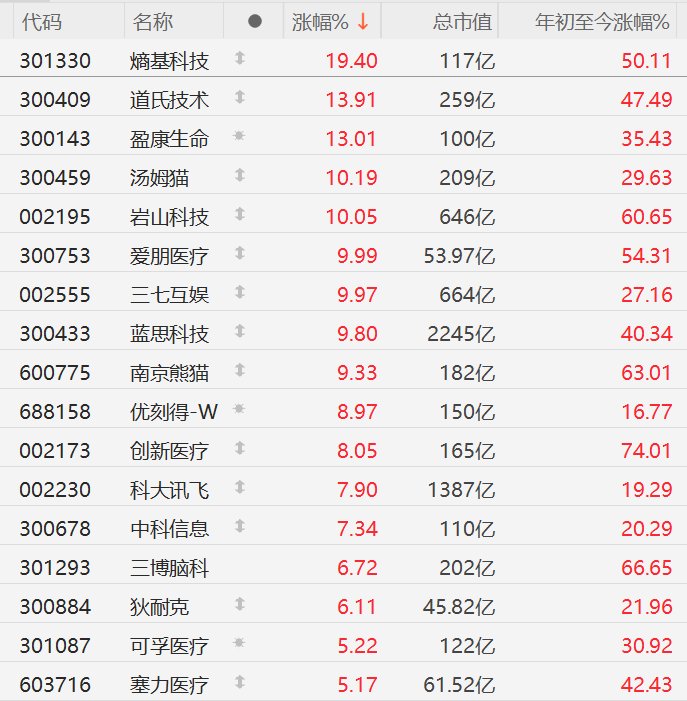
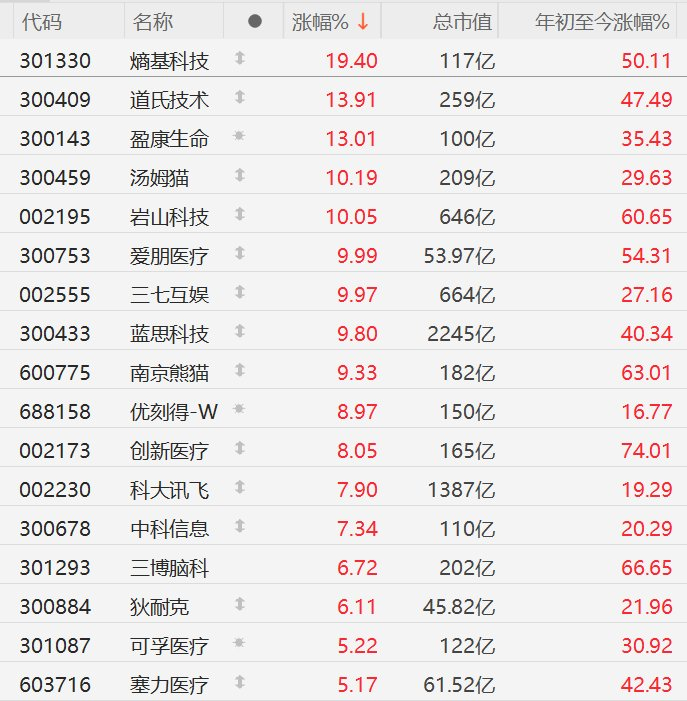
Group 1 - The A-share market saw a strong performance in brain-computer interface concept stocks, with several companies approaching or hitting their daily limit up [1] - Notable gainers included Entropy Technology, which approached a 20% limit up, and Dao's Technology and Yingkang Life, both rising over 13% [1] - Other significant performers included Tom Cat, which increased by over 10%, and Yanshan Technology, which hit a 10% limit up [1] Group 2 - The table lists various companies with their respective stock codes, percentage increase, total market capitalization, and year-to-date performance [2] - Entropy Technology (301330) had a 19.40% increase, with a market cap of 11.7 billion and a year-to-date increase of 50.11% [2] - Dao's Technology (300409) rose by 13.91%, with a market cap of 25.9 billion and a year-to-date increase of 47.49% [2] - Yingkang Life (300143) increased by 13.01%, with a market cap of 10 billion and a year-to-date increase of 35.43% [2] - Other companies like Tom Cat (300459) and Yanshan Technology (002195) also showed significant gains, with year-to-date increases of 29.63% and 60.65% respectively [2]





A股脑机接口概念股走强,爱朋医疗涨超9%
Ge Long Hui A P P· 2026-01-12 06:31
Core Viewpoint - The A-share market has seen a strong performance in brain-computer interface concept stocks, with several companies approaching or hitting their daily price limits [1] Group 1: Stock Performance - Entropy Technology (熵基科技) approached a 20% daily limit increase, with a rise of 19.40% and a market capitalization of 11.7 billion [2] - Dao's Technology (道氏技术) increased by 13.91%, reaching a market cap of 25.9 billion [2] - Yingkang Life (盈康生命) rose by 13.01%, with a market cap of 10 billion [2] - Tom Cat (汤姆猫) saw a 10.19% increase, with a market cap of 20.9 billion [2] - Rock Mountain Technology (岩山科技) hit a 10% daily limit increase, with a market cap of 64.6 billion [2] - Three Seven Entertainment (三七互娱) approached a 10% daily limit increase, with a rise of 9.97% and a market cap of 66.4 billion [2] - Other notable performers include Aipeng Medical (爱朋医疗) at 9.99%, Lens Technology (蓝思科技) at 9.80%, and Nanjing Panda (南京熊猫) at 9.33% [2] Group 2: Year-to-Date Performance - Entropy Technology has a year-to-date increase of 50.11% [2] - Dao's Technology has risen 47.49% year-to-date [2] - Yingkang Life has a year-to-date increase of 35.43% [2] - Tom Cat has increased by 29.63% year-to-date [2] - Rock Mountain Technology has a significant year-to-date increase of 60.65% [2] - Aipeng Medical has a year-to-date increase of 54.31% [2] - Nanjing Panda has a remarkable year-to-date increase of 63.01% [2] - Other companies like Innovation Medical (创新医疗) and Keda Xunfei (科大讯飞) have year-to-date increases of 74.01% and 19.29%, respectively [2]
可孚医疗股价涨5.24%,兴银基金旗下1只基金重仓,持有8.38万股浮盈赚取24.39万元
Xin Lang Cai Jing· 2026-01-12 02:28
Group 1 - The core viewpoint of the news is that Kefu Medical has seen a stock price increase of 5.24%, reaching 58.49 CNY per share, with a trading volume of 2.12 billion CNY and a market capitalization of 12.218 billion CNY as of January 12 [1] - Kefu Medical, established on November 19, 2009, and listed on October 25, 2021, is primarily engaged in the research, production, sales, and service of home medical devices [1] - The revenue composition of Kefu Medical includes rehabilitation aids at 43.12%, medical care products at 32.45%, health monitoring products at 20.76%, and other supplementary products at 3.68% [1] Group 2 - From the perspective of fund holdings, Kefu Medical is a significant investment for the Xingyin Fund, with the Xingyin Smart Consumer Mixed A Fund (018990) holding 83,800 shares, accounting for 4.1% of the fund's net value, making it the fifth-largest holding [2] - The Xingyin Smart Consumer Mixed A Fund was established on November 2, 2023, with a latest scale of 19.7561 million CNY, and has achieved a year-to-date return of 3.07% [2] - The fund has a one-year return of 32.34%, ranking 3994 out of 8157 in its category, and a cumulative return since inception of 30.42% [2]
华创证券:政策加码、临床加速 脑机接口产业化进入关键阶段
智通财经网· 2026-01-12 01:57
Core Insights - The commercialization of brain-computer interfaces (BCIs) is steadily advancing, presenting vast market opportunities in China, where competition is still in its early stages with most companies being small and not yet in a saturated market [1] - Invasive BCIs have significant advantages in signal quality, while non-invasive BCIs offer high safety and ease of use, serving as a complement to invasive types [1] - The current focus of the industry is on the medical field, with potential future expansion into non-medical areas [1] Group 1: Global Developments - Neuralink, a global leader in BCIs, is expected to enter the commercialization phase by 2026, with 12 patients having successfully implanted devices as of September 2025 [2] - Neuralink plans to increase the number of electrodes in its devices to over 30,000 by 2028, aiming for comprehensive brain connectivity [2] - The company has outlined three core product lines: Telepathy for motor disabilities, Blindsight for visual impairments, and Deep for neurological disorders [2] Group 2: Competitive Barriers - Key competitive advantages for Neuralink include flexible electrode arrays, precise implantation robots, and low-power intracranial signal processing systems [3] - The development of a closed-loop technical system through interdisciplinary research and clinical collaboration is essential for domestic companies [3] Group 3: Industry Trends in China - National strategies are guiding the BCI industry, with policies expected to be released in 2025 to support development [4] - Clinical advancements are accelerating, with significant breakthroughs in invasive and semi-invasive BCI systems reported in 2025 [4] - The financing market for BCIs is thriving, with 24 financing events recorded in 2025, marking a 30% increase year-on-year [4] - The supporting industrial chain for BCIs is rapidly forming, with pilot implementations in medical and everyday scenarios [4]
【华创医药】华创医疗器械求索系列11:脑机接口行业——政策加码,临床加速,产业化进入关键阶段
华创医药组公众平台· 2026-01-12 00:51
Core Viewpoint - The article discusses the development and commercialization of brain-computer interface (BCI) technology, highlighting its market potential, competitive landscape, and various applications, particularly in the medical field [3][5]. Group 1: Brain-Computer Interface Overview - BCI technology establishes a direct communication pathway between the brain and external devices, with steady progress in commercialization leading to vast market opportunities [3]. - The competitive landscape in China's BCI sector is still in its early stages, with most companies being small and not yet in a saturated market [3]. - There are two main types of BCI products: invasive BCIs, which offer significant signal quality advantages, and non-invasive BCIs, which are safer and easier to operate, serving as a complement to invasive types [3]. - Current applications are primarily in the medical field, with future potential to expand into non-medical areas [3]. - The industry chain has high technological barriers at the upstream level, while the mid and downstream sectors exhibit strong agglomeration effects [3]. Group 2: Global Leader Neuralink's Path to Industrialization - Neuralink, a global pioneer in BCI, is expected to enter the industrial application phase by 2025, with 12 patients having successfully implanted devices [4]. - The company plans to scale production of BCI devices starting in 2026, transitioning from laboratory research to large-scale manufacturing [4]. - Neuralink has outlined a three-step technology iteration plan, aiming to increase the number of electrodes in implants significantly by 2028 to enable comprehensive brain connectivity [4]. - The company has identified three core product lines: Telepathy for motor function recovery, Blindsight for visual perception restoration, and Deep for neurological function recovery [4]. - Neuralink's competitive advantages include advanced electrode technology, precise implantation robotics, and low-power signal processing systems [4]. - The development of Neuralink offers insights for domestic companies, emphasizing the importance of interdisciplinary research, clinical collaboration, and gradual commercialization [4]. Group 3: Factors Driving BCI Industrialization in China - National strategies are guiding the BCI sector, with local policies being introduced to support its development [5]. - Clinical advancements are accelerating, with significant breakthroughs in various BCI applications, including invasive and semi-invasive systems [5][6]. - The financing market for BCI is thriving, with 24 financing events recorded in 2025, marking a 30% year-on-year increase [5]. - The supporting industry chain for BCI technology is rapidly forming, facilitating the practical application of BCI in medical, production, and daily life scenarios [6]. Group 4: Key Companies in the BCI Sector - Notable companies in the BCI field include: - Xinwei Medical (interventional BCI) - Maipu Medical (neurosurgical consumables) - Kefu Medical (bionic implant BCIs) - Meihua Medical (upstream BCI industry) - Sanbo Brain Science (neurological specialty medical group) - Weisi Medical (rehabilitation BCIs) - Mailande (rehabilitation BCIs) - Xiangyu Medical (rehabilitation BCIs) - Chengyitong (comprehensive BCIs) - Aipeng Medical (neuro-regulation BCIs) - Chuangxin Medical (exoskeleton BCIs) [11].

《掘金ETF》周报:商业航天“一飞冲天” AI主线多点开花 如何“高抛低吸”?
Di Yi Cai Jing· 2026-01-11 14:48
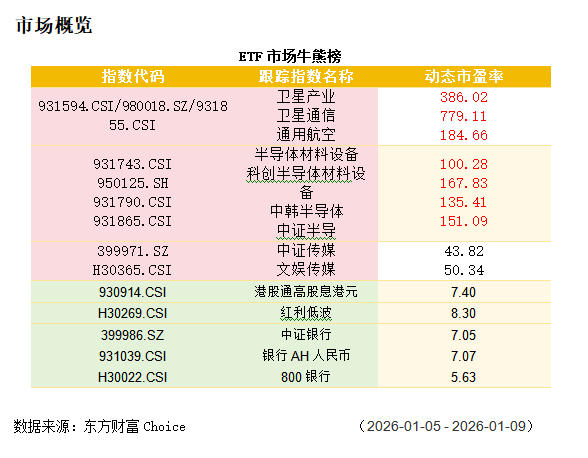
Core Insights - The ETF market has shown significant performance in technology growth styles, particularly in sectors like brain-computer interfaces, AI applications, commercial aerospace, and semiconductors, with notable market profitability [1][2]. Group 1: Commercial Aerospace ETFs - The commercial aerospace theme ETF, specifically the Yongying National Satellite Communication Industry ETF (159206.SZ), saw a net inflow of 35.89 billion yuan, leading the market in ETF fund inflows [2]. - The Zhaoshang Zhongzheng Satellite Industry ETF (159218.SZ) recorded a net inflow of 13.79 billion yuan, tracking the satellite industry index with major components including China Satellite and Aerospace Electronics [2]. - The funding logic is driven by policy catalysts, technological breakthroughs, and order placements, indicating a high prosperity cycle for the sector [2]. Group 2: Brain-Computer Interface ETFs - The Yongying Zhongzheng All-Index Medical Device ETF (159883.SZ) experienced a net inflow of 14.41 billion yuan, with over 23% of its components related to brain-computer interfaces [2]. - The funding logic is supported by announcements from Neuralink regarding large-scale production of brain-computer interface devices and the inclusion of brain-computer interfaces in China's 14th Five-Year Plan [2]. Group 3: AI Application ETFs - The GF Zhongzheng Media ETF (512980.SH) saw a net inflow of 8.73 billion yuan, focusing on gaming applications related to brain-computer interfaces [3]. - The Huaxia Zhongzheng Animation Game ETF (159869.SZ) also reported a net inflow of 8.23 billion yuan, benefiting from AI cost reduction and efficiency improvements [3]. Group 4: Semiconductor ETFs - The Guotai Zhongzheng Semiconductor Material Equipment Theme ETF (159516.SZ) had a net inflow of 23.18 billion yuan, focusing on AI computing power upstream core targets [4]. - There is a structural differentiation within the semiconductor theme ETFs, with inflows into material equipment and outflows from chip sectors [3]. Group 5: Overall ETF Market Trends - The industry theme ETFs had a net inflow of 138.27 billion yuan over the past week, while broad-based index ETFs experienced a significant net outflow of 129.01 billion yuan, indicating a preference for sector-specific investments [5][9]. - The market is witnessing a divergence in valuations, with major broad-based indices at historical highs while certain sectors, like Hong Kong stocks, are attracting inflows due to lower valuations [7][9].
股票行情快报:可孚医疗(301087)1月9日主力资金净卖出2803.32万元
Sou Hu Cai Jing· 2026-01-09 14:02
Core Viewpoint - The stock of Kefu Medical (301087) has shown a positive performance with a closing price of 55.58 yuan, reflecting a 2.93% increase as of January 9, 2026, with significant trading activity and mixed capital flow [1][2]. Financial Performance - For the first three quarters of 2025, Kefu Medical reported a main revenue of 2.398 billion yuan, representing a year-on-year increase of 6.63% [2]. - The net profit attributable to shareholders reached 260 million yuan, up 3.3% year-on-year, while the net profit excluding non-recurring items was 222 million yuan, reflecting a 1.46% increase [2]. - In Q3 2025, the company achieved a single-quarter revenue of 902 million yuan, marking a significant year-on-year growth of 30.72% [2]. - The single-quarter net profit attributable to shareholders was approximately 92.83 million yuan, up 38.68% year-on-year, and the net profit excluding non-recurring items was about 85.80 million yuan, showing a 62.68% increase [2]. - The company's debt ratio stands at 27.37%, with investment income of 18.18 million yuan and financial expenses of -3.77 million yuan, while the gross profit margin is reported at 53.35% [2]. Market Activity - On January 9, 2026, the net outflow of main funds was 28.03 million yuan, accounting for 3.43% of the total transaction amount, while retail investors experienced a net outflow of 258.2 million yuan, representing 0.32% of the total [1]. - Conversely, speculative funds saw a net inflow of 30.62 million yuan, which is 3.74% of the total transaction amount [1]. Analyst Ratings - Over the past 90 days, eight institutions have provided ratings for Kefu Medical, with seven recommending a buy and one suggesting an increase in holdings [2]. - The average target price set by institutions in the last 90 days is 54.56 yuan [2].
脑机接口的“身份证”来了?新晋顶流,最强马斯克概念!
Jin Rong Jie· 2026-01-09 06:34
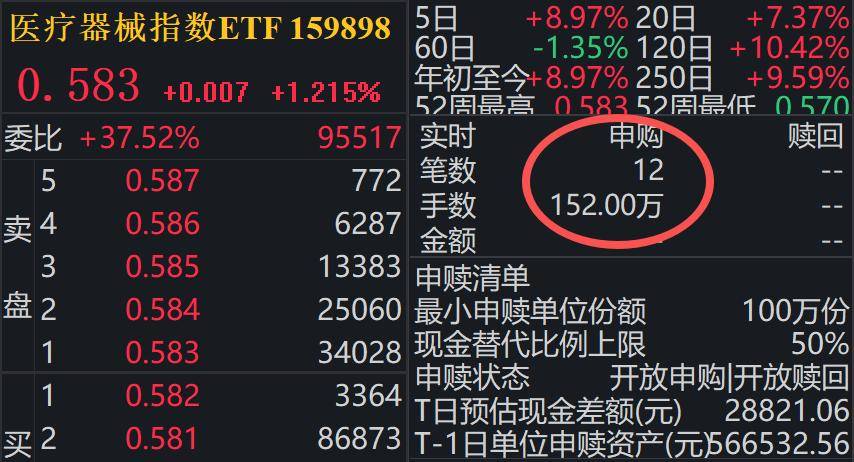
Core Insights - The announcement of the first non-invasive brain-computer interface (BCI) medical device registration in China marks a significant shift from laboratory research to clinical and market applications, indicating a new growth trajectory for the industry [1][2] - The medical device sector is experiencing a surge, with companies like Dean Diagnostics and Kingmed Diagnostics hitting their upper trading limits, reflecting strong market interest in BCI technologies [1][3] - The BCI sector is seen as a promising investment opportunity, with a clean chip structure and lower entry points compared to other tech sectors like satellites and chips [1] Industry Developments - The Chinese government has included BCI in its new five-year plan as a key future industry, signaling ongoing support for research and approval processes [2][3] - Major players in the industry are accelerating their efforts, with Neuralink announcing plans for large-scale production by 2026 and significant investments being made domestically [2][3] - Technological advancements in China, such as the ability for paralyzed patients to drink water using their thoughts, demonstrate the country's leadership in BCI technology [2] Market Dynamics - The BCI technology is categorized under medical devices, which are essential for addressing real and painful issues faced by patients, such as stroke recovery and spinal cord injuries [3][4] - The medical device index ETF (159898) includes approximately 24% of companies with substantial BCI business operations, providing an efficient investment vehicle for this emerging sector [3][4] - The medical device sector, which has faced declines over the past four years, is expected to see a turnaround driven by advancements in BCI technology [4]
国内首张非侵入式脑机接口证出炉!医疗器械指数ETF(159898)午后拉升、标的指数“含脑量”约24%
Sou Hu Cai Jing· 2026-01-09 06:21
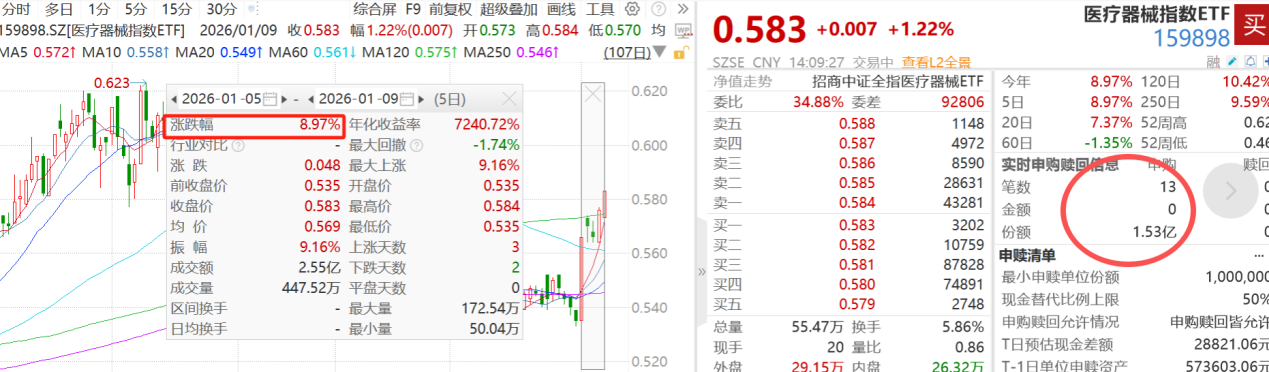
Group 1 - The medical device sector is experiencing a significant rally, with the Medical Device Index ETF (159898) seeing a net inflow of over 88 million yuan during intraday trading on January 8, following a previous inflow of over 116 million yuan [1] - Key stocks such as Di'an Diagnostics and Kingmed Diagnostics reached their daily limit, while others like Anbiping and Xiangsheng Medical saw gains exceeding 10% and 9% respectively [1] - The Medical Device Index ETF (159898) has a current scale of 659 million yuan, with approximately 24% of its holdings related to the brain-computer interface (BCI) concept [2][3] Group 2 - The brain-computer interface industry is highlighted as a key development area in the new five-year plan, with supportive policies for clinical trials, registration, and pricing [1] - Strong Brain Technology, a leading BCI company, recently completed a financing round of about 2 billion yuan, marking it as the second-largest financing in the BCI field globally, after Neuralink [2] - The Medical Device Index ETF (159898) includes several companies with substantial involvement in the BCI sector, making it a convenient and efficient tool for investment in this emerging field [3]