
Anduril

Search documents
Military Drones Could Be Defense Industry’s Big Bubble, Rheinmetall’s CEO Says
Yahoo Finance· 2025-09-12 10:07
Core Viewpoint - The military drone market may be experiencing a bubble, as suggested by Rheinmetall's CEO, who leads a rapidly growing defense company [3][4]. Group 1: Market Dynamics - Drones have become essential in the Ukraine war, prompting various arms manufacturers, including Lockheed Martin and Anduril, to produce or plan to produce UAVs [2]. - Rheinmetall's market value has surged from approximately 4.2 billion euros before the war to over 86 billion euros, equivalent to $100.91 billion [3]. Group 2: Company Projections - Rheinmetall aims to increase group sales to between 40 billion and 50 billion euros by 2030, up from 9.75 billion euros last year, with an order backlog potentially reaching 120 billion euros by mid-next year [4]. - The company anticipates drone sales between 120 million and 140 million euros for the current year, although there are concerns about securing enough contracts to meet previous projections of 1 billion euros by 2030 [5]. Group 3: Pricing and Technology Trends - The cost of short-range drones has decreased significantly, with prices around 1,000 euros per unit, while long-range drones are now priced at approximately 2,500 euros [6]. - Advancements in counter-drone technology are rapidly improving, which may diminish the effectiveness of UAVs on the battlefield [6].
军事智能化:新质战斗力核心,掌握制智权关键
AVIC Securities· 2025-09-12 03:01
Investment Rating - The report maintains an "Overweight" investment rating for the defense industry [3]. Core Insights - Military intelligence is not a future concept but a current reality, driven by advancements in artificial intelligence and technology [3][19][28]. - The military sector is undergoing significant transformation due to the integration of AI, which is reshaping defense strategies, operational capabilities, and equipment systems [17][30]. - The global military AI market is projected to reach approximately $21.003 billion by 2027, with the U.S. military AI market expected to grow to $3.133 billion by 2025 [9][10]. Summary by Sections Military Intelligence: New Quality Combat Power - Military intelligence is characterized by self-perception, decision-making, execution, learning, adaptation, and enhancement capabilities [3][18]. - The current era is witnessing a rapid evolution in military operations, with AI technologies being pivotal in this transformation [19][28]. Transformation of Defense Systems - AI is not just upgrading equipment but is fundamentally changing the defense system, structure, and operational models [3][30]. - Companies like Palantir have seen significant market success, with stock prices increasing by over 1263.68% since the onset of the Russia-Ukraine conflict [3][8]. Main Application Paths of Military Intelligence - AI encompasses various technologies, including machine learning, robotics, computer vision, biometrics, and natural language processing, which are applied across different military domains [8][9]. - The military AI market is expected to grow significantly, with the U.S. market projected to reach $3.133 billion by 2025 and the global market reaching $12.428 billion [9][10]. Key Industry Segments - The report identifies several companies involved in the military AI sector, including aerospace electronics, Chengdu Huami, and others focusing on computing power, sensors, algorithms, and intelligence analysis [10][11].
X @TechCrunch
TechCrunch· 2025-09-10 19:16
Anduril has landed a lucrative contract and is bringing its uncrewed undersea vehicle Ghost Shark to Australian waters next year. https://t.co/7keSMidrKf ...
Time to Buy the Dip on Archer Aviation Stock Below $10?
The Motley Fool· 2025-09-04 08:23
Core Viewpoint - The electric air taxi industry, particularly through companies like Archer Aviation, is poised for significant growth, but faces substantial financial challenges in the near term [1][2]. Industry Overview - The electric vertical takeoff and landing (eVTOL) vehicles are seen as a revolutionary advancement in urban transportation, with significant investments from major companies [1][2]. - The future of flight is being shaped by advancements in eVTOL technology, with expectations for flying cars becoming a reality [1]. Company Overview - Archer Aviation is developing its flagship eVTOL vehicle, the Midnight, which is undergoing rigorous design, manufacturing, and certification processes with the FAA [3][4]. - The Midnight is designed to be quieter than traditional helicopters, making it suitable for urban environments, and aims to launch point-to-point taxi networks in Los Angeles for the 2028 Summer Olympics [4][5]. Financial Performance - Archer Aviation is currently losing $447.5 million annually in free cash flow, with each Midnight vehicle costing approximately $5 million [8]. - To achieve positive cash flow, Archer needs to generate around $1.5 billion in revenue, which would require delivering about 300 Midnight aircraft annually [9][10]. - The company anticipates producing only 50 Midnight aircraft per year in the near term, indicating a significant gap to reach profitability [10]. Market Position - As of the last quarter, Archer Aviation had $1.7 billion in cash after raising $850 million, providing a runway for scaling manufacturing and proving eVTOL technology viability [12]. - Despite this cash position, the market cap stands at $5.6 billion, with a 53% increase in shares outstanding over the past year due to capital raises, which may hinder per-share value creation [13]. Profitability Outlook - Achieving profitability will be challenging without sufficient scale in eVTOL manufacturing, and the projected $1.5 billion in revenue may not be adequate for positive free cash flow [14]. - The timeline for reaching this revenue level could extend to five to ten years, with the company currently generating zero revenue [14].



招聘最猛的竟不是OpenAI,这家陷入间谍案的HR初创,正在狂招工程师
3 6 Ke· 2025-09-04 08:22
Group 1 - The U.S. tech job market has undergone significant changes since the launch of ChatGPT in November 2022, with some positions experiencing drastic declines while others remain in high demand [1] - The largest wave of layoffs in U.S. history began in 2023, impacting the IT job market, but hiring activities are gradually recovering, albeit with limited new positions [2] - The average tenure of software engineers at major tech companies has increased significantly, indicating a slowdown in hiring and a reluctance among employees to change jobs [6][80] Group 2 - The demand for AI engineers has surged since mid-2023, making it the hottest position in the tech industry, with a notable increase in job openings [29] - Major tech companies like Apple, IBM, and Amazon are leading in job openings, with Apple having the highest number at 2,177 positions [13] - Over half of the open positions are at senior levels, and there is a notable decrease in vacancies for senior engineers, prompting them to apply for lower-level positions [21][24] Group 3 - The San Francisco Bay Area remains the dominant hub for tech jobs, accounting for nearly 20% of global tech job openings, with a total of 9,072 positions [72][74] - The average tenure at major tech companies has increased by about two years over the past three years, reflecting a more stable workforce amid hiring slowdowns [80] - The trend of internal mobility among major tech firms is prevalent, with companies primarily hiring from each other, leading to longer tenures [85] Group 4 - Remote job opportunities have decreased, with the proportion of remote positions falling from 25% to 20% over the past year, although AI engineering roles still see a slight increase in remote opportunities [98][100] - The salary for remote positions has generally declined by 10-15%, as supply exceeds demand, making high-paying remote jobs a rare privilege [102]
当AI时代软件成本趋于零时,商业模式会有哪些变化?
Hu Xiu· 2025-09-04 00:26
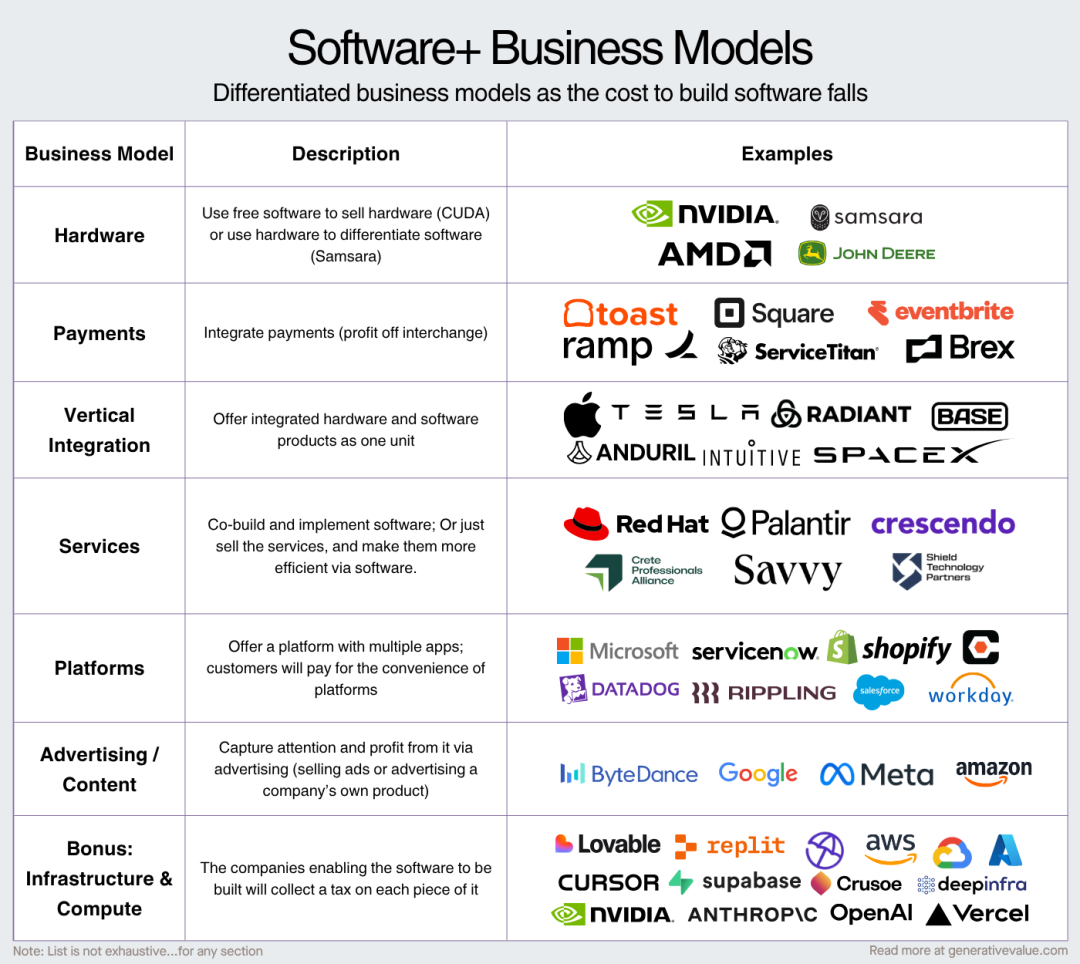
Group 1 - The software business model is undergoing a significant transformation, with AI tools drastically reducing software development costs, leading to a fundamental restructuring of the software industry's commercial logic [1][3][36] - As software creation costs approach zero, traditional software sales models become unsustainable, necessitating differentiation in other areas [1][3][36] - Historical parallels are drawn, indicating that the current shift resembles the free software movement of the 1990s, which began with companies like Red Hat [5][48] Group 2 - The decline in software development costs will impact the distribution of value within the industry, making it harder to create and maintain technological differentiation [3][41] - Companies are likely to adopt various business models, including hardware differentiation, vertical integration, and service-oriented approaches, to adapt to the changing landscape [2][10][12] Group 3 - Hardware is becoming a core differentiator in the new software landscape, with companies like Nvidia successfully using free software to enhance their hardware offerings [7][9] - The trend of vertical integration is expected to rise, allowing companies to control user experiences more effectively and innovate within their sectors [10][12] Group 4 - Service models are evolving, with companies needing to ensure software adoption and optimal usage through human labor integration [13][16] - The payment model is highlighted as a way to integrate software into existing financial infrastructures, allowing companies to profit without charging directly for software [19][20] Group 5 - Platform strategies are gaining importance, as companies seek to provide integrated solutions that simplify user experiences and reduce the management burden of multiple software tools [23][28] - Advertising models are also emerging, where companies leverage software to capture attention and monetize it, similar to Google and Facebook [29][30] Group 6 - The infrastructure model is becoming crucial, as companies providing the foundational services for software development will capture significant value in the AI era [32][34] - The shift towards free software may lead to a dual-track market, where low-risk applications dominate with free models, while high-risk, complex applications retain traditional pricing structures [45][46] Group 7 - The implications of these changes extend to talent needs and organizational structures, requiring companies to build multidisciplinary teams and adapt to new roles [51][53] - Investors and entrepreneurs must rethink traditional metrics for evaluating software companies, as new business models may not align with conventional SaaS indicators [55][59] Group 8 - The future of the software industry will depend on understanding user needs and building sustainable business models, rather than merely focusing on coding skills [60][61] - The barriers to software development are diminishing, allowing more individuals to create software and businesses, which will intensify competition in the market [61][62]

X @Ansem 🧸💸
Ansem 🧸💸· 2025-09-03 19:47
RT Tanay Jaipuria (@tanayj)Saquon Barkley's angel portfolio is wild.Anthropic, Ramp, Anduril, Cognition among others https://t.co/dN6iwhBH2s ...
X @Anthony Pompliano 🌪
Anthony Pompliano 🌪· 2025-09-03 12:43
RT Polina M. Pompliano (@polinapompliano)EXCLUSIVE PROFILE: 'Saquon Barkley Is Playing for Equity'You know @Saquon as an NFL superstar, but he's been building an elite investment portfolio over the last four years.He's got equity stakes in startups like Ramp, Anthropic, Anduril, Strike, and Neuralink.He turned a $10 million income stream into a $35 million asset by investing in Bitcoin.This is a side of Saquon you’ve never seen.Read it here: https://t.co/08g27xWSAO ...
X @TechCrunch
TechCrunch· 2025-08-21 22:14
Blue Origin and Anduril notched small contracts that could revolutionize how the Pentagon transports cargo. https://t.co/q9NvD5hX4X ...
X @Andy
Andy· 2025-08-15 17:02
Risks and Concerns - The tokens may not represent actual ownership in the underlying companies [1] - Valuations are extremely high, ranging from $3 billion to $515 billion, potentially unsuitable for smaller investors [1] - The tokens carry extra risks, including self-custody, smart contract vulnerabilities, and potential lack of liquidity [1] Innovation and Market Perception - The concept of buying shares of private companies like Anduril, SpaceX, and OpenAI on-chain is innovative [2] - There is uncertainty about the long-term viability of this approach [2] - Market awareness of the availability of these on-chain assets may be limited [2]