Cantor Fitzgerald

Search documents
Streamex Corp. to Participate at the Cantor Fitzgerald Crypto & AI/Energy Infrastructure Conference on November 10-12, 2025
Globenewswire· 2025-11-06 13:30
Core Insights - Streamex Corp. is participating in the Cantor Crypto & AI/Energy Infrastructure Conference, highlighting its focus on institutional-grade tokenization of real-world assets [1][2] - The company aims to connect with institutional investors to discuss the transformative potential of real-world asset tokenization, particularly through its yield-bearing gold-backed stablecoin, GLDY [2] Company Overview - Streamex Corp. specializes in the tokenization of real-world assets, particularly in the gold and commodities market, utilizing institutional-grade infrastructure [3] - The company is developing a platform that offers regulated, yield-bearing, and liquid financial products, supported by a gold-denominated treasury and advanced tokenization technology [3]


Amazon Is Lifting Cipher Mining Stock. Is There More Upside in Store?
Yahoo Finance· 2025-11-03 21:02
Core Insights - Cipher Mining (CIFR) shares surged over 20% following a $5.5 billion, 15-year hosting agreement with Amazon Web Services (AWS) [1] - The AWS deal signifies a strategic shift for Cipher from crypto mining to AI infrastructure, addressing the demand for high-performance computing [3] - The partnership is expected to provide long-term revenue visibility and operational scale, enhancing Cipher's relevance in the AI sector [4] Company Developments - The AWS agreement includes 300 megawatts of hosting capacity, with deployment set to begin in 2026 [3] - Cipher Mining has also secured a similar deal with Google-backed Fluidstack, reinforcing its transition into AI infrastructure [1][3] - Analysts predict that the combination of long-term hosting agreements will drive CIFR's share price to $26 within the next year [5] Market Sentiment - Cantor Fitzgerald has raised its price target for Cipher Mining, indicating a potential upside of 14% from current levels [6] - The consensus rating for CIFR stock is "Moderate Buy," with price targets reaching as high as $27, suggesting nearly 20% upside potential [7]


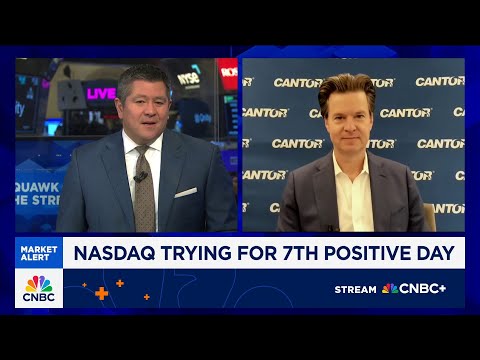
Cantor Fitzgerald's Eric Johnston: Rally remains strong with sales growth and margins rising
CNBC Television· 2025-11-03 16:48
Market Outlook - Cantor Fitzgerald's chief equity and macro strategist Eric Johnston discussed market outlooks on CNBC's 'Squawk on the Street' [1]
Jefferies Maintains Hold on Hudson Pacific (HPP), Lowers PT to $2.40, Cites AI’s Impact on Office Demand
Yahoo Finance· 2025-10-31 09:42
Group 1 - Hudson Pacific Properties Inc. (NYSE:HPP) is considered one of the best stocks under $3 to invest in [1] - Jefferies lowered the price target for Hudson Pacific to $2.40 from $2.50 while maintaining a Hold rating [1][2] - Jefferies identified AI as a key theme influencing future office demand [1][3] Group 2 - Cantor Fitzgerald initiated coverage of Hudson Pacific with an Overweight rating and a price target of $3.50 [3] - The sentiment from Cantor Fitzgerald is part of a broader coverage initiation of US REITs, indicating a lack of enthusiasm for a REIT recovery in 2026 [3] - Cantor Fitzgerald believes the REIT industry is well-positioned over the next 12 to 24 months [3]

Meta市值一夜蒸发1.5万亿
新华网财经· 2025-10-31 03:38
Core Viewpoint - Meta's stock experienced a significant sell-off due to the company's third adjustment of capital expenditure expectations for the year, raising concerns among analysts about uncontrolled spending on artificial intelligence [1][3]. Group 1: Stock Performance and Market Reaction - Meta's stock closed down 11.33%, marking the largest single-day drop in three years, with a market value loss of $214.7 billion (approximately 1.53 trillion RMB) [1]. - This loss ranks as the tenth largest single-day market value loss in U.S. corporate history and is the second largest in Meta's history, following a $232 billion loss on February 3, 2022 [1]. Group 2: Capital Expenditure Adjustments - Meta raised its capital expenditure forecast for 2025 to a range of $70 billion to $72 billion, up from a previous range of $66 billion to $72 billion [3]. - The CEO, Mark Zuckerberg, indicated that this spending is aimed at keeping pace with AI demand, suggesting that excess infrastructure could be utilized in the future [3]. Group 3: Revenue and Investment Concerns - Despite achieving over $60 billion in annualized revenue from AI advertising tools, investor concerns about potential over-expenditure remain [4]. - Analysts have drawn parallels between Meta's current spending plans and previous high-cost investments in the metaverse, which were not well-received by Wall Street [5][11]. Group 4: Analyst Reactions and Target Price Adjustments - Following the earnings report, multiple investment banks downgraded their target prices for Meta's stock, with Bank of America lowering its target from $900 to $810 while maintaining a "buy" rating [8][10]. - KeyBanc Capital Markets also reduced its target price from $905 to $875, keeping an "overweight" rating [9]. - Oppenheimer downgraded Meta's rating from "outperform" to "market perform," citing increasing uncertainty regarding the company's aggressive AI investments [10][11]. Group 5: Competitive Landscape and Future Outlook - Analysts expressed skepticism about the financial returns from Meta's AI investments, particularly in comparison to competitors like OpenAI, Google, and Tesla [12]. - Benchmark analysts noted that Meta's stock may only fluctuate within a range until a reasonable return on its capital expenditures is established [11].

New CLO Fund Comes to Blockchain: Securitize CEO
Yahoo Finance· 2025-10-29 19:39
Core Insights - Securitize is in the process of going public through a blank-check company initiated by Cantor Fitzgerald [1] - The company has partnered with Bank of New York Mellon to bring collateralized loan obligations (CLOs) onto the blockchain [1] - The Securitize Tokenized AAA CLO Fund will focus on CLOs with high credit ratings and will utilize the Ethereum blockchain for token representation, with BNY acting as the custodian for the assets [1]

X @Cointelegraph
Cointelegraph· 2025-10-28 18:01
Company Actions - Securitize, backed by BlackRock, plans to go public through a $1.25 billion SPAC merger [1] - The SPAC merger is with an affiliate of Cantor Fitzgerald [1]
X @Wu Blockchain
Wu Blockchain· 2025-10-28 16:41
Company Overview - Securitize plans to go public via SPAC merger with Cantor Fitzgerald's CEPT [1] - Securitize expects to raise up to $469 million in gross proceeds [1] - Securitize is the only full-stack tokenization platform fully registered with the SEC [1] Funding & Investment - The deal includes a $225 million PIPE from new and existing institutional investors [1] - $244 million is from CEPT's trust account, assuming no redemptions [1] Market Position - Securitize reports over $4.5 billion in tokenized assets [1] - Securitize has a 20.8% market share [1]
下一只黑天鹅,关税退款“大赌局”
3 6 Ke· 2025-10-28 10:39
Core Insights - A potential legal battle may force the U.S. government to refund hundreds of billions in tariffs, creating a unique speculative market [1] - The U.S. Treasury Secretary has acknowledged that if the Supreme Court rules certain tariffs illegal, the Treasury may have to refund "about half of the tariffs" collected [1] - The case has already been ruled against the Trump administration by lower courts, and the Supreme Court is set to hear oral arguments on November 5 [1] Group 1: Market Reactions - Investment banks like Jefferies and Oppenheimer are facilitating special transactions connecting importers who paid high tariffs with investors seeking high returns [2] - Importers, facing cash flow issues, are selling their potential tariff refund claims at a significant discount to investors [2] - Investors typically buy these claims for 20 to 40 cents on the dollar, potentially yielding several times their original investment if the Supreme Court rules in their favor [3] Group 2: Retail Investor Participation - Retail investors are participating in this speculative market through emerging prediction markets like Kalshi and Polymarket, making small bets on the outcome of the Supreme Court ruling [4][5] - The trading prices on these platforms reflect the market's implied probability of the tariffs being upheld, estimated at around 40% [5] Group 3: Market Limitations - The liquidity in these prediction markets is extremely low, making them unsuitable for institutional investors looking to hedge millions in risk exposure [6] - These markets serve more as a sentiment gauge rather than an effective risk transfer tool [6] Group 4: Legal and Logistical Challenges - The outcome of all bets hinges on the Supreme Court's ruling, which may be influenced by the justices' views on executive power [7] - Even if the Supreme Court rules the tariffs illegal, the refund process could be complicated, posing logistical challenges for many small importers [7]
下一只黑天鹅,关税退款“大赌局”!
美股研究社· 2025-10-28 10:24
Core Viewpoint - A potential legal battle may force the U.S. government to refund hundreds of billions in tariffs, creating a unique speculative market around this issue [3][4]. Group 1: Legal Context and Implications - U.S. Treasury Secretary Yellen acknowledged that if the Supreme Court rules certain tariffs imposed by the Trump administration as illegal, the Treasury may have to refund "about half of the tariffs," which he described as a "terrible" blow to the department [3][4]. - Two lower courts have already ruled that the Trump administration lacked legal authority to impose certain tariffs under the International Emergency Economic Powers Act, with the case now set for oral arguments at the Supreme Court on November 5 [4][12]. - As of August this year, over $70 billion in disputed tariffs have been collected, and a reversal of this policy could have profound effects on U.S. finances and importing businesses [4][12]. Group 2: Market Reactions and Investment Strategies - Wall Street investment banks, including Jefferies and Oppenheimer, are facilitating unique transactions connecting importers who have paid high tariffs with investors seeking high returns, primarily hedge funds [5]. - The core logic of these transactions involves cash-strapped importers selling their future potential claims for tariff refunds at a significant discount, allowing them to receive guaranteed payments without waiting for court decisions [5]. - Investors typically purchase these claims for 20 to 40 cents on the dollar, meaning favorable Supreme Court rulings could yield several times the original investment [5]. Group 3: Retail Investor Participation - Unlike institutional investors, retail investors are participating in this speculative market through emerging prediction markets like Kalshi and Polymarket, where they can place small bets on outcomes such as whether the Supreme Court will uphold the tariffs [7][8]. - The trading prices of contracts on these platforms reflect the market's implied probability of the tariffs being upheld, estimated at around 40% [8][10]. - However, the liquidity in these markets is low, with total trading volumes on Kalshi and Polymarket being less than $250,000 and $400,000 respectively, making them ineffective for large-scale risk hedging [10]. Group 4: Challenges Ahead - The outcome of all bets hinges on the Supreme Court's decision, which may be influenced not only by legal interpretations but also by the justices' views on executive power [12]. - Even if the Supreme Court rules the tariffs illegal, the refund process could be complicated, described as a "logistical nightmare," particularly for small importers who may struggle to provide detailed documentation for refunds [13][14].