Viking Therapeutics

Search documents
Viking Therapeutics Loses 20% in a Month: How to Play the Stock
ZACKS· 2025-09-02 15:31
Core Insights - Viking Therapeutics (VKTX) shares have declined over 20% in the past month, underperforming the industry growth of 1% and also lagging behind the sector and S&P 500 [1][9] - The decline followed mixed results from a mid-stage study of VK2735, an experimental obesity drug, raising concerns about its safety and tolerability despite achieving weight loss results [4][5][9] Company Pipeline and Development - VKTX is developing VK2735, a dual GLP-1 and GIP receptor agonist, showing potential in the obesity treatment space with both oral and subcutaneous formulations [6] - The phase II VENTURE study for the subcutaneous version of VK2735 met all primary and secondary endpoints, leading to the initiation of two late-stage studies expected to report results by late 2026 or early 2027 [7][8] - VKTX is also pursuing drugs for non-alcoholic steatohepatitis (NASH) and X-linked adrenoleukodystrophy (X-ALD), with promising clinical study results [10] Competitive Landscape - The obesity market is projected to reach $100 billion in the U.S. by 2030, with Eli Lilly and Novo Nordisk currently leading with their injectable drugs [11] - VKTX, along with its competitors, is racing to introduce oral weight-loss pills, with Novo's oral Wegovy under FDA review and Lilly's orforglipron showing positive late-stage study results [12][13] Financial Position and Valuation - VKTX lacks a stable revenue stream and faces significant cash burn due to ongoing clinical studies, which could impact its stock if setbacks occur [14] - The company is trading at a premium valuation, with a price/book ratio of 3.82 compared to the industry average of 3.09 [15] - Estimates for VKTX's loss per share for 2025 and 2026 have widened significantly in the past 60 days, indicating potential financial challenges ahead [17] Investment Outlook - Despite a strong cash position of $808 million and no debt, the lack of revenue and competition from larger pharmaceutical companies raises concerns for VKTX's stock [18] - The stock is currently rated Zacks Rank 4 (Sell), reflecting the challenges in justifying further investment at this stage [18]



Viking Therapeutics, Inc. (VKTX) Suffers a Larger Drop Than the General Market: Key Insights
ZACKS· 2025-08-29 22:46
Company Overview - Viking Therapeutics, Inc. (VKTX) closed at $27.05, reflecting a decrease of -1.92% from the previous trading session, underperforming compared to the S&P 500's loss of 0.64% [1] - Over the past month, shares of the company have declined by 15.32%, while the Medical sector gained 1.3% and the S&P 500 increased by 1.91% [1] Earnings Projections - The upcoming earnings release is highly anticipated, with projected EPS at -$0.68, indicating a significant drop of 209.09% compared to the same quarter last year [2] - Full-year Zacks Consensus Estimates forecast earnings of -$2.42 per share and revenue of $0 million, representing year-over-year changes of -139.6% and 0%, respectively [2] Analyst Estimates - Recent changes to analyst estimates for Viking Therapeutics indicate the dynamic nature of near-term business trends, with positive revisions seen as a favorable sign for the business outlook [3] - The Zacks Rank system, which incorporates these estimate changes, provides actionable ratings for stocks [4] Zacks Rank Performance - The Zacks Rank system ranges from 1 (Strong Buy) to 5 (Strong Sell), with 1 stocks historically contributing an average annual return of +25% since 1988 [5] - Currently, Viking Therapeutics holds a Zacks Rank of 4 (Sell), with the Zacks Consensus EPS estimate remaining unchanged over the last 30 days [5] Industry Context - Viking Therapeutics operates within the Medical - Biomedical and Genetics industry, which has a Zacks Industry Rank of 99, placing it in the top 41% of over 250 industries [6] - The Zacks Industry Rank measures the strength of industry groups, indicating that the top 50% rated industries outperform the bottom half by a factor of 2 to 1 [6]
Why Viking Therapeutics Stock Popped Nearly 4% Today
The Motley Fool· 2025-08-28 22:42
Group 1 - Numerous companies in the healthcare sector are actively developing obesity drugs, which have gained significant attention in the medical field [1] - Viking Therapeutics experienced a nearly 4% increase in share price due to positive research findings related to obesity treatments, outperforming the S&P 500 index's 0.3% rise [1] - The effectiveness of obesity drugs extends beyond weight reduction, showing potential benefits for various health conditions, attracting investor interest [2] Group 2 - A recent study highlighted that GLP-1 agonists, which promote a feeling of satiety, may positively impact hidradenitis suppurativa, a troublesome skin condition [4] - Research published in JAMA Dermatology indicates that GLP-1 agonists possess anti-inflammatory properties and can be beneficial for treating hidradenitis suppurativa [5] - Viking's VK2735, a dual agonist targeting both GLP-1 and GIP receptors, could potentially provide additional value if it proves effective for hidradenitis suppurativa [6]

Viking Therapeutics: What's Next?
The Motley Fool· 2025-08-26 10:15
Core Viewpoint - Viking Therapeutics experienced a significant 40% drop in stock price following the release of Phase 2 results for its oral obesity treatment VK2735, despite demonstrating a strong 12.2% weight loss signal over 13 weeks [1][2]. Company Developments - The Phase 3 VANQUISH program was launched on June 25, 2025, with two large trials enrolling: VANQUISH-1 for 4,500 adults with obesity and VANQUISH-2 for 1,100 adults with type 2 diabetes, both lasting 78 weeks [4]. - The injectable formulation previously showed a 14.7% weight loss at 13 weeks with mild to moderate side effects that decreased over time, indicating potential for transitioning from injectables to oral pills for long-term management [5]. Market Opportunity - Goldman Sachs revised its 2030 obesity market forecast to $95 billion, suggesting that even a 2% market share could yield approximately $1.9 billion in annual revenue for Viking, which has a market cap of $2.9 billion [7]. - The company is exploring monthly dosing options for its injectable treatment, positioning itself alongside Novo Nordisk as one of the few to demonstrate efficacy in both oral and injectable forms [8]. Financial Position - Viking has $808 million in cash as of June 30, 2025, but faces a $300 million expense for its registrational program, making partnerships increasingly likely after further data analysis and FDA feedback [9]. - Wall Street maintains an average price target of $87 to $90 per share, indicating a potential 200% upside from current levels, attributed to a misunderstanding of trial design and tolerability issues [11]. Industry Context - The CDC reports that 40% of U.S. adults have obesity, highlighting a vast addressable market for obesity treatments [12]. - Big Pharma remains interested in obesity assets, with companies like AbbVie, Roche, and Amgen actively pursuing deals, making Viking's late-stage opportunity attractive, especially after the recent stock decline [10].

速递|有望实现半年一针减重20%!司美格鲁肽长效植入剂研发公司完成1000万美元股权融资
GLP1减重宝典· 2025-08-23 03:03
Core Viewpoint - Vivani Medical is focusing on the development of the subcutaneous semaglutide implant NPM-139, which shows promising results in weight loss and aims to reshape the treatment landscape for obesity and metabolic diseases [2][3]. Financial Updates - Vivani Medical announced a $10 million equity financing by issuing 7,936,500 shares at $1.26 per share, ensuring operations until mid-2026 and accelerating the clinical development of NPM-139 [3]. - The company previously raised approximately $3 million through a private placement of 2,912,600 shares [4]. Clinical Development - NPM-139 has entered a new phase of development, demonstrating sustained weight loss effects for over six months in animal studies, supported by positive results from the LIBERATE-1 clinical trial [3][4]. - The company plans to initiate clinical trials for NPM-139 in 2026, with the design of the clinical development plan, including dose exploration and weight maintenance studies, to be announced later this year [5][6]. Strategic Partnerships - Vivani expanded its collaboration with Okava Pharmaceuticals to develop a long-term GLP-1 therapy for dogs and cats, utilizing NanoPortal technology for obesity, diabetes, and cardiometabolic diseases [4]. Company Overview - Vivani Medical utilizes the NanoPortal™ platform to develop long-acting drug implants aimed at stable drug release, improving patient compliance and tolerance. The core project NPM-139 is a miniaturized, six-month subcutaneous semaglutide implant for long-term weight management in overweight and obese populations [8].
Is Beaten-Down Viking Therapeutics Stock a Buy on the Dip?
The Motley Fool· 2025-08-21 09:24
Core Viewpoint - Viking Therapeutics' stock price plummeted by 39.2% following disappointing clinical trial results for its oral obesity candidate VK2735, primarily due to safety concerns related to higher dosages [1][4]. Group 1: Clinical Trial Results - VK2735 demonstrated significant weight loss, with patients losing up to 14.7% of their weight after 13 weeks of daily dosing [11]. - However, the safety profile was concerning, as 35% of patients in the higher dosage groups reported vomiting, compared to only 13% for Eli Lilly's Zepbound [8][9]. - The adverse reactions raise doubts about VK2735's viability as a competitive alternative to existing injectable obesity treatments [8][9]. Group 2: Market Context - The anti-obesity drug market is currently dominated by GLP-1 receptor agonists, with Novo Nordisk's semaglutide generating $17.6 billion in sales in the first half of 2025, and Eli Lilly's tirzepatide reaching $14.7 billion [5][6]. - Tirzepatide's success is attributed to its dual action on GLP-1 and GIP receptors, setting high expectations for VK2735, which is also a dual receptor agonist [7]. Group 3: Future Prospects - Viking Therapeutics is not solely reliant on VK2735; it has initiated a phase 3 trial for an injectable version of VK2735, expected to enroll around 4,500 adults [10]. - The company also has two thyroid hormone receptor-beta agonists in clinical testing, with VK2809 having already succeeded in a phase 2 study [12]. - Despite the setback with oral VK2735, the company still holds potential for future growth through its other candidates [14]. Group 4: Investment Considerations - With a market cap around $2.9 billion, the current valuation suggests that investors are not expecting significant outcomes from VK2735 or the rest of Viking's pipeline [13]. - For investors with a high risk tolerance, this may present a buying opportunity as the company continues to develop its other drug candidates [14].

速递|股价一夜暴跌42%!Viking口服减肥药2期数据不及预期
GLP1减重宝典· 2025-08-21 03:04
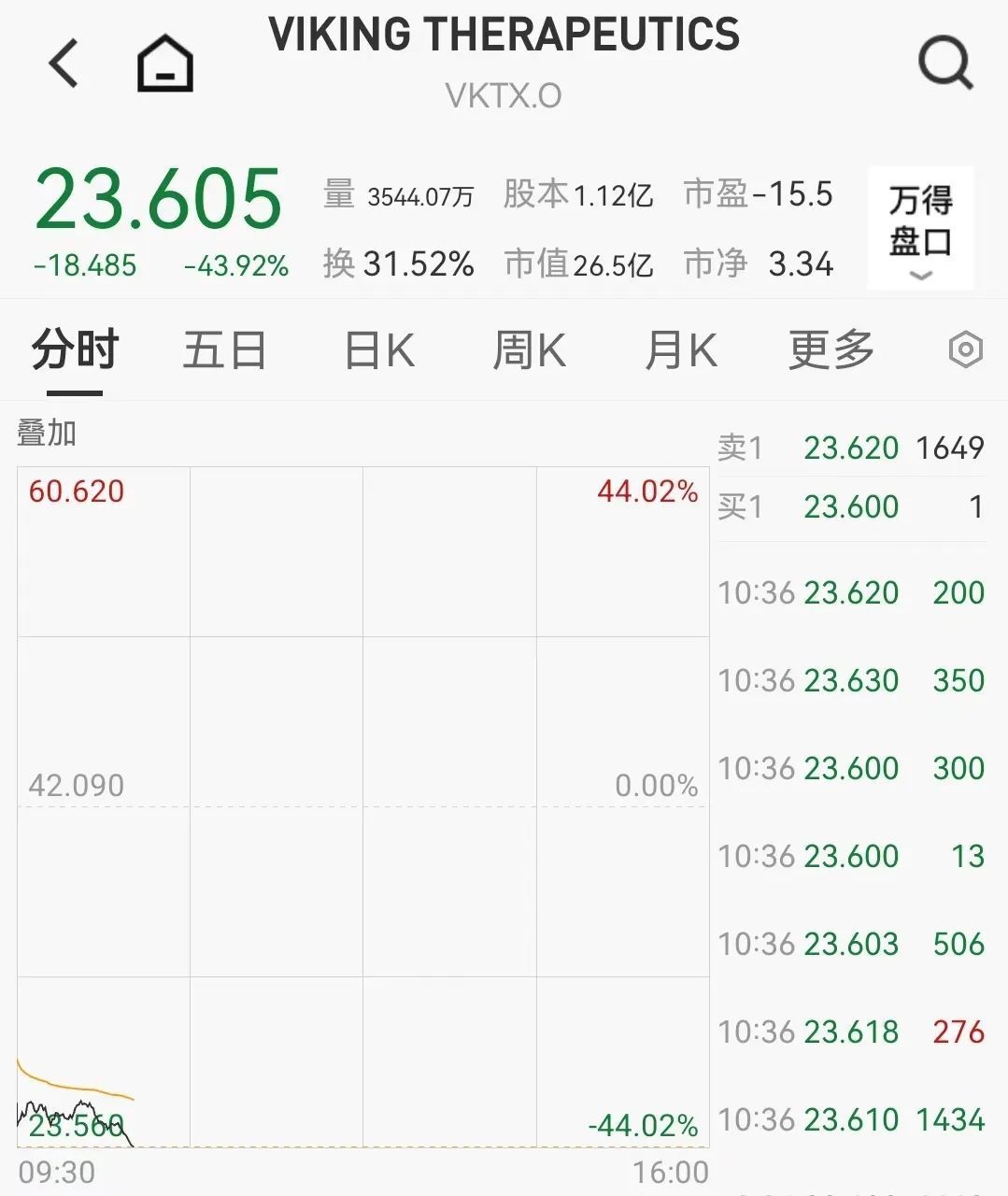
Core Viewpoint - Viking Therapeutics' stock plummeted by 43% after disappointing mid-stage trial results for its oral obesity drug, leading to a significant decrease in market capitalization from over $4 billion to approximately $2.69 billion [2] Group 1: Company Performance - Viking's oral medication helped patients lose up to 12.2% of their weight over approximately three months, with no plateau in weight loss observed, suggesting potential for greater effects in long-term trials [4] - The company faced a high dropout rate of about 28% within just 13 weeks, compared to a 25% dropout rate over 72 weeks for Eli Lilly's oral medication [5] - Common reasons for discontinuation included gastrointestinal side effects, with 58% of patients experiencing nausea and 26% experiencing vomiting, compared to 48% and 10% in the placebo group [6] Group 2: Competitive Landscape - The disappointing results for Viking's drug further solidified the market leadership of Eli Lilly and Novo Nordisk, whose oral weight loss medications are expected to reach the market much sooner than Viking's candidate VK2735 [2] - Eli Lilly's highest dose oral medication achieved a weight loss of 12.4% over 72 weeks, demonstrating stronger results compared to Viking's [4][6] - Viking's drug mimics two naturally occurring gut hormones, GLP-1 and GIP, which suppress appetite and may improve metabolism of sugars and fats [7]
Viking Therapeutics: Panic Creates Opportunity
Seeking Alpha· 2025-08-21 00:52
Group 1 - The article discusses the potential for undervalued stocks that are mispriced by the market as of the end of August [1] - It suggests that investors may consider joining a platform for insights on these investment opportunities [1] Group 2 - There is a mention of a potential long position in VKTX that may be initiated within the next 72 hours [2] - The article emphasizes that the opinions expressed are those of the author and not influenced by any compensation from companies mentioned [2] Group 3 - The information provided is intended for informational purposes only and does not constitute a solicitation to buy or sell securities [3] - It highlights the importance of conducting personal research or consulting a financial advisor before making investment decisions [3]

Viking Therapeutics: What's Happening With VKTX Stock?
Forbes· 2025-08-20 13:50
Group 1 - Viking Therapeutics' stock fell 42% on August 19, 2025, due to disappointing Phase 2 results for its oral obesity pill VK2735, which showed only up to 12.2% weight loss over three months, underperforming compared to competitors like Eli Lilly and Novo Nordisk [2] - 28% of patients discontinued VK2735 therapy due to side effects such as nausea and vomiting, indicating potential challenges in patient adherence [2] - Despite the setback with VK2735, Viking has a diversified pipeline with several promising candidates that may be undervalued by the market [3] Group 2 - Viking's current stock price of $24 is significantly below the analyst average price target of $89, suggesting a valuation disconnect that may not be justified given the company's diversified pipeline [3] - The Phase 3 trials for VK2735's subcutaneous formulation began in June 2025, and prior Phase 2 data indicated a viable injectable route with up to 13.1% placebo-adjusted weight loss [6] - Other pipeline assets include VK2809 for NASH/MASH, VK5211 for hip fracture recovery, VK0612 for type 2 diabetes, and VK0214 for X-linked adrenoleukodystrophy, contributing to further diversification [6] Group 3 - Key risks for Viking include potential clinical disappointments, substantial capital needs for Phase 3 trials, and intense competition in metabolic disorders [7] - For risk-tolerant long-term investors, the current valuation may over-penalize the company for the shortcomings of one program, presenting a speculative investment opportunity [7] - The conclusion suggests that if execution improves across other programs, the diversified pipeline could offer meaningful long-term upside [7]

又一“减肥药”,史诗级暴跌
Zhong Guo Ji Jin Bao· 2025-08-19 22:54
Core Viewpoint - Viking Therapeutics experienced a significant stock drop of nearly 44% following the release of disappointing mid-term trial data for its weight loss drug VK2735, raising concerns about its competitiveness against established players like Eli Lilly and Novo Nordisk [1][3]. Group 1: Company Performance - Viking Therapeutics' stock opened down nearly 44%, marking its largest intraday drop since April 2016 [1]. - The company's market capitalization fell to approximately $2.65 billion after the announcement [2]. - The mid-term trial data indicated that VK2735 helped patients lose up to 12.2% of their weight, with 80% of participants reporting a weight loss of over 10% [3]. Group 2: Clinical Trial Insights - Approximately 28% of patients dropped out of the VK2735 trial within three months, which negatively impacted investor confidence [3]. - In contrast, the previous year, Viking reported positive results from the second phase of VK2735 trials, where patients lost an average of 14.7% of their weight over 13 weeks [4]. Group 3: Industry Context - Eli Lilly's oral weight loss drug Orforglipron also faced scrutiny after its trial results showed a 12.4% average weight loss, leading to a 14% drop in its stock price [6]. - Analysts noted that despite the drop, Eli Lilly's core growth drivers remain strong, and the market reaction may have been an overreaction [6][7].